Making Tax Digital: £30k landlords next – are you in?
Landlords already caught by Making Tax Digital have until 7 November 2026 to send HMRC their second quarterly update, covering rent and expenses from 6 April to 5 October. Miss the first one in August? HMRC has now started signing people up itself, so staying quiet is no longer an option.
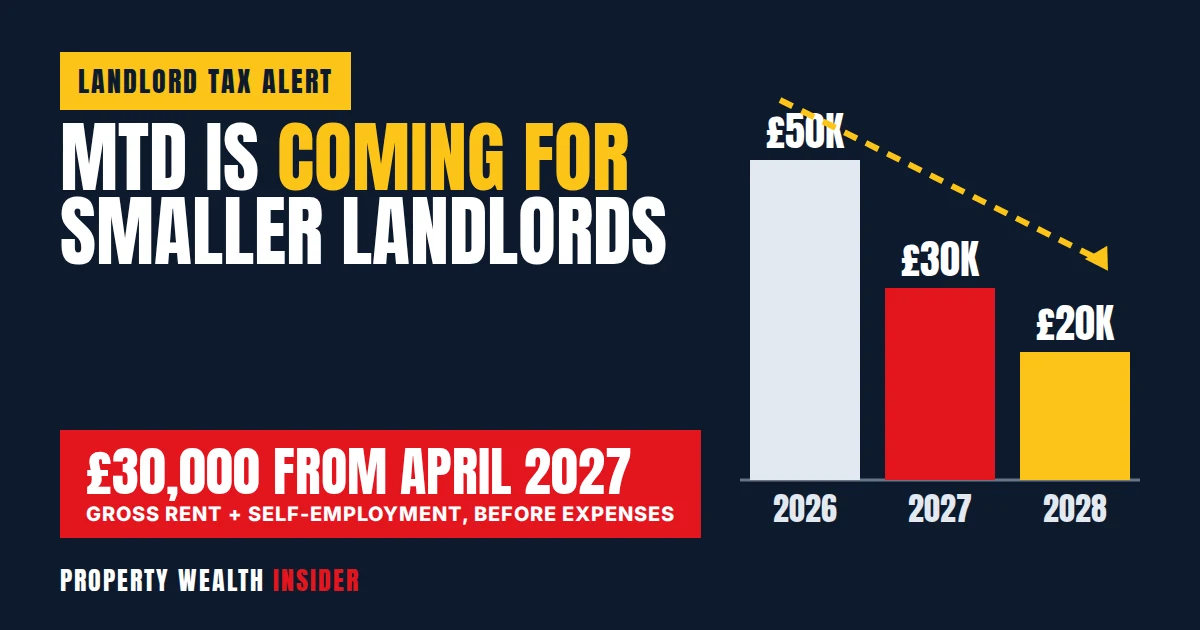
The bigger story is who comes next. From 6 April 2027 the threshold drops from £50,000 to £30,000 of gross rent and self-employment income, and from 6 April 2028 to £20,000. That pulls in a huge slice of ordinary one- and two-property landlords.
The trap is that the test uses your rent before expenses, and it is based on a tax return you may already have filed. Use our checker below to see exactly where you stand.
Key facts
- MTD for Income Tax has applied since 6 April 2026 to landlords and sole traders with qualifying income over £50,000 in 2024-25.
- Next wave: over £30,000 in 2025-26 means you start on 6 April 2027; over £20,000 in 2026-27 means 6 April 2028.
- “Qualifying income” is gross rent plus gross self-employment income, before expenses. Salary, pensions and dividends do not count.
- Quarterly updates are due 7 August, 7 November, 7 February and 7 May. The tax return is still due by 31 January.
- No penalty points for late quarterly updates in 2026-27. From 2027-28, 4 points triggers a £200 penalty.
What is happening now
Making Tax Digital (MTD) for Income Tax is HMRC’s new way of doing Self Assessment for landlords and sole traders. It is a UK-wide rule: it applies to landlords in England, Wales, Scotland and Northern Ireland, and to UK-resident landlords with overseas property.
Instead of one tax return a year, you keep digital records in compatible software and send HMRC a short summary of income and expenses every quarter. You then file your tax return as normal by 31 January.
HMRC said more than 864,000 sole traders and landlords were due to send a first update by 7 August 2026. On 12 August it reported that 436,000 had done so, with 570,000 signed up to the service. From September 2026 HMRC began signing up anyone who should be using MTD for 2026-27 but has not registered.
What counts as qualifying income
HMRC defines qualifying income as your total income from self-employment and property before expenses (turnover). Mortgage interest, letting fees and repairs do not reduce it.
- Counts: gross UK rent, UK-resident landlords’ overseas rent, your share of jointly owned property income, and gross sole-trader turnover.
- Does not count: PAYE salary, state and private pensions, dividends (including from your own company), and your share of partnership profits.
- Company landlords: MTD for Income Tax covers individual landlords and sole traders registered for Self Assessment, so rent received by a limited company is outside it.
Joint owners: only your share counts. If you only get told your share after expenses have been taken off, HMRC says it will assess that net figure instead.
Which year decides? HMRC looks at a past tax return. Your 2025-26 return (due by 31 January 2027) decides whether you start on 6 April 2027. That leaves as little as nine weeks between filing and starting.
Worked examples
- Two-flat landlord: gross rent of £2,600 a month is £31,200 a year. After £14,000 of mortgage interest and costs, profit is only £17,200. Qualifying income is still £31,200, so a similar figure in 2025-26 means MTD from 6 April 2027.
- Side hustle plus one let: £18,000 of rent plus £14,000 of gross freelance turnover is £32,000. Neither income alone crosses £30,000, but together they do.
- Married couple, 50/50: three houses bring in £48,000 a year, so each spouse has £24,000. Neither is in for April 2027, but both cross £20,000 if 2026-27 is similar, so both start on 6 April 2028.
- High earner, small portfolio: a £90,000 salary plus £15,000 of rent. Qualifying income is £15,000, as salary does not count. At £20,000 or less, HMRC treats you as exempt.
Checker: am I in Making Tax Digital?
Enter your gross figures for one tax year and pick the year. The checker applies that year’s threshold and shows your start date and first four deadlines.
Am I in Making Tax Digital?
Guide only, based on HMRC’s published thresholds. It does not cover every exemption or unusual income type. HMRC’s decision letter and your accountant have the final word.
Quarterly deadlines and the tax return
Each update is cumulative: it covers everything from the start of the tax year to the end of the quarter. That means you can fix a mistake in a later update without resending an earlier one. HMRC only receives category totals, not individual receipts.
| Update | Standard period | Calendar period (optional) | Deadline |
|---|---|---|---|
| 1 | 6 April – 5 July | 1 April – 30 June | 7 August |
| 2 | 6 April – 5 October | 1 April – 30 September | 7 November |
| 3 | 6 April – 5 January | 1 April – 31 December | 7 February |
| 4 | 6 April – 5 April | 1 April – 31 March | 7 May |
| Tax return | Full tax year, filed through MTD software | 31 January after the tax year | |
Payment dates do not change. MTD does not alter when your tax is due, only how you report it.
Penalties: what happens if you miss a deadline
MTD uses a points-based penalty system for late filing:
- 2026-27: no penalties for missing a quarterly update deadline, though updates are still mandatory. A late tax return still earns a point.
- From 2027-28: one point per missed quarterly update or return deadline. At 4 points you pay £200, then another £200 for every further miss.
- Clearing points: below 4, each point expires 24 months after the missed deadline. At 4, you must file on time for 12 months and clear any outstanding returns from the past 24 months.
- Late payment (2026-27): no penalty up to 15 days late. After that, 3% of tax owed at day 15 (waived for 16-30 days in your first year), another 3% at day 30, and a 10% annual rate from day 31. The rates rise to 4% for 2027-28.
Example: a landlord who pays £6,000 of tax 35 days late in 2026-27 faces a 3% (£180) penalty at day 15 and a further 3% at day 30, if nothing has been paid. That is £360 before the daily charge and interest.
Exemptions and digital exclusion
Some people are exempt without having to ask. This includes anyone with qualifying income of £20,000 or less, people without a National Insurance number before the tax year starts, and people who claim Married Couple’s Allowance or Blind Person’s Allowance.
If you are digitally excluded, you must apply by phone or in writing. That covers people whose age, health or disability stops them using a computer, people with religious objections, and people with no practical internet access. HMRC aims to reply within 28 days.
Will not work as an excuse: HMRC says it will not grant an exemption just because you have always filed on paper, don’t know the software, or keep few records.
What to do now: step-by-step
Already in (over £50,000): send your 6 April – 5 October figures by 7 November 2026. If you missed August, send it now. Updates are cumulative, so the November update covers both quarters.
Heading for April 2027 (over £30,000): use the months before the start to test your set-up, so the first 7 August 2027 update is routine.
- Work out your number. Add up gross rent (your share) and gross self-employment turnover from your 2025-26 figures.
- File your 2025-26 return early. It is the one HMRC uses for the April 2027 decision. Don’t leave it to January.
- Separate your money. Use a dedicated bank account for rent and property costs so a bank feed captures everything.
- Choose software. Use HMRC’s software finder. Free products exist for simple affairs, and bridging software works if you prefer spreadsheets.
- Connect bank feeds. Link the account and set up rules to categorise rent, repairs, agent fees and finance costs.
- Record digitally from day one. Every item needs an amount, a date and a Self Assessment category, starting from 6 April (or 1 April on calendar quarters).
- Sign up. Register through GOV.UK with your Government Gateway login, or have your agent do it. You can volunteer early.
- Diary the deadlines. 7 August, 7 November, 7 February, 7 May and 31 January.
- Brief your agent. Ask your letting agent for monthly statements that split rent and costs by category.
FAQ
Do landlords have to use Making Tax Digital?
Yes, if you are an individual landlord registered for Self Assessment and your gross property and self-employment income is over the threshold. That is £50,000 now, £30,000 from April 2027 and £20,000 from April 2028.
Is the MTD threshold based on profit or rent?
Rent. It is gross income before expenses. A landlord with £32,000 of rent and £5,000 of profit is still over £30,000.
Does my salary count towards the Making Tax Digital threshold?
No. PAYE employment income, pensions and dividends are excluded. Only self-employment and property income count.
How does MTD work for jointly owned rental property?
Only your share counts towards the threshold. Joint owners can also keep less detailed records, such as one quarterly entry per category, and can leave out expenses on jointly let property from quarterly updates.
What happens if I miss the 7 November MTD deadline?
For 2026-27 there is no penalty for a late quarterly update, but it is still required. From 2027-28 each miss is a penalty point, and 4 points means a £200 penalty.
Can I stop using MTD if my rent falls?
Only after your qualifying income has been below the relevant threshold for 3 tax years in a row. At that point you can choose to opt out.
Sources
- HMRC: Check if you’re eligible for Making Tax Digital for Income Tax
- HMRC: Work out your qualifying income
- HMRC: Send quarterly updates
- HMRC: Create digital records
- HMRC: Penalties for Making Tax Digital for Income Tax
- HMRC: Find out if you can get an exemption
- HMRC: Apply for an exemption
- HMRC: Sign up for Making Tax Digital for Income Tax
- HMRC: Find compatible software
- HMRC press release, 23 July 2026
- HMRC press release, 12 August 2026
This article is news and general guidance, not financial, legal or tax advice. Check your own position with HMRC or a qualified adviser.