EPC C by 2030: £10,000 cap – upgrade or sell up?
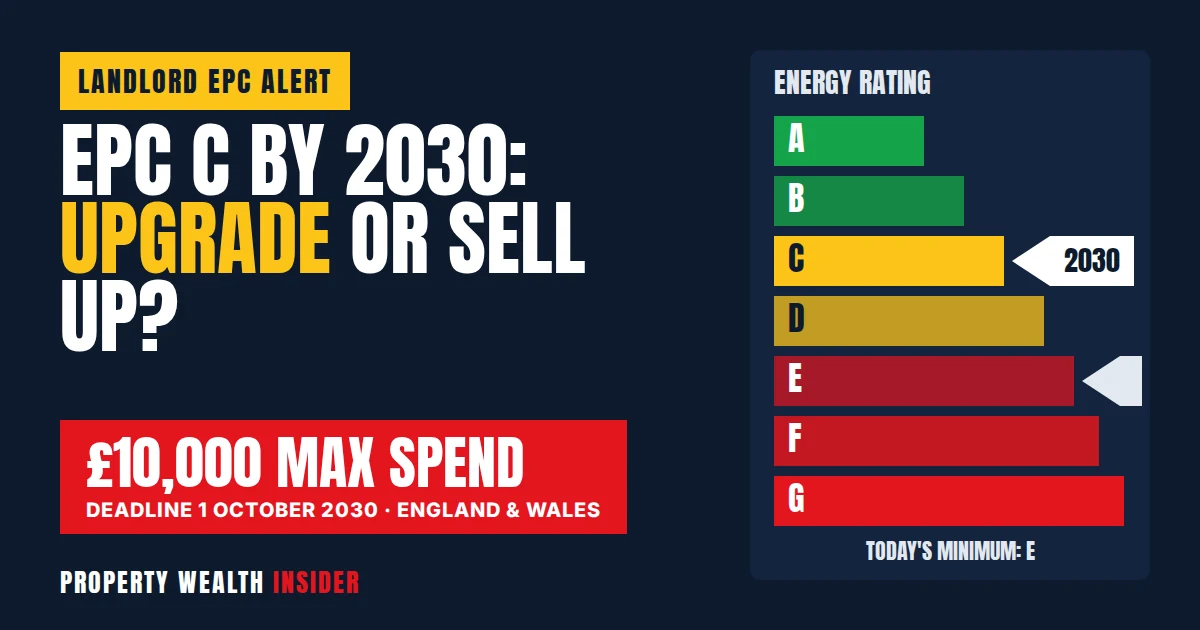
Every privately rented home in England and Wales has until 1 October 2030 to hit a new EPC C-equivalent standard, and one landlord buying firm now says some owners will sell rather than pay for the work. The government’s own numbers put the average bill at £5,400 a property, with a maximum required spend of £10,000.
Whether you upgrade or sell comes down to arithmetic: what your property needs, what it will cost, whether that falls inside the cap, and how long the payback takes. Most landlords haven’t run those numbers yet, and many don’t know which exemptions they could use.
This guide sets out what is law now and what is only planned, runs worked examples in £, and includes a calculator so you can test your own property.
Key facts
- In force now: rented homes in England and Wales must be EPC E or above. The spending cap is £3,500 including VAT, and the maximum fine is £5,000 per property.
- Planned: all tenancies must meet the new EPC C standard by 1 October 2030. New tenancies do not get an earlier deadline.
- The required spend is capped at £10,000 per property over 10 years. The government estimates the average cost at £5,400.
- If your EPC shows C or above and is dated before 1 October 2029, your property counts as compliant until that EPC expires.
- Qualifying work carried out since 1 October 2025 already counts towards the £10,000 cap. The proposed maximum fine is £30,000 per property, per breach.
- This applies only to England and Wales. Scotland has its own separate proposals.
The “sell, don’t upgrade” claim, checked
The warning comes from LandlordBuyer, a company that buys property from landlords. Its managing director, Jason Harris-Cohen, says that where a lot of work is needed, selling “could become the more attractive option”. The firm has not published any survey of its own. Its figures (the £10,000 cap and the £5,400 average) come from the government’s impact assessment.
The government has researched this directly. In interim results published in its January 2026 response, 59% of the 631 landlords surveyed said they would carry out improvements, 15% didn’t know, and 23% said they would leave the rental market.
There’s a catch. The same 23% said they would leave even if the standards stayed as they are. The government’s conclusion was that higher standards have “a limited impact” on decisions to exit. It also found that landlords were weighing up an exit “without awareness or understanding” of the exemptions open to them.
PWI verdict: The case for selling is real for some properties, especially hard-to-treat homes where the rent is low. For most landlords, though, the cap and the exemptions put a firm limit on the cost. Get a new EPC and quotes before you decide anything.
What is law now, and what is coming
Under the current MEES rules, you cannot let a home rated F or G on an assured, regulated or domestic agricultural tenancy unless you have registered an exemption. That has applied to new tenancies since 1 April 2018 and to all tenancies since 1 April 2020.
The higher standard is set out in the Department for Energy Security and Net Zero’s government response of 21 January 2026. It is policy, not yet law. Ministers need new powers through an Act of Parliament, followed by regulations they aim to bring into force in 2027. The E standard continues to apply until then.
| Now (in force) | From 1 October 2030 (planned) | |
|---|---|---|
| Minimum standard | EPC E | C-equivalent on new EPCs: a fabric standard, then either a smart readiness or a heating system standard (you choose which) |
| Who it covers | All tenancies in scope | All tenancies in scope. Short-term lets are excluded for now |
| Spending cap | £3,500 including VAT | £10,000 per property over 10 years, or 10% of value for homes worth under £100,000 |
| Spend that counts | Work done since 1 October 2017 | Work done since 1 October 2025, plus your EPC fees. Boiler Upgrade Scheme grants do not count |
| Maximum fine | £5,000 per property | £30,000 per property, per breach |
| Early compliance | n/a | An EPC of C or above dated before 1 October 2029 protects you until it expires |
The deadline depends on EPCs that don’t exist yet. The response had aimed to launch the new-style EPCs in October 2026. On 9 March 2026 the government pushed that back to the second half of 2027. The new certificates replace today’s single rating with four headline metrics: energy cost, fabric performance, heating system and smart readiness.
What upgrades cost: typical prices
The government’s modelling expects about 1.75 million rented homes to be upgraded by 2030, at an average landlord cost of £5,387. The spread is wide. The largest group falls between £4,000 and £5,000, but 52,000 homes land close to the £10,000 cap.
For individual measures, the Energy Saving Trust publishes typical installed prices for Great Britain. Your new EPC will list the measures recommended for your property, and those recommendations are what count.
| Measure | Typical installed cost (GB) | Typical bill saving a year | Fits under a £10,000 cap? |
|---|---|---|---|
| Draught proofing (whole house, professional) | around £250 | around £55 | Yes |
| Loft insulation, 0 to 270mm | £750 | not published | Yes |
| Loft top-up, 120 to 270mm | £600 | not published | Yes |
| Suspended timber floor insulation | £1,400 to £2,500 | £55 (up to £85 detached) | Yes |
| Cavity wall insulation | around £2,200 | pays back in 5 years or less | Yes |
| A-rated windows replacing single glazing (semi) | around £4,800 | £85 | Yes |
| Solar PV, around 4.5kWp | around £7,600 | 9 to 12 year payback | Yes, alone |
| Internal wall insulation (3-bed semi) | around £12,000 | not published | No |
| External wall insulation (3-bed semi) | around £15,000 | not published | No |
| Air source heat pump | around £12,000, less a £7,500 grant | depends on tariff | Your share only (grant excluded) |
Energy-saving materials are zero-rated for VAT until 31 March 2027. From 1 April 2027 they go back to the 5% reduced rate. If you’re doing the work anyway, doing it before April 2027 is cheaper.
Calculator: EPC upgrade cost and payback
Tick the measures your EPC recommends and swap in your own quotes. The calculator works out whether you’re inside the cap, how many months of rent the work costs, and how long it takes to pay back.
EPC upgrade cost and payback
Guide only, not advice. The costs are typical Energy Saving Trust prices (GB), and your quotes will vary. The 2030 rules are planned, not yet law, and the exact C standard on the new EPCs has not been set. Payback ignores tax relief, finance costs and inflation.
Worked examples: upgrade, exempt or sell?
1. The government’s own sums: a D-rated home
The impact assessment takes a higher-rate landlord charging the average rent in England, £16,788 a year. It assumes getting from D to C costs around £6,000 and lifts the rent by 4.9%, which is £823 a year. After 40% tax that leaves £494, so the landlord takes about 12 years to get the money back. The government itself says the rent premium may not be caused by the EPC.
2. Cavity-wall semi: a cheap fix
A D-rated semi needs loft insulation (£750), cavity wall insulation (£2,200) and draught proofing (£250), a total of £3,200. That is well inside the £10,000 cap. If the tenant saves £210 a year, the whole-property payback is about 15 years. At £1,399 a month rent, the cost is 2.3 months’ rent. That is much less than the fees and tax you’d typically face on a sale.
3. Solid-wall terrace: cap plus exemption
A Victorian terrace needs floor insulation (£1,950), A-rated windows (£4,800) and draught proofing (£250), which comes to £7,000. Internal wall insulation at around £12,000 would take the total well over the cap. Under the planned rules, the landlord does the £7,000 of work and then registers the new solid wall insulation exemption, which lets them decline that measure if it is the only one left.
4. Low-value flat: the 10% cap
A flat worth £85,000 has its cap cut to 10% of its value, which is £8,500. If the recommended work comes to £9,400, the landlord spends up to £8,500 and can then register an exemption. Owners in this position are the ones most tempted to sell, even though the planned rules already limit what they have to spend.
The new exemptions
Exemptions apply to specific measures. If one measure is exempt, you still have to install the other relevant measures within the cap. Registration will continue through the PRS Exemptions Register, which the government is redeveloping.
| Planned exemption | When it applies | Lasts |
|---|---|---|
| Cost cap | You have spent £10,000, or the next cheapest measure would take you over it | 10 years |
| Property value adjustment | The property is worth under £100,000, so the cap becomes 10% of its value | 10 years |
| Negative impacts | You can show a measure would harm the fabric or structure (this replaces the devaluation and wall insulation exemptions) | 10 years |
| High cost | Even the cheapest recommended measure costs more than the cap | Typically 5 years |
| All relevant improvements made | No further improvements are possible and the property is still below the standard | Typically 5 years |
| Solid wall insulation | You choose not to install solid wall insulation and it is the only measure left | Typically 5 years |
| Third-party consent | The tenant, freeholder or planning authority refuses consent | Typically 5 years |
| New landlord | You have just acquired a property with tenants already in it | 6 months |
For now the current rules still apply: exemptions last 5 years and the cap is £3,500. The government is also looking at a portfolio option that would let larger landlords pool their caps across several properties. Nothing has been decided on that yet.
What to do now: step by step
- Check every EPC on the find an energy certificate service. Note the rating and the expiry date (EPCs last 10 years).
- Close to a C? If a few cheap measures would get you there, do them and get a new EPC showing C before 1 October 2029. That protects you until the certificate expires.
- Book the cheap wins before 31 March 2027 while the 0% VAT rate lasts. Keep invoices: work done since 1 October 2025 counts towards the cap.
- Check grants. Use the government’s find ways to save energy tool, and the Boiler Upgrade Scheme if you’re considering a heat pump.
- Talk to your accountant about which costs are allowable repairs and which are capital. The government response has worked examples (Annex A).
- Only then decide whether to upgrade, register an exemption or sell. Run the calculator above for each property.
- EPC rating and expiry date recorded for every let property
- Properties below E fixed now, or an exemption registered
- Quotes for the measures your EPC recommends, from TrustMark or MCS installers
- Invoices dated from 1 October 2025 filed as evidence for the cap
- Value checked for any property worth under £100,000
- Grants checked, and tenant consent planned for the works
- A decision for each property: upgrade, exempt or sell
FAQ
Do rental properties need an EPC C by 2030?
In England and Wales, that is the government’s decided policy: all tenancies must meet a C-equivalent standard by 1 October 2030. It still needs legislation. Until then the legal minimum is E.
Is the EPC C deadline 2028 for new tenancies?
No. The 2025 consultation proposed 2028 for new tenancies, but the government dropped that. There is a single date, 1 October 2030, for all tenancies.
What is the maximum a landlord has to spend?
Under the planned rules, the maximum is £10,000 per property over 10 years, including EPC fees and any grants other than the Boiler Upgrade Scheme. For homes worth under £100,000, it is 10% of the property’s value. Today the cap is £3,500.
Will my current EPC C still count?
Yes, if it is rated C or above and dated before 1 October 2029. It counts as compliant until it expires or is replaced.
Does this apply in Scotland or Northern Ireland?
No. These rules cover England and Wales. Scotland has separate proposals for a Heat Retention Rating C, with 2028 for new tenancies and the end of 2033 for all lets. Northern Ireland is not covered.
Do holiday lets and Airbnbs have to meet EPC C?
Not for now. The government has excluded short-term lets but says it will keep that under review and wants the power to bring them in later.
Sources
- DESNZ: Improving the energy performance of privately rented homes (2025 update), consultation outcome
- DESNZ: Government response, January 2026 (PDF)
- DESNZ: Impact assessment (PDF)
- GOV.UK: Domestic private rented property minimum energy efficiency standard, landlord guidance
- MHCLG/DESNZ: Reforms to the Energy Performance of Buildings regime (partial response and 9 March 2026 update)
- HMRC: VAT Notice 708/6, energy-saving materials
- GOV.UK: Energy Performance Certificates
- Scottish Government: Draft Energy Efficiency (Domestic Private Rented Property) (Scotland) Regulations consultation
- Energy Saving Trust: loft insulation, cavity wall, solid wall, floor, windows, draught proofing, solar panels, air source heat pumps
- LandlordBuyer comments, via The Intermediary
This article is news and general guidance, not financial, legal or tax advice. The 2030 standard is planned policy and may change before it becomes law.