32% of Landlords Freeze Rents: The New Rules for Raising Yours
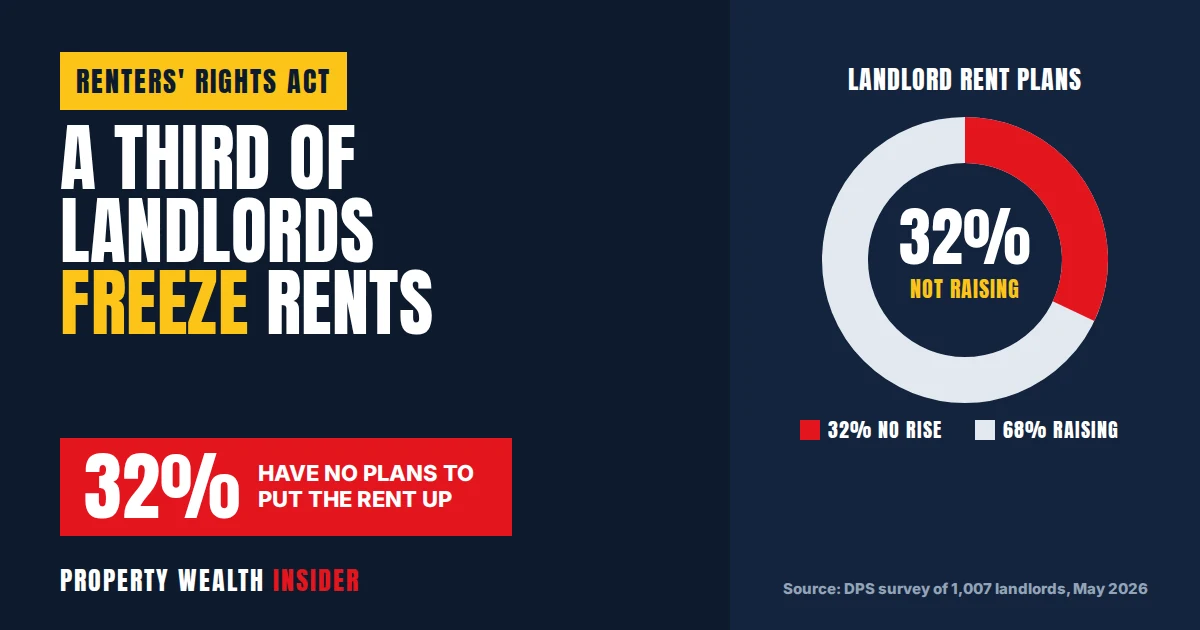
Almost a third of landlords have no plans to put the rent up, even as the new rules in the Renters’ Rights Act bed in. The Deposit Protection Service (DPS) surveyed 1,007 landlords straight after the Act started on 1 May 2026. It found 68% plan to increase rents on some or all of their properties. That leaves 32% who don’t.
Just 19% said they intend to raise rents automatically every year. Meanwhile official figures show rents are still climbing. The Office for National Statistics (ONS) puts the average rent in England at £1,459 a month, up 4.0% in the year to August 2026.
This matters because the way you raise rent in England has changed completely. Rent review clauses in tenancy agreements no longer work. Every increase now has to go through one statutory process, and tenants can challenge it at a tribunal. Get it wrong and your increase can be thrown out. Below: the rules, regional figures and a planner that works out your earliest legal start date.
Key facts
- 68% of landlords plan to raise rents on some or all properties, which means 32% don’t (DPS survey of 1,007 landlords, May 2026).
- Only 19% plan to increase rents automatically every year.
- Average private rent in England: £1,459 a month, up 4.0% in the year to August 2026 (ONS).
- In England, rents can go up only once a year, using Form 4A, with at least two months’ notice.
- If a tenant challenges your notice, the tribunal can’t set the rent higher than you proposed, but it can set it lower, at market rent.
- For new tenancies you can ask for no more than one month’s rent in advance, and only after the tenancy agreement is signed.
What the DPS survey found
The DPS surveys landlords and tenants twice a year. Its latest Private Rented Sector Review (August 2026) is based on surveys taken immediately after 1 May 2026, when the Renters’ Rights Act started to apply. 1,007 landlords and 1,271 tenants replied.
The DPS says most landlords plan to keep rents where they are for the next six months. It suggests many are waiting to see how the new rules affect their local market before they decide anything.
| Finding (DPS, May 2026 wave) | Figure |
|---|---|
| Landlords planning to raise rents on some or all properties | 68% |
| Landlords planning automatic annual rent rises | 19% |
| Landlords citing legislation costs as a reason to raise rents | 86% |
| Landlords citing maintenance costs | 75% |
| Landlords citing mortgage costs | 46% |
| Landlords intending to sell some or all of their portfolio (one to two years) | 56% (up from 53%) |
| Tenants paying up to a quarter more than last year | 44% |
| Tenants paying more than a quarter more than last year | 9% |
| Tenants who reported no rent increase | 32% |
Cost pressure hasn’t gone away. The cost of complying with the new legislation is now the top reason landlords give for raising rents.
How fast rents are rising where you let
The ONS Price Index of Private Rents, published on 16 September 2026, shows average UK rent up 3.8% to £1,400 in the year to August 2026. In England it rose 4.0% to £1,459. Wales was up 4.3% (£846) and Scotland 1.1% (£1,013).
The North East and North West lead at 5.8% each. The South East is lowest at 3.0%. London is still by far the most expensive region at £2,332 a month.
Worked example: if an average England rent of £1,459 rose in line with the 4.0% national figure, it would go up by about £58 a month, or around £700 a year. In the North East the same 5.8% rise on £788 is about £46 a month, or £548 a year.
The rent increase rules in England from 1 May 2026
These rules apply to private assured tenancies in England. Wales, Scotland and Northern Ireland have their own separate regimes. The legal basis is section 13 of the Housing Act 1988, as amended by the Renters’ Rights Act 2025.
| Rule | What it means in practice |
|---|---|
| One route only | You can only raise rent with a section 13 notice, by agreeing a lower rent after serving one, or through a tribunal decision. Any tenancy clause that allows the rent to go up another way has no effect (s.13(4A)). |
| Prescribed form | You must use Form 4A (private rented sector, England only). |
| Notice period | You must serve the notice at least two months before the new rent starts. |
| First increase | This can’t start until 52 weeks after the tenancy began. |
| Later increases | These must start at least 52 weeks after the last increase took effect. In some cases it’s 53 weeks, which keeps the date on the same annual cycle (see Note A3 on Form 4A). |
| Start date | The new rent must start at the beginning of a tenancy period, so on the day rent is normally due. |
| Tenant challenge | Before the start date, the tenant can apply to the First-tier Tribunal. The fee is £47. |
| Rent in advance | You can’t take rent before the agreement is signed. After that, you can ask for a maximum of one month’s rent in advance. |
| No bidding | You must advertise a fixed rent and can’t accept or encourage offers above it. |
Rent review clause in an old tenancy agreement? From 1 May 2026, section 13(4A) says any term allowing the rent to rise other than through a section 13 notice, an agreement following one, or a tribunal decision is of no effect. A clause such as “rent rises by RPI every April” no longer works on its own. You still need to serve Form 4A.
Rent increase planner
Enter your figures to see the size of the rise and the earliest date the new rent could legally start. The planner also shows how your proposal compares with market rent, which is the figure a tribunal would look at.
Rent increase planner (England)
This is a guide only, not legal advice. It assumes a monthly periodic assured tenancy in England and applies the two-month notice rule, the 52-week rule and the requirement to start on a rent day. It does not apply the 53-week adjustment explained in Note A3 of Form 4A, so check your date against the form. Allow extra time for service by post.
Worked example (the planner’s default figures): the current rent is £1,200 and the proposed rent is £1,260. That’s a 5.0% rise, or £720 a year. The last increase took effect on 15 November 2025 and the notice is served on 1 October 2026. Two months later is 1 December 2026, which is after the 52-week point. The next rent day is 15 December 2026, so that’s the earliest start date. At £1,260, the proposed rent is only £15 below the £1,275 market estimate. That’s close enough that you should keep evidence of similar local lets in case of a challenge.
What happens if your tenant challenges it
A tenant who disagrees with your notice can apply to the First-tier Tribunal (Property Chamber) using form MR1 or the online service. They must apply before the start date on your notice. The fee is £47, and help with fees is available.
The tribunal decides the rent the property could reasonably be let for on the open market. Under the new section 14ZB, the new rent is whichever is lower: the open-market rent or the rent you proposed. It can’t go higher than your proposal.
- No backdating: if the tribunal’s decision comes after your proposed start date, the new rent starts from the first rent day on or after the decision. The tenant pays the old rent while they wait.
- Hardship: if starting the new rent on those dates would cause the tenant undue hardship, the tribunal can put the start date back by up to two months from its decision.
- Validity: the tenant can also argue your notice is invalid, for example because the notice period was too short, the form was wrong or the start date was wrong.
- New tenancies: separately, a tenant can challenge the starting rent within the first six months of a tenancy (s.14(A1)-(A2)).
What overpricing costs you: say the current rent is £1,200 and you propose £1,350 when the market rent is £1,275. The tribunal can cut it to £1,275. If the decision comes three months after your intended start date, the tenant pays £1,200 during that time. You miss out on the £75 monthly rise you would have had at market level, which is £225 in total. Proposing £1,275 from the start would have avoided both problems.
How to raise the rent legally: step by step
- Check the dates. Find when the tenancy started and when the last increase took effect. The new rent can’t start within 52 weeks of either.
- Research market rent. Collect three to five similar lets nearby, using live adverts, recently let listings and an agent’s opinion. Check the ONS local-area figures too.
- Set a defensible figure. Propose no more than market rent. Take the property’s condition into account, because the tribunal can.
- Talk to the tenant first. A conversation reduces the chance of a challenge. You still need the formal notice.
- Complete Form 4A. Use the current version from gov.uk. Include all tenants’ names, the tenancy start date, the date of the last increase, the new rent and a start date that falls on a rent day.
- Serve it properly and keep proof. Use a method set out in the tenancy agreement. Otherwise hand it over in person, leave it at the property or send it by registered post. Leave extra time on top of the two months.
- Diary the start date. If you hear nothing before the start date, update the rent amount and ask the tenant to change their standing order.
- If challenged, send evidence. Reply to the tribunal with your comparable lets and details of the property’s condition.
- Tenancy start date and last increase date confirmed
- 52 weeks will have passed by the proposed start date
- Comparable local rents saved as evidence
- Proposed rent at or below market rent
- Current Form 4A downloaded from gov.uk (not the old Form 4)
- All joint tenants named; all joint landlords sign, or one signs for all
- Start date is a rent day and at least two months after service
- Service method matches the tenancy agreement; proof of service kept
- Any old rent review clause ignored; Form 4A served instead
- Reminder set to update rent records and the tenant’s standing order
FAQs
How much notice do I need to give to increase rent in England?
At least two months, using Form 4A. The new rent must also start on a rent day and at least 52 weeks after the last increase, or after the tenancy began if the rent has never been raised.
Can I still use a rent review clause in my tenancy agreement?
No. From 1 May 2026, any term allowing the rent to rise outside the section 13 process has no effect. You need to serve Form 4A instead.
Can the tribunal increase the rent above what I asked for?
No. The tribunal sets whichever is lower: the open-market rent or the rent in your notice. If the market rent is higher than your proposal, you only get what you proposed.
Is there a cap on how much I can raise the rent?
There is no fixed percentage cap in England. In practice, market rent is the limit, because a tenant can challenge anything above it.
How much rent in advance can a landlord ask for now?
For tenancies under the new rules in England, you can’t take any rent before the agreement is signed. After it’s signed, you can ask for a maximum of one month’s rent in advance.
Do these rules apply in Wales or Scotland?
No. Form 4A and the Renters’ Rights Act rent rules covered here apply to England. Wales and Scotland have their own rent increase rules.
Sources
- The DPS: The Private Rented Sector Review, August 2026
- ONS: Private rent and house prices, UK: September 2026
- ONS: Price Index of Private Rents, UK: monthly price statistics
- Housing Act 1988, section 13 (as amended)
- Housing Act 1988, section 14
- Housing Act 1988, section 14ZB
- GOV.UK: Assured tenancy forms for privately rented properties from 1 May 2026 (Form 4A)
- GOV.UK: Renters’ Rights Act: an overview for landlords
- GOV.UK: Renters’ Rights Act overview for tenants
- GOV.UK / HMCTS: Apply for an open market rent determination
This article is news and general guidance only, not financial, legal or tax advice.