Student landlords’ 24.3% yield hotspot: the cheap cities winning
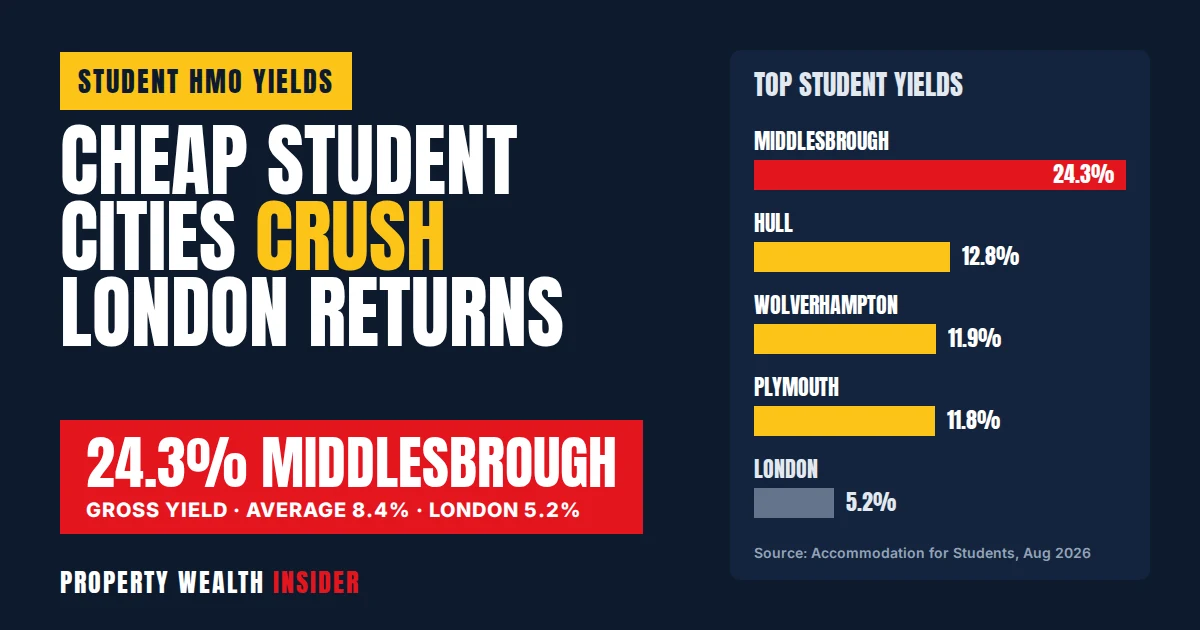
Middlesbrough is the top place in England and Wales to own a student let. New research from the letting portal Accommodation for Students puts its gross student yield at 24.3%. That is nearly three times the student-market average of 8.4%, and more than four times London’s 5.2%.
The pattern is simple. The highest yields come from cities where houses are cheap but students still pay decent rents: Hull, Wolverhampton, Plymouth and Stoke-on-Trent follow Middlesbrough. The lowest come from pricey southern towns such as Kingston, Bedford and Oxford.
But these are gross figures based on advertised rents. They leave out empty weeks, bills, licensing, management and mortgage costs. The student-let rules in England also changed on 1 May 2026. Below we check the numbers against official house prices, explain the new rules, and give you a calculator to test a deal properly.
Key facts
- Middlesbrough tops the table at a 24.3% gross yield: £24,326 a year in advertised rent against a local value of £100,019.
- The student-market average is 8.4%. London ranks near the bottom at 5.2% and Kingston is last at 4.5%.
- The best property type is a flat with 3 or more bedrooms, at 12.5%. Houses with 6+ bedrooms return 9.4%.
- The research covers 22,107 student properties across 61 cities (48 ranked) in the 12 months to June 2026.
- Official average price in Middlesbrough is £140,909 (ONS/HM Land Registry, July 2026), against £293,479 for England as a whole.
- In England, student HMO landlords can use possession Ground 4A with 4 months’ notice, ending between 1 June and 30 September.
What the research found
The Student Housing Rental Yield Report (August 2026 edition) compares advertised student rents with the prices paid for similar property nearby. It covers privately let shared houses, flats and studios. Purpose-built student blocks were stripped out.
Each property is valued against sold homes of the same type and size in the same locality, using sold-price data that includes HM Land Registry records. So a six-bed HMO is compared with six-bed sales, not with the average semi.
Size matters a lot. Shared houses let by the room go from a 5.2% yield at 1-2 bedrooms to 9.4% at 6+ bedrooms. Rent grows with every extra room, while the price grows more slowly. The strongest segment of all is the flat with 3+ bedrooms, at 12.5%.
Top student cities vs official house prices
We set the research against the official UK House Price Index for July 2026, published by the ONS and HM Land Registry on 16 September 2026. The ONS figure is the average for all homes in the council area, not just student-type houses.
| Rank | City | Gross yield | Annual student rent | Value of student-type property | ONS average price, July 2026 | ONS annual change |
|---|---|---|---|---|---|---|
| 1 | Middlesbrough | 24.3% | £24,326 | £100,019 | £140,909 | +3.7% |
| 2 | Hull | 12.8% | £21,046 | £164,683 | £135,511 | +5.9% |
| 3 | Wolverhampton | 11.9% | £15,498 | £130,473 | £220,559 | +7.2% |
| 4 | Plymouth | 11.8% | £27,627 | £234,169 | £223,161 | +2.2% |
| 5 | Stoke-on-Trent | 11.7% | £18,409 | £157,589 | £147,377 | -0.8% |
| 6 | Northampton | 11.4% | £35,585 | £313,414 | £291,929* | +1.2% |
| 7 | Liverpool | 11.3% | £26,024 | £229,421 | £189,036 | +8.1% |
| 8 | Durham | 11.2% | £30,364 | £270,111 | £140,447* | +4.7% |
| 9 | Lancaster | 10.8% | £27,181 | £251,931 | £202,966 | +4.9% |
| 10 | Gloucester | 10.1% | £33,797 | £335,909 | £240,718 | +4.9% |
| 46 | London | 5.2% | £36,166 | £697,910 | £550,037 | n/a |
Yield, rent and student-type value: Accommodation for Students, 12 months to June 2026. ONS prices: UK HPI July 2026 (council area; London is the regional figure). *Northampton uses West Northamptonshire and Durham uses County Durham, which are much wider areas than the student districts.
Two things jump out. In Middlesbrough the student houses being let are valued at around £100,000, well below the town’s £140,909 average. That cheap entry price is what drives the 24.3% figure.
In Durham, Lancaster and Gloucester it’s the other way round. Student houses cost far more than the local average, because they are big houses in popular spots. So a “cheap city” average price does not mean cheap student stock. Always price the exact house type you plan to buy.
Why a 24% gross yield is not 24% in your pocket
The report works out annual rent as weekly room rents times 52 weeks, at the latest advertised price. It says clearly that achieved rents, empty periods, running costs, licensing and finance are out of scope. In other words, it’s a best-case headline figure.
Here is how that plays out on a typical deal. Take a 5-bed student house bought for £150,000, let at £100 per room per week.
| Line | Annual £ | Notes |
|---|---|---|
| Headline rent (5 × £100 × 52 weeks) | £26,000 | Gross yield 17.3% |
| Realistic rent (48 weeks let) | £24,000 | Gross yield 16.0% |
| Bills included (£350 a month) | -£4,200 | Energy, water, broadband, TV licence |
| Management at 12% | -£2,880 | Letting and managing agent |
| Other costs | -£2,500 | Insurance, repairs, licence, safety checks |
| Net before finance | £14,420 | Net yield 9.6% |
| Interest-only mortgage (75% at 5.5%) | -£6,188 | £112,500 loan |
| Cash flow | £8,233 | About £686 a month |
That is still a strong deal. But the net yield is roughly half the headline figure, and the deal is on paper only. Buy in a street students don’t want and 48 let weeks can easily become 40. Tax is not included either.
Student let yield and cash-flow calculator
Put in your own figures. The defaults match the worked example above.
Student let yield and cash-flow calculator
Guide only, not financial advice. Ignores tax, stamp duty, legal fees and refurbishment costs, so cash-on-cash is based on the deposit alone. For comparison, the research’s student-market average gross yield is 8.4%.
The rules for student lets in England now
The Renters’ Rights Act 2025 changed private renting in England from 1 May 2026. Wales has its own system and is not covered by these changes. The main points for student landlords, according to the government’s Renters’ Rights Act information sheet and the legislation:
- No more fixed terms. Assured shorthold tenancies were abolished on 1 May 2026. All tenancies are now periodic, so you can’t sign students to a 12-month fixed term and rely on it ending.
- Ground 4A for student HMOs. You can seek possession so the property can be re-let to students for the next academic year. It only works if the property is an HMO (or in one).
- Every tenant must be a student. Each tenant must be a full-time student when the tenancy starts, or you must reasonably believe they will become one. One non-student on a joint tenancy means the ground can’t be used.
- Written warning up front. Before the tenancy is entered into, you must give a written statement that you may use this ground. For existing tenancies, the government says this had to be given by 31 May 2026 in most cases.
- Timing rules. The tenancy must be signed no more than six months before the tenant can move in. The notice is 4 months and must end between 1 June and 30 September. You must intend to re-let to students.
Practically, this means signing groups late. A house signed in November for a September move-in fails the six-month test and loses Ground 4A. For a September move-in, that means signing from March onwards.
HMO licensing. A mandatory HMO licence is needed if 5 or more people from more than one household rent the property and share a toilet, bathroom or kitchen. A licence lasts up to 5 years. Letting an unlicensed HMO can mean an unlimited fine. Many councils also run additional licensing that catches smaller HMOs, so check before you buy.
How to vet a student area: step by step
- Start with the university, not the yield. Check which universities and campuses are nearby and whether student numbers are growing or shrinking.
- Map where students actually live. The research found yields vary street by street. Walk the area and check walking time to campus and the high street.
- Count the competition. Look at how many rooms are advertised and how many purpose-built blocks are opening. Lots of empty rooms in July is a warning sign.
- Check the council’s HMO policy. Look for additional licensing and Article 4 directions, which mean you need planning permission to turn a family home into an HMO.
- Price the exact house type. Use sold prices for the same size in the same streets, not the town average in the table above.
- Run the numbers at 40 weeks and a higher rate. If the calculator still shows positive cash flow, the deal has a buffer.
- HMO licence (mandatory or additional) confirmed with the council
- Article 4 and planning status checked
- Fire safety, room sizes and amenity standards costed
- Ground 4A written statement ready to give before every new student tenancy
- Tenancies signed no more than six months before move-in
- All joint tenants confirmed as full-time students
- Bills budget set for all-inclusive rents
- Deal stress-tested at 40 let weeks and a higher mortgage rate
FAQs
Which UK city has the highest student rental yield?
Middlesbrough, at a 24.3% gross yield in the 12 months to June 2026, followed by Hull at 12.8%. The research covers England and Wales only, as comparable sold-price data isn’t published for Scotland or Northern Ireland.
What is a good yield for a student HMO?
The student-market average gross yield is 8.4%. Because student lets carry bills, voids and licensing costs, focus on net yield and cash flow instead. Use the calculator above to test your deal.
Can I still give students a 12-month fixed term?
Not in England. Since 1 May 2026 all assured tenancies are periodic. To get a student house back for the next intake, use Ground 4A if the property is an HMO and you meet the conditions.
How much notice do I give students under Ground 4A?
Four months, and the notice must end between 1 June and 30 September. You must also have given a written statement before the tenancy started saying you may use the ground.
Does a student house need an HMO licence?
If 5 or more people from more than one household share facilities, yes, a mandatory licence is needed. Smaller shared houses may need one too where the council runs additional licensing.
Sources
- Accommodation for Students: Student Housing Rental Yield Report, August 2026 edition
- Accommodation for Students: Research and reports
- ONS / HM Land Registry: UK House Price Index, July 2026 (released 16 September 2026)
- GOV.UK: The Renters’ Rights Act Information Sheet 2026
- legislation.gov.uk: Housing Act 1988, Schedule 2 (Ground 4A)
- legislation.gov.uk: Housing Act 1988, section 8 (notice periods)
- legislation.gov.uk: Renters’ Rights Act 2025
- GOV.UK: House in multiple occupation licence
This article is news and general guidance only. It is not financial, legal or tax advice.