Flat trap: 39.5% of London flats now sell at a loss
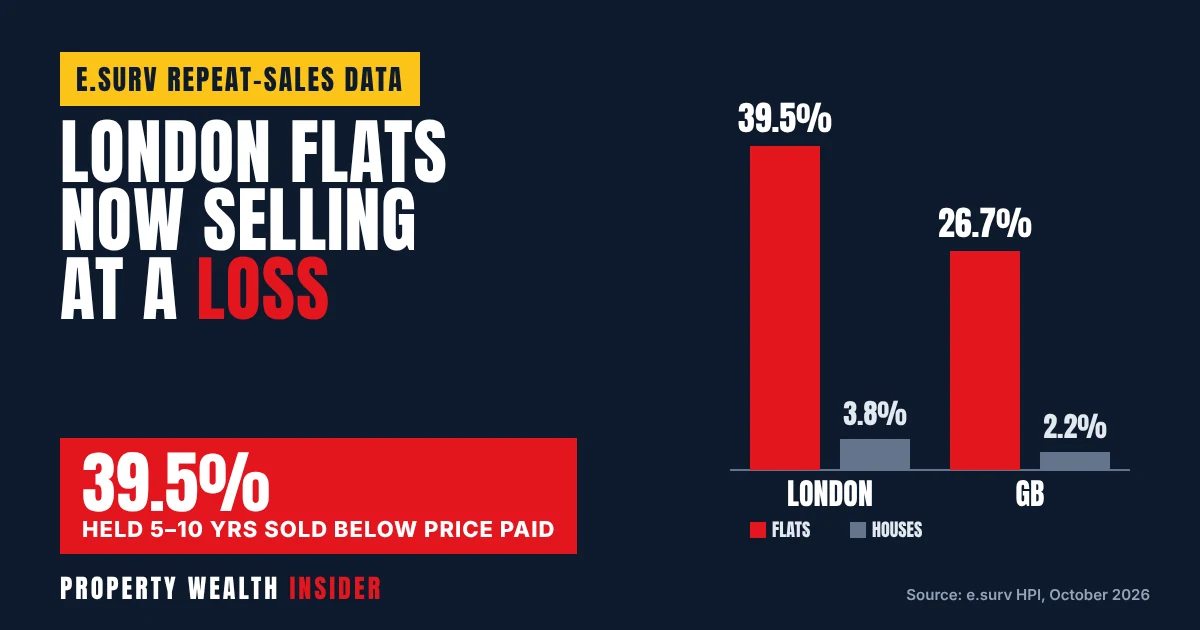
Almost four in ten London flats that were bought five to ten years ago and sold in 2025/26 went for less than their owner paid. That is the headline from a new repeat-sales study by e.surv Chartered Surveyors, which matched HM Land Registry and Registers of Scotland records to see what owners actually got back when they sold.
It is not just a London problem. Around a third of flats held for that long in the South East and East of England also sold at a nominal loss. For houses held for the same period, the share selling at a loss was below 4% in every region of England and Wales.
If you bought a buy-to-let flat between 2016 and 2021 and are thinking about selling, this matters. Below we explain why flats are lagging, what the leasehold reforms actually change (and what is still only proposed), and how to work out your real profit or loss after stamp duty, fees and tax.
Key facts
- 39.5% of London flats held 5–10 years and sold in 2025/26 went for less than the previous purchase price, against 3.8% of London houses (e.surv analysis of Land Registry data).
- Across Great Britain the figure was 26.7% for flats and 2.2% for houses. In Scotland it was 9.8% for flats.
- e.surv puts the average GB price at £328,900 in September 2026, up 1.5% a year. London is the only region falling, down 2.3%.
- Official UK HPI data shows flats and maisonettes in England down 3.5% in the year to July 2026, while detached homes rose 1.4%.
- Selling at a loss means no Capital Gains Tax, and the loss can be carried forward against future gains if you claim it within 4 years of the end of the tax year of sale.
The numbers, region by region
e.surv looked at homes that sold in 2025/26 and compared each sale with the price recorded the last time the same property changed hands. The study splits results by how long the owner held the property and by flats versus houses.
The pattern is stark. In every region flats did worse than houses. The gap is widest in London and the South East, where flats make up a big part of the market. e.surv notes that flats account for around three-fifths of homes in the capital.
Holding for longer helps, but it does not fix the problem. For flats held 10–15 years, 16.6% across GB still sold below the previous price, compared with 1.9% of houses.
| Measure | Flats | Houses / all homes | Source |
|---|---|---|---|
| London, held 5–10 yrs, sold below previous price | 39.5% | 3.8% | e.surv |
| Great Britain, held 5–10 yrs | 26.7% | 2.2% | e.surv |
| Great Britain, held 10–15 yrs | 16.6% | 1.9% | e.surv |
| England, annual price change to July 2026 | -3.5% (avg £217,362) | +1.4% detached (avg £474,626) | UK HPI |
| London, annual price change | -2.9% (e.surv, Sept 2026) | -2.3% all homes (e.surv); -3.3% all homes to July (UK HPI) | e.surv / UK HPI |
The official UK House Price Index for July 2026 tells the same story. London prices have now fallen for eleven months in a row, with Inner London hit hardest.
Why flats are falling behind houses
e.surv traces the split back to around 2017, close to the Grenfell Tower fire. Since then, several pressures have piled onto the flat market at once.
- Building safety. Cladding and fire safety scrutiny made some blocks harder to sell and mortgage, and slowed sales while paperwork was chased.
- Service charges and ground rent. Rising running costs cut what buyers will pay and eat into a landlord’s net yield, which investors price in.
- Leasehold tenure. Short leases, onerous ground rent clauses and uncertainty about reform make some buyers and lenders cautious.
- Location mix. Flats are concentrated in London and other markets where overall growth has been weak, and the pandemic shifted demand towards space and gardens.
Scotland is the useful comparison. It has a different system for owning and managing flats rather than English-style leasehold, and its flats held 5–10 years sold at a loss less than one time in ten. In Scotland, flat prices are up 7.2% on a year ago, per e.surv. That does not prove tenure is the cause, but e.surv says it suggests the way flats are owned and managed may matter.
There is also a building safety catch specific to landlords in England. The government’s cladding cost protections apply only to a “qualifying lease”. One test is that on 14 February 2022 you did not own more than three dwellings in the UK (your main home aside). The building must be over 11 metres or at least five storeys. Portfolio landlords can fall outside some protections, and buyers will want to know.
Leasehold reform: what is law and what is not
Many landlords are holding off selling in the hope that leasehold reform will lift values. Here is where things actually stand for leaseholders in England.
| Measure | Status at 8 October 2026 |
|---|---|
| Scrapping the two-year ownership wait before you can extend a lease or buy the freehold | In force since 31 January 2025 (Leasehold and Freehold Reform Act 2024, s.27) |
| Cheaper lease extensions and freehold purchases, including removing “marriage value” for leases of 80 years or less | Not yet in force. Government consultation on valuation rates is open; it says it will commence the changes “as soon as possible”. A High Court challenge was won by the government but is under appeal. |
| Ground rent capped at £250 a year, falling to a peppercorn after 40 years, for older leases | Proposed only, in the draft Commonhold and Leasehold Reform Bill. Government says it could come into force in late 2028. |
| Ban on selling new flats as leasehold (commonhold instead) | Proposed, details under consultation |
The bottom line: if your flat has a short lease or a high ground rent, the big cost savings are not here yet. Pricing your sale on the assumption that they are is a gamble.
Worked examples: two landlords selling up
The headline price change is only part of the story. Stamp duty, legal fees and agent fees all come off your real result. These examples are illustrative, with figures rounded.
Example 1: London flat bought in 2018
Priya bought a one-bed flat in east London for £450,000. She paid £26,000 stamp duty, £2,500 in legal and survey fees, and later spent £8,000 on an improvement that counts for CGT. In 2026 she sells for £430,000, paying 1.8% agent fees including VAT (£7,740) and £2,000 legal fees.
- Price change: -£20,000 (-4.4%)
- Total cost base: £450,000 + £26,000 + £2,500 + £8,000 = £486,500
- Net proceeds: £430,000 – £9,740 = £420,260
- Real loss after costs: -£66,240. No CGT to pay, and the loss can be carried forward.
- With a £300,000 mortgage to clear, she walks away with £120,260 of equity.
Even if she had collected £60,000 in net rent over eight years, the investment is still £6,240 down overall before income tax on that rent. A £20,000 price fall became a £66,000 capital loss once costs were counted.
Example 2: South East flat bought in 2016
Tom bought a two-bed flat for £250,000, paying £10,000 stamp duty and £2,000 in fees. He sells ten years later for £275,000, with £4,950 agent fees and £1,500 legal fees.
- Price change: +£25,000 (+10%) over a decade
- Gain after costs: £275,000 – £6,450 – £262,000 = £6,550
- Taxable after the £3,000 allowance: £3,550
- CGT at 24% (higher rate): £852. At 18% (if it all fits in the basic rate band): £639.
On paper that is a 10% rise. After costs and tax, Tom’s capital gain is about £5,700, or roughly 2% of what he put in, over ten years.
Calculator: your real profit or loss
Put in your own figures. The calculator starts with Priya’s London example.
Flat sale: real profit or loss
Guide only, not tax or financial advice. Assumes one individual owner who is UK resident, selling a UK residential property in 2026-27. Joint owners each have their own allowance. Rent is shown before income tax. Gains straddling the basic rate band are taxed partly at 18% and partly at 24%. Companies pay Corporation Tax, not CGT.
CGT and loss relief explained
For the 2026-27 tax year, CGT on gains is 24% for higher and additional rate taxpayers. Basic rate taxpayers pay 18% on the part of the gain that fits inside the £37,700 basic rate band and 24% on the rest. The annual tax-free allowance is £3,000. These rules apply across the UK.
HMRC lets you deduct stamp duty, solicitor, surveyor and estate agent fees from the gain, along with the cost of genuine improvements. Normal maintenance such as decorating does not count. See HMRC’s Capital Gains Manual and gov.uk’s guide to working out your gain.
If there is CGT to pay, a UK resident must report and pay within 60 days of completion. Non-residents must report every UK property sale, even with no tax due.
Do not waste a loss. A capital loss is first set against gains in the same tax year. Unused losses carry forward to future years, and you only use enough to bring a later gain down to the tax-free allowance. But you must claim it within 4 years of the end of the tax year you sold in. A landlord selling a loss-making flat and a profitable house in the same tax year can cut the CGT bill on the house.
What to do now
- Dig out your completion statement. You need the exact purchase price, stamp duty and fees. Without them you cannot claim them against a gain.
- Get two or three valuations. Ask agents for recent sold prices of flats in your block, not just asking prices.
- Run the calculator. Compare your real result with keeping the flat and its net rent.
- Check the lease and building. Remaining lease term, ground rent, service charge history and any building safety paperwork. Buyers’ surveyors will ask.
- Think about a lease extension. The two-year wait has gone, but the cheaper valuation rules are not in force yet. Get a quote before deciding to extend or wait.
- Plan the timing for tax. If you have gains elsewhere, a loss in the same tax year is worth more. Speak to a tax adviser.
- Claim your loss. Report it to HMRC on your tax return, within the four-year window.
- Purchase completion statement (price, stamp duty, legal fees)
- Invoices for improvements (not repairs)
- Lease: years remaining and ground rent terms
- Last three years of service charge accounts
- Building safety and cladding information for the block
- Mortgage redemption statement, including any early repayment charge
- Sold-price evidence for similar flats nearby
- Note of other capital gains or losses this tax year
FAQs
Are London flats losing value?
Many are. e.surv found 39.5% of London flats held for 5–10 years sold for less than the previous purchase price, and official data shows London prices overall falling for eleven months in a row to July 2026.
Do I pay capital gains tax if I sell a flat at a loss?
No. If your sale price, minus costs, is below what you paid plus purchase costs and improvements, there is no gain to tax. Report the loss so you can use it against future gains.
Can I offset a property loss against other gains?
Yes. Capital losses are deducted from gains in the same tax year, and unused losses can be carried forward. You must claim within four years of the end of the tax year of sale.
Can I deduct stamp duty from capital gains tax?
Yes. HMRC treats stamp duty land tax as an allowable cost of buying, along with solicitor, surveyor and estate agent fees.
Will leasehold reform push flat prices back up?
Possibly in time, but most of the cost-cutting changes are not yet in force. The ground rent cap is still a draft proposal that the government says could start in late 2028.
Should I sell my buy-to-let flat now or wait?
It depends on your net rent, mortgage costs, lease and tax position. Use the calculator to compare your real sale result with the income you would give up, and take personal advice.
- e.surv House Price Index, October 2026 (PDF)
- e.surv: Great Britain October 2026 House Price Index
- UK House Price Index England: July 2026
- GOV.UK: Capital Gains Tax rates and allowances
- GOV.UK: Capital Gains Tax losses
- GOV.UK: Tax when you sell property, work out your gain
- HMRC Capital Gains Manual CG15250
- GOV.UK: Report and pay CGT on UK property
- Leasehold and Freehold Reform Act 2024 (Commencement No. 2) Regulations 2025
- GOV.UK: Extending your lease or buying your freehold, plain English explainer
- GOV.UK: Capping ground rents at £250
- GOV.UK: Building safety qualifying lease
This article is news and general guidance only. It is not financial, legal or tax advice.