30-Year Gilt Yield Smashes 6%: Stress-Test Your Remortgage Now
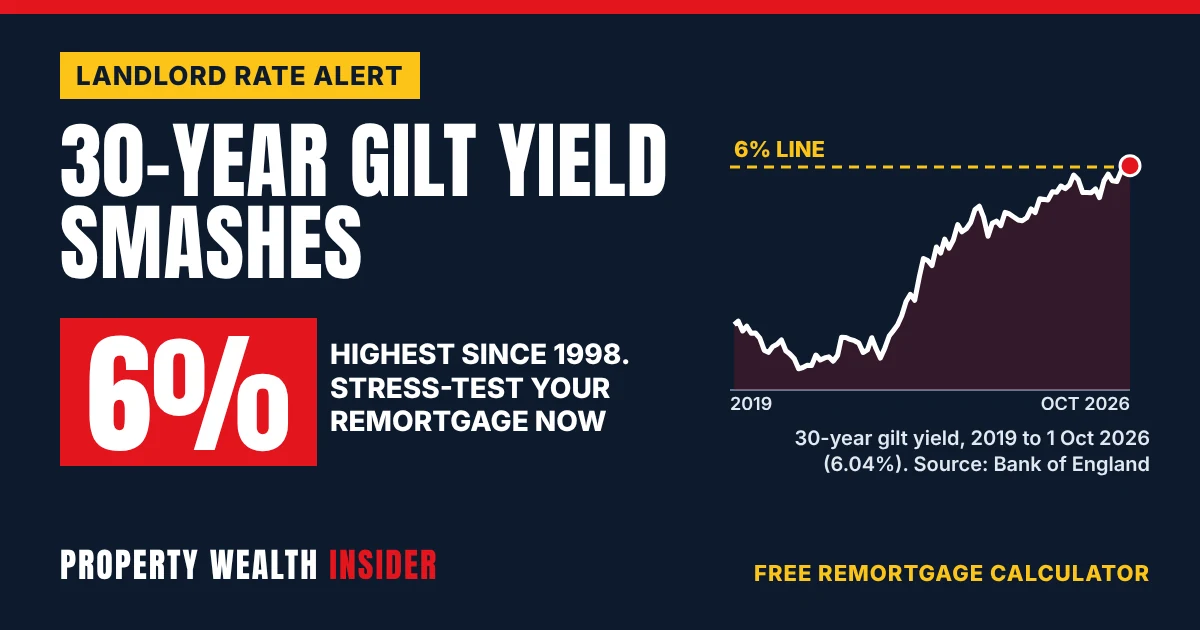
The UK government’s 30-year borrowing cost broke through 6% on Thursday 1 October 2026, a level Reuters reported had not been seen since January 1998. For landlords whose fixed-rate buy-to-let deals end in the next year or two, it is a loud warning that cheap refinancing is not coming back any time soon.
The move came while Bank Rate sat unchanged at 3.75%. That gap is the point: the price of long-term money is being set by bond markets, not just by the Bank of England, and lenders price fixed-rate mortgages off those markets.
Below we explain what actually moved, how it feeds through to buy-to-let pricing, what a remortgage could do to your monthly payment and your rental cover, and a calculator to stress-test your own figures before your fix runs out.
Key facts
- The 30-year gilt yield rose to about 6.03% on 1 October 2026, the highest since January 1998, according to Reuters (LSEG data).
- The Bank of England’s own estimated 30-year nominal spot yield for 1 October 2026 was 6.04%; the 10-year was 5.42%.
- Bank Rate is 3.75%, unchanged since 18 December 2025 and held again on 17 September 2026. The next decision is on 5 November 2026.
- The Bank of England’s estimated 2-year SONIA (OIS) rate was 4.54% on 1 October 2026, up from 3.71% a year earlier. This is the kind of short-term market rate that 2-year fixes are priced from.
- Regulator’s rules: lenders must test buy-to-let affordability at a minimum interest rate of 5.5% (unless the fix is 5 years or longer), with 125% rental cover described as the industry standard.
What happened to gilt yields
Gilts are the bonds the government sells to borrow money. When investors demand a higher return to hold them, the yield rises. On 1 October the 30-year yield climbed to roughly 6.03%, while the 10-year reached about 5.51%, its highest since July 2007, Reuters reported.
Reuters linked the sell-off to rising US Treasury yields, inflation worries tied to energy prices and the Middle East conflict, and markets starting to price in possible Bank of England rate rises. This was not a one-day blip. On the Bank of England’s measure the 30-year yield had already touched 6.02% on 15 September, and it has risen in most months of 2026.
The Bank of England’s own yield curve data tells the same story. Its estimated 30-year spot yield was 5.31% at the end of 2025 and 6.04% on 1 October 2026. Back at the end of 2020 it was 0.78%. That is the backdrop to every five-year fix taken out in the cheap-money years now coming up for renewal.
Why a 30-year gilt matters to your buy-to-let
Your mortgage is not priced directly off a 30-year gilt. Lenders fund fixed-rate deals mainly using swap rates of a similar length, so 2-year and 5-year rates matter most. But long gilt yields are the clearest signal of what markets think borrowing will cost over the years ahead, and short and long rates have been rising together.
The Bank of England’s estimate of the 2-year SONIA overnight index swap (OIS) rate was 4.54% on 1 October 2026, against 4.40% on 1 September and 3.71% on 1 October 2025. The 5-year equivalent was 4.65%. With Bank Rate at 3.75%, markets are pricing in rates that stay higher for longer, not cuts.
For context, the Bank of England’s quoted rate for a residential 2-year fix at 75% loan-to-value was 4.92% in August 2026, and 4.78% for a 5-year fix. Buy-to-let deals are a separate market with their own pricing and fees, so check real quotes for your loan, but those figures show where mainstream fixed pricing sat before the latest jump.
The Bank Rate timetable: 3.75% since 18 December 2025. Held on 17 September 2026. Remaining 2026 announcements: 5 November and 17 December. A hold does not mean fixed rates stay put: swap rates move every day.
What a higher rate does to your payments
The rates below are illustrations, not quotes. They show how quickly costs rise on a typical loan when a cheap fix ends.
Example 1: interest-only, £200,000. On a 3% fix the interest is £500 a month. Remortgage at 5.5% and it becomes £917 a month: an extra £417 a month, or £5,000 a year, on one property.
Example 2: repayment, £150,000 with 20 years left. At 2% the payment is about £759 a month. At 5% it is about £990, an extra £231 a month or roughly £2,773 a year.
If you own in your own name, the hit is bigger after tax. Mortgage interest on residential lets no longer comes off your rental profit; you get a tax reduction at the basic rate instead. In Example 1 a higher-rate taxpayer would get relief of about £1,000 on the extra £5,000 of interest, so most of the rise comes out of taxed income.
| New rate | Interest-only, per month (£200k) | Repayment, 25 yrs, per month (£200k) | Rent needed for 125% cover | Rent needed for 160% cover |
|---|---|---|---|---|
| 3.0% | £500 | £948 | £625 | £800 |
| 4.5% | £750 | £1,112 | £938 | £1,200 |
| 5.0% | £833 | £1,169 | £1,042 | £1,333 |
| 5.5% | £917 | £1,228 | £1,146 | £1,467 |
| 6.0% | £1,000 | £1,289 | £1,250 | £1,600 |
| 6.5% | £1,083 | £1,350 | £1,354 | £1,733 |
Rent needed is monthly rent at that interest rate on an interest-only basis, which is how rental cover is calculated. The 160% column is one named lender’s test for higher-rate taxpayers (see below).
Will you still pass the rental cover test?
Higher payments hurt cash flow. A failed rental cover test is worse: it can cap how much you can borrow when you switch lender, and force you to put cash in or stay put.
The Prudential Regulation Authority’s supervisory statement SS13/16, which applies to buy-to-let lenders across the UK, says lenders should assume a rate rise of at least 2 percentage points and a minimum borrower rate of 5.5%, unless the rate is fixed for five years or more. It describes a 125% interest cover ratio (ICR) as the industry standard.
Individual lenders set their own tests on top. Nationwide’s buy-to-let arm, The Mortgage Works, publishes its criteria: 125% for lower-rate taxpayers (with income and portfolio limits), 160% for higher-rate taxpayers, and stress rates that depend on the deal. A like-for-like remortgage above 65% LTV is tested at 4.5% or the pay rate, whichever is higher; a 2-year fix used to raise capital is tested at 5.5% or pay rate plus 2%.
That last point is the trap. Once pay rates themselves are around 5% or more, “whichever is higher” means the test rate rises with the market.
Worked example: £200,000 interest-only, rent £1,100 a month (£13,200 a year). At a 5.5% test rate the annual interest is £11,000, so cover is 120%, short of 125%. The most this rent supports at 125% and 5.5% is £192,000, so you would need to find about £8,000 to borrow from a lender using that test.
Remortgage shock calculator
Enter your own loan and the rate you have been quoted (or a rate you want to test). The calculator shows the change in your payment and checks your rental cover against the test you choose.
Remortgage shock calculator
Guide only, not financial advice. Rental cover is rent divided by interest, tested at the higher of the stress rate and your new rate. Lenders’ tests, fees and rent assessments differ; get a full quote before you decide.
What to do now: a step-by-step plan
- List every fix end date. Put each property’s balance, rate, end date and early repayment charge in one sheet. Anything ending within 12 months is your priority.
- Run each loan through the calculator at three rates: your best current quote, that quote plus 1%, and 6%. If a property only works at the lowest, you have a problem to solve now, not on the day the fix ends.
- Check rental cover, not just cash flow. If cover falls below 125% at the stress rate, a new lender may lend less. Ask your existing lender whether a product transfer involves a fresh affordability test.
- Ask about securing a rate early. Find out how far ahead of your end date your lender, or a new one, will let you lock in a deal, what it costs, and whether you can switch if rates fall before completion.
- Compare 2-year and 5-year fixes on the stress test, not just the rate. Under the regulator’s rules a fix of five years or more can be tested at the pay rate rather than the 5.5% floor, which can help a tight property pass.
- Review rent against the market within the rules for your nation and tenancy type. Rent increase procedures differ in England, Wales, Scotland and Northern Ireland.
- Build a cash buffer for the rate change and, if you own personally, the extra tax from the basic-rate cap on interest relief.
- Fix end dates and early repayment charges listed for every property
- Payments tested at current quote, quote +1% and 6%
- Rental cover checked at the lender’s stress rate (125% or higher)
- Product transfer offer requested from current lender
- 2-year vs 5-year fix compared, including fees
- Rent reviewed against local market and the rules for your nation
- Cash buffer set aside for higher payments and tax
- Diary note for the next Bank Rate decision: 5 November 2026
FAQs
Why are gilt yields rising if the Bank of England has not raised rates?
Gilt yields reflect what investors expect over the life of the bond, including inflation and future Bank Rate. Reuters linked the latest rise to higher US yields, energy-driven inflation worries and markets pricing in possible rate rises later this year.
Will buy-to-let mortgage rates go up because of the 30-year gilt?
Not directly. Fixed rates track swap rates of a similar length, mainly 2 and 5 years. Those have risen too: the Bank of England’s estimated 2-year SONIA rate was 4.54% on 1 October 2026, up from 3.71% a year earlier, which puts upward pressure on new fixes.
What is the buy-to-let stress test rate in 2026?
Under PRA rules lenders must assume at least 5.5%, or a 2-point rise, for fixes shorter than five years. Lenders set their own rates on top; The Mortgage Works, for example, tests at between 4% and 5.5% depending on the deal, or the pay rate (plus 2 points on some deals) if that is higher.
What is a good interest cover ratio for buy-to-let?
The regulator describes 125% as the industry standard minimum, meaning rent must be at least 1.25 times the mortgage interest at the test rate. Higher-rate taxpayers often face tougher tests; one major lender uses 160%.
When is the next Bank of England interest rate decision?
Thursday 5 November 2026, followed by 17 December 2026. Bank Rate is currently 3.75%.
Sources
- Bank of England: UK yield curves (nominal and OIS data)
- Bank of England: Interactive database (Bank Rate, quoted mortgage rates IUMBV34, IUMBV42)
- Bank of England: Bank Rate
- Bank of England: MPC dates
- PRA: SS13/16 Underwriting standards for buy-to-let mortgage contracts
- The Mortgage Works: income and rental calculation criteria
- GOV.UK: Changes to tax relief for residential landlords
- Reuters: UK 30-year gilt yields top 6% for first time since 1998
This article is news and general guidance only, not financial, legal or tax advice.