Licence fee rip-off? Minister says councils must not profit
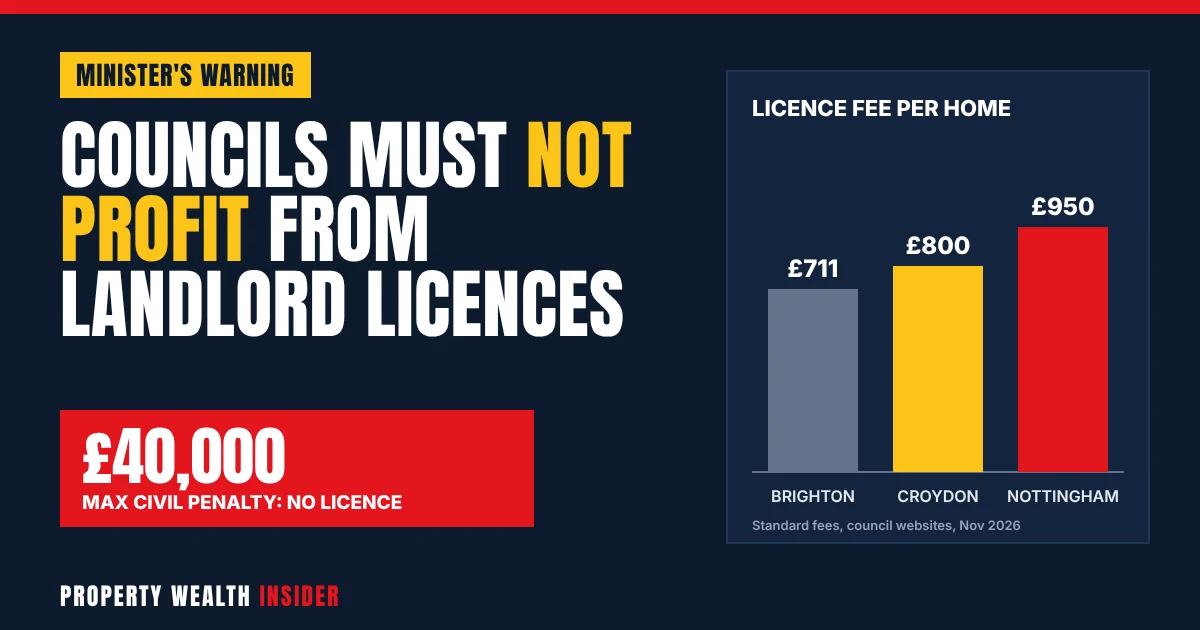
Councils in England have been told in writing that they are not meant to make money out of landlord licensing. Housing Minister Matthew Pennycook said on 5 November 2026 that licence fees should cover the cost of running a scheme, and that councils should publish both the fee and how they worked it out.
That matters because selective licensing now costs many landlords £700 to £1,300 per property, and councils no longer need Whitehall sign-off to launch a scheme of any size. The fines for getting it wrong also went up this year.
Below: what the minister said, what the law lets councils charge, real fees from three councils, and a calculator showing your licence’s true monthly cost. England only.
Key facts
- Minister’s answer published 5 November 2026 to written questions 20082 and 20083: councils are “not expected to profit from licensing”.
- Licence fees can cover the cost of running a scheme, under section 87 of the Housing Act 2004.
- Real standard fees: Brighton & Hove £711, Croydon £800, Nottingham £950 per property.
- Since 23 December 2024, councils need no Secretary of State approval for a scheme of any size.
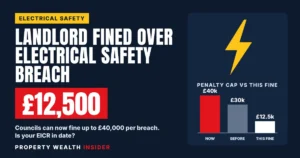
- Civil penalty for an unlicensed property rose from £30,000 to up to £40,000 for conduct from 1 May 2026.
- Rent repayment orders can now claw back up to 2 years’ rent, up from 12 months.
What the minister said
Conservative MP Sir James Cleverly (Braintree) tabled two written questions on 28 August 2026. One asked what guidance councils have on enforcing selective licensing, including fines. The other asked whether the government had compared the costs and outcomes of selective licensing.
Pennycook gave the same answer to both on 5 November 2026. He pointed to the government’s revised civil penalties guidance, then said licensing schemes are designed locally and councils can set fees that cover the cost of running them. Councils are “not expected to profit from licensing”, and should make their fees and the reasoning behind them transparent and easy to find.
Be clear about what this is. It is a written answer, not new law or new guidance. It does not cap fees, order refunds or change any scheme. What it does give you is a clear statement from the minister that you can quote when a council’s fee looks high or its workings are hard to find.
The answer also lands as schemes are getting easier to launch. Under the government’s General Approval 2024, councils in England have not needed the Secretary of State’s confirmation for a selective licensing scheme of any size since 23 December 2024. They must still meet the legal tests, consult for at least 10 weeks, and the consultation should set out the proposed fees. A designation can last up to 5 years.
What the law lets councils charge
Selective licensing sits in Part 3 of the Housing Act 2004. Section 87 lets a council require a fee with each application. When it sets that fee, it can take into account all the costs of carrying out its functions under Part 3, in other words running the licensing scheme, plus some related housing management costs.
So “cover the cost” covers a lot: processing, inspections, compliance work and admin. What a fee should not do is generate a surplus to spend on other things.
The courts have also limited when councils can take the money. In Hemming v Westminster (Supreme Court, 19 July 2017), a sex shop licensing case, the council could include enforcement costs in its fee, but only from applicants who were actually granted a licence. In R (Gaskin) v Richmond upon Thames (High Court, 31 July 2018), the court applied that reasoning to HMO licensing. It ruled that a council could not demand an upfront application fee that included management and enforcement costs.
That is why most councils now split fees in two:
- Part A is paid when you apply and covers processing the application. It is usually non-refundable.
- Part B is paid only once the council decides to grant the licence, and covers running and enforcing the scheme.
The Provision of Services Regulations 2009 also require charges under authorisation schemes to be reasonable and proportionate, and not to exceed the cost of the procedures involved. A rewritten version of regulation 18(4) took effect on 1 October 2026. It says application charges must relate only to the cost of deciding that application.
Real licence fees from three councils
We checked the fees for a standard single-let property on three councils’ own websites on 11 November 2026.
| Council | Part A (on application) | Part B (on approval) | Standard total | Discounts / extras |
|---|---|---|---|---|
| Brighton & Hove | Split not published on fees page | £711 | £807 late fee; £75 off each for accreditation, energy efficiency, charitable status (max two) | |
| Croydon (2026 scheme, 14 wards) | £480 | £320 | £800 | £100 off if accredited; £50 off for EPC B or above |
| Nottingham (accredited) | £290 | £469 | £759 | DASH, Unipol or ANUK accreditation |
| Nottingham (standard) | £290 | £660 | £950 | Fees from 1 April 2026 |
| Nottingham (less compliant) | £290 | £1,028 | £1,318 | Applies where fee policy criteria are met |
Notice that Nottingham’s Part A is only £290 while Croydon’s is £480. Part A is meant to cover processing the application, so a big gap there is a fair thing to ask your council about.
Calculator: the true cost of your licence
A headline fee of £950 sounds painful, but it covers several years. Enter your council’s fee, how long your licence lasts and your rent to see the real cost per month and the effect on your gross yield. The defaults use Nottingham’s standard fee.
Licence fee true cost calculator
Guide only. It spreads the fee evenly over the licence term and ignores discounts, tax relief and penalties. It is not financial or legal advice; check the exact fee and licence length with your council.
Worked example 1: one house in Nottingham
Standard fee £950 (£290 + £660), licence for 5 years, rent £850 a month (£10,200 a year), property worth £160,000.
- Cost per year: £950 ÷ 5 = £190, or about £15.83 a month.
- Share of rent: £190 ÷ £10,200 = 1.86%.
- Gross yield: 6.38% before, 6.26% after, a drop of about 0.12 percentage points.
If you get accredited, the fee falls to £759. That saves £191 over the licence, or about £38 a year.
Worked example 2: four flats in Croydon
Four separate flats in the scheme area at £800 each comes to £3,200, with £1,920 of Part A fees due when you apply. Over 5 years that is £640 a year. On rents of £1,500 a month per flat (£72,000 a year in total), the fees take 0.89% of your rent. Accreditation would save £100 per flat, or £400 in total.
The price of not licensing
Disputing a fee does not mean you can skip the licence. Letting a property that needs a selective licence without one is an offence under section 95 of the Housing Act 2004, and the Renters’ Rights Act 2025 raised the stakes from 1 May 2026.
| Sanction | Before 1 May 2026 | Conduct from 1 May 2026 |
|---|---|---|
| Civil penalty (instead of prosecution) | Up to £30,000 | Up to £40,000 |
| Starting point in MHCLG guidance for an unlicensed selective licensing property | £12,000, adjusted up or down by the council | |
| Prosecution | Unlimited fine | Unlimited fine |
| Rent repayment order | Up to 12 months’ rent | Up to 2 years’ rent |
A council can either prosecute or issue a civil penalty for the same offence, not both. The higher £40,000 maximum does not apply to conduct before 1 May 2026, and the new rent repayment rules do not reach back to rent periods before that date.
Put that against example 1. Skipping a £950 licence could mean a penalty starting at £12,000 under government guidance, plus a rent repayment order of up to 24 × £850 = £20,400. That is more than 30 times the cost of the licence.
Is your council’s fee transparent?
The minister expects councils to publish their fees and the reasoning behind them where landlords can easily find them. Use this checklist on your council’s licensing pages. Print it and tick it off.
- The full fee is published, including any late or less-compliant rates.
- The fee is split into Part A (application) and Part B (on approval), with what each covers.
- There is a fee policy or cabinet report explaining how the fee was calculated.
- The council says whether licence income is ring-fenced for running the scheme.
- Discounts (accreditation, EPC, multiple flats) and how to claim them are clearly set out.
- The refund policy is published, including what happens to Part A if you are refused.
- The consultation, which should have set out the proposed fees, is still available to read.
- The scheme’s start date, end date and licence length are clear.
If several of those are missing, ask the council in writing for its fee calculation. If you get no answer, a Freedom of Information request for the scheme’s income and costs is free.
What to do now
- Check every address. Use your council’s licensing map or postcode checker. Many schemes cover selected wards, not whole boroughs.
- Apply before you are chased. Late fees and less-compliant rates can add hundreds of pounds, and some discounts are lost once the council has written to you.
- Claim every discount. Accreditation and a good EPC each knock money off at the councils we checked.
- Run your numbers in the calculator above so you know the real monthly cost and can budget for it.
- Test the fee’s transparency using the checklist. If it fails, ask for the fee calculation and quote the minister’s 5 November 2026 answer.
- Respond to consultations. New schemes must be consulted on for at least 10 weeks, with fees set out. That is the best time to challenge the cost.
FAQ
Can councils make a profit from selective licensing fees?
No. The Housing Minister said on 5 November 2026 that councils can charge fees covering the cost of running a scheme, but are not expected to profit. The Housing Act 2004 limits fees to the costs of licensing functions.
How much does a selective licence cost?
It depends on the council. Standard fees we checked were £711 in Brighton & Hove, £800 in Croydon and £950 in Nottingham, with discounts for accredited landlords. A licence lasts up to 5 years.
Why is the licence fee paid in two parts?
Court rulings found that councils cannot demand the costs of running and enforcing a scheme upfront with the application. So Part A covers processing and Part B, covering the wider scheme costs, is only charged once the licence is going to be granted.
What is the fine for not having a selective licence?
For conduct from 1 May 2026, councils in England can issue a civil penalty of up to £40,000 or prosecute, where the fine is unlimited. Tenants or the council can also seek a rent repayment order of up to 2 years’ rent.
Do councils still need government approval for selective licensing?
No. Since 23 December 2024, councils in England can introduce a scheme of any size without Secretary of State confirmation, as long as they meet the legal conditions and consult for at least 10 weeks.
Sources
- UK Parliament: written question 20083, answered 5 November 2026
- UK Parliament: written question 20082, answered 5 November 2026
- Housing Act 2004, section 87 (licence applications and fees)
- Housing Act 2004, section 95 (offences)
- Housing Act 2004, section 249A (financial penalties)
- Financial Penalties (Housing Offences and Breach of Banning Orders) Regulations 2026
- Housing and Planning Act 2016, section 44 (rent repayment orders)
- Renters’ Rights Act 2025 (Commencement No. 2) Regulations 2026, regulation 11
- MHCLG: Civil penalties under the Renters’ Rights Act 2025 and other housing legislation
- MHCLG: Selective licensing in the private rented sector, a guide for local authorities
- Provision of Services Regulations 2009, regulation 18
- Provision of Services (Amendment and Transitional Provision) Regulations 2026
- R (Hemming) v Westminster City Council [2017] UKSC 50
- R (Gaskin) v Richmond upon Thames LBC [2018] EWHC 1996 (Admin)
- Croydon Council: selective licence fees and discounts
- Nottingham City Council: selective licensing
- Brighton & Hove City Council: selective licence fees, discounts and exemptions
This article is news and general guidance only, not financial, legal or tax advice.