MTD deadline Saturday: landlords over £50k must file by 7 Nov
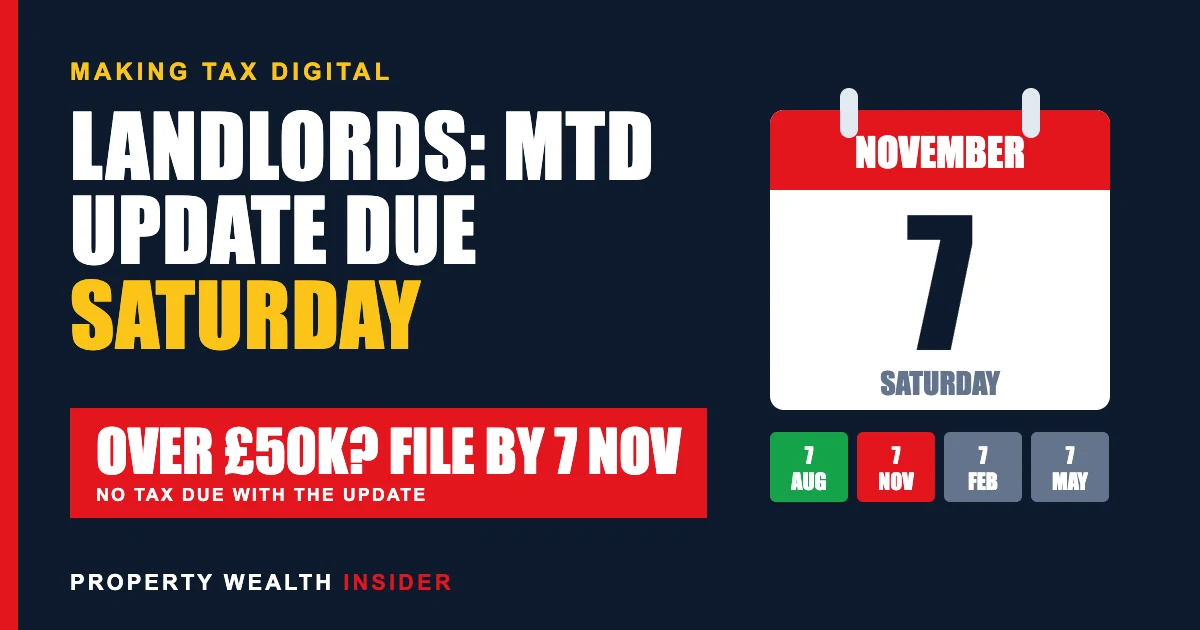
Landlords and sole traders with more than £50,000 of qualifying income have until Saturday 7 November 2026 to send HMRC their second Making Tax Digital quarterly update. It is the second deadline of the first year of compulsory MTD for Income Tax, and there is no tax to pay with it.
HMRC published a “five things you need to know” release on 2 November 2026 to tackle the myths it keeps hearing: that an update is a tax return, that a mistake means resubmitting, and that a Saturday deadline really means Friday. It is also opening the Self Assessment helpline from 9am to 3pm on deadline day.
If you are in, the job is quick. If you are not sure whether you are in, or you are one of the 1,077,000 extra people HMRC expects to bring in from April 2027, read on: we explain who counts, what late updates really cost, and give you a checker that counts down to your next deadline.
Key facts
- Second quarterly update due by Saturday 7 November 2026. You can still send it on the day itself.
- Applies now to sole traders and landlords with qualifying income over £50,000 (based on the 2024-25 tax return).
- Qualifying income is gross rent plus self-employment turnover, before expenses. Joint landlords count only their share.
- No penalty points for late quarterly updates in 2026-27. From 2027-28 it is one point per missed deadline, and 4 points = £200.
- Threshold falls to £30,000 from 6 April 2027 and £20,000 from 6 April 2028.
- The 2026-27 tax return, sent from MTD software, is due by 31 January 2028.
What you have to send by 7 November
A quarterly update is a summary of your income and expenses, sent from HMRC-recognised software. It gives a total for each category, such as rent received, repairs or insurance. It does not list individual receipts or invoices.
The figures are cumulative. This update covers the new quarter to 5 October, but HMRC’s guidance says you send year-to-date totals from 6 April. That is why fixing an old error is so simple, as we explain below. If you had no income or expenses in the period, you still have to send an update.
| Update | Standard period (tax year) | Calendar period (if elected) | Deadline |
|---|---|---|---|
| 1st | 6 April to 5 July 2026 | 1 April to 30 June 2026 | 7 August 2026 |
| 2nd (now) | 6 April to 5 October 2026 | 1 April to 30 September 2026 | 7 November 2026 |
| 3rd | 6 April 2026 to 5 January 2027 | 1 April to 31 December 2026 | 7 February 2027 |
| 4th | 6 April 2026 to 5 April 2027 | 1 April 2026 to 31 March 2027 | 7 May 2027 |
| Tax return | Whole 2026-27 tax year, sent from MTD software | 31 January 2028 | |
Calendar periods are for people whose accounts run from 1 April to 31 March. The deadlines are the same either way. You can only switch to calendar periods before you send the first update of a tax year, so that choice is fixed for 2026-27.
Five myths HMRC wants to kill off
- “It’s a tax return.” No. An update includes no tax calculation and no payment. Your overall tax position is only worked out when you submit the 2026-27 return.
- “I need to ring HMRC to check my August update arrived.” No. Your submission history is in your HMRC online account and in your MTD software. You don’t need to phone or use webchat.
- “I need expensive accounting software.” No. Recognised options include simple packages for landlords, some free products, and bridging software that links your existing spreadsheet to HMRC.
- “A mistake means resending my last update.” No. Correct the digital record as soon as you can and the fix goes into your next update. The exception is your fourth update, which you may need to resend to correct errors, add joint property expenses or record Rent a Room income.
- “A Saturday deadline means Friday.” No. You can submit on 7 November itself. HMRC still wants people to file early and to call during the week, when its full phone service is open.
Deadline-day help: the Self Assessment helpline (0300 200 3310) takes quarterly update calls from 9am to 3pm on Saturday 7 November. Agents can use the same number, because the Agent Dedicated Line is closed that day.
Are you in? Qualifying income explained
The test uses qualifying income. That is your gross self-employment turnover plus your gross property income, before any expenses. It is not profit. HMRC takes the figure from your Self Assessment return for an earlier tax year. Your 2024-25 return decided whether you had to start in April 2026.
Some income doesn’t count: PAYE wages, dividends (including from your own company), pensions and your share of partnership profits. For jointly owned property, only your share of the rent counts. MTD is part of HMRC’s Income Tax system, not devolved housing law, so it isn’t limited to England. If you are UK resident, your UK and overseas rental income both count. If you are not UK resident, only UK property income and self-employment income declared on your UK return count.
| Qualifying income over | Measured on | MTD starts | First quarterly deadline |
|---|---|---|---|
| £50,000 | 2024-25 return | 6 April 2026 | 7 August 2026 |
| £30,000 | 2025-26 tax year | 6 April 2027 | 7 August 2027 |
| £20,000 | 2026-27 tax year | 6 April 2028 | 7 August 2028 |
Worked examples
- Mixed income: £38,000 rent plus £15,000 from a sole-trader side business gives £53,000 of qualifying income. That is over £50,000, so this person has been in MTD since April 2026 and must file by Saturday.
- Gross, not profit: A landlord collects £48,000 in rent but makes £14,000 profit after mortgage interest, agent fees and repairs. Qualifying income is £48,000, not £14,000. They are under £50,000, so they are not in this year. If 2025-26 rent is similar, they are well over £30,000 and will start on 6 April 2027.
- Joint owners: A couple share a portfolio 50/50 that brings in £64,000 a year. Each has £32,000 of qualifying income, so neither is in for 2026. Both will be in from April 2027 if 2025-26 is similar.
What a missed update really costs
For the 2026-27 tax year, HMRC will not give penalty points for late quarterly updates. That covers 7 August, 7 November, 7 February and 7 May. Late tax returns still get points. This is a grace year, not an exemption, because the updates are still a legal requirement.
From 2027-28 the points system applies in full. Each missed quarterly deadline earns one point, and so does a late tax return. You only get one point per deadline, even if you run several businesses. At 4 points you are charged a £200 penalty, and another £200 for every deadline you miss after that.
Worked example: In 2027-28 a landlord misses the August, November and February updates. That is 3 points and no charge yet. They also miss 7 May 2028. That is the 4th point and a £200 penalty. If the 2027-28 return then goes in after 31 January 2029, that is another £200, or £400 in total.
Points below the threshold drop off automatically 24 months after the missed deadline. Once you reach the threshold, they stay until you have filed every update and return on time for 12 months and sent anything outstanding from the previous 24 months.
MTD checker and deadline planner
Enter your gross figures (your share for joint lets) and the tax year they relate to. The tool tells you whether and when MTD applies, counts down to your next quarterly deadline from today’s date, and shows the penalty points you would build up in a full year where points apply.
MTD checker & deadline planner
Guide only, not tax advice. It assumes you start the year with no penalty points and that HMRC uses the figures you enter. HMRC confirms your start date in writing, and some exemptions can override the result.
What to do before Saturday
- Check your August update went through. Look at the submission history in your HMRC online account or your software. There is no need to call.
- Bring your records up to date to 5 October (or 30 September if you use calendar periods). Record every rent receipt and expense in your software or bridged spreadsheet.
- Fix any errors in the records now. The corrected totals go into this update automatically, because the figures run from 6 April.
- Joint owners: enter only your share of the rent and, where your software supports it, your share of the costs.
- Submit early. If you get stuck, call during the week. If you have to, call the Self Assessment helpline between 9am and 3pm on Saturday 7 November.
- Put 7 February 2027 in your diary for update three. If you are near £30,000, check your 2025-26 figures now so you are ready for April 2027.
- Logged in to HMRC online account or MTD software and confirmed the August update was received
- All rent received from 6 April to 5 October 2026 recorded
- All allowable expenses for the same period recorded by category
- Joint property income entered at my share only
- Spreadsheet users: bridging software linked and tested
- Any known errors corrected in the digital records
- Agent authorised (if using one) and told the deadline
- Update submitted, and submission reference or history checked
- 7 February 2027 and 7 May 2027 deadlines in the calendar
If you think you shouldn’t be in MTD at all, look at the exemptions. Some are automatic, such as qualifying income of £20,000 or less. Others you have to apply for. The main one is being digitally excluded, where using software isn’t reasonable because of age, health, disability, religious belief or lack of internet access. Not liking software or the cost of it doesn’t count. Exempt or not, you still file a Self Assessment return.
FAQs
Do I have to pay tax when I send my MTD quarterly update?
No. A quarterly update has no tax calculation and no payment. MTD doesn’t change how you pay Self Assessment tax or when payments are due.
Is the MTD deadline on Saturday 7 November or Friday 6 November?
Saturday 7 November 2026. You can submit on the day, and the Self Assessment helpline is open from 9am to 3pm for quarterly update questions.
What happens if I miss the MTD quarterly deadline in 2026?
For 2026-27, HMRC will not give penalty points for late quarterly updates, but you still need to send them. From 2027-28 each missed deadline earns a point, and 4 points brings a £200 penalty.
Does MTD use my rental profit or my total rent?
Your total rent. Qualifying income is gross property and self-employment income before expenses. Joint owners count only their own share.
I made a mistake in my first update. Do I need to resubmit it?
No. Correct the digital record and the fix appears in your next update, because updates show year-to-date totals. You may need to resend the fourth update of the year to make some corrections.
When does Making Tax Digital start for landlords earning over £30,000?
On 6 April 2027, based on qualifying income over £30,000 in 2025-26. The first quarterly update is due 7 August 2027. The £20,000 threshold follows from 6 April 2028.
Sources
- HMRC: Five things you need to know ahead of Making Tax Digital for Income Tax quarterly deadline (2 November 2026)
- GOV.UK: Use Making Tax Digital for Income Tax – send quarterly updates
- GOV.UK: Penalties for Making Tax Digital for Income Tax
- GOV.UK: Work out your qualifying income for Making Tax Digital for Income Tax
- GOV.UK: Find out if and when you need to use Making Tax Digital for Income Tax
- GOV.UK: Find out if you can get an exemption from Making Tax Digital for Income Tax
- GOV.UK: Use Making Tax Digital for Income Tax – submit your tax return
- HMRC: MTD for Income Tax dates you need to know
- HMRC: Act now – 864,000 sole traders and landlords face new tax rules (5 February 2026)
- HMRC: 436,000 sole traders and landlords make their tax digital (12 August 2026)
- HMRC: Sole traders and landlords earning more than £30,000 urged to act now (5 October 2026)
This article is news and general guidance, not financial, legal or tax advice. Check your own position with HMRC or a qualified adviser.