Landlord register: £65 fee is VAT-free, first bill from £5.34
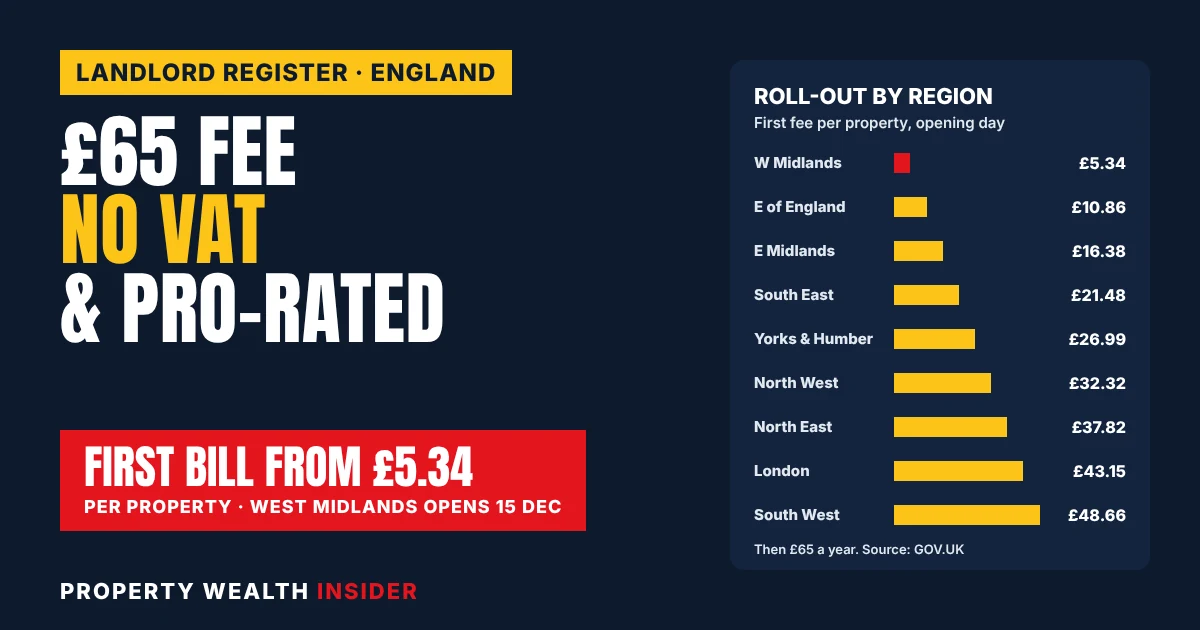
The government has confirmed that the new landlord register fee of £65 per property will not carry VAT, and has explained how the first bill will be cut during the roll-out. For many landlords the first payment will be a few pounds, not £65.
Housing minister Matthew Pennycook set this out in a written parliamentary answer published on 17 November 2026. He also said which units count as separate registrations: every privately rented flat in a block needs its own entry, but the rooms in an HMO do not. Registration opens in the West Midlands on 15 December 2026, and the rest of England follows region by region until November 2027.
The rules apply to private landlords in England with properties let on assured or regulated tenancies. Below we explain the exact pro-rating formula, what each region will pay first, what counts as one registration, the £7,000 and £40,000 penalties, and what to get ready now. There’s also a calculator to work out your own bill.
Key facts
- The annual fee is £65 per property, with no VAT (confirmed in written answer UIN 33524, 17 November 2026).
- Days before 15 November 2027 are not charged. A West Midlands landlord registering on 15 December 2026 pays just £5.34 per property at first.
- Each privately rented flat in a block is a separate registration. A licensed HMO is one registration, not one per room.
- The roll-out runs region by region from 15 December 2026 (West Midlands) to 14 November 2027 (South West deadline).
- Failing to register can bring a penalty of up to £7,000. Knowingly or recklessly giving false information can bring up to £40,000.
What the minister confirmed
Mr Pennycook gave the same answer to seven written questions from MPs, including UIN 33524 from Liberal Democrat Gideon Amos. The questions were tabled on 9 October 2026 and answered on 17 November 2026. Four points in the answer are new:
- No VAT. The £65 is the whole fee, not £65 plus 20%.
- Pro-rating. Fees will be reduced during the roll-out of the “Register your rental property” service so that people who register first do not pay more.
- Flats and HMOs. Where a whole building is made up of privately rented units, each unit is a separate dwelling and needs its own registration. Individual rooms in an HMO do not.
- No impact assessment yet. None was produced for the Private Rented Sector Database Regulations 2026 because the direct cost is below the threshold that requires one. A full impact assessment will come before the second stage of implementation.
The minister also said the fee will pay for running the service and for council staff to find and tackle landlords who don’t comply. Work has started on letting large portfolio landlords connect their property management software directly to the service, but no bulk upload tool has been promised yet.
How the pro-rated first fee works
The GOV.UK landlord guidance publishes the method. Your first fee leaves out every day before 15 November 2027. In practice, nobody pays for any time before then, whenever they register.
The formula is (£65 ÷ year length) × (days to renewal − free days), rounded down to the penny. Your renewal date is one year after you register your first property. Any property you add later moves onto that same renewal date.
Worked example 1: A Birmingham landlord registers on 15 December 2026. Renewal is 15 December 2027, 365 days away. The 335 days before 15 November 2027 are free, so 30 days are charged: £65 ÷ 365 × 30 = £5.34 per property. After that it’s £65 a year.
Worked example 2: A landlord registers on 25 June 2027. The year to renewal is 366 days (it includes 29 February 2028), and 143 days are free. That leaves 223 charged days, so the fee is £39.60 per property. Both examples come from the government’s own guidance.
Worked example 3 (our calculation): A London landlord with six flats registers on their region’s opening day, 15 July 2027. Each flat costs £43.15, so the first bill is £258.90. From July 2028 the bill is 6 × £65 = £390 a year.
| Region | Opens | Must register by | First fee per property if you register on opening day* |
|---|---|---|---|
| West Midlands | 15 Dec 2026 | 14 Mar 2027 | £5.34 |
| East of England | 15 Jan 2027 | 14 Apr 2027 | £10.86 |
| East Midlands | 15 Feb 2027 | 14 May 2027 | £16.38 |
| South East | 15 Mar 2027 | 14 Jun 2027 | £21.48 |
| Yorkshire and Humber | 15 Apr 2027 | 14 Jul 2027 | £26.99 |
| North West | 15 May 2027 | 14 Aug 2027 | £32.32 |
| North East | 15 Jun 2027 | 14 Sep 2027 | £37.82 |
| London | 15 Jul 2027 | 14 Oct 2027 | £43.15 |
| South West | 15 Aug 2027 | 14 Nov 2027 | £48.66 |
*PWI calculation using the published GOV.UK formula. Dates from GOV.UK and the Private Rented Sector Database Regulations 2026.
The table looks as though early regions get a bargain, but they don’t. Whatever date you register, the charge for each day after 15 November 2027 is the same, about 18p per property. Landlords who register earlier simply reach their first full-price renewal sooner. This is why the minister said early registrants won’t pay more. The guidance also confirms the fee is tax-deductible.
Regional roll-out: when you must register
Each region gets a three-month window. The dates are set in the Private Rented Sector Database Regulations 2026 and repeated in the GOV.UK guidance. You can register before your region opens. During the roll-out you only have to register properties that are currently let or that become let between 15 December 2026 and 14 November 2027.
To check which region you’re in, look up your property’s council. The regulations list them. For example, the West Midlands covers Birmingham, Coventry, Dudley, Herefordshire, Sandwell, Shropshire, Solihull, Staffordshire, Stoke-on-Trent, Telford and Wrekin, Walsall, Warwickshire, Wolverhampton and Worcestershire. GOV.UK also has a postcode checker.
What counts as one registration
There are two kinds of entry. Your landlord record is free. Each property record costs the £65 fee. This is how the minister’s answer and the guidance apply to common set-ups:
| Your set-up | Property registrations (fee-paying) | Annual fee once at full rate |
|---|---|---|
| One house let to a family | 1 | £65 |
| Block of 12 flats, all privately rented | 12 (each flat is a separate dwelling) | £780 |
| Licensed 6-bed HMO let room by room | 1 (rooms are not registered individually) | £65 |
| House owned jointly by a couple | 1 property, but each joint landlord needs a landlord record (free) | £65 |
| Your landlord record | 0 (registering yourself and updating records is free) | £0 |
| Empty property, not let during the roll-out | 0 for now. In future, unlet homes must be registered before they’re marketed | £0 for now |
| Supported exempt accommodation | 0 (excluded by the regulations) | £0 |
The guidance says landlords with an HMO licence should make “one registration for the whole property”. If you own a converted building with self-contained flats, follow the minister’s rule that each privately rented unit is a separate dwelling. Check the GOV.UK guidance before you register if your building could be classed either way.
Calculator: your PRS Database bill
Enter your self-contained dwellings and HMOs, choose your region and the date you plan to register. The calculator uses the published GOV.UK pro-rating formula and assumes you register all your properties on the same day.
PRS Database fee calculator
Guide only, not legal or financial advice. It assumes the fee stays at £65 for five years (the government can review it) and that every property is registered on the same date. Per-property fees are rounded down to the penny, as GOV.UK specifies. The penalty shown is the statutory maximum for one penalty, which councils set case by case.
Penalties for not registering
The penalties are in sections 82, 90, 91 and 92 of the Renters’ Rights Act 2025. Your local council enforces them.
- Up to £7,000 for breaching the duty to have active landlord and dwelling entries, or the rules on marketing and advertising (section 91(2)(a)).
- Up to £40,000 for an offence under section 92. This covers knowingly or recklessly giving false or misleading information, a breach that continues more than 28 days after a penalty, or a different breach within five years of an earlier penalty.
- Repeat penalties: a council can impose a further penalty if the breach is still going on 28 days after the last one.
- Possession blocked: under section 90, a court cannot make a possession order while the landlord is in breach of the duty to register, except on Ground 7A or Ground 14 (antisocial behaviour).
- Rent repayment orders: GOV.UK says tenants can apply from 15 December 2026, but only once the registration window for their area has opened.
Compare that with the fee. One £7,000 penalty is the same as more than 100 years of the £65 fee for a single property. For a West Midlands landlord, the first payment is £5.34.
What to do now: get-ready checklist
You can register a property without its tenancy and safety details, but you must add them within 28 days or the entry may be deactivated. Gathering everything first makes registration much quicker. The regulations list what each property record needs:
- Find your region and deadline using the council list or GOV.UK postcode checker
- Count your registrations: one per self-contained dwelling and one per licensed HMO
- Have the details for your landlord record ready (organisations need their Companies House or charity number, or director/trustee details)
- A correspondence address in England or Wales (not a PO Box) and an email address
- For each property: full address, ownership type, dwelling type and number of bedrooms
- Names and emails of the freeholder, any superior landlord and your managing agent
- Number of occupants and households living there
- HMO, additional or selective licence numbers, where you have them
- Gas safety record (copy and issue date) if the property has gas
- EICR (copy and expiry date) or EIC
- Current EPC, plus any MEES exemption if the rating is below the minimum
- Rent charged and how often it’s paid, which utilities are included, and whether it’s let furnished, part-furnished or unfurnished
- If you have joint owners, decide who registers the property and invites the others
- Diarise your renewal date and the 28-day deadline for updates, such as an expiring certificate
- Now: work out your region and how many registrations you need, using the table and calculator above.
- Before your window opens: scan your certificates and put them in one folder per property. Renew anything that is about to expire.
- When you’re ready: create your free landlord record first. A property record can’t be made until it exists.
- Register each property and pay the pro-rated fee. You can register before your region opens if you prefer.
- Within 28 days: add any tenancy and safety details you left out. A letting agent can do this part for you, but you must start the registration yourself.
FAQ
Do I pay VAT on the £65 landlord database fee?
No. Both the minister’s written answer of 17 November 2026 and the GOV.UK guidance say the fee is not subject to VAT. The guidance also says it is tax-deductible.
Do I need to register each room in my HMO?
No. A licensed HMO is one registration for the whole property. You do give details of the occupants, households and HMO licence number in that one entry.
I own a block of flats. Is that one registration?
No. The minister confirmed that privately rented units in a building are individual dwellings, and each one must be registered separately at £65 a year.
When do I have to register my rental property?
By the end of your region’s three-month window. The first window is the West Midlands, which runs from 15 December 2026 to 14 March 2027. The last is the South West, from 15 August to 14 November 2027.
Does registering early cost more?
No. Every day before 15 November 2027 is excluded from the first fee, so you pay the same rate per day from that date, whenever you sign up.
Does the PRS Database apply in Wales or Scotland?
No. The “Register your rental property” service is for privately rented homes in England only.
- UK Parliament written answer UIN 33524 (Matthew Pennycook, answered 17 November 2026)
- GOV.UK: Register your rental property service, guidance for landlords
- The Private Rented Sector Database Regulations 2026
- Renters’ Rights Act 2025, section 82 (marketing, advertising and letting)
- Renters’ Rights Act 2025, section 90 (restriction on gaining possession)
- Renters’ Rights Act 2025, section 91 (financial penalties)
- Renters’ Rights Act 2025, section 92 (offences)
This article is news and general guidance, not financial, legal or tax advice.