Rents Up 3.8% — But 2027 Tax Rise Swallows 82% of It
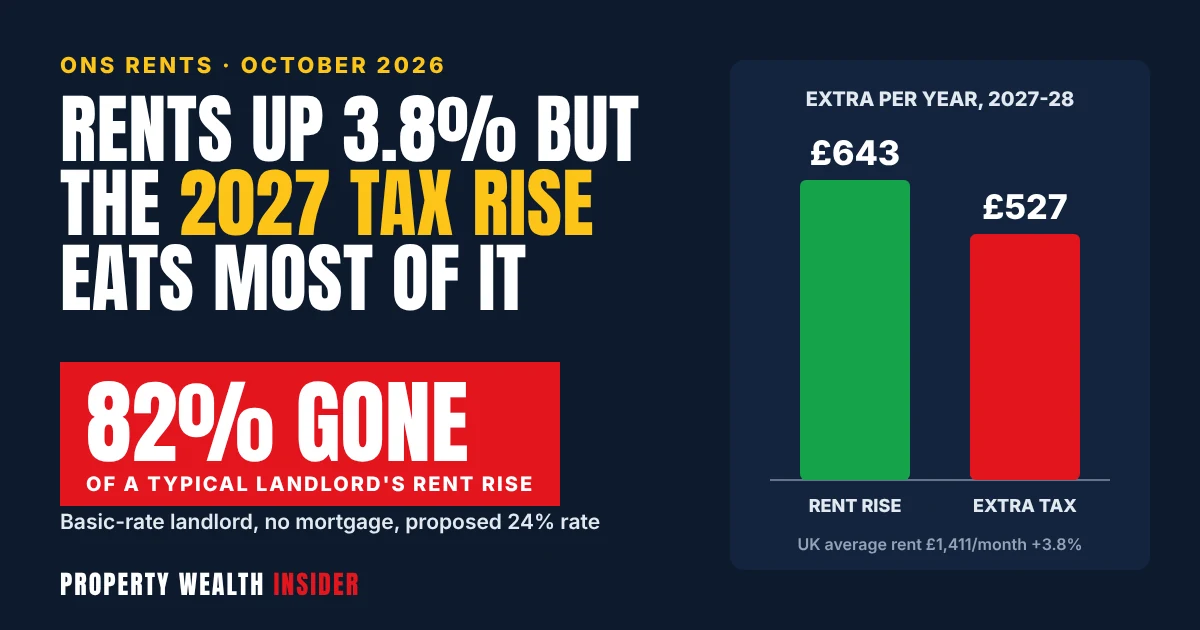
Private rents across the UK rose 3.8% in the year to October 2026, taking the average monthly rent to £1,411, according to Office for National Statistics figures published on 18 November 2026. That is only just ahead of CPI inflation, which the ONS put at 3.6% on the same day.
For landlords the bigger question is what happens next April. From 6 April 2027 rental profits get their own, higher income tax rates. Budget 2026 proposes 24%, 44% and 49%, which is 4 points above today’s 20%, 40% and 45%. We ran the numbers: a landlord with no mortgage needs a rent rise of more than 5% just to stand still after tax.
This affects individual landlords in England, Wales and Northern Ireland who let property in their own names. Limited company landlords pay corporation tax, so these rates don’t apply to them. Scottish taxpayers are outside the new UK property rates.
Key facts
- Average UK private rent: £1,411 a month in October 2026, up 3.8% on a year earlier (ONS, provisional).
- England £1,472 (+4.0%), Wales £849 (+3.9%), Scotland £1,015 (+0.7%), Northern Ireland £876 (+1.2%, August data).
- Fastest-rising English region: North West, 5.6%. Slowest: South West, 3.3%.
- CPI inflation: 3.6% in the 12 months to October 2026.
- Property income tax rates from 6 April 2027: 24% / 44% / 49% proposed at Budget 2026. The 22% / 42% / 47% rates are already law.
- On our sums, an average-rent, basic-rate landlord with no mortgage who raises rent 3.8% ends up about £141 a year worse off after tax.
What the ONS rent figures show
The ONS Price Index of Private Rents covers new and existing tenancies, so it tracks what tenants actually pay rather than asking rents on new listings. On that measure the average UK rent was £1,411 in October 2026, which is £51 a month more than a year earlier.
Annual growth was 3.8%, the same as in September. Rental inflation has stopped falling but isn’t picking up again either. With CPI at 3.6%, rents are only just ahead of prices in general.
The UK figures for the latest two months are provisional and may be revised. Northern Ireland data runs two months behind and only covers newly advertised lets, so the ONS warns against comparing it directly with England and Wales. Scotland’s data has historically been weighted towards new lets as well.
Rents by region: who is rising fastest
The North West tops the English growth table at 5.6%, just down from 5.7% in September. The South West is now the slowest English region at 3.3%, a sharp fall from 4.2% a month earlier. London rents averaged £2,350, the highest in the country. The North East was the lowest at £793.
The last two columns in the table below show what happens if a typical basic-rate landlord with no mortgage puts rent up at their region’s current pace and then pays the proposed 24% rate. Costs are assumed to be 25% of rent.
| Area | Average rent (Oct 2026) | Annual change | Extra rent a year at that pace | After-tax change, basic rate, 2027-28* |
|---|---|---|---|---|
| North East | £793 | 4.9% | £466 | -£20 |
| North West | £979 | 5.6% | £658 | +£23 |
| Yorkshire and The Humber | £872 | 4.7% | £492 | -£34 |
| East Midlands | £928 | 3.5% | £390 | -£112 |
| West Midlands | £983 | 3.7% | £436 | -£105 |
| East of England | £1,302 | 3.7% | £578 | -£139 |
| London | £2,350 | 3.8% | £1,072 | -£235 |
| South East | £1,448 | 3.9% | £678 | -£135 |
| South West | £1,254 | 3.3% | £497 | -£168 |
| England | £1,472 | 4.0% | £707 | -£127 |
| Wales | £849 | 3.9% | £397 | -£79 |
| Scotland | £1,015 | 0.7% | £85 | n/a (Scottish rates) |
| Northern Ireland (Aug) | £876 | 1.2% | £126 | -£243 |
| UK | £1,411 | 3.8% | £643 | -£141 |
*Our calculation: after-tax profit in 2027-28 at 24% compared with 2026-27 at 20%. Assumes costs of 25% of rent, no mortgage, and that all rental profit falls in the basic-rate band. Rents and growth rates: ONS.
The April 2027 property income tax rise explained
Until now rental profit has been taxed at the same income tax rates as wages. That changes from the 2027-28 tax year, which starts on 6 April 2027, when property income gets its own set of rates. The change has come in two steps.
| Band | 2026-27 (now) | 2027-28: Finance Act 2026 (law) | 2027-28: Budget 2026 (proposed) |
|---|---|---|---|
| Basic rate | 20% | 22% | 24% |
| Higher rate | 40% | 42% | 44% |
| Additional rate | 45% | 47% | 49% |
| Section 24 finance cost credit | 20% | 22% | 24% |
- Step 1, already law: Budget 2025 created separate property rates of 22%, 42% and 47% for 2027-28. These are set in section 7 of the Finance Act 2026.
- Step 2, proposed: Budget 2026 (28 October 2026) adds another 2 points, taking the rates to 24%, 44% and 49% from 6 April 2027. HMRC says this will be legislated in Finance Bill 2026-27, so it is not yet law.
- Where it applies: individuals in England, Wales and Northern Ireland. The Scottish Parliament and the Senedd now have powers to set their own property rates. Welsh property rates are built from the UK rates plus the Senedd’s Welsh rate.
- Personal allowance ordering: from April 2027 your personal allowance and other reliefs are set against wages, pensions and other income before property income. More of your rent profit may therefore fall into a taxed band.
The Section 24 detail matters more than it first looks. Mortgaged landlords can’t deduct mortgage interest from rental profit. Instead they get a tax credit at the basic rate. The Finance Act 2026 changes that credit to the property basic rate, so when the property basic rate goes up, the credit on your interest goes up with it.
In practice the extra tax is charged on rental profit after mortgage interest. A heavily geared landlord feels much less of the rise than one who owns outright. HMRC’s impact note estimates the Budget 2026 increase alone will cost affected taxpayers £225 a year on average in 2027-28.
Worked examples: who comes out ahead
All of these use the UK average rent of £1,411 a month (£16,932 a year), a 3.8% rise to £17,575 for 2027-28, and running costs of 25% of rent. Each one compares after-tax profit in 2026-27 with 2027-28 at the proposed rates.
Example 1: basic-rate landlord, no mortgage
- Profit now: £16,932 less 25% = £12,699. Tax at 20% = £2,540. Kept: £10,159.
- Profit 2027-28: £17,575 less 25% = £13,181. Tax at 24% = £3,164. Kept: £10,018.
- The rent rise brings in £643. The 4-point rate rise costs £527, which is 82% of it. The landlord ends up £141 worse off.
Example 2: higher-rate landlord, no mortgage
The extra tax is the same £527, but the higher rate takes a bigger share of everything else. After-tax profit falls from £7,619 to £7,382, so this landlord is £238 worse off.
Example 3: higher-rate landlord with £6,000 a year mortgage interest
Tax now: £12,699 at 40% = £5,080, less a 20% credit of £1,200 = £3,880. In 2027-28: £13,181 at 44% = £5,800, less a 24% credit of £1,440 = £4,360. The rate rise takes only £287 (45% of the rent rise), because the bigger interest credit offsets part of it. After-tax profit edges up from £2,819 to £2,822, so this landlord roughly breaks even.
The stand-still rent rise. With no mortgage and costs that rise in line with rent, this is how much you need to raise rent just to keep the same after-tax profit under the proposed rates: 5.3% for basic rate, 7.1% for higher rate and 7.8% for additional rate. Under the rates already in law (22/42/47) the figures would be 2.6%, 3.4% and 3.8%. Of the regions, only the North West’s 5.6% currently clears the basic-rate bar.
Calculator: will the tax rise eat your rent rise?
Pick your region to load the ONS average, or type in your own rent. Then add your costs, mortgage interest and tax band.
Will the 2027 tax rise eat your rent rise?
This is a guide only, not tax advice. It assumes all rental profit stays in one tax band, running costs rise in line with rent, and the Section 24 credit is the property basic rate multiplied by the lower of your interest and your profit. It ignores the personal allowance, losses, Scottish taxpayers and any Senedd variation. Speak to a qualified accountant before acting.
House prices: London slides, the North East leads
The same release shows the average UK house price was £273,000 in September 2026, up 1.2% on a year earlier. Prices rose 0.8% in England to £293,000, 1.8% in Wales to £215,000 and 2.3% in Scotland to £198,000.
London was the weakest region, down 3.5% in a year. Inner London fell 7.2%, its biggest annual drop since August 2009, as London flat prices fell for a 14th month in a row. At the other end, the North East rose 4.6%.
Put the two releases together and northern landlords are in the best position: rents are growing fastest there and capital values are still rising. Owners of London flats get neither, with prices falling and rent growth below the England average.
What landlords should do now
- Run your own numbers. Use the calculator with your real rent, costs and interest. The region averages are only a starting point.
- Check your band for 2027-28. The personal allowance now comes off your other income first, so rental profit may push you into the 44% band sooner than you expect.
- Benchmark your rent against the local market. The ONS area tool and the new median and quartile dataset (England and Wales) show whether you are under the market before you propose an increase.
- Use the correct legal process for any increase. The rules for raising rent differ in England, Wales, Scotland and Northern Ireland. Follow the procedure for your nation and tenancy type.
- Bring allowable spending forward where it makes sense. Genuine repairs cost the same whenever you do them, but each £1 of allowable cost saves tax at your marginal rate in the year you claim it.
- Review your ownership structure with an adviser. Incorporating, transferring to a spouse or selling can each bring capital gains tax and stamp duty costs. Get a properly costed comparison before you act.
- Watch Finance Bill 2026-27. The 24/44/49 rates aren’t law until it passes. The 22/42/47 rates already are.
- Note this year’s rent, running costs and mortgage interest for each property
- Work out your 2027-28 tax band, with property income counted last
- Run the calculator at both 22% and 24% basic rates
- Compare your rent with local ONS figures
- Confirm the legal rent-increase procedure for your nation
- List repairs and allowable costs due before and after 6 April 2027
- Book a tax review with your accountant before the end of the 2026-27 tax year
FAQ
How much have UK rents gone up in 2026?
The ONS says average UK private rents rose 3.8% in the 12 months to October 2026, to £1,411 a month. Growth was 4.0% in England, 3.9% in Wales and 0.7% in Scotland. Northern Ireland was up 1.2% in the year to August.
What is the landlord tax rate from April 2027?
Property income rates of 22%, 42% and 47% for 2027-28 are already in the Finance Act 2026. Budget 2026 proposes raising them to 24%, 44% and 49% from 6 April 2027, subject to Finance Bill 2026-27. They apply to individuals in England, Wales and Northern Ireland.
Does the Section 24 mortgage interest credit go up too?
Yes. The Finance Act 2026 links the finance cost credit to the property basic rate. It moves from 20% to 22% under current law, and to 24% if the Budget 2026 rates are legislated.
Do the new property tax rates apply to limited companies?
No. They are income tax rates for individuals, trusts and estates. Companies pay corporation tax on their profits.
Do Scottish landlords pay the new property rates?
Not the UK rates. Scottish taxpayers are outside the England, Wales and Northern Ireland property rates. The Scottish Parliament has been given the power to set its own property income rates.
How much do I need to raise rent to cover the tax rise?
With no mortgage, roughly 5.3% at basic rate, 7.1% at higher rate and 7.8% at additional rate under the proposed 2027-28 rates. Mortgaged landlords need less because their interest credit rises too.
Sources
- ONS: Private rent and house prices, UK: November 2026
- ONS: Price Index of Private Rents, UK: monthly price statistics
- ONS: Consumer price inflation, UK: October 2026
- HMRC: Income Tax, changes to tax rates for property and savings income (Budget 2026)
- HM Treasury: Budget 2026 OOTLAR, Annex A rates and allowances
- HMRC: Changes to tax rates for property, savings and dividend income, technical note (Budget 2025)
- Finance Act 2026, section 7: property rates for 2027-28
- Finance Act 2026, Schedule 1: consequential amendments, including finance cost relief
This article is news and general guidance only. It is not financial, legal or tax advice.