Landlord tax hits 44%: does a limited company now pay?
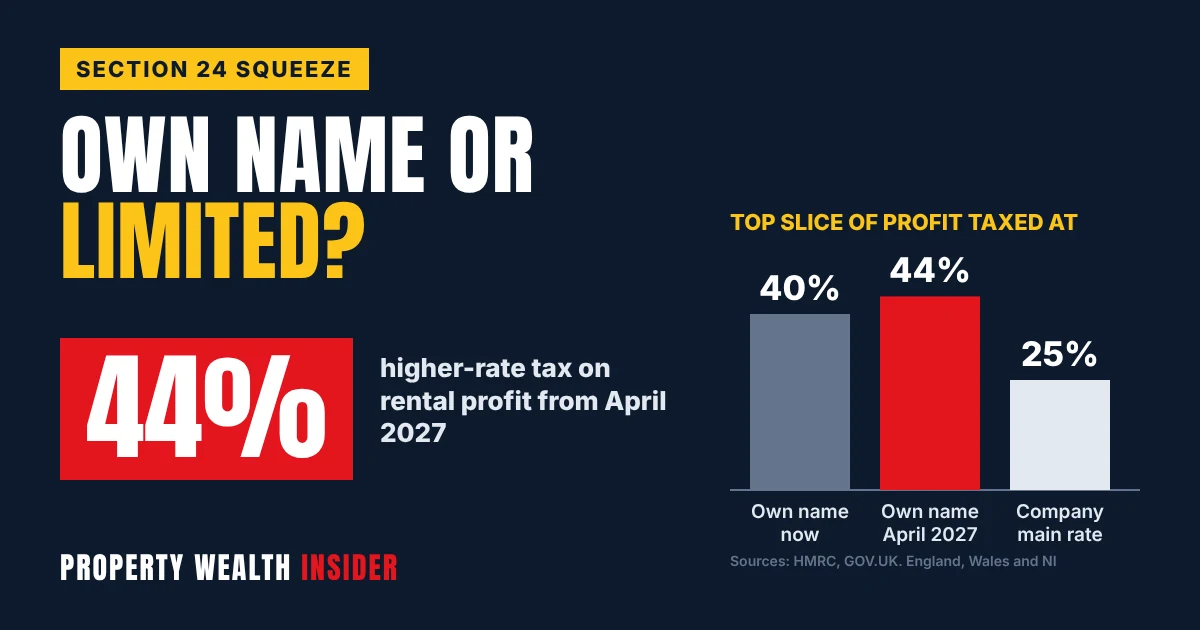
Landlords who own property in their own name face a second income tax rise in a year. At the Budget on 28 October 2026 the Chancellor added 2 more percentage points to the tax on rental profits. From 6 April 2027, property income will be taxed at 24%, 44% and 49% in England, Wales and Northern Ireland.
That is 4 points above today’s rates, because Budget 2025 had already added 2 points from the same date. Higher-rate landlords with mortgages are hit hardest, since Section 24 already stops them deducting their interest in full. Companies pay corporation tax instead, and those rates have not changed.
So should you buy, or hold, through a limited company? Below we run the numbers both ways, set out the costs that can wipe out the saving, and give you a calculator to test your own figures.
Key facts
- From 6 April 2027, property income tax rates rise to 24% / 44% / 49% (basic / higher / additional) in England, Wales and Northern Ireland.
- That is 4 points above today’s 20% / 40% / 45%: 2 points from Budget 2025 and 2 more from Budget 2026.
- The Section 24 tax reduction for mortgage interest is 20% now. HMRC says that from 2027/28 it will be given at the property basic rate, which is set to be 24%.
- Company profits still pay corporation tax at 19% up to £50,000 and 25% above £250,000, with marginal relief in between.
- HMRC estimates 2.4 million landlords will face changes in tax from the Budget 2026 increase by 2031/32. It expects the increase to raise £575 million in 2028/29.
What the Budget changed
Budget 2025 created separate income tax rates for property income, starting in 2027/28. Budget 2026 then raised all three of those rates by another 2 points. HMRC’s policy paper, published on 29 October 2026, sets out the new rates. Parliament still has to pass them in Finance Bill 2026-27, so treat them as announced rather than law.
| Tax | 2026/27 (now) | 2027/28 (from 6 April 2027) |
|---|---|---|
| Basic rate on property income | 20% | 24% |
| Higher rate on property income | 40% | 44% |
| Additional rate on property income | 45% | 49% |
| Section 24 finance cost tax reduction | 20% | Property basic rate (24% on announced rates) |
| Dividend tax (basic / higher / additional) | 10.75% / 35.75% / 39.35% | No further change announced at Budget 2026 |
| Corporation tax | 19% to 25% | No change announced |
Where the new rates apply: the property rates cover England, Wales and Northern Ireland. Scotland sets its own income tax rates, and HMRC says the Scottish and Welsh governments can set their own property income rates.
Savings income gets the same 2-point rise across the whole UK. Tax on wages and pensions is unchanged, so your salary uses up the basic-rate band first. Rental profit then sits on top, which often pushes it into the 44% band.
Why Section 24 makes it worse
Section 24 stopped individual landlords deducting mortgage interest from residential rental income. It was phased in from 6 April 2017 and has applied in full since 6 April 2020. Instead you get a tax reduction worth 20% of your finance costs, capped by reference to your property profits and total income.
For a higher-rate landlord, that means paying 40% tax on rent that is partly spent on interest, with only 20% given back. From April 2027 it becomes 44% tax with, on the announced rates, 24% given back. Companies are outside Section 24 and still deduct interest as a normal business cost.
One small bit of good news: HMRC’s technical note from November 2025 says finance cost relief from 2027/28 will be given at the property basic rate. With that rate now set at 24%, the Section 24 reduction should rise with it. Check the final Finance Act wording before you rely on it.
Personal vs company: a worked example
Take one property with £18,000 a year in rent, £7,500 of mortgage interest and £3,000 of other costs. The landlord earns £45,000 from a job. For the company, we assume £1,200 a year of extra running costs such as accounts and filing. Your own figure may differ.
| 2027/28, England | Own name | Limited company |
|---|---|---|
| Taxable profit | £15,000 (interest not deducted) | £6,300 (after interest and £1,200 running costs) |
| Tax on profit | £5,546 at 24% and 44% | £1,197 corporation tax at 19% |
| Section 24 reduction | minus £1,800 (24% x £7,500) | n/a |
| Kept, money left in company | n/a | £5,103 |
| Dividend tax if all paid out | n/a | £495 |
| Cash in your pocket | £3,754 | £4,608 |
Here the company comes out £854 a year ahead if every penny is paid out, or £1,349 ahead if profits stay in the company to fund the next deposit. In 2026/27, on today’s rates, the gap is £554.
Now flip it. If the same landlord earns £20,000 from work, all the rental profit stays in the basic band. Personally they keep £5,700, against £4,608 through the company. Owning in their own name is £1,092 a year better. Your tax band decides most of this.
Calculator: who keeps more?
Personal vs limited company: who keeps more?
Guide only, not tax advice. England, Wales and Northern Ireland rates for 2026/27 and the announced 2027/28 rates. Personal allowance £12,570 (tapered above £100,000), bands frozen. Your other income uses up the allowance and bands first. Section 24 reduction is 20% (2026/27) or 24% (2027/28) of the lowest of interest, property profit and income above the allowance; unused interest carried forward is ignored. Corporation tax uses 19%/25% with marginal relief, assuming no associated companies. Dividends get the £500 allowance. Excludes stamp duty, capital gains tax, mortgage rate differences, losses, student loans and child benefit charges.
The costs that can cancel the saving
The yearly tax gap is only half the story. Here is what the headline numbers leave out.
Moving property you already own. Selling a property to your own company is a sale at market value. Stamp Duty Land Tax (England and Northern Ireland) is charged on the market value when you are connected with the company, even if it pays you less. Companies pay the higher rates on residential property from the first purchase.
Example: a flat worth £250,000 that you bought for £150,000. Stamp duty at the higher rates is £15,000 (5% on the first £125,000 plus 7% on the next £125,000). A higher-rate taxpayer would also face capital gains tax on the £100,000 gain: after the £3,000 annual exempt amount, 24% on £97,000 is £23,280. That is £38,280 before legal and mortgage fees, or around 45 years of the £854 saving in our example.
Specialist reliefs can apply in some cases, such as properties run as a genuine business or held in a partnership. Do not assume they apply to you without written advice. Wales charges Land Transaction Tax and Scotland charges LBTT instead of SDLT.
New purchases are different. If you already own a home, you pay the higher stamp duty rates anyway. So buying a new property through a company usually costs no more in stamp duty than buying it yourself. One exception: residential properties over £500,000 bought by companies can be charged a flat 17%, although relief is available for property rental businesses.
Mortgages. Company buy-to-let mortgages are a separate product. Rates, fees and lender terms, including any personal guarantee from directors, can differ from personal deals. Get real quotes for both routes before you decide.
Getting money out. Profit in a company is not your money until you take it out. Dividends are taxed at 10.75%, 35.75% or 39.35% above a £500 allowance. A company suits landlords who will leave profits in to keep buying. It suits those who need the rent to live on much less.
Running costs and paperwork. A company means annual accounts, a corporation tax return and a Companies House filing. Directors also have legal duties. Budget for an accountant every year.
What to do now
- Work out your 2027/28 band. Add your expected salary or pension to your rental profit before interest. If the total goes over £50,270, Section 24 and the new rates hit you hardest.
- Run both routes in the calculator for each property, with and without paying profits out.
- Separate existing and future property. Many landlords keep what they own personally and buy new property through a company, which avoids the cost of moving existing homes.
- Price the move. If you are thinking of moving existing property, get stamp duty, capital gains tax, legal and early repayment charge figures in writing.
- Get mortgage quotes for both routes from a broker who handles company buy-to-let.
- Take advice from a property tax specialist before 6 April 2027, while there is time to plan the first year of the new rates.
- Total income for 2027/28 estimated, including rental profit before interest
- Annual mortgage interest for each property listed
- Calculator run for own name and company, with profits paid out and kept in
- Market value and original purchase price of each property noted
- Stamp duty and capital gains tax on any transfer worked out
- Company buy-to-let mortgage quotes obtained
- Annual accountancy cost for a company confirmed
- Specialist tax advice booked before April 2027
FAQ
Is it worth buying buy-to-let through a limited company in 2027?
It often is for higher-rate taxpayers with mortgages who plan to keep profits in the business and keep buying. It is often not worth it for basic-rate landlords, mortgage-free landlords, or anyone who needs the rental income to live on.
Does Section 24 apply to limited companies?
No. Section 24 applies to individuals, including partners in partnerships. A company deducts mortgage interest as a cost before corporation tax.
What are the landlord income tax rates from April 2027?
From 6 April 2027 property income will be taxed at 24% (basic), 44% (higher) and 49% (additional) in England, Wales and Northern Ireland, as announced at Budget 2026. Scotland sets its own rates.
Will the mortgage interest tax credit go up to 24%?
HMRC has said finance cost relief from 2027/28 will be given at the property basic rate, which Budget 2026 set at 24%. That points to a 24% credit, subject to the final legislation.
Can I transfer my rental property to my limited company without paying stamp duty?
Usually not. A transfer to a company you are connected with is charged on market value at the higher rates, and capital gains tax may be due as well. Limited reliefs exist for some business or partnership structures and need specialist advice.
Do limited companies pay the 5% stamp duty surcharge?
Yes. In England and Northern Ireland, companies pay the higher rates on residential purchases of £40,000 or more, even on their first property. A flat 17% rate can apply above £500,000 unless a relief, such as the one for rental businesses, applies.
Sources
- HM Treasury: Budget 2026
- HMRC: Income Tax, changes to tax rates for property and savings income (29 October 2026)
- HMRC: technical note on property, savings and dividend rates (finance cost relief)
- HMRC: tax relief for residential landlords, how it’s worked out
- HMRC: Corporation Tax rates and allowances
- GOV.UK: Tax on dividends
- GOV.UK: Income Tax rates and Personal Allowances
- HM Treasury: income tax thresholds maintained until 5 April 2031
- GOV.UK: Capital Gains Tax rates and allowances
- HMRC: Higher rates of Stamp Duty Land Tax
- HMRC: Stamp Duty Land Tax, corporate bodies
- HMRC: SDLT when transferring ownership of land or property
This article is news and general guidance only. It is not financial, legal or tax advice.