Landlord profits slump 11% as finance costs soar 32%
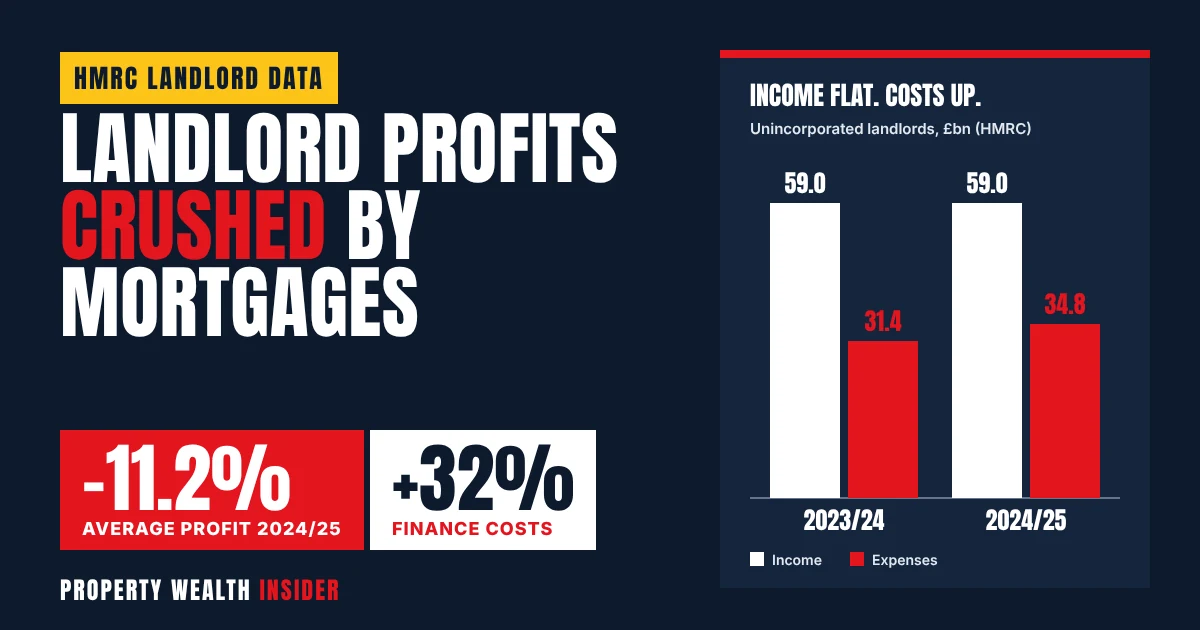
The average tax-paying landlord made 11.2% less profit in the 2024/25 tax year, after finance costs jumped 32%, according to new Savills analysis of HMRC data. And the people who crunched the numbers say the worst may still be to come.
Savills’ head of residential research, Lucian Cook, expects taxable profits to fall again in 2025/26 as cheap fixed-rate mortgages run out. For landlords who locked in five-year deals in 2021, that cliff edge is arriving right now, just weeks before the Budget on 28 October 2026.
This hits individual landlords with mortgages hardest, because Section 24 taxes them on profit they never actually see. Below we unpack HMRC’s figures, show the remortgage maths in pounds, and give you a calculator to run your own numbers.
Key facts
- Average profit for tax-paying landlords fell 11.2% in 2024/25 as finance costs rose 32% (Savills analysis of HMRC data).
- HMRC: landlords declared £58.99bn of rental income in 2024/25, flat on £59bn the year before, while declared expenses rose 11% to £34.75bn.
- Residential finance costs were the biggest single expense at £12.82bn, claimed by 1.15 million landlords (39.8%).
- Bank of England quoted five-year fixed rates (75% LTV) were 1.28% in September 2021 and 4.98% in September 2026.
- From 6 April 2027, property income will be taxed at 22% / 42% / 47% under Finance Act 2026, with finance cost relief at 22%.
What HMRC’s landlord figures show
HMRC’s Property rental income statistics 2026, published on 28 August 2026, cover unincorporated landlords (individuals and partnerships) filing Self Assessment across the UK. Limited companies are not included.
The headline: rents stopped growing, costs did not. Income declared was £58.99bn in 2024/25, against £59bn in 2023/24. Expenses rose from £31.42bn to £34.75bn.
| Tax year | Landlords | Income declared | Expenses declared | Income less expenses* |
|---|---|---|---|---|
| 2020/21 | 2.81m | £46.69bn | £22.33bn | £24.36bn |
| 2021/22 | 2.87m | £52.75bn | £24.95bn | £27.80bn |
| 2022/23 | 2.90m | £55.63bn | £27.59bn | £28.04bn |
| 2023/24 | 2.91m | £59.00bn | £31.42bn | £27.58bn |
| 2024/25 | 2.88m | £58.99bn | £34.75bn | £24.24bn |
Source: HMRC Property rental income statistics 2026, tables 1, 2 and 6. *PWI calculation: total income minus total allowable expenses, including residential finance costs. HMRC notes a correction to services expenses means figures are not comparable with earlier editions.
On our simple measure, the gap between what landlords took in and what they spent shrank by 12.1% in a single year, to its lowest level in the five-year series. That lines up closely with the 11.2% fall in average profits Savills found.
Mortgage interest is now the elephant in the room. Residential finance costs totalled £12.82bn in 2024/25, which is 37% of everything landlords claimed. Only 39.8% of landlords claimed them, which fits Savills’ finding that fewer than 40% of private landlords have a mortgage.
Why finance costs hurt more than they should
Since 2020/21, individual landlords cannot deduct mortgage interest from rental income. Instead, HMRC gives a tax reduction worth 20% of the lowest of three figures: your finance costs (plus any brought forward), your property profits, or your adjusted total income above the personal allowance.
This is Section 24. It applies across the UK to individuals and partners in partnerships, according to HMRC. Finance costs include mortgage interest, interest on loans for furnishings, and fees for taking out or repaying a mortgage. Capital repayments get no relief at all.
For a basic-rate taxpayer, the 20% credit roughly matches the tax saved by a deduction. For higher and additional-rate landlords it does not. Every £1,000 of extra interest costs them £1,000 in cash but saves only £200 in tax, not £400 or £450.
The bottom line: when your mortgage rate rises, your tax bill barely falls. So a higher-rate landlord’s after-tax profit drops much faster than their real profit.
The 2021 fixed-rate cliff edge
Lucian Cook’s warning is about timing. Landlords on fixed rates have been shielded, but each deal that ends resets to today’s prices. The 2024/25 figures only partly reflect that.
Bank of England data shows the average quoted five-year fixed rate at 75% loan-to-value was 1.28% in September 2021. In September 2026 it was 4.98%. These are residential benchmarks, not buy-to-let rates, which are priced separately, but they show the scale of the jump facing anyone whose 2021 deal is expiring.
Worked example. A higher-rate landlord lets a flat for £1,200 a month (£14,400 a year), pays £3,000 in other costs and has a £150,000 interest-only mortgage. Their fix at 1.9% ends and they remortgage at 5%.
| Old deal at 1.9% | New deal at 5% | |
|---|---|---|
| Mortgage interest | £2,850 | £7,500 |
| Real profit (rent minus all costs) | £8,550 | £3,900 |
| Taxable profit under Section 24 | £11,400 | £11,400 |
| Tax at 40%, less 20% interest credit | £3,990 | £3,060 |
| Profit after tax | £4,560 | £840 |
| Tax as share of real profit | 46.7% | 78.5% |
Interest rose by £4,650, but tax fell by only £930. After-tax profit collapses by £3,720, or 81.6%. A basic-rate landlord in the same position would see a 54.4% fall, from £6,840 to £3,120.
Calculator: your remortgage profit squeeze
Put in your own figures to see what a new mortgage rate does to your take-home profit. Tick the box to see the position under the 2027 property tax rates.
Remortgage profit squeeze calculator
Guide only, not tax or financial advice. Assumes an individual landlord, an interest-only mortgage, all rental profit taxed at your chosen band (rest-of-UK rates, not Scottish rates), and a finance cost credit capped at your property profit. Unused finance costs can be carried forward, which this tool does not model. Check your position with an accountant.
The 2027 property tax rates make it tighter
This is now law, not a proposal. Section 7 of Finance Act 2026 sets a property basic rate of 22%, a property higher rate of 42% and a property additional rate of 47% for the 2027/28 tax year, which starts on 6 April 2027.
HMRC’s technical note says the separate rates apply to England, Wales and Northern Ireland, and that the finance cost tax reduction will rise to the property basic rate of 22%. Section 8 lets the Scottish Parliament and the Senedd set their own property rates.
For our higher-rate landlord at 5%, tax goes from £3,060 to £3,138, and after-tax profit drops to £762. Because the interest credit also rises to 22%, the extra hit is small for heavily mortgaged landlords. A mortgage-free higher-rate landlord with the same £11,400 profit pays £4,788 instead of £4,560, an extra £228 a year.
Sell or hold before the Budget?
Savills does not expect a rush for the exit. With fewer than 40% of landlords mortgaged, most are not exposed to the rate squeeze. It says HMRC capital gains tax data points to a slight dip in disposals of investment properties and second homes in 2025/26, and expects any sell-off to be gradual.
Savills also expects any pre-Budget sales spike to be smaller than in the past. In England, Section 21 was abolished from 1 May 2026 under the Renters’ Rights Act, so getting vacant possession to sell takes longer and needs a valid possession ground.
This is not advice, but these are the points worth weighing:
- Reasons some hold: low or no mortgage, strong yield, long-term capital growth plans, or a sitting tenant who pays well. Selling also means losing future rent.
- Reasons some sell: negative after-tax cash flow at today’s rates, a large balance to refinance, or a portfolio that only works on cheap money.
- Tax on sale: CGT is 18% for basic-rate and 24% for higher-rate taxpayers, with a £3,000 annual exempt amount in 2026/27. UK residential gains must be reported and paid within 60 days of completion.
- Timing: nobody knows what the 28 October Budget contains. A sale agreed in a hurry, at a discount, to beat a rule that never arrives can cost more than the rule would have.
What to do now: step by step
- List every fixed-rate end date. Note the balance, current rate and when each deal ends.
- Get real quotes. Ask a broker for buy-to-let rates and fees on each property. Ask whether you can lock in a new deal before your current one ends.
- Run the calculator for each property. Use both 2026/27 and 2027 rules, and test a rate 1% higher than your quote.
- Find your weakest property. Rank them by after-tax profit, not rent or yield.
- Review costs and rent. Check every allowable expense is being claimed, and whether rents are in line with the local market.
- Talk to an accountant before 28 October. Ask about your full Section 24 position, carried-forward finance costs, CGT on any sale, and whether your structure still makes sense.
- Read the Budget, then decide. Do not act on rumours. Check what is actually announced and when it takes effect.
- Fixed-rate end dates listed for every mortgage
- Broker quotes for each remortgage, including fees
- After-tax profit calculated at old and new rates
- Stress test at quote plus 1%
- 2027/28 property tax rates factored in
- Unused finance costs from earlier years checked
- CGT estimate for any property you might sell
- Possession route checked if selling a let property in England
- Accountant meeting booked before the Budget
FAQs
Are landlord profits falling in the UK?
Yes, on HMRC’s latest data. Savills found average profits for tax-paying landlords fell 11.2% in 2024/25, as finance costs rose 32%. HMRC figures show income flat at about £59bn while declared expenses rose 11%.
How much tax relief do landlords get on mortgage interest?
Individual landlords get a tax reduction of 20% of the lowest of their finance costs, property profits or adjusted total income above the personal allowance. From April 2027 the reduction will be 22%.
Can you pay more tax than your rental profit?
Effectively, yes. Because interest is not deducted before tax, higher and additional-rate landlords with large mortgages can pay tax that is a very large share of their real profit, and can even owe tax while making a loss after interest.
What are the new property income tax rates from 2027?
Finance Act 2026 sets property rates of 22% (basic), 42% (higher) and 47% (additional) for 2027/28, starting 6 April 2027. Scotland and Wales will be able to set their own property rates.
When is the Autumn Budget 2026?
The Chancellor has confirmed the Budget will be delivered on Wednesday 28 October 2026, alongside a new Office for Budget Responsibility forecast.
Do limited company landlords pay Section 24?
No. Section 24 applies to individual landlords and partners in partnerships. HMRC’s rental income statistics also exclude companies, so the profit falls above relate to unincorporated landlords.
Sources
- Savills: Profits and disposals, what HMRC is telling us
- HMRC: Property rental income statistics 2026
- HMRC: Changes to tax relief for residential landlords, how it’s worked out
- HMRC: Restricting finance cost relief for individual landlords
- Finance Act 2026, section 7: property rates of income tax for 2027-28
- HMRC: Change to tax rates for property, savings and dividend income, technical note
- Bank of England Database: quoted five-year fixed mortgage rate, 75% LTV (IUMBV42)
- HM Treasury: Chancellor’s letter confirming the Budget date
- MHCLG: Renters’ Rights Act protections in force from 1 May 2026
- GOV.UK: Capital Gains Tax rates
- GOV.UK: Income Tax rates and bands
This article is news and general guidance only. It is not financial, legal or tax advice.