£277k payback: Ombudsman slams Let Property over BTL rents
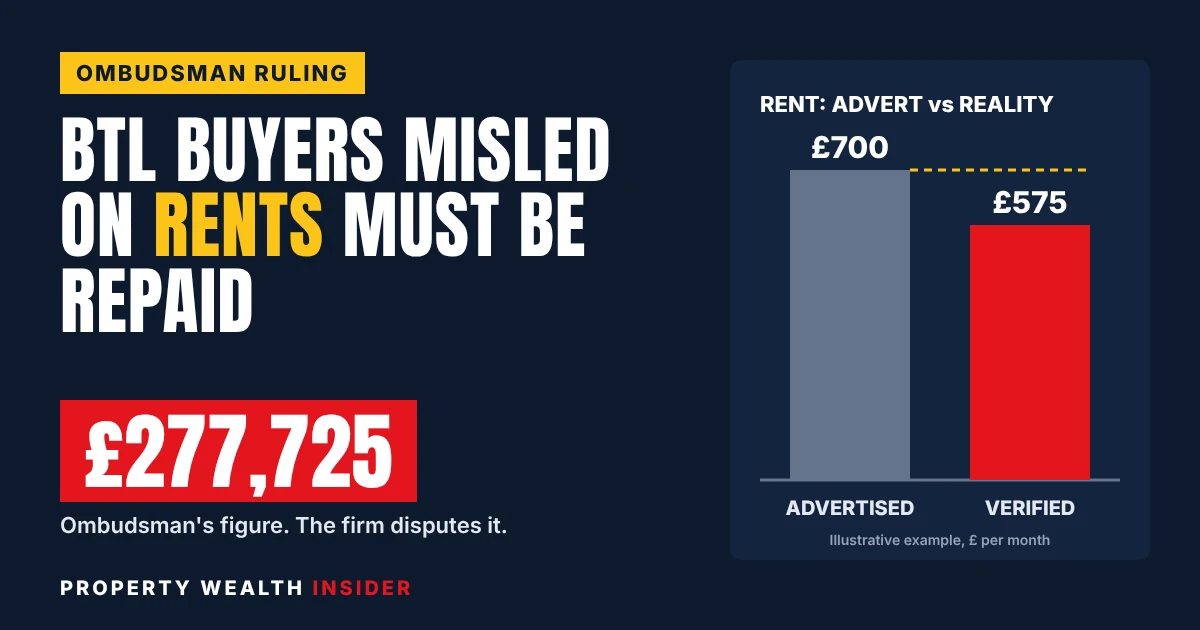
A Glasgow-based firm that sells tenanted buy-to-let flats between landlords has been told to repay £277,725 to customers after The Property Ombudsman found it treated buyers unfairly, the BBC reported on 23 November 2026. The firm, Let Property, disputes that total.
At the heart of the case are “buyers’ premiums”: upfront payments of about £3,000 that investors paid to reserve a property with a sitting tenant. According to the BBC, many of those deals later collapsed when rents, valuations or even the construction type turned out to be different from what buyers had been led to expect.
If you buy “investor-ready” tenanted stock from social media ads, portals or deal-sourcing firms anywhere in the UK, this is the case to read. Below we set out what was found, what the firm says, and a calculator to stress-test any tenanted deal before you hand over a fee.
Key facts
- The Property Ombudsman (TPO) says Let Property will repay a total of £277,725, which the BBC understands is the biggest overall repayment of its type.
- Individual repayments range from £100 to £12,300, averaging more than £3,200, against a 2025 average TPO award in sales cases of £616.
- TPO logged 199 complaints about the firm over five years. This year it found for the complainant in 44 (77%) of the cases it decided after 73 of 133 settled directly.
- Let Property disputes the total. It says TPO ordered £187,975 in awards to 63 individuals and that all have been paid.
- Most complaints concerned buyers’ premiums of about £3,000 paid upfront to reserve tenanted buy-to-lets.
What the Ombudsman found
The Property Ombudsman is a free redress scheme for consumers that covers the whole UK. Every estate agent dealing in residential property must belong to an approved scheme like it, a duty created by the Consumers, Estate Agents and Redress Act 2007 and the Estate Agents (Redress Scheme) Order 2008.
According to the BBC, chief ombudsman Lesley Horton described the failings as “systemic”. She said the issues being misrepresented included rental income, valuation and construction type, some of which make properties very difficult to mortgage. In her view that information should be given to buyers up front.
The complaints were numerous enough that TPO set up a specialist team in April 2026. Horton told the BBC that typical compensation in other cases with substantial awards was £600 to £1,000, and called the averages at this one firm “unprecedented”. The BBC also reported that TPO had received as many complaints about Let Property, which has two branches, as about another agency with more than 150.
For scale, TPO’s own Annual Review 2025 shows total awards of £718,279 across every residential sales case it handled in 2025, with an average award of £616.
The National Trading Standards Estate Agency Team told the BBC it was aware of the complaints and was referring them to the relevant local trading standards services. Those services would then decide whether any law had been broken. No enforcement action had been reported at the time of writing.
What Let Property says
Let Property told the BBC it disputes TPO’s repayment figure. It says the Ombudsman ordered £187,975 in awards to 63 individuals, including sellers, prospective landlords and buyers, and that all of them have been paid.
The firm accepted that some customers had “experienced difficulties”, particularly when completing on properties in England. It said it does not believe its business model lacks transparency or fairness. It also rejected the claim that clients are routinely left without communication, saying every buyer gets a dedicated sales progressor.
The company says that since 2025 it has given buyers independent condition assessments and pre-checks on rental income and tenancy agreements. The BBC reports that it has left TPO for a rival redress scheme but must still make the repayments TPO ordered.
How a £3,000 buyer’s premium can vanish
A buyer’s premium (sometimes called a reservation fee) is paid to the selling firm, not into the purchase price, to take a property off the market. According to the BBC, Let Property’s website says premiums will be refunded if information such as rental income, service charges or tenure is inaccurate, but not valuation.
That gap matters because a down-valuation is one of the most common ways a buy-to-let purchase dies. One buyer told the BBC that his lender’s surveyor valued a Lincolnshire property £25,000 below the advertised price after he had paid a £3,000 premium.
| What goes wrong | Why the deal collapses | Is the fee at risk? |
|---|---|---|
| Rent lower than advertised | The lender’s ICR test uses the rent its valuer can support, so you can borrow less | Depends on the terms. Get the refund trigger in writing |
| Down-valuation | The loan is based on the lower valuation, so you need more cash | Often yes. The BBC reports Let Property’s refund terms exclude valuation |
| Non-standard construction | Many lenders will not lend at all | Depends on whether it was disclosed up front |
| No access for a survey | The lender can withdraw its offer | Depends. In one BBC case TPO rejected the complaint, finding access was not the firm’s fault |
The fee is not a deposit on the property. If the purchase falls through, getting it back depends on the reservation agreement you signed and on redress if the agent misled you.
Misleading people about a property can break consumer law. The unfair commercial practices rules in the Digital Markets, Competition and Consumers Act 2024 came into force on 6 April 2025. They ban misleading actions, such as giving false information, and misleading omissions, such as leaving out information people need to make a decision. Under the Act, the CMA and the courts can fine traders up to 10% of worldwide turnover. Nothing in TPO’s findings has been reported as a breach of that Act.
Why an inflated rent breaks the deal: worked example
Lenders do not take the advert’s word for it. The Bank of England’s buy-to-let underwriting standards (SS13/16) expect rental income to be verified by an independent valuer, automated valuation models or an existing rental agreement. Lenders must also test the rent against interest at a stressed rate. Unless the rate is fixed for five years or more, lenders must allow for a rise of at least 2 percentage points and assume a rate of at least 5.5%. SS13/16 calls a minimum interest cover ratio (ICR) of 125% the industry standard. Many lenders ask more of higher-rate taxpayers.
Here is an illustrative tenanted flat advertised at £95,000 with “£700 a month rent”. You plan a 25% deposit (£23,750) and a 5.5% interest-only mortgage. Your own checks show the market rent is £575, and the lender values it at £85,000.
| As advertised | After your checks | |
|---|---|---|
| Monthly rent | £700 | £575 |
| Gross yield on £95,000 | 8.8% | 7.3% |
| Valuation used by lender | £95,000 | £85,000 |
| Loan at 75% | £71,250 | £63,750 |
| Cash you need for the price | £23,750 | £31,250 (+£7,500) |
| Monthly interest at 5.5% | £327 | £292 |
| Cashflow after 15% running costs | £268 | £197 |
The deal still washes its face, but you now need £7,500 more in cash and earn £1,500 a year less in rent than advertised. If you cannot find the extra money, the purchase fails and, under many reservation terms, so does the £3,000 premium. The figures exclude stamp duty, legal fees and any premium, so the real cash gap is bigger.
Calculator: tenanted BTL deal reality check
Enter the advertised figures and your own checked figures. The tool shows the yield gap, cashflow at the real rent, what the lender is likely to lend under an ICR test, and how much cash and fee are at stake.
Tenanted BTL deal reality check
Guide only, not financial advice. Interest-only, before tax, stamp duty, legal fees and mortgage fees. Lenders apply their own ICR, stress rate and valuation rules.
Due-diligence checklist for a sitting-tenant purchase
When you buy with a tenant in place you take on their tenancy, and with it any compliance gaps. In England, the Renters’ Rights Act changes took effect on 1 May 2026. Every existing assured shorthold tenancy became an assured periodic tenancy, section 21 “no fault” evictions ended, and rent can be raised only once a year using the section 13 process. Ask for the following before you pay anything non-refundable:
- The signed tenancy agreement and every addendum. Check the rent figure matches the advert.
- Proof the tenant received the government’s Renters’ Rights Act Information Sheet 2026 by 31 May 2026, or the written statement of terms if the tenancy started on or after 1 May 2026. Missing it can mean a fine of up to £7,000.
- Rent payment history: 6 to 12 months of bank statements or the agent’s rent ledger, not just a spreadsheet.
- The deposit protection certificate and prescribed information. Deposits must be protected within 30 days, and deposit compliance affects whether a court will grant you possession.
- The current gas safety record. Checks are annual, and existing tenants must get a copy within 28 days.
- An electrical installation condition report (EICR). Installations must be checked at least every 5 years.
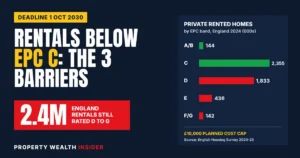
- An EPC rated E or above. The standard rises to C by 1 October 2030, with a spending cap of up to £10,000 per property, so price that in.
- Any rent arrears, disputes, outstanding repair requests or council notices.
- Construction type and tenure (leasehold term, service charge, ground rent), confirmed with your lender before you pay a fee.
- The agent’s redress scheme membership, which you can check with the National Trading Standards property agent checker.
- The reservation agreement’s refund clause, in writing: exactly what triggers a refund, and whether a down-valuation is covered.
Scotland, Wales and Northern Ireland have their own tenancy, deposit and safety rules, so check the local government guidance if the property is outside England.
Lost a reservation fee? What to do now
- Gather evidence. Save the listing, ads, messages, rent claims, the reservation agreement and the lender’s valuation or decline letter.
- Complain formally to the firm. Use its complaints procedure and ask for a written final response.
- Escalate to its redress scheme. TPO says you can refer once you have a final viewpoint letter dated within the last 12 months, or if more than 8 weeks have passed since your formal complaint. Your complaint to the firm must have been made within 12 months of the problem. The service is free. If the firm has moved schemes, check which one covers it using the property agent checker.
- Report it to trading standards through Citizens Advice if you think you were misled.
- Next time, run the numbers first. Use the calculator above with your own rent evidence before any money leaves your account.
FAQ
How much does Let Property have to repay?
The Property Ombudsman puts the total at £277,725, the BBC reported. Let Property disputes this and says the Ombudsman ordered £187,975 in awards to 63 individuals, all of which have been paid.
Is a buy-to-let reservation fee refundable?
Only if the agreement you sign says so. Check exactly which events trigger a refund, especially down-valuations and mortgage refusals, and get it in writing before you pay.
Can I complain to The Property Ombudsman about an estate agent?
Yes, if the agent is registered with TPO. Complain to the agent first. You can escalate once you have a final response or after 8 weeks without one, and the service is free for consumers.
How do I check the rent on a tenanted property is real?
Ask for the tenancy agreement and 6 to 12 months of bank statements showing rent received. Then compare the rent with similar local listings or a letting agent’s appraisal. Your lender’s valuer will check it too.
Does the tenancy continue if I buy a property with a sitting tenant?
Yes. You take over as landlord. In England, since 1 May 2026 tenancies are assured periodic, section 21 has gone, and you need a legal ground under section 8 to recover possession.
- BBC News: Property firm told to repay customers thousands over unfair sales tactics (23 November 2026)
- The Property Ombudsman: Annual Review 2025
- The Property Ombudsman: How it works (consumers)
- Consumers, Estate Agents and Redress Act 2007: explanatory notes
- The Estate Agents (Redress Scheme) Order 2008
- National Trading Standards Estate and Letting Agency Teams
- GOV.UK: What businesses need to know about unfair commercial practices (DMCC Act 2024)
- Bank of England PRA: SS13/16 underwriting standards for buy-to-let mortgage contracts
- GOV.UK: Renters’ Rights Act, an overview for landlords
- GOV.UK: The Renters’ Rights Act Information Sheet 2026
- GOV.UK: Deposit protection schemes and landlords
- HSE: Gas safety check records
- GOV.UK: Electrical safety standards in the private rented sector
- GOV.UK: Improving the energy performance of privately rented homes, government response
This article is news and general guidance, not financial, legal or tax advice.