2.4m rentals below EPC C: the 3 barriers stopping landlords
Nearly half of England’s privately rented homes are still rated below EPC band C, and a new study from the TDS Charitable Foundation says landlords are not stuck because of cost alone. They don’t trust EPCs, they don’t understand the grant schemes, and they struggle to find reliable tradespeople to do the work.
That matters because the clock is running. The government has confirmed that every private tenancy in England and Wales must reach EPC C by 1 October 2030, with landlords expected to spend up to £10,000 per property. Spending since 1 October 2025 already counts.
Below we set out what the research found, what is law today versus what is only planned, and what the numbers look like for a real property. There’s also a planner that works out your cost cap, your headroom and how many months you have left.
Key facts
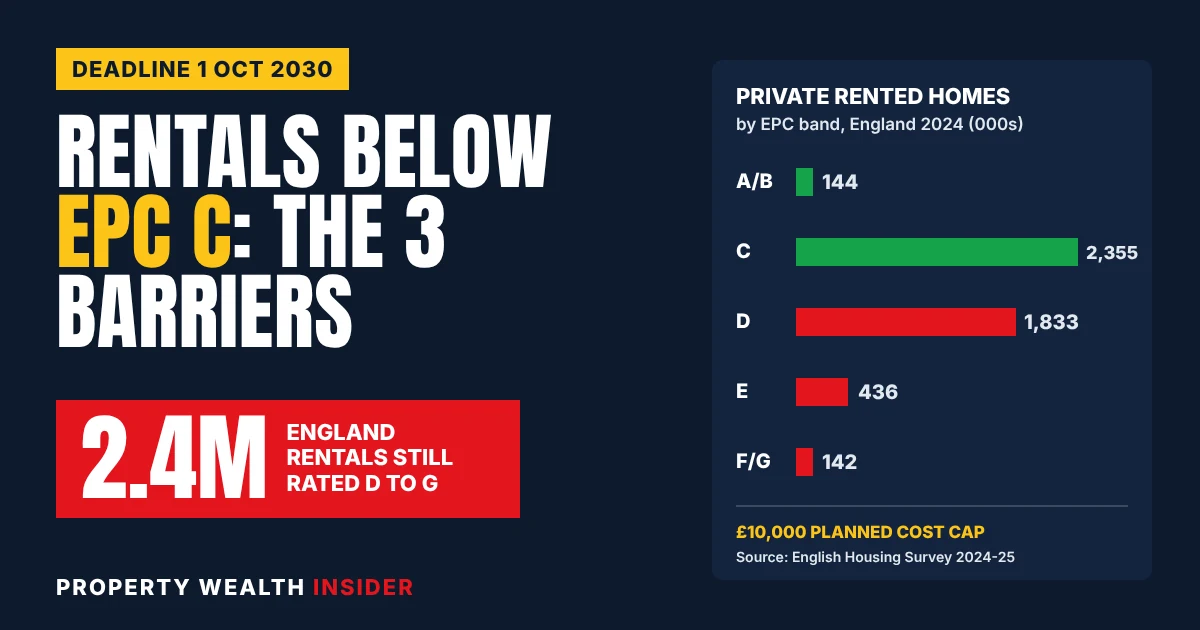
- About 2.41 million private rented homes in England were rated D to G in 2024. That’s 49% of the sector (English Housing Survey).
- Planned deadline: 1 October 2030 for all tenancies. The earlier idea of a 2028 date for new tenancies has been dropped.
- Planned cost cap: £10,000 per property over 10 years, or 10% of value if the home is worth under £100,000. Spending from 1 October 2025 counts.
- The maximum fine today is £5,000 per property. A Bill now before Parliament would raise it to £30,000.
- 36% of private tenants say their energy bills are difficult or very difficult to afford (TDS Voice of the Tenant 2026).
- New-style EPCs have been pushed back to the second half of 2027.
What the report found: three barriers
The study is called Making Energy Efficiency Funding Work for Tenants and Landlords. It’s based on 38 in-depth interviews with 21 tenants, 10 landlords and 7 stakeholders, carried out between November 2025 and February 2026. Every tenant and landlord interviewed had already contacted an energy efficiency scheme, and over half had had a measure installed. These are people who tried, not people who ignored the issue.
The researchers found that cost was still the barrier mentioned most often. Three other problems kept coming up as well:
- Mistrust of EPCs. Interviewees said ratings sometimes didn’t match how warm a home really was. Some described well-insulated homes scoring badly, or assessors unable to record certain heating systems. Landlords also found the recommendations confusing because they are listed cumulatively, so it’s hard to see which single measure gets you to C. Many tenants couldn’t remember their own EPC band.
- Confusion about schemes. Most landlords and tenants couldn’t name a specific programme. People usually found out about one through a leaflet, an online advert or word of mouth rather than by looking. Landlords with one or two properties were the least informed.
- Finding reliable trades. Landlords had trouble getting qualified, reliable installers, even at the quoting stage. Bad publicity about poor installations under earlier government schemes made some wary, especially of heat pumps.
Tenants had a worry of their own. Many feared that upgrades would lead to rent rises. The Foundation’s earlier survey found that 36% of tenants who thought their home needed improving hadn’t asked for it for that reason.
The report makes nine recommendations. These include properly resourcing and training councils to enforce the rules, focusing grants on low-income tenants and homes rated D to G, making zero-interest loans widely available to landlords through government or a kitemarked partnership, exploring tax relief for rentals rated A to C, and producing reformed EPCs that show how many points each individual measure adds.
The rules: law now vs planned
The rules are set by the Energy Efficiency (Private Rented Property) (England and Wales) Regulations 2015, so they cover England and Wales. Scotland and Northern Ireland have their own regimes. The government confirmed the EPC C policy in its response of 21 January 2026, but the new standard is not law yet. It still needs legislation, which the government aims to bring into force in 2027.
| Rule | In force now | Confirmed plan (not yet law) |
|---|---|---|
| Minimum rating | EPC E (since 1 April 2020) | EPC C, or equivalent against new EPC metrics |
| Deadline | Applies now | 1 October 2030, for all tenancies |
| Cost cap | £3,500 incl. VAT (spend since 1 October 2017 counts) | £10,000 per property over 10 years. Spend from 1 October 2025 counts |
| Low-value homes | No special rule | Cap of 10% of value if the home is worth under £100,000 |
| Exemption length | Mostly 5 years | 10 years for cost cap, property value and negative impacts exemptions |
| Maximum fine | £5,000 per property | £30,000 per property, per breach (Energy Independence Bill) |
| Existing EPC C | – | An EPC rated C before 1 October 2029 counts as compliant until it expires |
Two dates are worth noting. The Energy Independence Bill was introduced on 4 November 2026 and contains the power to raise fines to £30,000. And the new-style EPCs, originally aimed for October 2026, were moved on 9 March 2026 to the second half of 2027.
Already below E? The current EPC E minimum applies until 2030. If your property is rated F or G, you need to improve it or register a valid exemption now. You can’t wait for the new rules.
How many rentals are below C?
The latest English Housing Survey estimates England’s private rented stock at 4.91 million homes in 2024. Of these, 2.50 million were rated A to C and 2.41 million were rated D to G. In other words, half the sector already meets the target and the other half still has work to do.
Things have improved a lot over the past decade. The number of rentals below C has fallen by about a million since 2014. But band D is still the problem, with 1.83 million homes. Many of these are only a few SAP points short, which is exactly the situation where confusing, cumulative EPC recommendations make it hard to choose the right job.
How the £10,000 cost cap works, with examples
Under the confirmed plan, you install the relevant measures until the property reaches C. If it still falls short once you’ve spent the cap, or if the next cheapest measure would take you over it, you can register a cost cap exemption that lasts 10 years. The government’s impact assessment estimates the average spend at about £5,400.
Four rules decide what counts. Spending on relevant measures from 1 October 2025 counts. Third-party funding, such as a Warm Homes: Local Grant, counts. The cost of your before and after EPCs counts. But Boiler Upgrade Scheme money does not count.
Example 1: terrace worth £180,000, rated D. The cap is £10,000. Using the government’s own modelling costs, you might do loft insulation (£415), cavity fill (£505), a room thermostat (£240) and 12m² of double glazing (£3,150), for a total of £4,310. If the post-works EPC shows C, you’re done with £5,690 of the cap unused. If it doesn’t, you’re expected to carry on with further measures up to the £10,000 limit.
Example 2: flat worth £85,000. Because the home is worth under £100,000, the cap is 10% of value, which is £8,500. If you spent £2,000 on glazing in March 2026, that counts, so you have £6,500 of headroom left.
Example 3: heat pump route. The government models an 8kW air source heat pump at £11,800. The Boiler Upgrade Scheme pays £7,500, so you pay £4,300. Only that £4,300 counts towards the cap, which leaves you £5,700 of headroom on a £10,000 cap.
What measures cost, plus the upgrade planner
The costs below are the government’s own modelling assumptions from the impact assessment, in 2020 prices. Today’s quotes will probably be higher, so use them as a starting point and replace them with real quotes.
| Measure | Government cost assumption | Worked size | Example cost |
|---|---|---|---|
| Loft insulation | £175 + £6 per m² | 40m² | £415 |
| Cavity wall insulation (standard) | £295 + £3 per m² | 70m² | £505 |
| Hot water cylinder insulation | £20 | – | £20 |
| Draught proofing | £45 + £1 per metre | 50m | £95 |
| Room thermostat | £240 | – | £240 |
| Floor insulation | £40 per m² | 40m² | £1,600 |
| Double or secondary glazing | £1,230 + £160 per m² | 12m² | £3,150 |
| Solar PV (4kW) | £5,400 | – | £5,400 |
| Air source heat pump (8kW) | £11,800 | – | £11,800 |
| External solid wall insulation | £1,630 to £5,595 + £130 per m² | 80m² | £12,030+ |
EPC C upgrade planner
Planned measures (tick and edit the cost)
Guide only, not advice. It’s based on the government’s confirmed policy of January 2026, which is not yet law and may change. Default costs are government modelling assumptions in 2020 prices, so use real quotes. Only a new EPC can confirm whether a home reaches C.
Grants and funding you can use
The report found that confusion about schemes is a barrier in itself. Here is what is actually available from the primary sources.
- Boiler Upgrade Scheme (England and Wales): £7,500 for an air source or ground source heat pump, £5,000 for a biomass boiler and £2,500 for an air-to-air heat pump. Until March 2027, there’s an extra £1,500 for a heat pump in a home heated by oil or LPG with no mains gas. This money does not count towards the cost cap.
- Warm Homes: Local Grant (England only, runs to March 2028): for homes rated D to G where the household is on a low income. That means living in one of the most deprived postcode areas, receiving certain means-tested benefits, or having a gross household income under £36,000. Each landlord can have one home fully funded. Further homes need a 50% landlord contribution. Funding comes through your council, and it counts towards the cost cap.
- ECO and the Great British Insulation Scheme: the government chose not to continue these after 2026 and is putting £1.5bn of grant funding through the Warm Homes Plan instead.
- Loans: the government is “exploring” low and zero-interest consumer loans under the Warm Homes Plan, including how landlords might use them. Nothing is available to landlords yet, which is why the TDS report calls for them.
On tax, the government response says energy efficiency spending on a rental “may qualify as allowable expenses or be tax-deductible”, and that a heat pump may count as a repair in certain circumstances. Whether work is a repair or an improvement depends on the facts, so check with your accountant before you claim.
What to do now: step-by-step plan
- Find every EPC. Note the band, the SAP score and the expiry date for each property. A home that scores high in band D may need only one or two measures.
- Deal with F and G homes first. These are already non-compliant under today’s E minimum.
- Read the recommendations one by one. They’re cumulative, so ask your assessor how many points each single measure adds. That addresses the confusion the report identified.
- Aim for C before 1 October 2029. Under the plan, a C on the current EER rating counts until that EPC expires, which helps you avoid uncertainty about the new metrics.
- Check grants before you pay. Ask your council about Warm Homes: Local Grant if your tenant may qualify, and get the BUS voucher through your installer before any heat pump work.
- Use certified installers. Get at least two quotes and check certification, for example TrustMark or MCS for heat pumps and solar.
- Keep a cost cap file for each property. Include invoices dated from 1 October 2025, grant letters and EPC fees. You’ll need this evidence to register an exemption.
- Talk to your tenant early. Explain the access dates and be clear about rent, because the research shows fear of rent rises stops tenants engaging.
- EPC band, SAP score and expiry date logged for every property
- Any F or G homes improved, or an exemption registered
- Cost of each single measure checked with the assessor
- Council asked about Warm Homes: Local Grant
- BUS voucher confirmed before heat pump installation
- At least two quotes from certified installers
- Invoices from 1 October 2025 filed for each property
- Post-works EPC booked
- Tenant told about access dates and rent position
FAQ
Do rental properties need an EPC C by 2028?
No. The government confirmed there will be no earlier date for new tenancies. Under the plan, all tenancies in England and Wales must meet the standard by 1 October 2030. Until then, the legal minimum stays at E.
Is the EPC C rule for landlords law yet?
Not yet. It’s confirmed government policy, and the government aims for the regulations to come into force in 2027. The power to raise fines to £30,000 is in the Energy Independence Bill, which was introduced on 4 November 2026.
What is the £10,000 cost cap for EPC C?
It’s the most you’ll be required to spend on one property over 10 years, or 10% of its value if it’s worth under £100,000. Spending from 1 October 2025 counts. If the home still isn’t C after that, you can register a 10-year exemption.
Does the Boiler Upgrade Scheme grant count towards the cost cap?
No. The government has said BUS funding will not count towards the £10,000 cap. Other third-party funding, such as Warm Homes: Local Grant, does count.
My rental already has an EPC C. Am I compliant for 2030?
Under the plan, yes. A C against the current Energy Efficiency Rating on an EPC dated before 1 October 2029 counts as compliant until that EPC expires. After that, you’ll be assessed against the new metrics.
What is the fine for renting out a property below the EPC minimum?
Today the maximum is £5,000 per property. The planned new maximum is £30,000 per property, per breach, which the government wants in place before the 2030 standard applies.
- TDS Charitable Foundation: Making Energy Efficiency Funding Work for Tenants and Landlords (2026)
- TDS Charitable Foundation: housing research
- TDS Charitable Foundation: Voice of the Tenant Survey 2026 (Wave 6)
- GOV.UK: Improving the energy performance of privately rented homes, government response
- GOV.UK: impact assessment (measure cost assumptions)
- GOV.UK: Domestic private rented property minimum energy efficiency standard, landlord guidance
- GOV.UK: Energy Independence Bill factsheet, domestic PRS MEES enforcement
- GOV.UK: Reforms to the Energy Performance of Buildings regime (new EPC timing)
- GOV.UK: English Housing Survey 2024 to 2025, Chapter 2 energy efficiency
- GOV.UK: English Housing Survey 2024 to 2025 annex tables
- GOV.UK: Boiler Upgrade Scheme, what you can get
- GOV.UK: Warm Homes: Local Grant
This article is news and general guidance only. It is not financial, legal or tax advice.