Landlords slam brakes: BTL purchase searches crash 25%
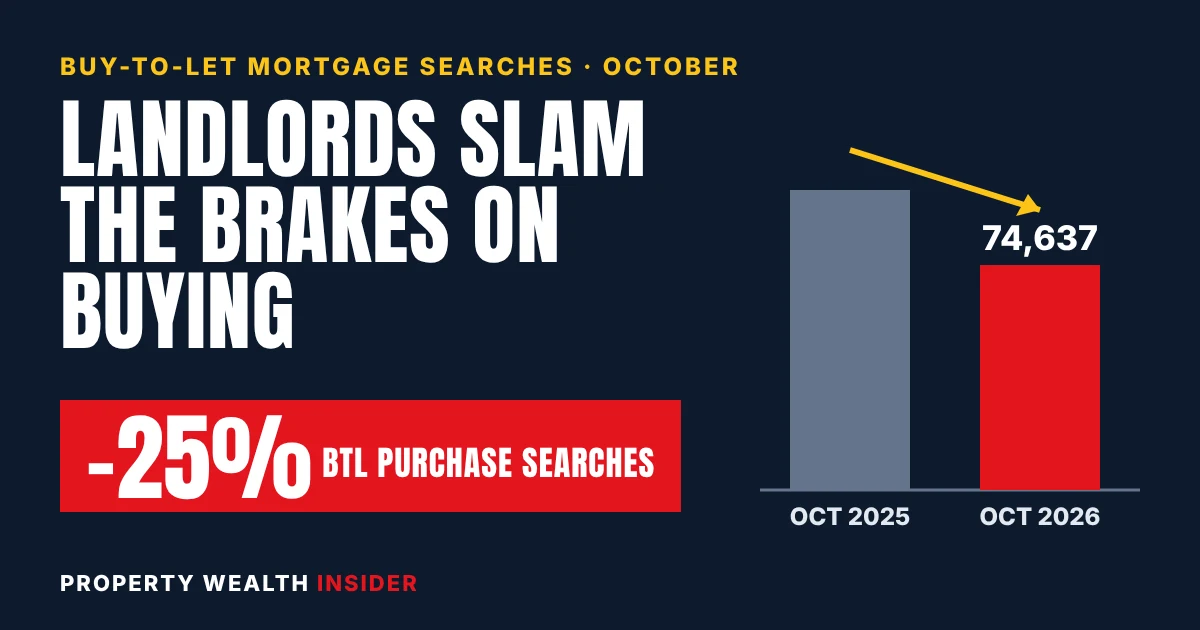
Landlords have taken their foot off the accelerator. Mortgage adviser searches for buy-to-let purchase loans fell 25% in October 2026 compared with October 2025, according to Twenty7tec’s latest Mortgage Market Snapshot, while buy-to-let remortgage searches edged up 2%.
Put simply, landlords are refinancing what they already own rather than buying more. The data landed the same day the Bank of England raised Bank Rate to 4%, and less than five months before higher income tax rates on rental profits begin in April 2027.
If you are still buying, or your fixed rate is ending, the number that decides how much you can borrow is usually the lender’s rental stress test, not the property price. We explain how it works below, and our calculator shows whether the rent supports the loan you need.
Key facts
- Buy-to-let purchase searches were 74,637 in October 2026, down 25% year on year (Twenty7tec).
- Total buy-to-let searches were 273,330, down 7% on September and on October 2025. BTL remortgage searches rose 2% year on year to 198,693.
- The Bank of England raised Bank Rate by 0.25 points to 4% on 5 November 2026. The next decision is due on 17 December 2026.
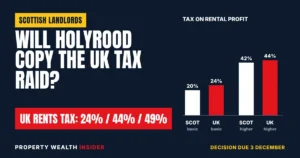
- From 6 April 2027, rental profits will be taxed at 24% / 44% / 49%, up from 20% / 40% / 45% now. This was announced at Budget 2026 and applies to individuals in England, Wales and Northern Ireland.
- PRA rules expect lenders to stress test at least 2 points above the rate, with a 5.5% floor, unless the rate is fixed for five years or more.
What the October search figures show
Twenty7tec runs mortgage sourcing software that advisers use to search for products. Its monthly snapshot counts those searches, so it is an early sign of demand rather than a count of completed loans.
Across the whole market, October searches totalled 1,825,082. That was 5% down on September but 12% up on a year earlier. The growth came from homeowners remortgaging, not from landlords.
| Search type (October 2026) | Searches | Change vs October 2025 |
|---|---|---|
| Total searches | 1,825,082 | +12% |
| Residential remortgage | 820,865 | +37% |
| Residential purchase | 592,572 | -1% (also -4% vs September) |
| First-time buyer | 138,315 | +1% |
| Buy-to-let (all) | 273,330 | -7% (also -7% vs September) |
| Buy-to-let remortgage | 198,693 | +2% |
| Buy-to-let purchase | 74,637 | -25% |
Some reports of this release mixed up the 7% and 25% figures. Both are correct but measure different things. The 7% fall is for all buy-to-let searches. The 25% fall is for buy-to-let purchase searches only. Purchases are now just over a quarter of landlord searches. The rest are remortgages.
Why landlords are pulling back from buying
Twenty7tec doesn’t give a reason for the fall. It only says buy-to-let “continues to face its own challenges”. But three things are making each new purchase harder to justify, and all three are on official record.
1. Rates went up, not down. On 5 November 2026 the Bank of England raised Bank Rate by 0.25 percentage points to 4%. It blamed high energy prices linked to conflict in the Middle East. Inflation is 3.5%, and the Bank expects it to reach about 5% by mid-2027. Landlords hoping for cheaper borrowing have had to think again.
2. Rental profits will be taxed more from April 2027. According to GOV.UK (published 29 October 2026), Budget 2026 set property income rates from 6 April 2027 at 24% basic, 44% higher and 49% additional. That is 4 points above today’s 20%, 40% and 45%. It replaces the 22%, 42% and 47% in section 7 of the Finance Act 2026. For individuals, the change applies in England, Wales and Northern Ireland, and the Scottish and Welsh governments can set their own property rates. The mortgage interest tax credit will be given at the property basic rate. Check HMRC guidance for the final figure for 2027-28.
3. Stamp duty for landlords is still heavy. In England and Northern Ireland, GOV.UK says buyers who will own more than one home usually pay 5% on top of the normal SDLT rates. Scotland (LBTT) and Wales (LTT) have their own taxes.
| Purchase price (England) | SDLT, one home only | SDLT with 5% surcharge |
|---|---|---|
| £200,000 | £1,500 | £11,500 |
| £250,000 | £2,500 | £15,000 |
| £300,000 | £5,000 | £20,000 |
Worked example: the April 2027 tax rise. A higher-rate landlord gets £14,400 a year in rent, pays £2,000 in allowable costs and £7,975 in mortgage interest. Taxable profit is £12,400 because interest isn’t deducted. In 2026-27, tax is £12,400 × 40% = £4,960, minus the 20% credit on interest (£1,595), so the bill is £3,365. In 2027-28, tax before the credit is £12,400 × 44% = £5,456, which is £496 more. The interest credit, at the property basic rate, will take back some of that rise. A basic-rate landlord with the same figures pays £2,976 before the credit instead of £2,480, also £496 more. Both cases assume all the profit falls in one tax band.
How buy-to-let rental stress tests work
Most UK buy-to-let lenders follow the Prudential Regulation Authority’s supervisory statement SS13/16. It doesn’t set one fixed formula. It sets minimum expectations, and each lender builds its own rules on top.
- Interest cover ratio (ICR). The PRA defines ICR as the expected monthly rent divided by the monthly interest at a stressed rate. It says the industry-standard minimum is 125%.
- Stress rate. Lenders should allow for a rise of at least 2 percentage points in buy-to-let rates, and assume a borrower rate of at least 5.5% over the first five years.
- Five-year fix exemption. The five-year rate stress doesn’t apply if the rate is fixed or capped for five years or more. That is why lenders often use lower stress rates on five-year fixes.
- Tax and costs. Lenders must take account of the landlord’s tax position, including the restriction on mortgage interest relief, as well as letting costs, voids and repairs. They may assume every borrower pays higher-rate tax.
- Portfolio landlords. Borrowers with four or more mortgaged buy-to-let properties get more detailed underwriting.
What lenders actually use. Many lenders want 125% cover from basic-rate taxpayers and 145% from higher-rate taxpayers. Virgin Money and Accord (YBS) both publish those levels. For products under five years, both stress at the higher of 5.5% or the pay rate plus 2 points. For five-year fixes they use lower rates. The Nottingham applies 125% to limited company buy-to-let, tested at the pay rate on five-year fixes. Criteria change often, so check the current version.
The formula: maximum loan = annual rent ÷ (ICR × stress rate). For £1,200 a month (£14,400 a year), the results look like this:
| Rent £1,200 pcm | Stress rate 5.5% | Stress rate 6.5% |
|---|---|---|
| ICR 125% (basic rate / limited company) | £209,455 | £177,231 |
| ICR 145% (higher rate) | £180,564 | £152,785 |
The same rent can support anything from about £153,000 to £209,000 of borrowing. Your tax band and the type of product you choose make a gap of more than £56,000.
Calculator: how much will a lender lend on your rent?
Enter the rent and the price. With “Auto” selected, the stress rate is the higher of your product rate plus 2 points or 5.5%, matching the PRA minimum for products under five years. For a five-year fix, choose “Custom” and enter the lender’s stress rate, which is often lower.
Buy-to-let borrowing stress test
Guide only, not financial advice. Lenders’ ICRs, stress rates, fees and LTV limits vary, and some let you add personal income to top up the rent. The deposit figure excludes stamp duty, legal fees and lender fees.
What the defaults show: £1,200 a month on a £250,000 property, at a 4.5% product rate stressed to 6.5% with 125% cover, supports a loan of about £177,231. That is less than the £187,500 a 75% LTV would allow, so the rent is the limit. You would need a deposit of about £72,769, which is £10,269 more than a standard 25% deposit. Interest-only payments at 4.5% would be about £665 a month. Switch to 145% and the maximum loan falls to £152,785.
What it means if you are buying or remortgaging
If you are buying: fewer landlords searching for purchase loans means fewer investors competing for the same stock. That can help you negotiate. But the maths is tight. Use the stress test to work out the most you can pay before you offer, then add the 5% surcharge (in England and Northern Ireland) to the cash you need.
If you are a higher-rate taxpayer: the 145% cover many lenders ask for can cut your borrowing a lot. Some landlords buy through a limited company, where lenders often use 125%. That decision affects tax, SDLT and costs, so take advice first.
If your fix is ending: you are part of the trend. BTL remortgage searches are up 2% while purchase searches are down. Some lenders use a lighter test for like-for-like remortgages. Accord, for example, publishes lower stress rates for a “straight switch” than for capital raising. Rents that have risen since you last borrowed may also give you more headroom.
Watch the five-year trade-off. A five-year fix can pass the stress test at a lower rate and let you borrow more. You are then tied in, often with early repayment charges. With inflation expected to rise, as the Bank of England says, certainty may be worth paying for. Just make sure the fix suits your exit plan.
What to do now: step by step
- Get evidence of the rent. Lenders rely on a valuer’s rental figure or an existing tenancy. Find out what similar homes really let for, not what agents advertise.
- Run the stress test at 125% and 145%. Use the calculator above to see which limit applies to you.
- Price in all the cash. Add the deposit, SDLT with the surcharge, fees and a buffer for empty months and repairs.
- Check your 2027-28 tax. Work out your rental profit at the new 24%/44%/49% rates. Remember the interest credit is given at the property basic rate.
- Compare two-year and five-year products on the full cost, not just the rate, including fees and early repayment charges.
- Start remortgage talks early. Many lenders let you secure a rate months before your fix ends. Ask your broker when you can lock in.
- Watch 17 December 2026. That is the Bank of England’s next rate decision.
- Rent evidence (tenancy agreement or comparable lets)
- Stress test done at 125% and 145% cover
- Deposit, SDLT surcharge and fees costed
- Tax band confirmed for 2027-28
- Two-year vs five-year fix compared, including fees and ERCs
- Fix end date in diary, with remortgage started in good time
- Broker or adviser booked for complex cases (limited company, portfolio of 4+)
FAQ
Are buy-to-let mortgage searches falling?
Yes. Twenty7tec recorded 273,330 buy-to-let searches in October 2026, down 7% on September and on October 2025. Purchase searches fell 25% year on year to 74,637. Remortgage searches rose 2% to 198,693.
What is the buy-to-let stress test rate?
Under PRA guidance, lenders should allow for at least a 2-point rise in rates and assume at least 5.5% over five years. That doesn’t apply to rates fixed for five years or more. Many lenders use the higher of 5.5% or the pay rate plus 2 points for shorter products, and a lower rate for five-year fixes.
What ICR do buy-to-let lenders use?
The PRA says 125% is the industry-standard minimum. Many lenders, including Virgin Money and Accord, ask for 145% from higher or additional-rate taxpayers. Limited company applications are often assessed at 125%.
How much rent do I need for a £200,000 buy-to-let mortgage?
At 125% cover and a 5.5% stress rate you need £200,000 × 1.25 × 5.5% = £13,750 a year, or about £1,146 a month. At 145% and 6.5% you need £18,850 a year, or about £1,571 a month.
When does the landlord income tax rise start?
From 6 April 2027. After Budget 2026, GOV.UK puts property income rates at 24% basic, 44% higher and 49% additional for individuals in England, Wales and Northern Ireland. The Scottish and Welsh governments can set their own rates. Relief on mortgage interest is given at the property basic rate.
Sources
- Twenty7tec – Mortgage Market Snapshot, October 2026 (PDF)
- Twenty7tec – Remortgaging remains strong despite October slowdown
- Bank of England – Bank Rate
- GOV.UK – Income Tax: changes to tax rates for property and savings income (Budget 2026)
- Finance Act 2026, section 7 – earlier property rates for 2027-28
- Finance Act 2026, section 8 – Scottish and Welsh property rates
- HMRC – Tax relief for residential landlords: how it’s worked out
- GOV.UK – Income Tax rates and bands
- GOV.UK – Stamp Duty Land Tax: residential property rates
- PRA – SS13/16 Underwriting standards for buy-to-let mortgage contracts
- Virgin Money – Buy-to-let rental cover criteria
- Accord (YBS) – Buy-to-let rental coverage criteria
- The Nottingham – ICR calculations
This article is news and general guidance only. It is not financial, legal or tax advice.