London Landlords U-Turn: Lettings Up 15% as Flat Sales Stall
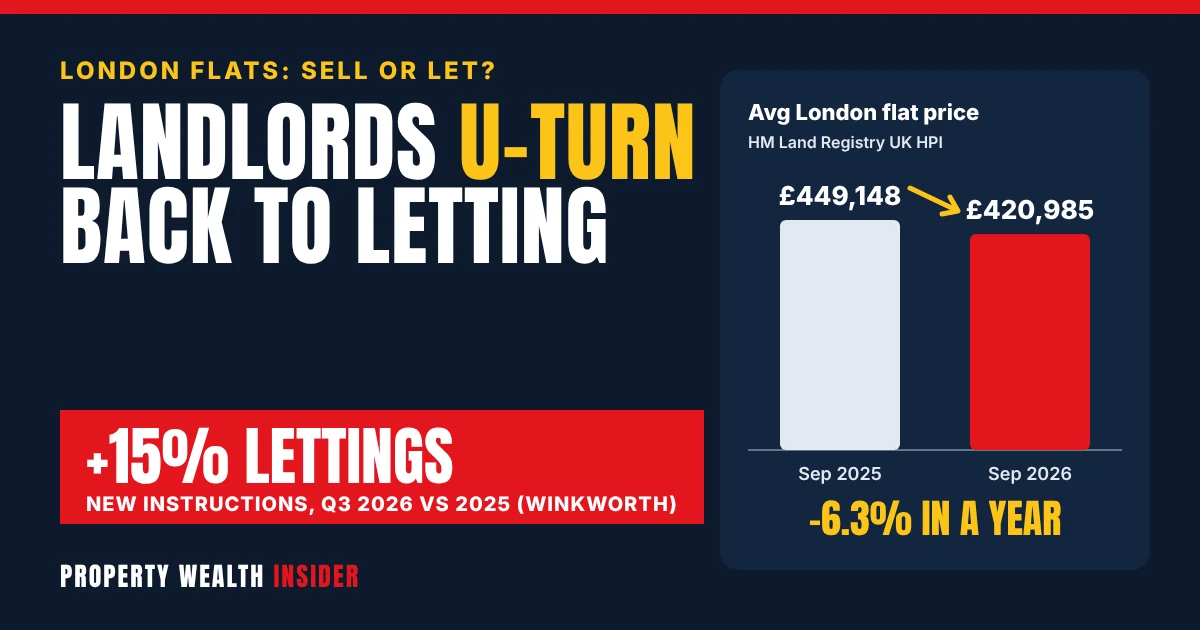
London landlords who put their flats up for sale this summer are quietly changing their minds. Winkworth’s latest Prime Fringe report shows new lettings instructions at its outer prime London offices jumped 15% in the third quarter of 2026 compared with a year earlier, as owners who had tested the sales market found buyers would not pay their price.
It is a sharp reversal. Over the summer, as the Renters’ Rights Act took effect in England on 1 May 2026, the same offices saw sales valuations rise 18% and lettings valuations fall 21%. Now flats are selling for less, taking longer to exchange, and HM Land Registry data shows the average London flat is worth 6.3% less than a year ago.
If you own a London flat and can’t decide whether to sell or re-let, here are the numbers, the tax on both sides, a Renters’ Rights Act trap, and a calculator.
Key facts
- New lettings instructions at Winkworth’s prime fringe offices were up 15% year-on-year in Q3 2026, after falling 17% over the summer.
- In Q2 2026, Winkworth’s sales valuations rose 18% while lettings valuations fell 21%: landlords were testing a sale.
- Its typical home exchanged at just over 97% of final asking price, down from almost 99% a year earlier, and launch to exchange took around six months.
- The average London flat cost £420,985 in September 2026, down 6.3% in a year (HM Land Registry UK HPI).
- CGT on residential gains is 18% or 24%, with a £3,000 allowance, and must be reported and paid within 60 days of completion.
- From 6 April 2027, property income is due to be taxed at 24%, 44% or 49% in England, Wales and Northern Ireland under Budget 2026 plans.
What Winkworth’s numbers show
The Prime Fringe Autumn Report 2026, published on 17 November, covers Winkworth’s offices just outside prime central London: Barnes, Chiswick, Clapham, Fulham & Parsons Green, St John’s Wood and North Kensington. It is one agent’s internal data, not a market-wide index, but it shows landlord behaviour from both the sales and lettings side.
| Measure (Winkworth fringe offices) | Period | Change on a year earlier |
|---|---|---|
| Sales valuations | Q2 2026 | +18% |
| Lettings valuations | Q2 2026 | −21% |
| New lettings instructions | Summer 2026 | −17% |
| New lettings instructions | Q3 2026 | +15% |
| Buyer registrations | Q3 2026 | +13% |
| New sales instructions | Q3 2026 | +4% |
| Agreed sales | Q3 2026 | Level |
| Sale price achieved vs final asking | Autumn 2026 | Just over 97% (almost 99% a year earlier) |
| Launch to exchange | Autumn 2026 | Around 6 months (about a month longer) |
Landlords asked for sale valuations in the summer, but only around three in five valuations became instructions, against two in three a year before. As former rentals hit the market, flat buyers got more choice and offers slipped below asking. One-beds made up 22% of Winkworth’s completed sales in the three months to September, up from 17%.
Ben Ainsworth, director of Winkworth Clapham, says in the report that “a significant proportion of landlords would still prefer to sell, but have been discouraged by the prices they can realistically achieve.” In other words, many of the landlords coming back are waiting, not recommitting.
Rental supply has swung back too: Winkworth’s registered tenants per new letting fell from close to 23 over the summer to around 16 in the autumn, below 18 a year earlier.
London flat prices: the official picture
The official UK House Price Index from HM Land Registry and the ONS backs up what agents are seeing. In the latest release, published 18 November 2026, the average London flat or maisonette cost £420,985 in September 2026, down from £449,148 a year earlier. That is a 6.3% fall, almost double the 3.5% drop for all London property types.
Over two years, the average London flat has lost £32,916. A landlord selling today is locking in that markdown, which is exactly why some are choosing to wait. The next UK HPI release, covering October, is due on 16 December 2026.
What a slower, softer sale costs you
Winkworth’s figures put a price on the weaker market. Its typical discount from final asking price rose from 1.4% in autumn 2025 to 2.7% in autumn 2026, even though there were more registered buyers per new instruction (9.0, up from 8.3).
Worked example: on a flat with a final asking price of £450,000, achieving almost 99% gets you about £445,500. Achieving 97% gets you £436,500. That two-point slide costs you £9,000 before you pay a penny in fees or tax.
Time is the second cost. Six months on the market with the flat empty means paying the mortgage, service charge and council tax with no rent. GOV.UK says you will usually pay council tax on an empty home, and a premium can apply once it has been empty for a year.
Worked example: mortgage interest of £850 a month, a £3,000 annual service charge (£250 a month) and council tax of £160 a month add up to £1,260 a month. Over six months that is £7,560 out of your pocket. Add six months of lost rent at £2,200 and the true cost of an empty sale period is £20,760.
The tax maths: CGT now, higher rental tax from April 2027
If you sell: according to GOV.UK, gains are taxed at 18% where they fall within your basic rate income tax band and 24% above it, for higher and additional rate taxpayers. The annual tax-free allowance for 2026 to 2027 is £3,000. You can deduct estate agent and solicitor fees and the cost of improvement work such as an extension, but not normal maintenance such as decorating.
UK residents must report and pay CGT on UK residential property within 60 days of completion. Budget 2026, delivered on 28 October, left residential CGT rates unchanged.
Worked example: you sell for £436,500 and pay selling costs of £6,548 (1.5%). You bought for £300,000 and spent £20,000 on improvements, so your cost base is £320,000. The gain is £109,953. After the £3,000 allowance, £106,953 is taxable. As a higher rate taxpayer you pay 24%, a bill of £25,669. Clear a £200,000 mortgage and you walk away with about £204,284.
If you keep letting: property income is taxed at normal income tax rates for 2026 to 2027 (20%, 40% and 45%). The Budget 2026 document says that from 6 April 2027 the property basic rate will be 24%, the higher rate 44% and the additional rate 49%, across England, Wales and Northern Ireland. That is a further two points on top of the 22%, 42% and 47% announced at Budget 2025. It is still to be legislated in Finance Bill 2026-27, so it is a plan, not law yet. Scotland is not included.
Mortgage interest is still not deductible. HMRC’s Budget 2025 paper says finance cost relief will be given at the property basic rate; we assume that means 24% under the Budget 2026 plans.
Worked example: the same flat lets for £2,200 a month (£26,400 a year). Take away the service charge (£3,000) and other costs such as letting fees, insurance and repairs (£4,500), and £18,900 is taxable. At 44% that is £8,316 tax, reduced by a 24% credit on £10,200 of mortgage interest (£2,448), so the bill is £5,868. After interest, you keep about £2,832 a year.
The squeeze in one line: in our example, the sale releases about £196,700 after a six-month empty period. At 4% interest (Bank Rate has been 4% since the Bank of England’s rise on 5 November 2026), taxed at the 44% higher savings rate due from April 2027, that cash would earn about £4,407 a year, against £2,832 from letting. Selling earns around £1,575 a year more, but the £20,760 cost of an empty sale would take about 13 years to recover. That is why so many landlords are hesitating.
Change one number and the answer flips. A basic rate taxpayer in the same example comes out ahead by letting. A smaller mortgage, or selling with the tenant in place, changes it again.
The Renters’ Rights Act trap if you evict to sell
This applies to England only. Since 1 May 2026, landlords who want vacant possession to sell must use the selling ground, Ground 1A. GOV.UK guidance says you must give 4 months’ notice, and you cannot use it to end a tenancy within its first 12 months.
The catch: the government’s guide to the Act says landlords cannot market or re-let the property for 12 months after using the selling or moving-in grounds. Breaching that restriction is an offence and can lead to a rent repayment order.
So if you evict to sell and then cannot get your price, you cannot simply return to letting as these Winkworth landlords did. You could be stuck with an empty flat, still paying the bills, for up to a year. The landlords who could switch back were mostly those whose flats were empty anyway, or who never served notice.
Tenants, meanwhile, can end a tenancy with two months’ notice. Winkworth’s Ben Ainsworth says tenants have become “more willing to serve two months’ notice and move” if they are unhappy. If your tenant leaves of their own accord, you are free to sell or re-let.
Sell now or keep letting? Run your numbers
Enter your own figures. The defaults match the worked examples above: a £450,000 asking price, a 3% discount (in line with Winkworth’s “just over 97%”) and a six-month wait to exchange.
Sell now or keep letting?
Guide only, not financial or tax advice. Uses the £3,000 CGT allowance and assumes no other gains; the 18% rate only applies to gains within your basic rate band. Rental tax uses the Budget 2026 rates planned for England, Wales and Northern Ireland from 6 April 2027 (not yet law), with mortgage interest relief assumed at 24%, and treats interest on the cash as taxed at the same rate. It ignores future price changes, early repayment charges and the personal savings allowance.
What to do now: step by step
- Get two realistic valuations, and plan for 97%. Ask agents what flats like yours have actually exchanged at, not what they were listed at. Run your numbers at 3% below asking, and test 5% too.
- Work out your CGT before you list. Pull together your purchase completion statement, agent and legal fee invoices and improvement receipts. Remember the 60-day deadline to report and pay after completion.
- Model your rent after April 2027. Re-run your letting profit at 24%, 44% or 49%. If you are a higher rate taxpayer with a large mortgage, your after-tax return may be thinner than you think.
- Think hard before serving Ground 1A notice. Four months’ notice plus a six-month sale, with a 12-month re-letting bar if it falls through. Selling tenanted avoids this, though Winkworth says investor buyers are largely absent across prime London.
- If the flat is already empty, decide quickly. Every month empty costs you the full outgoings plus the lost rent. Set a deadline and a minimum price; if no acceptable offer arrives, re-let.
- If you keep letting, keep the tenant happy. Tenants can leave on two months’ notice, so good management and fair annual rent reviews protect your income.
- Two agent valuations, with recent exchange prices for similar flats
- Purchase completion statement and legal fee invoices
- Invoices for improvement work (not repairs or decorating)
- Mortgage redemption statement, including any early repayment charge
- Service charge, ground rent and council tax figures for an empty period
- Current tenancy start date (Ground 1A cannot end a tenancy in its first 12 months)
- Your expected 2026-27 and 2027-28 income, to confirm your tax band
- A note in your diary: report and pay CGT within 60 days of completion
FAQs
Are London landlords selling up or staying?
Both. Winkworth’s fringe offices saw landlords test the sales market over the summer, then 15% more new lettings instructions in Q3 as flat prices disappointed. Its agents say smaller landlords with one or two properties are still more likely to sell.
How much are London flat prices falling?
The UK House Price Index puts the average London flat at £420,985 in September 2026, down 6.3% on a year earlier. The October figures are due on 16 December 2026.
How much capital gains tax will I pay selling a buy-to-let?
18% on any part of the gain within your basic rate band and 24% above it, after deducting what you paid, estate agent and solicitor fees, improvement costs and the £3,000 annual allowance. You must report and pay within 60 days of completion.
Should I sell my buy-to-let before April 2027?
The April 2027 change raises tax on rental income, not CGT, so there is no CGT reason to rush. The question is whether your after-tax rent at the new rates beats what the sale cash would earn. Run both sides in the calculator above.
Can I re-let if my flat doesn’t sell after evicting the tenant?
Not straight away in England. Government guidance says you cannot market or re-let for 12 months after using the selling ground, and breaking that rule is an offence.
Sources
- Winkworth: Prime Fringe Market Update, Autumn / Winter 2026
- Winkworth Prime Fringe Autumn Report 2026 (PDF)
- HM Land Registry: UK House Price Index England, September 2026
- HM Land Registry: UK HPI full data file, September 2026
- GOV.UK: Capital Gains Tax rates and allowance
- GOV.UK: Work out your gain when selling a property
- GOV.UK: Report and pay CGT on UK property within 60 days
- HM Treasury: Budget 2026
- HMRC: Changes to tax rates for property, savings and dividend income
- GOV.UK: Income Tax rates and bands
- MHCLG: Renters’ Rights Act implementation roadmap
- MHCLG: Grounds for possession guidance
- MHCLG: Guide to the Renters’ Rights Act
- GOV.UK: Council Tax on empty properties
- Bank of England: Bank Rate
This article is news and general guidance, not financial, legal or tax advice. Take professional advice on your own circumstances.