Holiday let key safes: 58% leave a key in – is your cover safe?
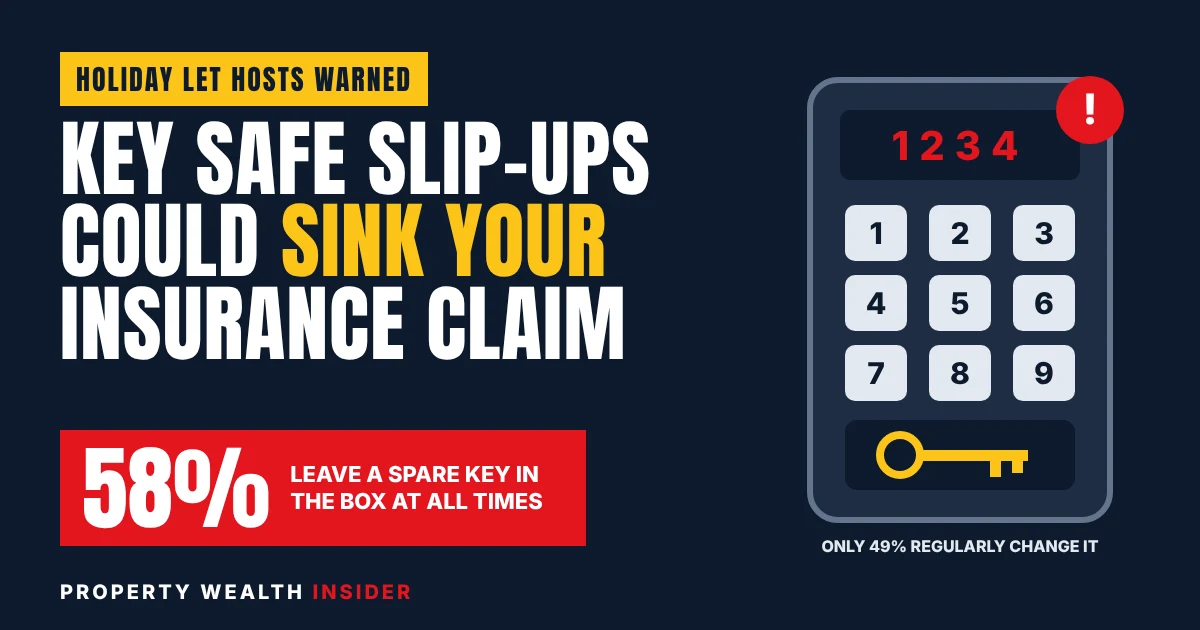
More than half of key safe owners leave a spare key sitting in the box around the clock, even when nobody is due to arrive. That is the headline from new consumer research by MoneySuperMarket, and it lands squarely on holiday let and serviced accommodation hosts who rely on self check-in.
The same research found fewer than half of owners change their code regularly, and almost a third would happily send it by text or WhatsApp. Put that next to official crime data showing most domestic burglars come in through a door, usually at the front, and the problem is obvious: the box by your front door is only as secure as the habits around it.
For landlords the real sting is the insurance claim. If someone walks in with your own key, there may be no sign of forced entry, and your insurer will want to know whether you followed the security conditions in your policy. Here is what the numbers say, what to fix this weekend, and a free tool to score your own set-up.
Key facts
- 58% of key safe owners surveyed keep a key in the box at all times, even when no one is expected (Censuswide for MoneySuperMarket, 1,000 UK adults, September 2026).
- Only 49% of key safe owners regularly change the code; 32% of people would share a code by text or WhatsApp.
- 199,015 of 310,467 Airbnb listing pages analysed (about 64%) advertised self check-in.
- A door was the way in for 76% of domestic burglaries in England and Wales in the year to March 2025, and 60% came in at the front (ONS, Crime Survey for England and Wales).
- In only around 3% of those burglaries did the offender already have a key, but in 14% the door was simply not locked (ONS).
- England’s mandatory short-let register is not yet in force; gov.uk says it is expected to begin in March 2027.
What the key safe research found
MoneySuperMarket commissioned Censuswide to survey 1,000 UK adults in September 2026 about who they trust with their door codes and how they manage them. It also crawled 310,467 Airbnb listing pages to see how many advertised self check-in.
One caveat worth knowing: the 58% and 49% figures are based on the key safe owners within that 1,000-person sample, not all 1,000. So treat them as a strong signal about habits, not a precise national measurement. Self check-in also does not always mean a key safe; many hosts use smart locks or keypads instead.
| Finding | Figure | Why a host should care |
|---|---|---|
| Key safe owners who keep a key in the box at all times | 58% | An empty property with a key outside is accessible to anyone who has ever had the code. |
| Key safe owners who regularly change the code | 49% | Last month’s guest, cleaner or contractor may still be able to get in. |
| People who would share a code by text or WhatsApp | 32% | Messages get forwarded, screenshotted and left on lost phones. |
| Airbnb listing pages advertising self check-in | 199,015 of 310,467 (64%) | Contactless arrival is now the norm, so your access set-up is part of your security. |
How burglars actually get in
The Office for National Statistics publishes detailed “nature of burglary” tables from the Crime Survey for England and Wales. For April 2024 to March 2025, they show doors were the route in for 76% of domestic burglaries in a dwelling, against 17% for windows.
The front of the property was the point of entry in 60% of cases, the back in 33% and the side in 5%. That front door, with a key box screwed to the wall beside it, is exactly where most attempts happen.
The detail cuts both ways. Only around 3% of burglaries involved an offender who already had a key, so a key box is not some magnet for mass break-ins. But 14% happened because the door was not locked at all, and that is the self check-in failure most hosts will recognise: a guest leaves without locking up, the key goes back in the box, and the property sits open until the cleaner arrives.
The ONS figures are based on 245 survey incidents, so small shifts year to year should not be over-read. The direction is clear enough: the front door is the main battleground.
Why it matters for your insurance claim
Whether a key safe affects a claim comes down to two things: how the thief or intruder got in, and what your policy’s security conditions say. Insurers can ask how access was gained and whether you met any requirements on locks, key storage and approved security devices.
MoneySuperMarket’s own guidance notes that some insurers may reject a theft claim where keys from a key safe were used to get in. Some policies specify a particular model or security standard of key safe. If yours does and you fitted something else, that is a problem you want to find now, not after a break-in.
There is a more basic trap too. The government’s guidance for self-catering holiday homes in England says hosts should have dedicated holiday let insurance, public liability cover, and buildings and contents cover suitable for short-term letting. A standard home policy on a property you let to paying guests is unlikely to be the right cover at all.
Worked example (illustrative): A two-bed coastal let earns £160 a night. A previous guest still has the code, which was never changed, and lets themselves in while the property is empty. Contents worth £3,500 go and the door frame is damaged. There is no forced entry, and the insurer finds the policy required a specified key safe standard that was not met. If the claim fails, the host pays the £3,500 plus repairs, and loses 12 booked nights while the place is put right: 12 x £160 = £1,920. Total hit: £5,420 before repairs, for a code that would have taken two minutes to change.
The reverse is also true. A host who changes the code for every booking, removes the key when no one is due, uses an independently attack-tested key safe that meets any policy requirement, and has told the insurer how check-in works is in a far stronger position if something goes wrong.
Score your key safe and self check-in risk
Tick what applies to your property. The tool gives a score out of 100, a risk band and the fixes that would add the most points. Below it, plug in your nightly rate to see what a rejected claim or forced closure could cost you.
Key safe & self check-in risk score
What a rejected claim could cost
Guide only. The score is a simple self-check built from published police and insurer guidance, not an insurer’s rating. Your cover depends on your own policy wording; read it or ask your insurer or broker.
With the default settings (code changed every guest but sent by WhatsApp, an unrated box visible from the street, the key left in between stays) the score is 40 out of 100: high risk. Fourteen lost nights at £150 is £2,100 of income, and with £2,500 of uninsured loss the bill reaches £4,600.
What to do now: 8 steps
- Dig out your policy wording. Search it for “key”, “key safe”, “lock”, “security” and “forced”. Note any named standard or model and any condition on unoccupied periods.
- Confirm the cover is right for paying guests. Gov.uk guidance says self-catering hosts in England should hold dedicated holiday let insurance with public liability and suitable buildings and contents cover.
- Tell your insurer how check-in works. Put it in writing: key safe or smart lock, where it is, how codes are issued. Keep the reply.
- Check the box itself. Police preferred key safes carry the Secured by Design mark and are attack-tested by an independent body. Guidance on the Secured by Design website says such boxes are tested against LPS 1175, the same Loss Prevention Certification Board standard used for doors and windows.
- Fit it properly. The same guidance advises a solid wall near the door, not the door itself, wooden fences, plastic cladding or plasterboard, with masonry fixings of at least 60mm.
- Think about sightlines. Out of street view is sensible, but do not bury it somewhere so hidden that someone could work on it unseen. Near the door and screened is the balance.
- Change the code every booking and pull the key between stays. Avoid birthdays and repeated digits. Log the date of each change.
- Send codes through the booking platform. Release them close to arrival, after any ID check, and never post a permanent code in your listing or house manual.
- Policy wording checked for key safe and security conditions
- Holiday let (not standard home) insurance in place, with public liability
- Insurer told in writing about self check-in
- Key safe is police preferred / independently attack-tested
- Fitted to solid masonry, not door, fence or cladding
- Not visible from the street, but not hidden from all view
- Code changed after every guest, cleaner and contractor
- Key removed when no booking is due
- Codes sent via booking platform, close to arrival
- Guest identity checked before code is released
- Door locked and box inspected at every changeover
- Log of code changes kept for any future claim
Other holiday let rules on the radar
Security is only one part of running a compliant short let. Three changes matter for most hosts right now, and only one of them is already in force.
| Change | Where | Status | What it means |
|---|---|---|---|
| Furnished holiday lettings (FHL) tax regime abolished | UK | In force from 6 April 2025 (income tax and CGT) and 1 April 2025 (corporation tax) | Holiday let income is now taxed like other residential lettings. Mortgage interest relief is restricted to a basic rate tax credit for individuals, and the old capital allowances, gains reliefs and pension earnings treatment have gone, subject to transitional rules. |
| Mandatory short-term let registration | England | Not yet in force; gov.uk says it is expected to begin in March 2027 | A mandatory national register for short-term lets is being introduced. Detailed rules are still to be confirmed, so watch for the launch. |
| Visitor levy | Cardiff (Wales) | Coming: new bookings for stays from 1 April 2027 | £1.30 per person per night for most accommodation (75p for hostel dorms and pitches). Providers pay it to the Welsh Revenue Authority. |
The levy is easy to underestimate. A family of four staying seven nights in a Cardiff holiday let would carry 4 x 7 x £1.30 = £36.40 of levy. Other Welsh councils can choose to introduce it after consulting, so check the Welsh Government’s tool for your area.
FAQ
Does a key safe invalidate holiday let insurance?
Not automatically. It depends on your policy’s security conditions. Some policies name a standard or model of key safe, and some insurers may refuse a theft claim if a key from the box was used to get in. Check the wording and tell your insurer how guests access the property.
Will my insurer pay if there was no forced entry?
That is the risk with key safes. Insurers look at how entry was gained, and a burglary using your own key leaves no damage to prove it. Records showing you changed the code and met every policy condition will help your case.
What is a police approved key safe?
“Police approved” usually means police preferred: the product carries the Secured by Design mark after independent attack testing. Guidance on the Secured by Design site says these key safes are tested against LPS 1175. Sold Secure is another independent testing scheme. Always check which standards your insurer accepts.
How often should I change my key safe code?
For a holiday let, after every guest and after anyone else (cleaners, trades) has had it. The research found only 49% of key safe owners regularly change their code.
Is it safe to send a key safe code by WhatsApp?
It is convenient, but messages can be forwarded or read on a lost phone, and 32% of people surveyed said they would do it. Using the booking platform’s messaging, close to arrival and with a code that changes each stay, limits the damage if it leaks.
Do I need to register my holiday let in England?
Not yet. The national registration scheme is not in force; gov.uk says it is expected to begin in March 2027. Your council may already have planning or local rules, so check with them.
Sources
- MoneySuperMarket: Key safe loopholes research (Censuswide survey and Airbnb analysis)
- MoneySuperMarket: Does a key safe invalidate home insurance?
- ONS: Nature of crime: burglary, year ending March 2025 (Tables 2a and 3a)
- GOV.UK: Letting out a self-catering holiday home in England: rules and regulations
- GOV.UK: Abolition of the furnished holiday lettings tax regime
- GOV.UK: Delivering a registration scheme for short-term lets
- Welsh Government: Visitor Levy in Wales
- Secured by Design: What to look for when buying a key safe
This article is news and general guidance only, not financial, legal, tax or insurance advice. Check your own policy and take professional advice for your situation.