Airbnb a leasehold flat? 90-night cap and the lease trap
Thinking of putting your leasehold flat on Airbnb? Before you list it, read your lease. In many flats the freeholder can stop short lets outright, and if you go ahead without permission you could be handed a tribunal ruling that you are in breach, the first step towards losing the lease altogether.
It is one of the most common questions flat owners ask, and the rules are getting tighter. A mandatory national registration scheme for short-term lets in England is now expected to start in March 2027, according to government guidance updated on 2 October 2026. In London, the 90-night planning cap still applies.
This guide covers England (with a few verified differences for Wales and Scotland). It is aimed at owner-occupiers who want to let their home while they are away, and at investors weighing serviced accommodation against a normal long let.
Key facts
- A lease clause limiting use to a “private residence” was held to be breached by short lets of days or weeks in Nemcova v Fairfield Rents [2016] UKUT 303 (LC).
- Before a freeholder can start forfeiture, the breach must be admitted or decided by a tribunal or court (s168 Commonhold and Leasehold Reform Act 2002), then 14 days must pass.
- In Greater London, short lets are capped at 90 nights per calendar year without planning permission, and the host must pay council tax on the property.
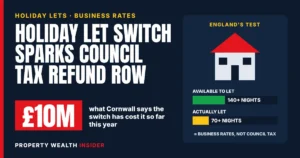
- In England a short let is moved onto business rates if it is available for 140+ nights and actually let for 70+ nights a year.
- The furnished holiday lettings tax regime was abolished from 6 April 2025. Registration is not yet in force and is expected in March 2027.
What your lease says about use
Owning a leasehold flat means you hold it under a contract with the freeholder. That contract nearly always limits how the flat can be used. The clause that matters for Airbnb is usually called the “user covenant”.
Typical wording says the flat must not be used “for any purpose other than as a private residence”, or “as a private dwelling” or “single private dwelling”. Some leases also ban any “trade or business” use, or anything that causes a nuisance to other residents.
The leading case is Nemcova v Fairfield Rents Ltd [2016] UKUT 303 (LC), decided by the Upper Tribunal (Lands Chamber) on 6 September 2016. The flat was in Enfield. The leaseholder said it was still her main home, that she let it for about 90 days a year, and mostly to business visitors.
She still lost. The judge held that using a property as a private residence needs “a degree of permanence going beyond being there for a weekend or a few nights in the week”. Granting very short lets, of “days and weeks rather than months”, breached the covenant. Her appeal was dismissed.
The catch: the tribunal stressed each case turns on the exact wording of the lease. Its own answer was “it all depends”. So do not rely on a friend’s lease or a forum post. Read yours, including any regulations or schedules it refers to.
Can the freeholder say no?
That depends on whether a clause is absolute (a flat ban) or qualified (allowed with consent). Two different kinds of clause are in play, and the law treats them differently.
Underletting and “parting with possession” clauses. If your lease bans underletting without consent, section 19(1) of the Landlord and Tenant Act 1927 implies that consent “is not to be unreasonably withheld”. Under section 1 of the Landlord and Tenant Act 1988, once you apply in writing the freeholder must respond within a reasonable time, and give conditions or reasons for refusal in writing.
User clauses (“private residence only”). Here the 1927 Act goes less far. Section 19(3) only stops a landlord charging a fine or premium for consenting to a change of use that involves no structural work. It does not force the freeholder to agree. Where the user covenant is absolute, the freeholder can simply refuse, and you would need a deed of variation to change it.
| What the lease says | Short-let risk | What it means for you |
|---|---|---|
| Use only as a private residence or private dwelling | High | Short lets of days or weeks are likely to breach it (Nemcova). Get written consent or a deed of variation first. |
| No trade or business use | Medium to high | Regular paid short lets may be argued to be a business. Take legal advice on your wording. |
| No underletting without consent, not to be unreasonably withheld | Medium | Apply in writing. The 1988 Act requires a reasoned reply in reasonable time. |
| Absolute ban on underletting or parting with possession | High | The freeholder can refuse. Only a variation removes the ban. |
| Expressly permits holiday or short lets | Lower | Lease risk is reduced, but planning, mortgage and insurance rules still apply. |
What happens if you let without consent
The worst case is forfeiture: the freeholder asks the court to end your lease. For a long lease of a dwelling, Parliament built in a safeguard first.
Under section 168 of the Commonhold and Leasehold Reform Act 2002, the freeholder cannot serve a section 146 forfeiture notice unless you have admitted the breach, or a tribunal or court has finally decided it happened. In England the application goes to the First-tier Tribunal. After a final decision, the freeholder must wait 14 days before serving the notice.
That is exactly the route taken in Nemcova: the freeholder applied under section 168(4), won at the First-tier Tribunal, and the Upper Tribunal upheld it. A ruling against you does not end your lease on its own, but it hands the freeholder the formal finding they need to take things further.
Be careful what you put in writing. An email saying “yes, I have been letting it on Airbnb” can count as an admission under section 168(2)(b). Get advice before you reply to a freeholder’s letter.
London’s 90-night rule and planning
Freeholder consent is only half the story. In Greater London, using homes as temporary sleeping accommodation counts as a material change of use under the Greater London Council (General Powers) Act 1973, so it needs planning permission.
Section 44 of the Deregulation Act 2015, in force since 26 May 2015, created an exception. You do not need permission if two conditions are met: total short-let nights in the calendar year do not exceed 90, and the person providing the accommodation is liable for council tax on the property for each of those nights.
Two traps. The 90 nights count all short-let use of the premises that year, by anyone, so a previous owner’s lets count too. And a council or the Secretary of State can switch the exception off for a particular property or area to protect local amenity.
Outside London, there is no fixed night count. Government guidance says your local planning authority decides whether you need permission, based on how the property is used and its effect on neighbours.
What is proposed, not in force: in 2023 the government consulted on a new “C5 Short Term Let” use class for England with linked permitted development rights. As of 5 November 2026 there is no short-term let use class for England in the Use Classes Order. The national registration scheme, legislated for in the Levelling-up and Regeneration Act 2023, is marked “not yet in force” and is expected to begin in March 2027.
Mortgage, insurance, rates and tax
Mortgage. Read your mortgage conditions. If they bar letting without the lender’s consent, get that consent in writing before the first guest arrives. A buy-to-let mortgage written for long lets may not cover holiday letting either.
Insurance. In a block, the freeholder usually insures the building, and leases commonly forbid anything that could void that policy. Tell the freeholder’s insurer what you plan. Government guidance says short lets should have dedicated holiday let insurance, public liability cover, and buildings and contents cover suitable for short-term letting.
Fire safety. Paying guest accommodation falls under the Regulatory Reform (Fire Safety) Order 2005. The government’s guide Making your small paying guest accommodation safe from fire includes a fire risk assessment checklist. Gas and electrical safety rules also apply.
Council tax or business rates. In England, a property is valued for business rates as self-catering if it is let commercially for periods of 28 nights or less, was available for at least 140 nights and actually let for at least 70 nights in the last 12 months, and will be available for at least 140 nights in the next 12. Otherwise it stays in council tax. Wales uses 252 and 182 nights.
Income tax. The furnished holiday lettings regime was abolished on 6 April 2025 (1 April 2025 for companies). Short-let profits are now taxed under the same rules as other residential lettings.
Worked example (London, owner away 90 nights): at £120 a night for 90 nights you take £10,800. Deduct a 15% platform and management fee (£1,620), 30 cleans at £40 (£1,200) and £1,800 of extra running costs, and you keep about £6,180 before tax. Let the same flat on a long let at £1,300 a month with a 10% agent fee and you keep £14,040 a year. Using those figures, short lets only catch up at around 179 nights, which is double London’s cap.
Short-let checker and income calculator
Pick the answers that match your lease and plans. The checker gives a risk verdict and a to-do list. The calculator compares short-let profit with a long let (since 1 May 2026, new private tenancies in England are assured periodic tenancies).
Short-let checker for leasehold flats
Guide only, not legal or financial advice. Figures are before tax. Your lease wording, your lender and your council decide what is allowed.
What to do now: step by step
- Get your lease. Find the user covenant, the underletting clause and any regulations schedule. If the flat is registered, a copy can be obtained from HM Land Registry.
- Classify each clause. Is it absolute or qualified? Does it say “private residence” or “private dwelling”? Use the table above.
- Write to the freeholder. Explain what you plan: how many nights, typical stay length, house rules, cleaning and key handover. Ask for consent or a licence in writing. Expect to pay their reasonable legal costs.
- Clear the lender and insurer. Get mortgage consent in writing and make sure the building and your own policy cover paying guests.
- Check planning. In London, track nights per calendar year and stay at 90 or below unless you have permission. Elsewhere, ask the council.
- Do the safety work. Fire risk assessment, smoke and carbon monoxide alarms, gas and electrical checks.
- Run the numbers. Compare net short-let profit with a long let using the calculator, and keep records for business rates and income tax.
- Lease read: user covenant and underletting clause noted
- Freeholder consent or licence received in writing
- Managing agent told, building rules for guests checked
- Mortgage lender consent in writing
- Buildings insurer told; holiday let and public liability cover in place
- London: nights log kept, 90 or fewer per calendar year
- Council tax in your name (London exception)
- Fire risk assessment done; alarms tested
- Gas and electrical safety checks done
- Business rates position checked (140 available / 70 let)
- Records kept for HMRC
FAQs
Do I need the freeholder’s permission to Airbnb my flat?
If your lease restricts use to a private residence, or restricts underletting, you will usually need written consent. Some leases ban short lets outright, and then the freeholder can simply say no. Check the exact wording.
Can a freeholder take my flat for doing Airbnb?
Forfeiture is possible for breach of covenant, but the freeholder must first get a tribunal or court decision that a breach happened, or your admission, under section 168 of the 2002 Act. You can apply to the court for relief from forfeiture under section 146(2) of the Law of Property Act 1925, but take legal advice early.
Is the London 90-night limit per year or per guest?
Per calendar year, for the property. It counts all short-let nights that year, including any by a previous owner, and only applies if the host pays council tax on the property.
Do I need to register my short let in England?
Not yet. The mandatory national registration scheme is not in force. Government guidance updated on 2 October 2026 says it is expected to begin in March 2027.
Will I pay business rates instead of council tax?
In England, only if the flat is let commercially for periods of 28 nights or less, was available for at least 140 nights and actually let for at least 70 nights in the last 12 months, and will be available for at least 140 nights in the next 12.
Is the rule different in Scotland or Wales?
Yes. Scotland runs a short-term let licensing scheme under the Civic Government (Scotland) Act 1982 (Licensing of Short-term Lets) Order 2022. Wales has added a short-term let use class (C6) to its planning law and uses 252 available and 182 let nights for business rates.
Sources
- Nemcova v Fairfield Rents Ltd [2016] UKUT 303 (LC), National Archives Find Case Law
- Landlord and Tenant Act 1927, section 19
- Landlord and Tenant Act 1988, section 1
- Commonhold and Leasehold Reform Act 2002, section 168
- Deregulation Act 2015, section 44
- Town and Country Planning (Use Classes) Order 1987, Schedule
- GOV.UK: Letting out a self-catering holiday home in England
- GOV.UK: Delivering a registration scheme for short-term lets
- GOV.UK: Spring 2023 consultations on short-term lets in England
- GOV.UK: Consultation on a use class for short-term lets (C5)
- Law of Property Act 1925, section 146
- GOV.UK: Business rates, self-catering and holiday let accommodation
- HMRC Property Income Manual PIM4150: furnished holiday lettings
- GOV.UK: Making your small paying guest accommodation safe from fire
- GOV.UK: Renters’ Rights Act overview
- Civic Government (Scotland) Act 1982 (Licensing of Short-term Lets) Order 2022
This article is news and general guidance, not financial, legal or tax advice.