Exempt housing probe hits 33,000 units: is your lease safe?
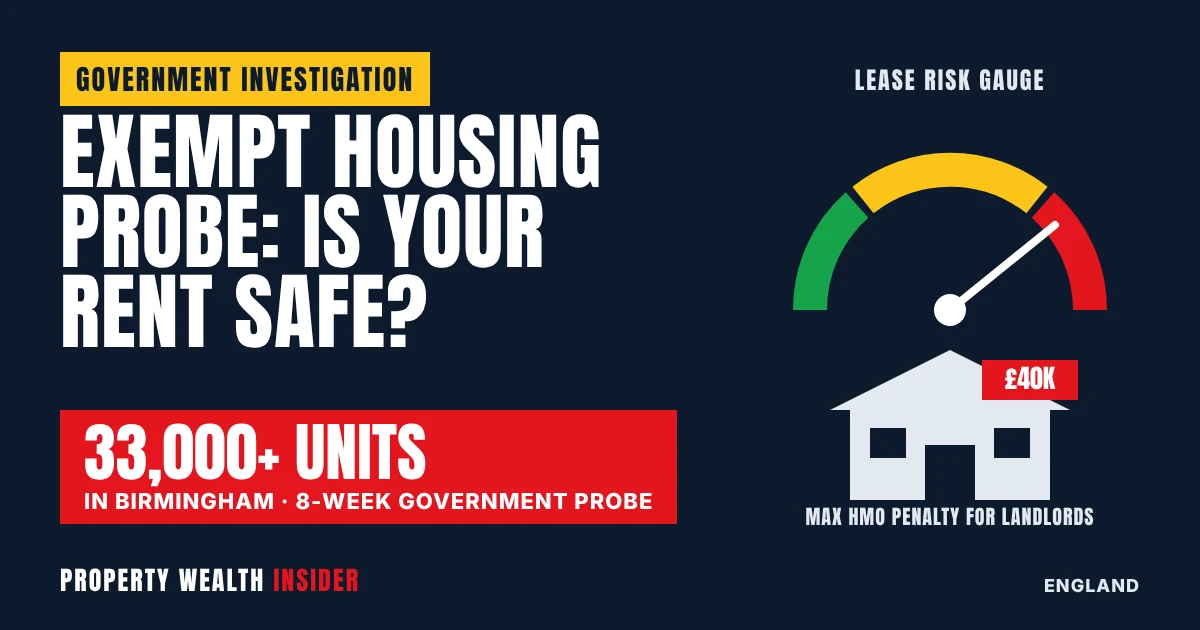
The government has ordered an urgent eight-week investigation into supported exempt accommodation in Birmingham, after reports of homes without heating or hot water, “ghost tenants” used to claim housing benefit, and support that was promised but never provided.
If you have been offered a “guaranteed rent” lease by a supported housing provider, this matters to you. Much of this sector runs on private landlords leasing homes to providers whose income depends on housing benefit, and the rules around that model are tightening fast.
Since 1 May 2026, a superior landlord in England can be prosecuted or fined up to £40,000 if the HMO they let to someone else is unlicensed. A new licensing regime for all supported housing in England is also out for consultation until 10 December 2026. Here is how the model works, where the risk sits, and how to check an offer before you sign.
Key facts
- The investigation, announced on 24 November 2026, will run for eight weeks and is led by Sir David Pearson, chair of the Supported Housing Advisory Panel.
- Birmingham City Council says the city has more than 33,000 supported exempt units across 12,000 properties, the largest concentration in England.
- Draft licensing regulations would require supported housing landlords in England to hold a five-year licence, with civil penalties of up to £40,000. Consultation closes 10 December 2026.
- Since 1 May 2026, superior landlords in England can commit the offence of operating an unlicensed HMO, and a clause in the lease is not on its own a defence.
- Exempt accommodation housing benefit is not capped at Local Housing Allowance, which is why providers can offer rents well above market.
What the government has announced
The Ministry of Housing, Communities and Local Government and the Department for Work and Pensions published the announcement on 24 November 2026. Housing Secretary Angela Rayner said the system “is being abused, with vulnerable people exploited at the expense of the taxpayer.”
Sir David Pearson will report directly to the two Secretaries of State. The government says initial findings and recommendations will go to ministers in the new year. Birmingham City Council, already working with government-appointed Best Value Commissioners, is expected to cooperate fully.
The investigation will look at three things: the quality of accommodation and support, how public money is used, and whether oversight and regulation are working. It will also ask whether the same problems exist elsewhere in the country.
None of this is new to MPs. In October 2022 the Commons Levelling Up, Housing and Communities Committee concluded: “we would describe the system of exempt accommodation as a complete mess.” That report found the number of households in exempt accommodation rose from 95,149 in 2016 to 156,868 in 2021, based on Freedom of Information data obtained by Crisis. The committee warned the rise may be overstated.
How exempt accommodation is paid for
“Exempt accommodation” is a housing benefit term. It covers a home provided by a non-metropolitan county council in England, a housing association, a registered charity or a voluntary organisation, where that body (or someone acting for it) also provides the resident with care, support or supervision.
It is one of four types of “specified accommodation”, alongside managed properties, refuges and local authority hostels. Housing costs in specified accommodation are not paid through Universal Credit. The resident claims housing benefit from the council instead.
The crucial bit for investors: DWP guidance says exempt accommodation claims use the “old scheme” (pre-1996) rules for working out eligible rent. They are not tied to Local Housing Allowance rates. A council can only cut the rent if it is unreasonably high compared with suitable alternative accommodation, not just higher.
Some limits do apply. The support itself must be “more than minimal”. Support, care and day-to-day living costs cannot be paid through housing benefit. Where the landlord is not a registered housing association, the claim must be referred to the Rent Officer. Councils are also told to set local rent limits to flag unreasonably high rents for scrutiny.
Why you are being offered guaranteed rent
Because exempt rents can sit above market levels, a provider can lease your house, fill each room with housing benefit claimants, and still pay you more than an ordinary tenant would. DWP guidance notes “an increase in supported housing providers leasing accommodation from profit-making organisations.”
The same guidance describes typical terms: short leases of three to ten years, long leases of 21 to 99 years, often on full repairing and insuring terms with annual rises linked to CPI.
Worked example. A five-bed house would let for £1,300 a month on the open market. A provider offers £2,000 a month on a 10-year lease. That is £700 a month extra, or £8,400 a year: a 53.8% premium over market rent.
| Ordinary let | Guaranteed-rent lease | |
|---|---|---|
| Monthly rent (example) | £1,300 | £2,000 |
| Who pays you | Your tenant | The provider, funded mostly by residents’ housing benefit |
| Rent level set by | The local market | What the council will accept as housing benefit |
| Typical lease length | Periodic tenancy | 3 to 10 years, or 21 to 99 years |
| Repairs | You | Often the provider (full repairing and insuring) |
| HMO licensing liability | You | Provider, and since 1 May 2026 potentially you too |
| If the payer fails | Rent arrears, possession claim | Provider insolvency, residents in situ, property condition unknown |
The premium is only as safe as the provider. The Regulator of Social Housing has warned that lease-based providers often have thin balance sheets, rely on 100% housing benefit income, and have seen void losses “as high as 40%” in some cases. It says a rescue by a stronger provider “cannot be presumed”.
The five risks for landlords who lease to providers
1. Provider failure. If the provider’s housing benefit is cut, its exempt status is refused, or it collapses, your “guaranteed” rent stops. You may get the property back with residents still in it and repairs that were never done.
Using the example above, say the provider fails after 18 months. You banked 18 x £700 = £12,600 of premium. Then three months empty costs £3,900 of market rent, and putting the house back into lettable condition costs £15,000. You end up £6,300 worse off than if you had let it normally.
2. HMO licensing offence. Mandatory HMO licensing in England applies to properties let to five or more people from more than one household who share facilities. Since 1 May 2026, the Renters’ Rights Act 2025 extends the section 72 offence to a landlord with a superior interest, so a head landlord can be liable as well as the provider.
You have a defence if you took all reasonably practicable steps to make sure the HMO was licensed, but the law now says a lease clause alone does not count. The maximum civil penalty is £40,000. In the example, that is almost five years of the £8,400 annual premium.
Buildings managed or controlled by a non-profit registered provider of social housing sit outside the HMO licensing rules. A charity or community interest company that is not a registered provider does not get that exemption.
3. Rent repayment orders. In 2023 the Supreme Court ruled in Rakusen v Jepsen that rent repayment orders could only be made against the immediate landlord. Since 1 May 2026, the law in England allows an order against a superior landlord who committed the offence.
4. Planning. The 2022 committee said non-registered providers with six or fewer residents could avoid needing planning permission, and that registered providers were outside Article 4 directions. It asked for these gaps to be closed. In April 2026 the government said it was “not minded” to change planning rules for supported housing yet. Check your local position before converting a house.
5. Enforcement and reputation. Birmingham City Council says it has investigated 7,000 complaints about the sector and recovered £8.8 million in housing benefit. The council has also called for a “property-based, mandatory licensing scheme”.
What the new licensing regime will change
The Supported Housing (Regulatory Oversight) Act 2023 has been in force since 29 August 2023. It created the Supported Housing Advisory Panel and powers for local supported housing strategies, National Supported Housing Standards and licensing. But licensing only happens once the regulations are made, and they have not been made yet.
The draft Supported Housing (Licensing) (England) Regulations 2027 would designate every local housing authority in England as a licensing district. Anyone “having control of, or managing” supported housing would need a five-year licence, meet the National Supported Housing Standards, and pass a fit and proper person test that now also covers the board.
| Rule | Status | Where |
|---|---|---|
| Supported Housing (Regulatory Oversight) Act 2023 | In force since 29 August 2023 (powers only) | England and Wales; licensing applies in England |
| Superior landlord HMO offence and £40,000 civil penalty cap | In force since 1 May 2026 | England |
| Rent repayment orders against superior landlords | In force since 1 May 2026 | England |
| Draft supported housing licensing regulations | Consultation 15 October to 10 December 2026 | England |
| Licensing in operation | Government expects implementation in 2027, subject to Parliament | England |
| Birmingham investigation | Eight weeks from 24 November 2026 | Birmingham, possibly wider |
Under the draft, councils would get six months to prepare once designated, followed by a three-month transition before operating without a licence becomes an offence. Councils would set their own fees on a cost-recovery basis. Penalties would reach £7,000, or £40,000 if an improvement notice is ignored.
Two details matter most for owners. The draft would switch off other property licensing, such as HMO licensing, where supported housing licensing applies. And the government has said that where a head landlord and a managing agent could both apply, they should agree who holds the licence. The managing agent is the appropriate holder if it runs the property day to day.
The government also plans to link housing benefit entitlement to the licence in England. In plain terms: an unlicensed provider could lose the income that pays your rent.
Check a lease offer: calculator
Enter the offer you have been sent to see the premium over market and the warning signs.
Supported-housing lease offer checker
Guide only, not legal or financial advice. The score is a simple weighting of common warning signs. It cannot judge a provider’s finances, the lease wording or your council’s licensing rules. Take legal advice before signing any lease.
What to do now
If you already lease to a provider:
- Find out whether the property needs an HMO licence and who holds it. Ask the council directly and keep the reply.
- Use your access rights to inspect. Check heating, hot water, fire safety and the number of residents against the licence.
- Ask the provider whether it plans to apply for a supported housing licence and who it expects to be the licence holder.
- Read your lease for break clauses, insolvency terms and handback condition, and get legal advice if any are missing.
- Consider responding to the government consultation before 11:59pm on 10 December 2026.
If you are weighing up a new offer, work through this checklist before you sign anything:
- Search the Regulator of Social Housing register and Companies House for the provider, its directors and any people with significant control.
- Ask for the provider’s latest accounts and check whether it has cash beyond housing benefit income.
- Ask which councils have accepted its rents as exempt, and whether any claims have been restricted or refused.
- Ask who commissions or funds the support, and how many hours each resident gets.
- Confirm with the council in writing whether an HMO licence (mandatory, additional or selective) is needed and who will hold it.
- Check whether planning permission or an Article 4 direction applies to the change of use.
- Insist on a break clause, a rent deposit or guarantee, a schedule of condition and a clear handback standard.
- Make sure the lease says rent is payable whether or not rooms are occupied.
- Agree a right to inspect at least twice a year and to see licence and safety certificates.
- Check your mortgage lender and insurer allow a lease to a supported housing provider.
- Have a solicitor who knows supported housing review the lease before signing.
FAQs
What is supported exempt accommodation?
It is housing provided by a housing association, charity, voluntary organisation or non-metropolitan county council that also gives residents care, support or supervision. Residents claim housing benefit rather than Universal Credit housing costs, and the rent is not capped at Local Housing Allowance.
Is guaranteed rent from a supported housing provider safe?
Only as safe as the provider paying it. The Regulator of Social Housing has warned that many lease-based providers have little cash and depend entirely on housing benefit. If their income is cut or they fail, your rent stops.
Can I be fined if the provider does not license the HMO?
Yes, in England. Since 1 May 2026 a landlord with a superior interest can commit the offence of operating an unlicensed HMO, with civil penalties of up to £40,000. A lease clause putting licensing on the provider is not enough on its own as a defence.
When will supported housing licensing start?
Not yet. Draft regulations are out for consultation until 10 December 2026, and the government expects implementation in 2027. Councils would then have six months to prepare and a three-month transition before unlicensed operation becomes an offence.
Sources
- GOV.UK: Urgent investigation into supported housing failure in Birmingham (24 November 2026)
- GOV.UK: Supported housing licensing regime, consultation on draft regulations
- GOV.UK: Supported housing regulation consultation, government response
- Supported Housing (Regulatory Oversight) Act 2023
- DWP: Housing Benefit guidance for supported housing claims
- Levelling Up, Housing and Communities Committee: Exempt Accommodation (October 2022)
- Birmingham City Council: roundtable on supported housing (July 2026)
- Regulator of Social Housing: Lease-based providers of specialised supported housing
- Housing Act 2004, section 72 and section 249A
- Housing Act 2004, Schedule 14
- Housing and Planning Act 2016, section 40
- Rakusen v Jepsen [2023] UKSC 9, press summary
- GOV.UK: House in multiple occupation licence
This article is news and general guidance, not financial, legal or tax advice.