£14,000 hole: what rent arrears cost before you get possession
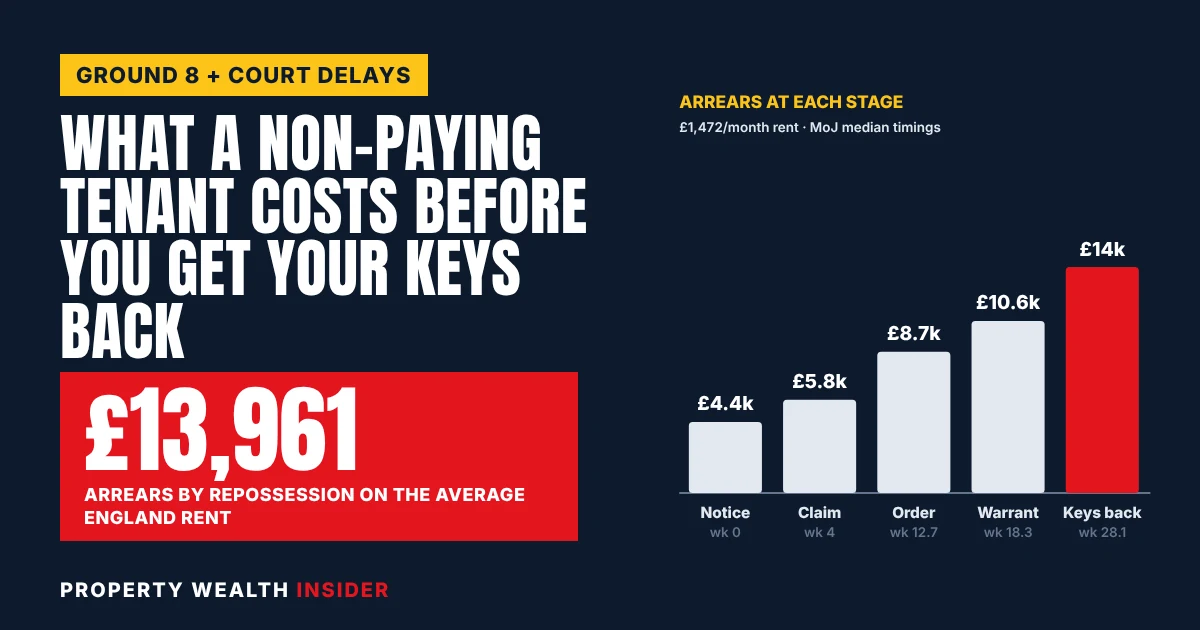
A tenant in England who stops paying the average rent could owe a landlord close to £14,000 by the time the bailiffs hand back the keys. That is what you get when you add the new legal minimum for a mandatory arrears claim to the time the courts are actually taking.
Since 1 May 2026, the mandatory rent arrears ground (Ground 8) needs three months’ rent owed, up from two, and a four-week notice, up from two weeks. Ministry of Justice figures published on 12 November 2026 show the typical private landlord claim then takes about 24 weeks to get from court to repossession.
This affects every private landlord in England who has a tenant falling behind. Below we run the numbers using official data only, region by region, and set out what to do from the first missed payment.
Key facts
- The average private rent in England is £1,472 a month (ONS, October 2026). In London it is £2,350.
- Ground 8 now needs at least 3 months’ rent unpaid, both when you serve notice and at the hearing. The notice period is 4 weeks (England, since 1 May 2026).
- Median time from claim to repossession for standard private landlord claims: 24.1 weeks. The mean is 32.3 weeks (MoJ, July to September 2026, provisional).
- Court fees: £415 to issue a possession claim and £152 for a bailiff warrant of possession.
- Using the average England rent and median timings, arrears reach about £13,961 (9.5 months’ rent) by repossession, or £14,528 with court fees.
The arrears rules since 1 May 2026
Section 21 has gone in England. The Ministry of Justice says valid section 21 notices had to be served by 30 April 2026, and accelerated possession claims issued by 31 July 2026. For a tenant who will not pay, you now rely on the rent arrears grounds in Schedule 2 to the Housing Act 1988, served on the new Form 3A. We looked at the rush of last-minute claims in our section 21 stampede report.
| Ground | What it needs | Notice | Court must evict? |
|---|---|---|---|
| Ground 8 (serious arrears) | At least 3 months’ rent (13 weeks if paid weekly or fortnightly) unpaid, both at notice and at the hearing | 4 weeks | Yes, it is mandatory |
| Ground 10 (some arrears) | Some rent unpaid when you serve notice and when you start proceedings | 4 weeks | No, only if the court thinks it reasonable |
| Ground 11 (persistent late payment) | Tenant has persistently delayed paying rent, even if nothing is owed on the day | 4 weeks | No, only if the court thinks it reasonable |
Two details catch landlords out. First, Ground 8 fails if the tenant pays the arrears down below the threshold before the hearing. Second, when you work out the arrears, you ignore any rent that is unpaid only because the tenant’s Universal Credit housing payment has not arrived yet.
Under the government’s Form 3A guidance, a notice is normally valid for 12 months, and you can apply to court the day after it expires. If the tenant enters a debt “breathing space”, you must not serve an arrears notice or start a new arrears claim while it lasts. These rules apply to England only. Wales has its own regime under the Renting Homes (Wales) Act.
How long possession really takes
The Ministry of Justice publishes timings for every type of landlord claim. For standard private landlord claims (not accelerated, not social housing), the median times in July to September 2026 were:
- 8.7 weeks from claim to possession order
- 14.3 weeks from claim to bailiff warrant
- 8.9 weeks from warrant to repossession
- 24.1 weeks from claim to repossession, with a mean of 32.3 weeks
The median is the middle case. The mean is pulled up by the slow ones, so plan for something between the two. These figures are provisional, cover England and Wales together, and only include cases that went all the way to a bailiff. Many of the repossessions in this quarter come from claims issued before 1 May.
Volumes are rising too. Landlord claims reached 28,249 in July to September 2026, up 21% on a year earlier, driven by accelerated claims. Standard private landlord claims were 7,291.
The maths: £4,416 becomes £13,961
Take a tenant paying the England average of £1,472 a month. That works out at about £339.69 a week (£1,472 × 12 ÷ 52).
- Day you can serve Ground 8 notice: 3 months owed, which is £4,416.
- Four-week notice runs out: about £1,359 more, so £5,775 owed.
- 24.1 weeks from claim to repossession (median): about £8,187 more, taking the total to £13,961.
- Court fees: £415 claim plus £152 warrant, which takes the total to £14,528 before any legal fees.
That is 9.5 months of rent. If your case runs at the mean speed of 32.3 weeks instead, arrears reach about £16,747, or 11.4 months of rent.
The arrears more than triple. Most of the money is lost after you serve notice, not before. Every week you wait to serve, and every week you wait to issue the claim after the notice expires, adds about £340 at the average rent.
A money judgment for the arrears is only worth what you can recover from the tenant. For many landlords, the realistic loss is most of this figure, plus the empty period and any repairs before re-letting.
Calculator: your arrears-to-possession cost
Put in your own rent and timings. The defaults are the England average rent, the Ground 8 minimum, the four-week notice and the MoJ median time from claim to repossession.
Arrears to possession cost calculator
Guide only, not legal or financial advice. Court timings vary widely by court and case. MoJ figures are medians for England and Wales. Ground 8 also needs 3 months’ arrears still owing at the hearing.
What it costs in your region
We ran the same median timeline (3 months owed at notice, 4-week notice, claim issued straight away, 24.1 weeks to repossession) against the ONS average rent for each English region. Every region works out at about 9.5 months of rent, but the cash difference is huge.
| Region (England) | Average rent, Oct 2026 | Arrears at notice (3 months) | Arrears at repossession | Plus £567 court fees |
|---|---|---|---|---|
| London | £2,350 | £7,050 | £22,289 | £22,856 |
| South East | £1,448 | £4,344 | £13,734 | £14,301 |
| East of England | £1,302 | £3,906 | £12,349 | £12,916 |
| South West | £1,254 | £3,762 | £11,894 | £12,461 |
| West Midlands | £983 | £2,949 | £9,323 | £9,890 |
| North West | £979 | £2,937 | £9,285 | £9,852 |
| East Midlands | £928 | £2,784 | £8,802 | £9,369 |
| Yorkshire and The Humber | £872 | £2,616 | £8,271 | £8,838 |
| North East | £793 | £2,379 | £7,521 | £8,088 |
| England | £1,472 | £4,416 | £13,961 | £14,528 |
A London landlord on the average rent is looking at more than £22,000 of unpaid rent by the time the bailiff attends. That is before solicitor costs, a void period, or repairs.
What to do, step by step
The figures show that delay is where the money goes. Here is a practical plan from the first missed payment.
- Day 1 to 7 after a missed payment: contact the tenant in writing. Ask why and when they will pay. Start a dated rent statement and keep it up to date, because you will need it for the notice and for court.
- If the tenant is on Universal Credit: check whether the arrears are only a delayed housing payment. Those are ignored for Ground 8. Under DWP guidance you can ask for a managed payment straight to you once arrears reach 2 months, or 1 month if they built up through underpaying. Apply through the Direct Rent Payment service.
- Month 1 to 2: offer a written repayment plan if it is realistic. If late payment keeps happening, keep a record, as it supports Ground 11 later.
- Before 3 months: you can serve Form 3A on Ground 10 (and 11) with any arrears. The court has discretion, so this works best alongside Ground 8 rather than on its own.
- The day 3 months’ rent is owed: serve Form 3A on Grounds 8, 10 and 11 together. Use the exact legal wording for each ground and record how you served it (form N215). See our Form 3A wording guide.
- Day after the notice expires: issue the claim (£415) and include a claim for the arrears. The EX50A fee list says no extra fee is due for a money claim added to a possession claim. Check the deposit is protected, because the court cannot make an order if it is not.
- Before the hearing: update the rent statement. If arrears drop below 3 months, Ground 8 fails, which is why you include Grounds 10 and 11 as back-ups.
- The day the order date passes: if the tenant has not left, apply for a warrant of possession (£152) straight away. The MoJ median is 8.9 weeks from warrant to repossession.
- Rent statement kept up to date, with dates and amounts
- Written contact with the tenant logged
- Universal Credit status checked; managed payment requested if eligible
- Deposit protection certificate and prescribed information to hand
- Form 3A completed with the full legal wording for Grounds 8, 10 and 11
- Proof of service recorded (N215 or a dated note on the notice)
- Diary date for the day after notice expiry to issue the claim
- Arrears figure re-checked the week before the hearing
- Warrant application ready for the day the possession date passes
FAQ
How many months of rent arrears before I can evict in England?
For the mandatory Ground 8, the tenant must owe at least 3 months’ rent (13 weeks if rent is weekly or fortnightly). This must be true both when you serve notice and at the hearing. You can use the discretionary Grounds 10 and 11 with smaller arrears, but the court decides whether eviction is reasonable.
What is the notice period for rent arrears eviction now?
Four weeks for Grounds 8, 10 and 11, starting on the day the notice is served. This has applied in England since 1 May 2026. A Form 3A notice is normally valid for 12 months.
How long does it take to evict a tenant for rent arrears?
Add the 4-week notice to the court time. MoJ data for July to September 2026 shows a median of 24.1 weeks from claim to repossession for private landlord claims, and a mean of 32.3 weeks. So expect roughly six and a half to eight and a half months from serving notice, if the case goes to bailiffs.
How much does it cost to go to court to evict a tenant?
The county court fee to issue a possession claim is £415. A warrant of possession for a county court bailiff is £152. Solicitor fees are extra and vary. The bigger cost is usually the rent that keeps going unpaid while you wait.
Can the tenant stop a Ground 8 eviction by paying some of the arrears?
Yes. If the arrears are below 3 months’ rent at the hearing, Ground 8 fails. The court can still consider Grounds 10 and 11 if you included them in your notice.
Sources
- ONS: Private rent and house prices, UK: November 2026
- ONS: Price Index of Private Rents, UK: monthly price statistics (18 November 2026)
- Ministry of Justice: Mortgage and landlord possession statistics, July to September 2026
- MoJ: statistical tables, July to September 2026 (Table 6b)
- Housing Act 1988, Schedule 2 (as amended)
- GOV.UK: Grounds for possession, guidance for landlords
- GOV.UK: Form 3A guidance for landlords
- HMCTS: Civil court fees (EX50)
- HMCTS: EX50A civil and family court fees, July 2026
- DWP: Universal Credit and rented housing, guide for landlords
This is news and general guidance, not financial, legal or tax advice.