HMO crackdown: Sandwell now demands planning for 3+ sharers
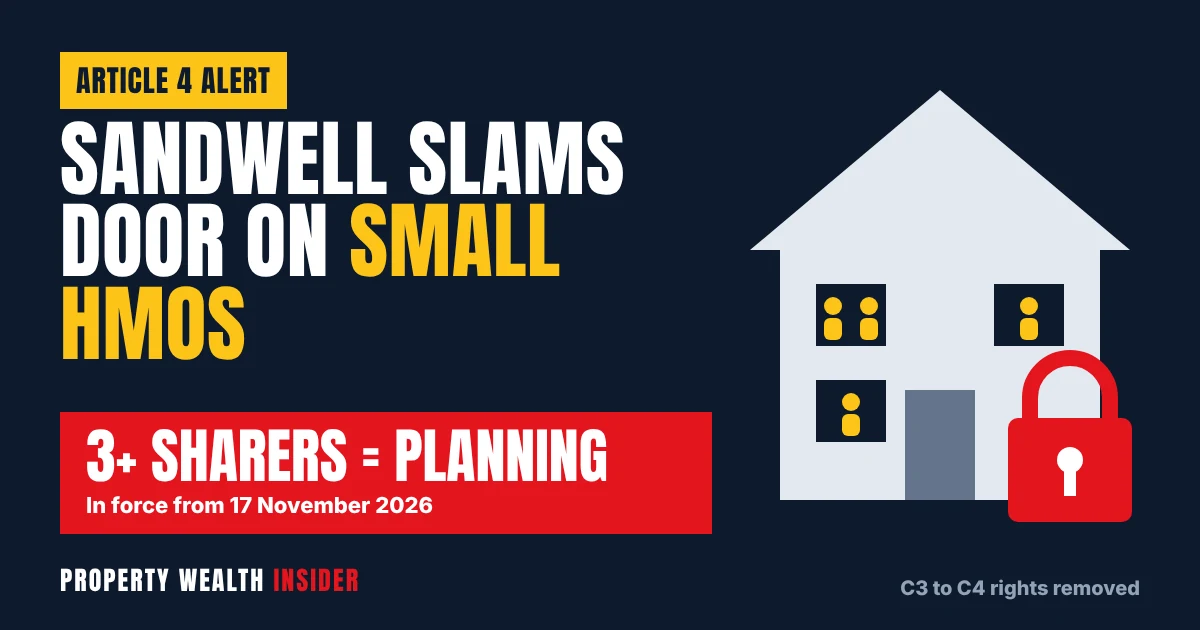
Sandwell Council has switched off the right to turn a family home into a small HMO without planning permission. Since 17 November 2026, any landlord in the West Midlands borough who wants to let a house to three to six unrelated sharers must apply for planning permission first, and get it.
The council used an immediate Article 4 Direction covering the whole borough, so the change took effect the day it was made. The public gets its say afterwards: a consultation runs until 21 December 2026, and the council then decides whether to make the rule permanent.
Kingston upon Thames in south-west London is lining up the same move for early 2027. If you own, are buying or are converting an HMO in either borough, here is what has changed, what an existing HMO now needs to prove, what it costs, and whether the numbers still work.
Key facts
- Sandwell’s borough-wide Article 4 Direction was made and came into force on 17 November 2026. Turning a house (C3) into a small HMO (C4) now needs planning permission.
- A small HMO is 3 to 6 unrelated residents sharing facilities. HMOs for 7 or more already needed planning permission, and still do.
- The consultation runs from 19 November to 21 December 2026. The direction lapses unless the council confirms it within 6 months.
- It is not backdated. Small HMOs that were already running before 17 November 2026 can carry on, and their owners can apply for a Lawful Development Certificate to prove it.
- The national fee for a change-of-use planning application in England is £610 now and rises to £732 from 8 December 2026.
- Kingston upon Thames plans its own immediate, borough-wide small-HMO direction for early 2027. These planning rules cover England only.
What Sandwell has changed
In England, a house can normally become a small HMO without a planning application. That right is “permitted development”: Class L of Part 3, Schedule 2 of the General Permitted Development Order 2015 lets you switch between use class C3 (dwellinghouse) and C4 (small HMO) in either direction.
Sandwell’s direction, formally “Article 4(1) Direction 1 of 2026”, removes only Class L(b), the switch from house to small HMO. It covers the whole of the borough. Going the other way, from HMO back to a family home, is still permitted development.
| Use | Who lives there | Planning permission in Sandwell before 17 Nov 2026 | From 17 Nov 2026 |
|---|---|---|---|
| C3 dwellinghouse | A family or single household, or up to 6 people living together as one household | n/a | n/a |
| C4 small HMO | 3 to 6 unrelated residents sharing a kitchen, bathroom or toilet | Not needed (permitted development) | Needed |
| Large HMO (sui generis) | 7 or more unrelated residents | Needed | Needed (no change) |
| C4 back to C3 | Return to a family home | Not needed | Not needed (no change) |
It is not a ban. The council itself says the direction “does not mean that planning permission will not be granted for HMOs”. Each application will be judged against local planning policy, including how many HMOs are already in the area.
Council leader Ray Nock said the direction will give the council “greater control over new developments”. He also asked residents to report properties they think are running as unauthorised HMOs, so expect more enforcement enquiries.
Planning vs licensing: two separate hurdles
Landlords often mix these two up, and getting it wrong is expensive. Planning decides whether a property may be used as an HMO at all. Licensing, under the Housing Act 2004, decides whether it is safe and properly managed. A licence does not give you planning permission, and planning permission does not give you a licence.
| Planning (Article 4) | HMO licensing | |
|---|---|---|
| Law | Town and Country Planning Act 1990 and the GPDO 2015 | Housing Act 2004 |
| Question it answers | Can this house become an HMO here? | Is this HMO safe, the right size and properly managed? |
| Sandwell trigger | Any new small HMO (3 to 6 people) from 17 Nov 2026 | Mandatory for 5 or more people. Sandwell’s borough-wide additional licensing, in force since 1 Oct 2024, covers 3 or more people in 2 or more households |
| Council team | Planning | Private sector housing / licensing |
| Risk if ignored | Enforcement notice requiring the HMO use to stop | Criminal offence, plus fines or civil penalties |
So a new small HMO in Sandwell now needs both: planning permission and a licence. Having an HMO licence already is still useful, because it is strong evidence that the property was in HMO use on a given date.
Already running a small HMO? What you must prove
The direction is not retrospective. If a property was already used as a small HMO before 17 November 2026, it can keep operating. The government’s planning guidance says an Article 4 direction cannot stop development that has already been carried out.
The catch is proving it. The council says owners can apply for a Lawful Development Certificate (LDC) for an existing use, with evidence that the property was in use as a small HMO before 17 November 2026. Under the government’s LDC guidance, the burden of proof is on the applicant, judged on the “balance of probability”. Your evidence needs to be “sufficiently precise and unambiguous”.
An LDC is optional, but it is the best protection you can buy. It closes down future arguments with neighbours or the council, and buyers’ solicitors and lenders will ask how the HMO use became lawful.
Is my small HMO lawful under Sandwell’s Article 4?
Guide only, not legal advice. It reflects Sandwell’s direction dated 17 November 2026 and national fees in England. Check your property’s planning history with the council and take professional advice before relying on it.
Print this list and work through it for each property. Everything should be dated before 17 November 2026 and show three or more unrelated people sharing facilities.
- Individual room tenancy agreements (or a joint sharer tenancy), with start dates and names
- Your Sandwell HMO licence, licence application or council correspondence about licensing
- Deposit protection certificates for each tenant
- Bank statements or a rent ledger showing room rents coming in
- Utility, broadband and council tax bills showing who was responsible and for what period
- Gas safety, EICR, fire alarm and fire door certificates for the HMO layout
- Dated listings for the rooms on letting portals
- Dated inventories and photographs showing bedrooms with locks and shared kitchens
- Signed statutory declarations from you, your agent or former tenants filling any gaps
- A floor plan showing room use, plus the property’s planning history from the council
Fees, deadlines and the 12-month compensation window
Several dates matter here, and one of them is easy to miss. Under Schedule 3 of the GPDO, an immediate direction expires after six months unless the council confirms it. For Sandwell, that deadline falls in mid-May 2027.
Then there is compensation. Because Sandwell gave no 12 months’ notice, section 108 of the Town and Country Planning Act 1990 lets owners claim compensation if the council refuses permission, or grants it with stricter conditions, on an application made within 12 months of the direction taking effect. Claims are limited to abortive expenditure and other loss directly caused by losing the right. For Sandwell, that window closes on 16 November 2027.
Fees are set nationally. A C3 to C4 change of use falls under category 14 (“material change in use”) of the Fees Regulations 2012. The government’s tables put that at £610 from 1 April 2026, rising to £732 from 8 December 2026. An existing-use LDC costs the same as a full application. A certificate for a proposed use costs half.
Watch out for an old myth: applications needed only because of an Article 4 direction used to be free. That exemption (regulation 5) was removed from 17 January 2018, so expect to pay.
Worked example: a landlord applies after 8 December with a £732 fee and £1,500 for plans and a planning statement. That is £2,232 before a single extra room is let. If they also want an LDC on an HMO they already run elsewhere in the borough, that is another £732 plus their time pulling the evidence together.
Is a small HMO still worth it? Run the numbers
Planning adds three things to an HMO deal: upfront fees, a wait of several months, and the risk of refusal. The calculator below compares a single let with a small HMO and turns those three into pounds. The defaults are illustrative only. Swap in your own figures.
Single-let vs small HMO under Article 4
Guide only, not financial or planning advice. It ignores mortgage costs, tax, capital growth and any compensation claim. HMO lenders and valuers may value the property differently from a single let.
Worked example using the defaults: a £150,000 house let to a family at £900 a month nets £9,180 a year after 15% costs, a 6.1% yield. As a five-bed HMO at £500 a room, gross rent is £30,000. Take off 20% costs (£6,000) and £550 a month in bills (£6,600), and it nets £17,400, a 10.6% yield on £164,232 all-in.
That is £8,220 a year extra, or £685 a month. The £2,232 of planning costs pays back in just over three months. Waiting three months for a decision while the house is single-let costs about £2,055 in lost uplift.
The real swing factor is refusal. At a 60% chance of approval, the five-year expected gain is about £15,200. Cut that chance to 20% and it drops to around £3,600. In streets that already have lots of HMOs, refusal is exactly what the council is now set up to deliver.
Kingston next, and why other councils are watching
Kingston upon Thames is following the same route. A report to its Place Committee on 18 November 2026 recommended an immediate, borough-wide direction removing the house-to-small-HMO right. Officers plan to make it in “early 2027”, followed by six weeks of public representations and a decision on confirmation within six months.
Kingston’s evidence puts the borough’s known or predicted HMOs at around 1,900, roughly 8.5% of the private rented sector and 2.5% of all homes. Its licensing register recorded 453 licensed HMOs in August 2026. The council warns that the two figures measure different things and do not mean the rest are unlicensed.
Kingston has not yet made its direction, so the right to convert still exists there today. Expect a rush of conversions before the direction lands. Kingston’s own report acknowledges that a long notice period could trigger exactly that, which is why it chose the immediate route. Once it is made, the rule bites the same day.
Both councils have chosen speed and accepted 12 months of compensation risk to get it. Kingston’s report notes that other councils with immediate HMO directions told officers they had received no compensation claims, even where they refused some applications.
Scope: everything here applies to England. Wales, Scotland and Northern Ireland have separate planning systems and their own HMO rules.
What to do now: step by step
- Existing Sandwell HMO owners: gather dated evidence of HMO use before 17 November 2026 now, while tenants and agents are easy to reach. Use the checklist above.
- Decide on an LDC. If you plan to sell, remortgage or expand, an existing-use certificate (£610, or £732 from 8 December) is worth having.
- Check your licence. Sandwell’s additional licensing has covered HMOs with 3 or more people in 2 or more households since 1 October 2024. Planning lawfulness does not replace it.
- Mid-purchase or mid-conversion? Do not let rooms to sharers until you have planning permission. Ask your solicitor to raise planning enquiries, and renegotiate the price if the deal relied on HMO income.
- Applying? Apply by 16 November 2027 to keep a possible compensation claim alive if the council refuses. Get pre-application advice on local HMO concentration first.
- Have your say by 21 December 2026. Use the council’s online survey, or write to the council. Its HMO page gives ldf_planning@sandwell.gov.uk and the formal notice gives planning_policy@sandwell.gov.uk. The postal address is Sandwell Council House, Freeth Street, Oldbury B69 3DE. Keep a copy of what you send.
- Kingston owners and buyers: watch for the direction notice in early 2027. Any HMO use you want protected needs to have actually started before the direction takes effect, with the paperwork to prove it.
FAQ
Do I need planning permission for an HMO in Sandwell?
Yes, for any new HMO. Since 17 November 2026, changing a house into a 3 to 6 person HMO needs planning permission anywhere in Sandwell. HMOs for 7 or more people already needed it.
Will my existing HMO be affected by the Article 4 Direction?
Not if it was lawfully in small-HMO use before 17 November 2026. The direction is not retrospective. You can apply for a Lawful Development Certificate to confirm that, with evidence dated before that day.
How much is a planning application for an HMO?
A change of use from house to small HMO falls under the national category 14 fee: £610 until 7 December 2026 and £732 from 8 December 2026. There is no longer a fee exemption for applications needed only because of an Article 4 direction.
Is an HMO licence the same as planning permission?
No. A licence under the Housing Act 2004 covers safety and management. Planning permission covers whether the property may be used as an HMO at all. In Sandwell a new small HMO now needs both.
Can the Article 4 Direction be overturned?
The council must weigh consultation responses and confirm the direction within six months of 17 November 2026. If it does not, the direction lapses and the permitted development right returns. Representations close on 21 December 2026.
Does the Kingston upon Thames HMO Article 4 apply yet?
Not yet. Kingston officers plan to make an immediate, borough-wide direction in early 2027. Until it is made, house-to-small-HMO changes there are still permitted development.
Sources
- Sandwell Council: new planning requirements for HMOs across the borough (18 November 2026)
- Sandwell Council: Article 4 Direction (HMO pages)
- Sandwell Council: Article 4(1) Direction 1 of 2026
- Sandwell Council: notice of making an immediate direction
- Sandwell Council consultation hub: HMO Article 4 survey
- Sandwell Council: HMO licensing and additional licensing
- Royal Borough of Kingston upon Thames: Place Committee, 18 November 2026
- GPDO 2015, Schedule 2 Part 3 Class L
- GPDO 2015, Schedule 3 (procedures for article 4 directions)
- Use Classes Order 1987, Schedule (Classes C3 and C4)
- Town and Country Planning Act 1990, section 108
- Fees Regulations 2012, regulation 5 (omitted 2018)
- MHCLG: planning fees from 1 April 2026
- MHCLG: planning fees from 8 December 2026
- GOV.UK Planning Practice Guidance: when is permission required (Article 4)
- GOV.UK Planning Practice Guidance: lawful development certificates
This article is news and general guidance only. It is not financial, legal, tax or planning advice.