Rents Tipped to Jump 14% by 2029 as Rental Supply Dries Up
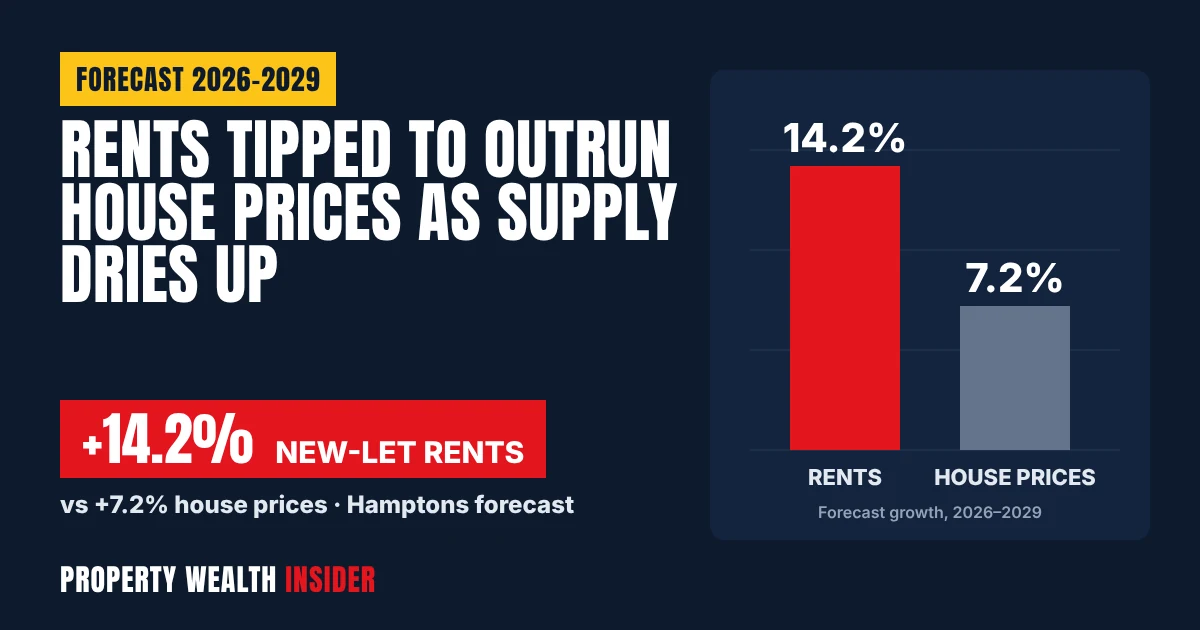
Rents on new lets are forecast to climb 14.2% between 2026 and 2029, roughly double the 7.2% Hamptons expects for house prices over the same four years. The estate agent says a shrinking pool of rental homes, not a booming economy, is doing the heavy lifting.
For landlords that is a mixed message. Rent rolls should keep growing and yields should edge up. But the same squeeze is being driven by higher costs and a tax rise on rental profits from April 2027, and rent can now only be raised through one formal route in England.
Below we turn the forecast into pounds for a typical let and a small portfolio, show how much of the uplift survives tax, and set out exactly how to raise rent lawfully under the Renters’ Rights Act.
Key facts
- Hamptons forecasts new-let rents up 14.2% over 2026–2029, against 7.2% for house prices. These are forecasts, not guarantees.
- New-let rent growth is forecast to peak at 4.5% in 2027, then ease to 3.5% in 2028 and 2.5% in 2029.
- Rents across all tenancies, including sitting tenants, are forecast to rise 10.9% over the same period.
- Official ONS data: UK private rents rose 3.8% in the year to October 2026, to an average of £1,411 a month (England £1,472, up 4.0%).
- Hamptons says homes available to rent in October were 26% below October 2016 levels, and 39% lower in London.
- From 6 April 2027 property income is taxed at 22% / 42% / 47% in England, Wales and Northern Ireland.
The forecast, year by year
Hamptons’ latest four-year outlook, published in November 2026, splits rental growth into two measures. “New lets” are rents agreed when a property is let to a new tenant. “All tenancies” includes existing tenants, whose rents usually move more slowly.
| Year (annual change) | New-let rents | All-tenancy rents | House prices |
|---|---|---|---|
| 2026 (by year end) | 3.0% | 2.0% | 1.0% |
| 2027 | 4.5% | 2.5% | 1.5% |
| 2028 | 3.5% | 3.0% | 2.5% |
| 2029 | 2.5% | 3.0% | 2.0% |
| Cumulative 2026–2029 | 14.2% | 10.9% | 7.2% |
Source: Hamptons rental and house price forecasts, November 2026. Great Britain. Forecasts, not outcomes.
One detail the headline hides: 2026 is almost over, so a slice of that 14.2% has already happened. Compounding only the 2027, 2028 and 2029 forecasts gives about 10.9% still to come on new lets and about 8.7% on all tenancies. That is the figure to plan with if you are setting budgets today.
Hamptons’ own index puts annual growth in newly agreed rents at 2.6% in October 2026, so the forecast assumes a clear acceleration next year rather than a continuation of today’s pace.
Why supply is the story
This forecast is less about tenants earning more and more about there being fewer homes to rent. Hamptons says the number of homes available to let in October 2026 was 26% lower than in October 2016 across Great Britain, with London down 39%.
New investment is not filling the gap. Landlords have bought 10.1% of homes sold in Great Britain so far in 2026, according to Hamptons, the lowest share in its records going back to 2010. That compares with 15.7% in 2015. Meanwhile the number of would-be tenants was 10% higher in October than a year earlier.
Fewer homes plus more applicants is the classic recipe for rising rents. The official figures already show it. The ONS says average UK private rents rose 3.8% in the 12 months to October 2026, while UK house prices rose just 1.2% in the year to September 2026.
Not the same as our earlier rent stories. The ONS measure covers all private rents and looks backwards. Hamptons’ 14.2% is a forward-looking forecast for new lets over four years. Both point the same way, but only the ONS figure is a measurement.
What 14% means in pounds
These examples apply Hamptons’ 2027, 2028 and 2029 forecasts to today’s rent, with one increase each year (the most the law allows in England). We assume each new rent runs for a full year.
Example 1: a single let at £1,000 a month, re-let at market rates. On the new-let path the rent goes to £1,045 in 2027, £1,082 in 2028 and £1,109 in 2029. That is £2,822 more rent over the three years than if it stayed at £1,000.
Example 2: a five-property portfolio with a £5,000 monthly rent roll. On the new-let path the roll reaches £5,543 a month by 2029, worth an extra £14,111 over 2027–2029. If your tenants stay put and you track the slower all-tenancy forecast instead, the roll reaches £5,437 and the extra is £10,090.
Example 3: yield. A £250,000 flat let at £1,250 a month yields 6.0% gross today. With rents on the new-let path and the value on Hamptons’ house price path, the 2029 gross yield is about 6.3%. Rents rising faster than prices is what pushes yields up.
Rent and yield projector 2026–2029
Put in your own numbers. Choose the Hamptons new-let path if you expect to re-let, the all-tenancy path if your tenants are long-stayers, or set your own rates.
Rent and yield projector 2026–2029
Guide only, not financial or tax advice. Forecast paths are Hamptons’ November 2026 forecasts for Great Britain and may not happen. Assumes one rent rise a year, each running a full year, and treats calendar years as tax years. Tax is applied at your chosen rate to the extra rent less extra costs. Mortgage interest is assumed flat.
Costs and the 2027 tax rise
Higher rents are only half the picture. From 6 April 2027, property income will be taxed at its own rates of 22% (basic), 42% (higher) and 47% (additional) in England, Wales and Northern Ireland. That is 2 points above the standard income tax rates. Scotland is not covered by the announcement.
For mortgaged landlords there is a small offset. HMRC’s technical note says relief for residential finance costs stays a tax reduction but is calculated at the property basic rate of 22% from 2027-28.
Worked example: take the £5,000-a-month portfolio from above, with £14,111 of extra rent over 2027–2029. If running costs of £12,000 a year rise 3% a year, about £2,203 of that goes on higher bills. A higher-rate landlord then pays 42% on the remaining £11,908, keeping about £6,907. In other words, under half of the forecast uplift reaches your pocket.
Watch for costs that do not track inflation, too. Remortgaging from an old fixed rate, compliance work and the planned move towards EPC C standards can each absorb a year or more of rent growth.
How to raise rent lawfully in England
A forecast is worthless if you cannot pass it on. Since the Renters’ Rights Act changes came into effect on 1 May 2026, there is one route for raising rent on an assured periodic tenancy in England: the section 13 process. Wales, Scotland and Northern Ireland have their own rules.
| Rule | What it means for you |
|---|---|
| Once a year | Only one increase in any 12 months, and none in the first year of the tenancy. |
| Form 4A | Use “Landlord’s notice proposing a new rent” (form 4A) for notices from 1 May 2026. |
| Two months’ notice | Serve it at least 2 months before the new rent starts. |
| Every time | Follow section 13 for every increase, even if the tenant has already agreed. |
| Tribunal challenge | If the tenant thinks the rent is above open market rent, they can ask the First-tier Tribunal to set it. |
| No bidding | You cannot encourage rental bidding or accept offers above the advertised rent. |
Source: GOV.UK, assured periodic tenancies: rent increases. England only.
The practical lesson: price increases to genuine open market rent, with evidence. A rise backed by three or four comparable local lets is far harder to challenge than a round-number guess based on a national forecast.
What to do now
- Map your review dates. List when each tenancy started and when rent last rose. You cannot raise rent within 12 months of the last increase.
- Benchmark each property. Gather current local asking and achieved rents for similar homes. That is your open market rent case.
- Run the projector. Test the new-let, all-tenancy and a cautious custom path. Plan on the cautious one.
- Budget for April 2027. Work out your tax bill at the new property rates and set aside money monthly.
- Serve form 4A properly. At least two months ahead, delivered in a way your tenancy agreement allows, and keep proof of service.
- Weigh rent against retention. A void month costs about 8% of a year’s rent. A modest rise that keeps a good tenant can beat a full market rise that loses one.
- Tenancy start date and last rent increase date recorded for every property
- Three or more local rental comparables saved for each property
- Latest blank form 4A downloaded from GOV.UK
- Notice served at least 2 months before the new rent date, with proof
- Tax set-aside updated for 22% / 42% / 47% property rates from 6 April 2027
- Mortgage fixed-rate end dates checked against projected rent
- EPC rating checked and upgrade costs estimated
FAQ
How much will rents go up by 2029?
Hamptons forecasts 14.2% growth in new-let rents over 2026–2029 and 10.9% across all tenancies. These are forecasts for Great Britain as a whole, so your area could differ.
Will rents rise faster than house prices?
That is Hamptons’ central forecast: 14.2% for new-let rents against 7.2% for house prices. The latest ONS figures show the same gap today, with rents up 3.8% and house prices up 1.2%.
How often can a landlord increase rent in England?
Once a year, and not in the first year of the tenancy. You must use form 4A and give at least two months’ notice under the section 13 process.
Can my tenant challenge a rent increase?
Yes. If they think the new rent is above open market rent, they can apply to the First-tier Tribunal, which will decide what the rent should be.
What tax will I pay on rental income from April 2027?
Property income will be taxed at 22%, 42% or 47% depending on your band, in England, Wales and Northern Ireland. Finance cost relief will be given at 22%.
- ONS: Private rent and house prices, UK: November 2026
- Hamptons: Why rents are forecast to rise faster than house prices (November 2026)
- Hamptons: Housing market forecasts 2026 (November 2026)
- GOV.UK: Assured periodic tenancies, rent increases
- GOV.UK: Renters’ Rights Act, an overview for landlords
- GOV.UK: Income Tax, changes to tax rates for property, savings and dividend income
- GOV.UK: Technical note on property, savings and dividend rates
This article is news and general guidance, not financial, legal or tax advice.