Landlord database: what could go public and the £7,000 fine
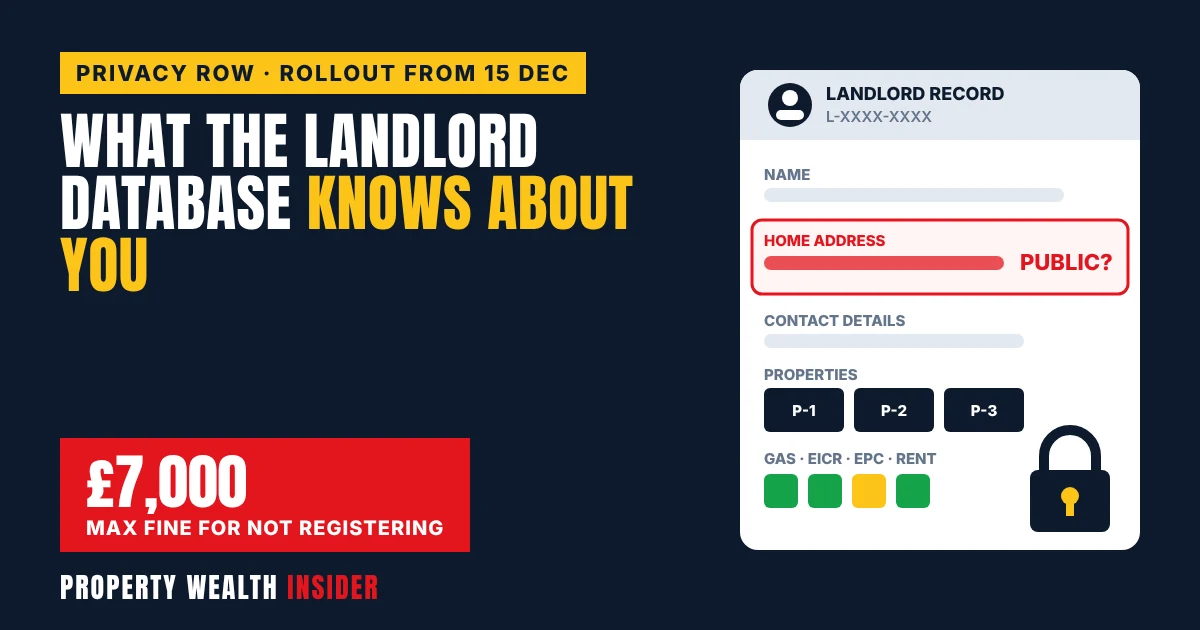
England’s compulsory landlord database opens in just over three weeks, and the biggest landlord body in the country has asked the data watchdog to step in before anyone hands over their home address.
The National Residential Landlords Association (NRLA) has written to the Information Commissioner’s Office (ICO) warning that ministers still have not said which landlord details will eventually be visible to the public. Its fear is simple: a searchable register that leaks a landlord’s home address could put people who have been harassed, threatened or abused in real danger.
This affects every private landlord in England with a property let on an assured or regulated tenancy. The database is England-only, so landlords letting in Wales, Scotland and Northern Ireland are not covered by it. Below we set out exactly what you must hand over, who can see it today, what could go public later, and how to keep your exposure as low as the law allows.
Key facts
- Registration on the government’s “Register your rental property” service opens region by region from 15 December 2026, starting with the West Midlands. The last region (South West) closes on 14 November 2027.
- The government says landlord and property information will not currently be shared publicly, but “some information” may become viewable by the public in future. It hasn’t said which.
- Failing to register can bring a council penalty of up to £7,000. False or misleading information, or repeated or continuing breaches, can bring up to £40,000.
- Each property must give a correspondence address in England or Wales. Missing compliance details must be added within 28 days or the registration may be deactivated.
- The NRLA has made 4 demands to the ICO, including publication of a Data Protection Impact Assessment before landlords are made to hand over data.
Why the NRLA has gone to the data watchdog
The database is created by Part 2, Chapter 3 of the Renters’ Rights Act 2025. The Act gives the Housing Secretary a power to decide, through later regulations, which details in landlord and property entries are “made available to the public”. Those public-access rules have not been announced.
That gap is the heart of the row. In its press release, the NRLA says landlords are being legally required to hand over sensitive information “without knowing exactly who will be able to access it or what might eventually be made public”. Chief executive Ben Beadle said that if ministers cannot give assurances before registration starts, “they should pause the rollout until they can”.
The association’s letter to the ICO asks for four things:
- A published DPIA. Confirmation that a full Data Protection Impact Assessment was done before landlords must submit data, with its key findings and safeguards made public.
- Clear privacy information. How landlords’ data will be used, stored, shared and retained, published before registration begins.
- Tight agent access controls. Proper permissions and monitoring for letting agents and other authorised users.
- Explicit home-address protection. Safeguards against inappropriate disclosure of landlords’ personal residential addresses and contact details.
The DPIA demand has teeth. ICO guidance says a DPIA is required where processing is “likely to result in a high risk” to people’s rights, and it must be done before the processing starts. The NRLA also points out that safety certificates uploaded to the system may contain tenants’ personal details too.
What the database will hold about you
According to the government’s landlord guidance, you register yourself first (free), then each property. Sign-in is through GOV.UK One Login, with an option to verify your identity. A paper route exists if you have no digital access.
| Stage | What you must provide | Privacy sensitivity |
|---|---|---|
| Landlord (individual) | Your personal details and contact information | High: this is the data the NRLA is worried about |
| Landlord (company, LLP, trust, charity) | A contact for the organisation, Companies House or Charity Commission number; directors, trustees or governing body details if there is no Companies House number | Medium: much is already on Companies House |
| Property, at registration | Address, bedrooms, rental status, a correspondence address in England or Wales, contacts for any managing agent, superior landlord or freeholder | Medium: your choice of correspondence address matters |
| Property, within 28 days | Gas safety certificate (if gas supplied), electrical safety certificate, EPC, tenancy information including rent, any licences (for example HMO) | Medium: certificates can carry tenant names |
| Ongoing | Changes or expiries within 28 days (personal details, occupancy, certificates) | Same as above |
Joint owners each have to register. One registers the property and invites the others, and a part-owner who is entitled to possession must register even if they are not named on the tenancy. Ordinary English partnerships register members as individuals, while LLPs register as organisations.
Agents can fill in licence, tenancy and certificate details using a password-protected link for each property. But the landlord must start every registration, pays the fee and stays legally responsible, according to the agent guidance.
Who can see it now and what could go public
Here is what is actually settled in law today, as opposed to what is still undecided.
| Question | Position now | Source |
|---|---|---|
| Who must get access? | Councils (local housing authorities), lead enforcement authorities, trading standards (weights and measures authorities), mayoral combined authorities and the Greater London Authority | Act, s.86(2) |
| What can councils use it for? | Only purposes connected with their housing, landlord and tenancy functions | Act, s.88 |
| Can non-public data be passed on? | Only to the bodies above or where regulations allow. Knowingly or recklessly disclosing it otherwise is a criminal offence | Act, s.87 |
| Is anything public today? | No. The government says landlord and property information “will not be shared publicly” currently | GOV.UK guidance |
| What will go public later? | Not decided. Set by future regulations under s.86. The government says “some information” may become viewable | Act, s.86(1); GOV.UK |
| Landlords with banning orders | Councils must add entries for relevant banning orders; regulations may require these to include an address. Public access to them must be delayed at least 21 days | Act, ss.83 and 86 |
| How long is data kept? | Entries are removed after 5 continuous years inactive | Act, s.89 |
The NRLA’s own reporting says the register will be open to councils first and become publicly accessible after the rollout finishes. The government has promised a privacy notice for the service and says it will update it before any change to how data is used or shared. At the time of writing, the only privacy notice we could find on GOV.UK covers user research for the service, not the live register.
One thing that will definitely be public: your unique landlord and property numbers. The Act requires written adverts to carry them, and the agent guidance gives the formats L-XXXX-XXXX and P-XXXX-XXXX. The government says the advert rule will come in at a later date, with guidance updated before it does.
Rollout dates, fee and penalties
Registration runs region by region. Each region gets three months, and you must register by your region’s end date. You can register early, before your region opens. During the rollout, only properties that are let (or let during the period) have to be registered; empty properties will need registering later, before they are marketed.
Registering yourself as a landlord is free. Each property costs £65 a year, with no VAT, and first-year bills are pro-rated during the rollout (our 20 November report covers the fee maths). The bigger number is the penalty.
Worked example: Priya owns four let houses in Birmingham. Registering costs her 4 × £65 = £260 a year, which the government says is tax-deductible. If she ignores the West Midlands deadline of 14 March 2027, her council can fine her up to £7,000. If the breach carries on more than 28 days after a penalty, a further penalty can follow, and continuing breaches can become an offence with a penalty of up to £40,000.
There are two less obvious costs as well. Under section 90 of the Act, a court cannot make a possession order while the landlord (or any joint landlord) is in breach of the duty to have active entries, except on Ground 7A or Ground 14. And from 15 December 2026, tenants can apply for rent repayment orders in areas whose registration window has opened.
Worked example: Mark has a flat in Leeds let at £950 a month. He registers in time but supplies an expired gas certificate date to get the record completed. Knowingly or recklessly giving false or misleading information is an offence under section 92, with a penalty of up to £40,000. That is more than three years of his rent (£950 × 12 = £11,400 a year) for one false entry.
Database readiness and exposure checker
Put in your set-up below. The tool gives you a readiness score, a privacy exposure rating, the paperwork to gather and a rough time to finish, plus your deadline and fee.
Landlord database readiness and exposure checker
Gather before you start:
Guide only, not legal or data protection advice. Time estimates are PWI assumptions, not government figures. Fee and dates are from GOV.UK guidance published 29 October 2026; the first-bill figure applies GOV.UK’s pro-rata method and matches its worked examples.
How to limit your exposure: step by step
You cannot opt out of registering, but you can control how much of your private life sits in public records. Do these in order.
- Choose your correspondence address now. Each property needs a correspondence address in England or Wales. The NRLA’s guidance says individual landlords can give a business address and phone number rather than personal ones. Companies must give an organisation address, which cannot be a PO box.
- Check what HM Land Registry already shows. A title register costs £7. Look at the address for service next to your name. You can have up to three, and one can be an email address, under Practice Guide 55.
- Clean up Companies House. Directors’ usual residential addresses are not public, but a home address used as a service address, registered office or on older forms may be. Companies House lets you apply to protect it.
- Redact before you upload. Certificates can name tenants. Only upload what the service asks for, and keep originals offline.
- Control agent access. Each property has its own access link and password. If an agent relationship ends, cancel the link and issue a new one, because agents cannot reset it themselves.
- Register on time anyway. The privacy row does not pause the law. Missing your region’s deadline risks a fine of up to £7,000 and blocks most possession claims.
- Know your region’s window and end date
- GOV.UK One Login account set up
- Correspondence address decided (not your home if you can avoid it)
- Gas safety records, EICRs and EPCs in date and scanned
- Tenancy details, rent and household numbers listed per property
- Licence references for any HMO or selectively licensed property
- Co-owners briefed and ready to accept their invitation
- Land Registry and Companies House addresses checked
- Agent access links issued and recorded
- Diary reminders for the 28-day update rule and annual renewal
FAQs
Will my home address be public on the landlord database?
Not at the moment. The government says landlord and property information is not currently shared publicly. What may be published later will be set by regulations that have not yet been made, which is exactly why the NRLA wants guarantees now.
Can I use my letting agent’s address instead of my own?
Each property needs a correspondence address in England or Wales. The NRLA says individual landlords can give a business address rather than a personal one. Your agent can then supply certificate and tenancy details, but you must start the registration yourself.
Who can see my information on the PRS database?
By law, councils, lead enforcement authorities, trading standards, mayoral combined authorities and the Greater London Authority get access. They may use it only for housing-related functions. Disclosing non-public information outside the rules is a criminal offence.
What happens if I do not register my rental property?
Your council can impose a penalty of up to £7,000. Continuing or repeated breaches, or false information, can lead to up to £40,000. You also cannot get most possession orders, and tenants may claim rent repayment orders once your region’s window has opened.
When do I have to register?
By the end of your region’s three-month window. It is 14 March 2027 for the West Midlands, the first region, and 14 November 2027 for the South West, the last. London’s window runs from 15 July to 14 October 2027.
- NRLA press release: Landlord safety at risk without database privacy safeguards
- NRLA: Landlords’ personal details should not be public knowledge
- NRLA: Landlord database, your FAQs
- GOV.UK: Register your rental property service, guidance for landlords
- GOV.UK: Register your rental property service, guidance for letting agents and property managers
- Renters’ Rights Act 2025, Part 2 Chapter 3 (ss.75 to 92)
- ICO: When do we need to do a DPIA?
- HM Land Registry: Get information about property and land
- HM Land Registry: Practice Guide 55, address for service
- Companies House: Your personal information on the public record
This article is news and general guidance only. It is not financial, legal, tax or data protection advice.