Agent still quoting Section 21? 32% don’t list landlord fees
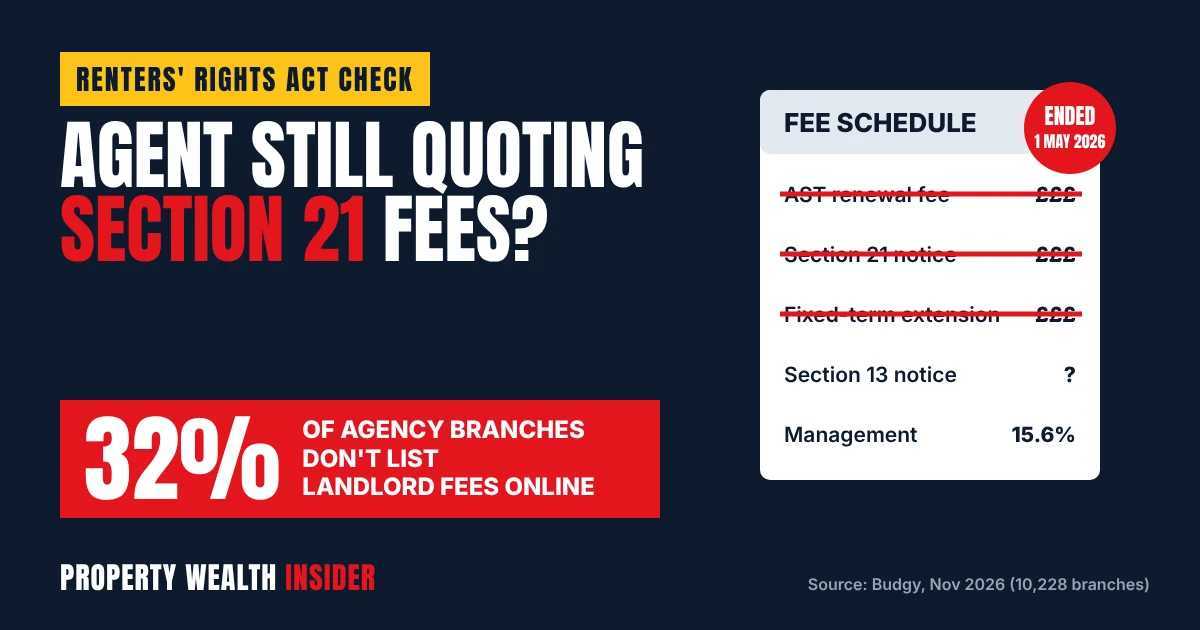
If your letting agent’s fee schedule still mentions Section 21 notices, tenancy renewals or “initial fixed terms”, it is describing a system that no longer exists in England. Those tenancies and notices ended on 1 May 2026, when the main Renters’ Rights Act reforms took effect.
If your agent’s website or terms still talk about renewals, fixed terms or Section 21 notices, they are out of date: none of those exist for private lets in England any more. Fresh data shows how patchy agents’ fee publishing still is. Agency comparison site Budgy has published a review of 10,228 agency branches in England. It found that 32% of branches with a website don’t appear to publish their landlord fees at all.
This affects every landlord in England who uses an agent, and the timing is tight. The government’s new landlord register opens on 15 December 2026, and the legal duty to register falls on you, not your agent. Below we cover what has changed, what an up-to-date fee schedule should look like, two tools to check your agent, and a printable checklist.
Key facts
- Assured shorthold tenancies and Section 21 “no-fault” notices were abolished for private lets in England from 1 May 2026. All assured tenancies are now periodic.
- Budgy reviewed 10,228 branches in November 2026. 32% of those with a website didn’t appear to publish landlord fees. Only 6,906 publish them.
- The typical full management fee is 15.6% of rent including VAT, about £2,756 a year on an average £1,472 monthly rent (Budgy).
- Agents must publish their fees, including VAT, on their website and at their premises. Councils can fine an agent up to £5,000 per penalty (Consumer Rights Act 2015, ss.83 and 87).
- Rent can now only be raised through a Section 13 notice, once a year, with at least two months’ notice.
- The landlord register opens on 15 December 2026 in the West Midlands. Every actively letting landlord must be registered by 14 November 2027.
What changed on 1 May 2026
The Renters’ Rights Act 2025 got Royal Assent on 27 October 2025. Its tenancy reforms apply to private lets in England. Section 1 makes assured tenancies periodic, with a rent period of no more than a month. Section 2 abolishes assured shorthold tenancies.
The government’s tenancy forms guidance confirms that from 1 May 2026, ASTs and Section 21 evictions ended for private rentals in England. Landlords who want possession must now use Section 8 (Form 3A) on one of the updated grounds. Existing tenancies converted automatically, and fixed terms became rolling periodic tenancies.
That removes several things agents used to charge landlords for. A fixed term can’t be renewed, a Section 21 notice can’t be served, and a rent review clause can’t be used. Rent increases now go through the statutory Section 13 process instead.
Old terms vs what replaced them
If you find any term from the left-hand column in your agent’s terms of business, ask the agent about it.
| Old term you may still see | What replaced it (England, from 1 May 2026) | What to ask your agent |
|---|---|---|
| Assured shorthold tenancy (AST) | Assured periodic tenancy. ASTs are abolished (RRA 2025 s.2). | Why do your terms and template agreement still say AST? |
| 6 or 12-month fixed term / “initial term” | Rolling tenancy with a rent period of a month or less (s.1). Tenants can leave on two months’ notice. | How do you now describe tenancy length to tenants and to me? |
| Section 21 notice (and a fee for serving it) | Section 8 notice (Form 3A) on a specified ground only. | Why is there still a Section 21 fee? What do you charge for Section 8, and what does it cover? |
| Tenancy renewal or extension fee | Nothing to renew. The tenancy simply continues. | Is any renewal fee or renewal commission still in my contract? |
| Rent review clause | Section 13 notice (Form 4A), once a year, with at least two months’ notice. The tenant can challenge it at tribunal. | What do you charge to serve a Section 13 notice? Is it refunded if the increase is challenged? |
| Several months’ rent upfront | No more than one month’s rent, asked for only after signing and before the tenancy starts. | Do your marketing and referencing terms still ask for rent upfront? |
| Tenant check-out, renewal or referencing fees | Still banned. Tenants can only be charged the “permitted payments” under the Tenant Fees Act 2019. | Are any tenant charges outside the permitted list? |
What the law says agents must publish
Under section 83 of the Consumer Rights Act 2015, a letting agent must list its fees on its website and at each office where it deals with clients face to face. Each fee must be described clearly enough for the payer to understand what it covers. Amounts must include tax. If a fee can’t be worked out in advance, the agent must explain how it is calculated.
In England, the list must also name the agent’s client money protection scheme and redress scheme. If the agent advertises on a property portal, the fees must appear there or be linked from there. Trading Standards enforce these rules, and section 87 lets them fine an agent up to £5,000 per penalty. Sections 83 to 88 cover England and Wales. The portal and scheme-statement duties apply only in England.
A fee list that still prices a Section 21 notice describes a service the agent can no longer legally provide. Whether that alone breaches section 83 is for Trading Standards to decide. Either way, it suggests the agent’s paperwork, and possibly its processes, haven’t caught up.
Check your agent: the Renters’ Rights-ready scorer
Open your agent’s fee page and your terms of business. Tick everything you find. The scorer gives a red, amber or green rating and a list of questions to send your agent.
Is your letting agent’s fee schedule Renters’ Rights-ready?
Red flags (obsolete since 1 May 2026)
Amber flags (transparency and process)
Guide only, not legal advice. A ticked item doesn’t prove your agent has broken the law. It shows where you should ask questions.
What your agent really costs now
Budgy’s November review puts the typical full management fee in England at 15.6% of rent including VAT. It is 18.0% in London and 15.0% elsewhere. Typical renewal fees varied widely: £216 in London, £180 in Manchester and £90 in Nottingham.
Worked example 1. Take a £1,472 monthly rent (the ONS October 2026 England average Budgy used). At 15.6%, management costs about £229.63 a month, or £2,756 a year. Under the old model, a £180 renewal fee pushed that to £2,936. Renewals have gone, but some agents now charge for a Section 13 rent increase notice. If yours charges £150, the yearly total is £2,906 in years you raise the rent and £2,756 in years you don’t.
Worked example 2. You propose a 5% increase, from £1,472 to £1,545.60, which adds £73.60 a month or £883 a year. Your agent’s 15.6% takes about £138 of that, and a £150 notice fee takes more. That leaves roughly £595 in the first year. The tenant can challenge the increase at the First-tier Tribunal. The tribunal can’t set the rent above the figure you proposed, and the new rent can’t be backdated. If the rent is challenged, your net gain falls, but the notice fee is still paid.
Annual agent cost: old renewal model vs new Section 13 model
Guide only, not financial advice. The new-model cost uses your current rent. The net gain assumes the full proposed increase applies for 12 months, which may not happen if the tenant challenges it. Default fee levels are Budgy medians (November 2026) except the Section 13 fee, which is an example.
Why it matters before the landlord register
The government has confirmed that the Register Your Rental Property service, the private rented sector database, launches on 15 December 2026. It starts in the West Midlands, and other areas follow over the next 12 months. Once your area is called forward, you have three months to register. All landlords actively letting property must be registered by 14 November 2027.
The duty to register is the landlord’s, and failing to register risks a fine. The government’s Renters’ Rights Act guide also says unregistered landlords won’t be able to get possession orders, except under grounds 7A and 14. Agents and landlords will have to show registration numbers on adverts, though the government hasn’t yet said from when.
If your agent’s paperwork is out of date, there is a real risk that the agent will miss your registration or advert duties. Under the Renters’ Rights Act, landlord civil penalties start at up to £7,000 and reach £40,000 for serious or repeated breaches. You pay those fines, not your agent.
Where this applies: The tenancy reforms, the landlord register and the Tenant Fees Act 2019 apply in England. The section 83 fee-publication duty covers letting agents in England and Wales. Wales has its own Renting Homes system, and Scotland and Northern Ireland have separate rules.
What to do now: step by step
- Download your agent’s current fee schedule and terms of business. Save a dated copy. If the fees aren’t on the website, ask for them in writing.
- Run the scorer above. Tick every obsolete term and copy the questions it gives you.
- Email your agent. Ask for an updated fee schedule, confirmation that renewal and Section 21 charges no longer apply to you, and what the Section 13 fee covers.
- Check your last invoices. Look for any renewal or extension fee charged after 1 May 2026, and ask why it was charged.
- Confirm your tenants have the government information sheet. Landlords with existing tenancies had to provide the Renters’ Rights Act information sheet. Ask your agent for proof that each tenant received it.
- Plan your landlord register entry. Find out when your area is called forward, decide who will submit the entry, and get the agent’s commitments in writing.
- Re-cost your agent. Use the calculator to compare what you pay now with the 15.6% England median. If the answers are poor, review your notice period and exit terms before you switch.
Printable checklist: print this page or copy the list below into an email to your agent.
- Current landlord fee schedule saved, with VAT-inclusive prices
- No Section 21 notice or Section 21 fee listed
- No AST, fixed-term or “initial term” wording in terms or template tenancy
- No renewal or extension fee or renewal commission charged since 1 May 2026
- Section 13 notice fee stated, with what it covers and what happens if the tenant challenges it
- No tenant fees outside the Tenant Fees Act permitted payments
- No more than one month’s rent upfront in marketing or referencing terms
- Client money protection and redress schemes named
- Renters’ Rights Act information sheet given to every existing tenant
- Landlord register plan agreed: who registers, when your area opens, any cost
- Agent’s notice period and exit fees checked
FAQ
Can my letting agent still charge me a tenancy renewal fee?
In England, private tenancies have been periodic since 1 May 2026, so there is no fixed term left to renew. A renewal fee charged for anything after that date should be challenged. Check your contract to see what the fee was meant to cover.
Can a Section 21 notice still be served in England?
No. Section 21 ended for private tenancies in England on 1 May 2026. Possession now goes through a Section 8 notice (Form 3A) on one of the updated grounds.
How often can I put the rent up under the Renters’ Rights Act?
Once a year, using a Section 13 notice (Form 4A) with at least two months’ notice. The tenant can challenge the increase at the First-tier Tribunal. The tribunal can’t set the rent above the figure you proposed.
Do letting agents have to publish their fees online?
Yes. Section 83 of the Consumer Rights Act 2015 requires agents to publish their fees on their website, if they have one, and display them at their offices, including tax. Trading Standards can fine an agent up to £5,000 per penalty.
Is my agent or me responsible for the landlord register?
The legal duty to register is the landlord’s. An agent may handle the admin for you, but if the entry isn’t made, you face the fine and the restrictions on possession orders.
- Budgy: Letting agent fees in England, ranked by city (November 2026)
- Consumer Rights Act 2015, Part 3 Chapter 3 (ss.83-88)
- Renters’ Rights Act 2025
- Renters’ Rights Act 2025, section 6: statutory procedure for increases of rent
- GOV.UK: Assured tenancy forms for privately rented properties from 1 May 2026
- GOV.UK: Guide to the Renters’ Rights Act
- GOV.UK: Stronger protections and greater confidence for renters (landlord register launch)
- GOV.UK: Tenant Fees Act 2019 statutory guidance (as amended by the Renters’ Rights Act 2025)
This article is news and general guidance, not financial, legal or tax advice.