Holiday let owners face 100% council tax premium threat
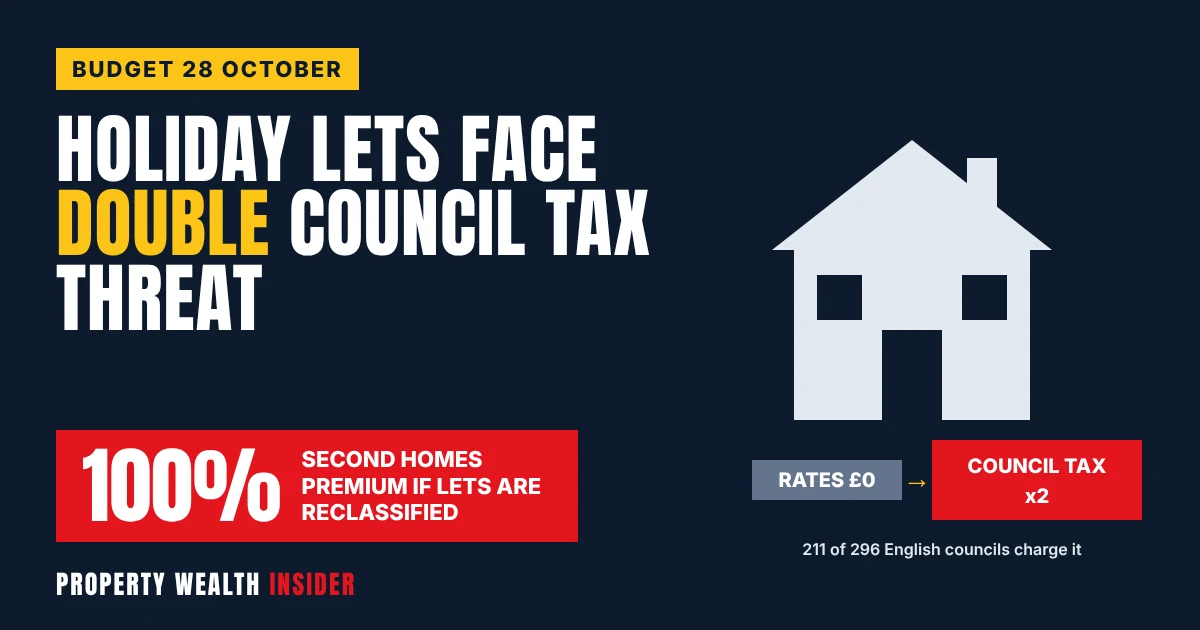
Holiday let owners in England could be dragged off business rates and onto council tax, opening the door to a 100% second homes premium, if the Treasury acts on a review it has confirmed is under way ahead of the Budget on Wednesday 28 October 2026.
Nothing has been decided. But national press reports say ministers are weighing up treating furnished holiday lets as second homes, and a Treasury minister told MPs on 10 September that the government is “carefully considering” responses to its call for evidence on the tax treatment of short-term lets, including self-catering accommodation.
For owners whose cottage currently pays nothing thanks to small business rate relief, the switch could mean a council tax bill of several thousand pounds a year. For larger, high-value lets the sums can work out very differently. Here is what is law, what is rumour, and how to run your own numbers.
Key facts
- The Budget is on Wednesday 28 October 2026, confirmed by Chancellor John Healey.
- To pay business rates in England, a self-catering let must be available for 140 nights and actually let for 70 nights in 12 months.
- Small business rate relief means £0 business rates on a rateable value of £12,000 or less, tapering to nothing at £15,000.
- Since 1 April 2025, English councils can charge a second homes council tax premium of up to 100%.
- 211 of 296 councils (71%) charged the premium in 2025, all at the full 100%.
- Reclassifying holiday lets as second homes is a proposal under review, not law.
What is proposed, and what is just speculation
Here is the firm ground. At the November 2025 Budget, the Treasury published a business rates call for evidence. It said concerns had been raised about small business rate relief (SBRR) “being used by second home owners whose main aim is not to operate a local business but to manage tax liabilities”.
It asked how many nights short-term lets are typically available and actually let, and how SBRR could be reformed to limit its use by second home owners. That consultation closed on 18 February 2026.
On 10 September 2026, Treasury minister James Murray answered a written parliamentary question on removing commercially let self-catering accommodation from business rates. He said the government is “carefully considering representations received” and will publish a response “in due course”.
What is not confirmed: the specific idea of moving all holiday lets onto council tax as second homes. That comes from national newspaper reports in September, not from any government document. It is one possible outcome. Others include tightening the 140/70-night test or restricting SBRR. We will only know on 28 October, and any change would need new legislation and a start date.
The rules today: business rates or council tax?
In England, a self-catering property is assessed for business rates rather than council tax only if it passes the Valuation Office test. It must have been available to let commercially for at least 140 nights in the previous 12 months, actually let for at least 70 nights, and you must intend to make it available for 140 nights in the next 12 months.
Your own use, discounted family stays and closures for repairs do not count. Stays longer than 28 nights cannot count towards the 70 let nights.
If you pass, the bill is your rateable value multiplied by the multiplier. Since 1 April 2026, holiday homes are treated as hospitality, so a let with a rateable value below £51,000 uses the 38.2p small retail, hospitality and leisure multiplier. Then SBRR knocks the bill to zero at £12,000 or less, tapering to nothing at £15,000, provided it is your only business property (or your others are tiny).
If you fail the test, you already pay council tax today, and your council can charge the second homes premium. That power comes from section 11C of the Local Government Finance Act 1992, inserted by the Levelling-up and Regeneration Act 2023, and has applied since 1 April 2025.
| Rule | England | Wales |
|---|---|---|
| Nights available to let (12 months) | 140 | 252 |
| Nights actually let (12 months) | 70 | 182 |
| Max second homes council tax premium | 100% (from 1 April 2025) | 300% (from 1 April 2023) |
| Small business rate relief | 100% at RV £12,000 or less, tapering to 0% at £15,000 | Separate Welsh scheme |
| Status | In force now | In force now |
Wales already went much further: its 252/182-night test and a council tax premium of up to 300% (Welsh Government) pushed many lets onto council tax from April 2023. Any Budget change in Westminster on business rates and council tax would apply to England.
Worked examples: who wins and who loses
These use the 2026-27 average Band D council tax in England of £2,392, the statutory band ratios, and a 100% premium. Your council’s figures will differ.
| Holiday let | Business rates now | Council tax + 100% premium | Change |
|---|---|---|---|
| Cottage, RV £9,000, Band C, only property | £0 (full SBRR) | £4,252 | +£4,252 |
| Barn conversion, RV £14,000, Band E, only property | £3,565 (33% SBRR) | £5,847 | +£2,282 |
| Large house, RV £20,000, Band F, no SBRR | £7,640 | £6,910 | −£730 |
The small cottage is the big loser. It pays nothing now, but Band C is 8/9 of Band D, so £2,126, doubled by the premium to £4,252 a year.
The mid-sized let sits on the SBRR taper. £14,000 × 38.2p is £5,348, less one-third relief, leaving £3,565. Band E council tax (11/9 of Band D) plus premium is £5,847, so it pays £2,282 more.
The large house gets no SBRR, so it pays £7,640 in rates. Band F council tax with the premium is £6,910, which is actually cheaper. The pain of any reclassification lands hardest on small, single-property owners.
Calculator: what reclassification would cost you
Find your rateable value on the VOA business rates service and your council’s Band D figure on its website. The tool works out SBRR automatically from your rateable value.
Business rates vs council tax: what reclassification would cost your holiday let
Guide only, not tax advice. Uses 2026-27 English multipliers and the SBRR taper; it ignores transitional relief, supporting small business relief, exceptions from the premium and any detail of a future policy, which has not been announced. Profit is before income tax and mortgage interest.
How many councils charge the second homes premium?
Most of them. The government’s Council Taxbase 2025 statistics show 211 of 296 English billing authorities (71%) were charging the premium in its first year, and every one of them charged the full 100%.
Those figures cover 267,894 properties classed as second homes for council tax. Holiday lets that pay business rates are not included, which is exactly why a reclassification would be such a big shift.
One detail matters for holiday lets. Under the 2024 exceptions regulations, “Class L” exempts homes whose planning permission says they may be used as a holiday let only, or bars occupation as someone’s main residence or for 28 continuous days a year. If your let has such a condition, the premium should not apply under today’s rules, although nobody yet knows how a reclassification would treat it.
What to do before 28 October
You cannot vote on the Budget, but you can make sure you are not caught out by rules that already apply, and that you have the numbers ready if the rules change.
- Check you still pass 140/70. Count genuine commercial nights available and let in the last 12 months, excluding your own use and stays over 28 nights.
- Gather evidence. Booking platform exports, invoices, a letting calendar and marketing records. The VOA can ask for these at any time.
- Check your rateable value. Values changed with the 2026 revaluation on 1 April 2026. Confirm yours and whether you still get full SBRR.
- Check your planning permission. A holiday-let-only condition could exempt you from the premium under Class L.
- Run the calculator with your real band and Band D, and review your 2027 pricing. Work out what nightly rate covers a worst-case council tax bill.
- Speak to your accountant. Since the furnished holiday lettings tax regime was abolished from April 2025, mortgage interest relief is restricted to the basic rate, so margins are already thinner.
- Nights available in last 12 months: at least 140?
- Nights actually let in last 12 months: at least 70?
- Booking records, invoices and calendar saved
- Rateable value checked after the 2026 revaluation
- SBRR confirmed on your rates bill
- Council tax band and Band D figure noted
- Planning permission checked for holiday-let-only conditions
- Worst-case cost modelled and 2027 pricing reviewed
- Accountant meeting booked for after 28 October
Holiday let council tax FAQs
Will holiday lets be classed as second homes in the Budget?
Not confirmed. The Treasury is reviewing the tax treatment of short-term lets and has said a response will come “in due course”. Reports of reclassification are speculation until the Budget on 28 October 2026.
Do holiday lets pay council tax or business rates in England?
Business rates if the property was available for 140 nights and let for 70 nights in the last 12 months, and you plan to make it available for 140 nights in the next 12. Otherwise council tax.
Can my council double the council tax on my holiday let?
Only if it pays council tax as a furnished home with no resident and the council has adopted the second homes premium. Most councils have. Lets on business rates are not affected today.
Is a holiday let with a planning restriction exempt from the premium?
Under current rules, yes, if the condition limits it to holiday let use, prevents main-residence occupation, or prevents occupation for at least 28 continuous days a year (Class L).
Does this apply in Wales or Scotland?
Council tax and business rates are devolved. Wales already uses a 252/182-night test and allows premiums up to 300%. Any change announced in the Budget would apply to England.
Sources
- HM Treasury: Budget date confirmed as 28 October 2026
- UK Parliament: written question 26763, answered 10 September 2026
- HM Treasury: Business rates and investment call for evidence
- VOA: Business rates for a self-catering property in England
- VOA: Business rates for a self-catering property in Wales
- GOV.UK: Small business rate relief
- GOV.UK: Estimate your business rates (2026-27 multipliers)
- Levelling-up and Regeneration Act 2023, section 80
- Council Tax (Prescribed Classes of Dwellings and Consequential Amendments) (England) Regulations 2024
- MHCLG: Council Taxbase 2025 in England
- MHCLG: Council Tax levels 2026 to 2027
- Local Government Finance Act 1992, section 5 (band ratios)
- HMRC: Abolition of the furnished holiday lettings tax regime
- Welsh Government: Council tax on empty and second homes
This article is news and general guidance, not financial, legal or tax advice.