London Rents Up 3% as Landlords Price In New Rules
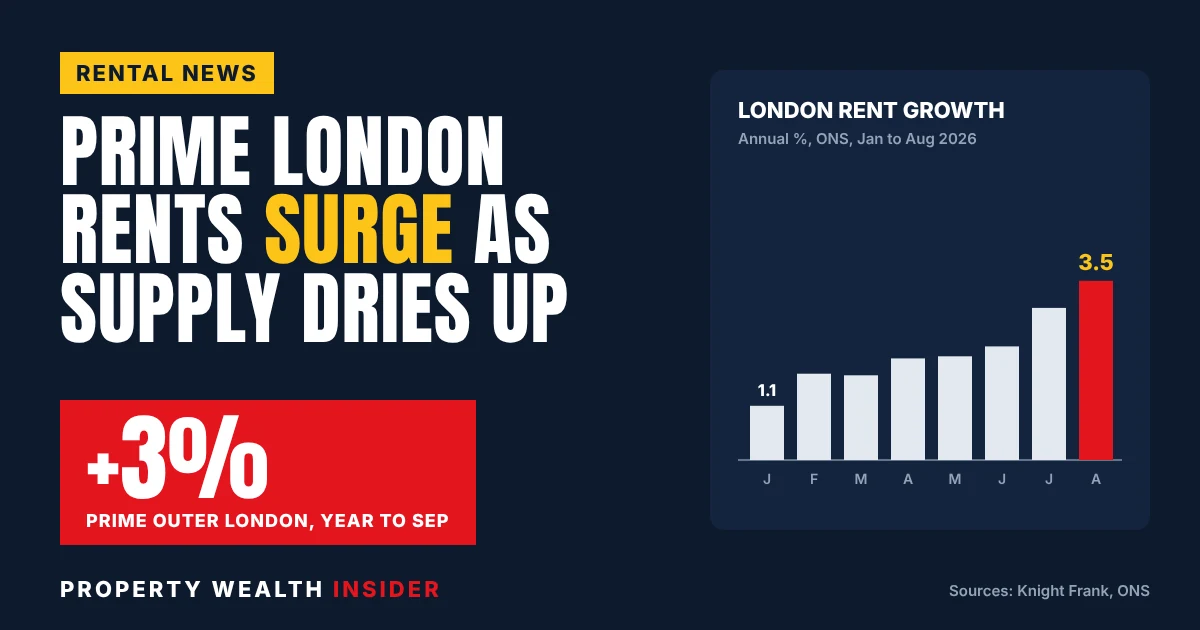
Rents in prime outer London rose 3% in the year to September 2026, and most of that came in the last six months. New figures from Knight Frank, published on 2 October 2026, show rents climbing 2.3% since the spring. That is the fastest six-month rise since January 2024.
The reason is simple: fewer homes to let and more tenants chasing each one. Knight Frank also says landlords are pricing in the extra risk of the Renters’ Rights Act, which came into force in England on 1 May 2026.
For London landlords, the market can support a rise. The law, though, now controls when you can raise rent, how you do it and how far. Below we compare the numbers, explain the new section 13 rules, and give you a planner to test any increase before you serve notice.
Key facts
- Prime outer London rents rose 3% in the year to September 2026, including 2.3% in the last six months (Knight Frank).
- New lettings listings in prime outer London fell 6.4% in the year to August compared with the previous 12 months.
- Prime outer London had 8.9 new prospective tenants for every new property in the three months to September, higher than during the pandemic. Prime central London had 5.6, the highest in four years.
- Across all of London, ONS puts average rent at £2,332 a month, up 3.5% in the year to August 2026.
- In England you can only raise rent once a year, using Form 4A with at least 2 months’ notice. Tenants can challenge the rise at tribunal.
The figures: prime vs mainstream London
Knight Frank tracks the top end of the market. Prime central London covers areas such as Kensington, Chelsea and Mayfair. Prime outer London covers the more expensive areas beyond the centre. The ONS Price Index of Private Rents covers the whole market, including existing tenancies as well as new lets.
| Measure | Annual rent growth | Latest period | Source |
|---|---|---|---|
| Prime outer London | +3.0% (+2.3% over 6 months) | Year to Sep 2026 | Knight Frank |
| Prime central London | +1.3% (+1.8% over 6 months) | Year to Sep 2026 | Knight Frank |
| London, all private rents (avg £2,332/month) | +3.5% | Year to Aug 2026 | ONS |
| Kensington and Chelsea (avg £3,690/month) | +2.1% | Year to Aug 2026 | ONS |
| England (avg £1,459/month) | +4.0% | Year to Aug 2026 | ONS |
| UK (avg £1,400/month) | +3.8% | Year to Aug 2026 | ONS |
The key word is acceleration. ONS figures show London rent growth fell to just 1.1% in January 2026, the lowest point in our chart. It has since climbed every month to 3.5% in August. ONS says London drove the rise in the UK rate to its highest since December 2025.
Why rents are rising again
Supply is shrinking. New listings in prime outer London were down 6.4% in the year to August, Knight Frank says. In prime central London, supply has held up better because weak sales have pushed some owners to let instead of sell.
Demand is strong. A ratio of 8.9 new tenants for every new property in prime outer London is higher than during the pandemic, when demand bounced back after each lockdown.
Landlord costs are up. Knight Frank cites Bank of England data showing the average five-year fixed buy-to-let mortgage at 75% loan-to-value was 4.7% in August, up from 3.88% in January. It also says landlords are setting asking rents higher to cover the new risks under the Renters’ Rights Act, calling this an “unintended but predictable consequence”.
Budget watch: the Budget is on 28 October 2026. Knight Frank notes speculation about capital gains tax rises and National Insurance on rental income. Nothing has been announced. Treat any reports as speculation until the Chancellor speaks.
How rent rises work under the Renters’ Rights Act
These rules apply in England only. Wales, Scotland and Northern Ireland have their own systems. Since 1 May 2026:
- Section 21 has gone. You cannot evict without a legal reason. You must use section 8 and a ground for possession.
- All tenancies are periodic. Existing ASTs became assured periodic tenancies and roll on (for example monthly) with no end date.
- One rise a year, by Form 4A. Rent can only go up through the section 13 process, with at least 2 months’ notice. A valid notice cannot raise rent within 52 weeks of the last increase.
- Tenants can challenge. A tenant who thinks the rise is above open market rent can apply to the First-tier Tribunal (Property Chamber). They must apply before the new rent’s start date. The fee is £47.
- The tribunal cannot add to your rise. HMCTS guidance says the open market rent it sets may be lower than, or the same as, the rent in your notice.
- No rental bidding. Adverts must state a rent. You cannot encourage or accept offers above it. This applies when you re-let.
Timing matters if a tenant challenges. If the tribunal decides after your proposed start date, the new rent usually starts from the next payment date after the decision, according to HMCTS guidance. A tenant can also ask for a later start on grounds of hardship. A rise you can’t justify can cost you months of the higher rent.
London rent rise planner
Enter your current rent and the rent you want to charge. The planner compares your rise with the latest ONS London figure, works out your yield and tells you the earliest date the new rent could start.
London rent rise planner
Guide only, not legal or financial advice. A tribunal decides open market rent for your property, using local comparable lettings, not an index. Rules shown apply to assured periodic tenancies in England. Dates are approximate: the new rent must start on the first day of a rental period.
Worked examples in pounds
Prime outer London flat at £3,000 a month. A 3% rise, in line with Knight Frank’s figure, takes rent to £3,090. That is £90 a month or £1,080 a year. On an £850,000 property, gross yield moves from 4.24% to 4.36%.
Average London let at £2,332 a month. A 3.5% rise, matching ONS, adds about £82 a month. That takes rent to roughly £2,414, or £979 more a year.
The over-reach. Say you ask for 10% on the £3,000 flat (£3,300) and the tribunal sets £3,090. You get £90 a month extra instead of £300. If the decision lands two months after your start date, you also lose two months of even that rise, which is £180 more. Asking for a figure you can prove usually pays better.
The timing trap. Rent last went up on 1 December 2025 and is due on the 1st. The earliest the new rent can start is 1 December 2026. To give 2 months’ notice, Form 4A needs to reach the tenant by the start of October 2026. Serve it now rather than waiting.
How to raise rent lawfully, step by step
- Check the date of the last rise. The new rent cannot take effect within 52 weeks of the last increase, or of the tenancy starting.
- Find your evidence. List 3-5 similar homes nearby (size, condition, features) that have actually let recently. HMCTS says agreed lettings are stronger evidence than asking prices on portals.
- Set a rent you can defend. Use the planner above. If your figure is well above the market data, have a clear reason, such as a refurbishment you paid for.
- Complete Form 4A. Download the current version from GOV.UK assured tenancy forms. Include the correct tenant names, address and signature.
- Pick the start date. It must be at least 2 months after the tenant receives the notice and fall on the first day of a rental period.
- Serve it and keep proof. Use the method your tenancy agreement allows and keep evidence of delivery.
- If the tenant applies to the tribunal, you have 28 days to respond on form MR2. Send your comparables.
- Last rent rise (or tenancy start) date confirmed and 52 weeks will have passed by the new start date
- 3-5 comparable lettings saved, with addresses, rents and dates
- Proposed rise tested against ONS London growth (3.5%) and local evidence
- Current Form 4A downloaded from GOV.UK and fully completed
- Start date at least 2 months away and on a rent due date
- Proof of service kept
- Renters’ Rights Act Information Sheet given to existing tenants (deadline was 31 May 2026)
- When re-letting: advert shows a fixed rent and no offers above it accepted
FAQ
How much are London rents going up in 2026?
ONS says average London rent rose 3.5% to £2,332 a month in the year to August 2026. Knight Frank says prime outer London rents rose 3% and prime central London 1.3% in the year to September.
How often can a landlord increase rent in England?
Once a year. Since 1 May 2026 you must use the section 13 process (Form 4A) and give at least 2 months’ notice.
Can a tenant refuse a rent increase?
They cannot simply refuse, but they can ask the First-tier Tribunal to decide the open market rent. They must apply before the new rent starts. The tribunal can set the same rent or a lower one, not a higher one.
Is there a cap on rent increases in London?
No. There is no percentage cap in England. The limit is open market rent: if a tenant challenges, the tribunal decides what similar homes let for.
Do these rules apply in Wales or Scotland?
No. The Renters’ Rights Act rules covered here apply to England. Wales and Scotland have separate rent and tenancy laws.
- Knight Frank: Prime London Rents Rise as Tenants Feel the Pre-Budget Squeeze (2 October 2026)
- Knight Frank: No News Has Been Good News for the Prime London Market (2 October 2026)
- ONS: Private rent and house prices, UK: September 2026
- ONS: Price Index of Private Rents, UK: monthly price statistics
- GOV.UK: Renters’ Rights Act: an overview for landlords
- GOV.UK: Renters’ Rights Act overview for tenants
- HMCTS: Apply for an open market rent determination
This article is news and general guidance only. It is not financial, legal or tax advice.