One Student Quits, Whole House Goes: The 2-Month Notice Trap
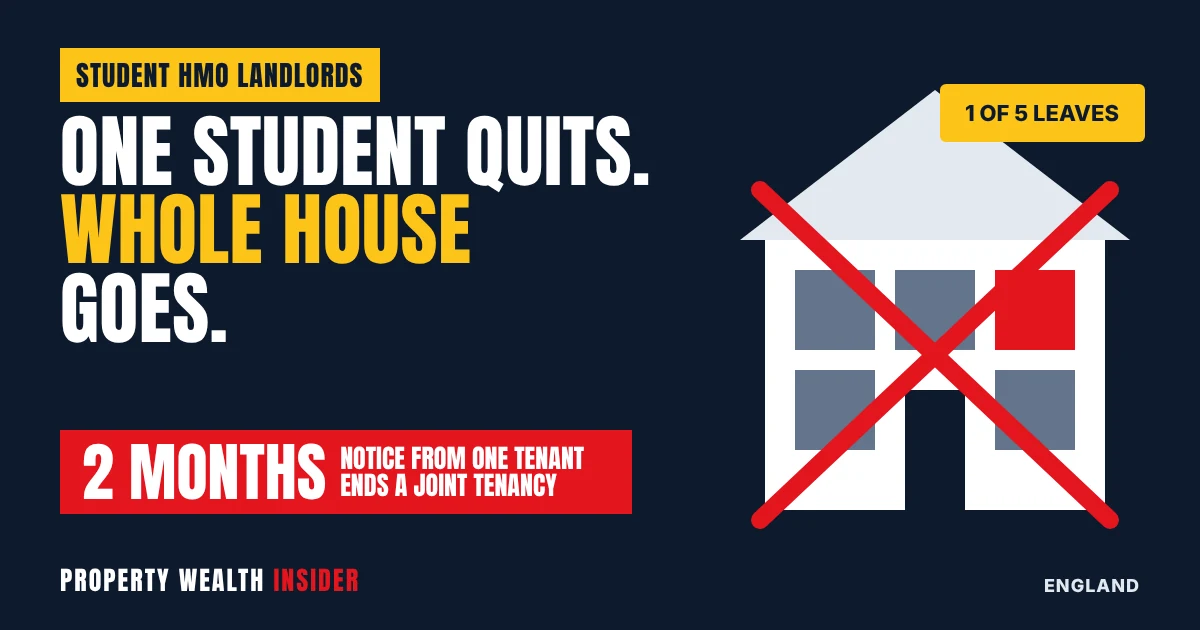
A single student handing in two months’ notice can now bring down the tenancy for an entire shared house in England. With fixed terms abolished since 1 May 2026, every student let is a rolling periodic tenancy, and the long-standing rule that one joint tenant can end a periodic joint tenancy for everybody has suddenly become a live income risk.
That puts a hard question in front of every student HMO landlord planning the 2027 letting cycle: keep one joint contract per house, or move to separate tenancies for each room? Neither option is free. One concentrates the risk; the other spreads it but multiplies the paperwork.
This guide covers England only. It sets out what the law now says, how each model handles deposits, council tax, licensing and the new student possession ground, and gives you a calculator to test your own numbers.
Key facts
- Assured shorthold tenancies became assured periodic tenancies on 1 May 2026 in England. You cannot put an end date in a tenancy agreement.
- A tenant can end a periodic tenancy with 2 months’ notice, in writing, ending in line with a rent period.
- One joint tenant’s valid notice to quit ends a periodic joint tenancy for all the joint tenants (the Monk rule, restated by the Supreme Court in 2014).
- New mandatory ground 4A lets student HMO landlords recover possession for the next academic year, with 4 months’ notice and a date falling between 1 June and 30 September.
- Ground 4A is lost if the tenancy was signed more than 6 months before the tenant could move in, or if you did not give written notice of it before the tenancy started.
- Deposits are capped at 5 weeks’ rent per tenancy (annual rent under £50,000) and must be protected within 30 days.
What changed on 1 May 2026
The Renters’ Rights Act 2025 tenancy reforms took effect in England on 1 May 2026. Government guidance for landlords confirms all existing assured shorthold tenancies converted to assured periodic tenancies, new lets are periodic, and section 21 is gone.
Under the old 12-month fixed term, a student who dropped out stayed liable for rent until the term ended, so the group had every reason to find a replacement. That safety net has gone.
Under the tenant guidance, any tenant can now end a periodic tenancy with 2 months’ notice in writing, given on or the day before the rent day. Combine that with the common-law rule on joint tenancies and the risk becomes obvious.
The Monk rule in one line: where a joint tenancy is periodic, a valid notice to quit served on the landlord by just one of the joint tenants ends the tenancy for all of them, even against the wishes of the others. The House of Lords settled this in Hammersmith and Fulham LBC v Monk [1992] AC 478, and the Supreme Court restated it in Sims v Dacorum Borough Council [2014] UKSC 63. The court described it as applying in the absence of a contractual term to the contrary; whether any clause can change the outcome under the new regime is a question for your solicitor.
In practice: five students share a house on one joint tenancy. One drops out in November and serves valid notice. When it expires, the tenancy ends for all five. The four who want to stay have no tenancy unless you grant them a new one. Get advice before taking any step against occupiers who remain; possession still runs through the courts.
Ground 4A: the student possession ground and its traps
Losing fixed terms also took away the guaranteed summer handover. To replace it, the Act inserted ground 4A into Schedule 2 to the Housing Act 1988. It is a mandatory ground, so if you prove it the court must order possession. All six conditions must be met:
- The dwelling is an HMO or is in an HMO.
- The tenant met the “student test” when the tenancy was signed: a full-time student, or reasonably expected to become one during the tenancy. With joint tenants, every one of them must meet it.
- Before the tenancy was entered into, you gave a written statement that you may recover possession on this basis and intend to re-let to students.
- The tenancy was signed no more than six months before the tenant was entitled to move in.
- The date given in your section 8 notice falls between 1 June and 30 September.
- You intend to re-let to students next time.
Under section 8 the notice period is four months from the day it is served. So to name 30 September, the last possible date, you need to serve by about the end of May. The government’s grounds for possession guidance confirms the four months and the six-month signing limit.
Trap one: signing too early. Student houses have traditionally been signed up in the autumn for the following September. Sign a September 2027 let in October 2026 and ground 4A is gone for that tenancy. For a 1 September move-in, the signing date needs to be no earlier than around the start of March.
Trap two: one non-student on a joint contract. If a joint tenant is not a student when the tenancy is signed, the whole joint tenancy fails the student test.
Trap three: room lets. The statute covers a dwelling that “is in an HMO”, which on its face includes a room let in a shared house. But the government’s landlord overview describes the ground as covering “full-time students on a joint contract” in an HMO. Until that is clarified, take legal advice before relying on ground 4A for individual room tenancies.
Joint vs room-by-room: side by side
Switching models changes more than the tenancy wording.
| Issue | One joint tenancy | Individual room tenancies |
|---|---|---|
| One student gives 2 months’ notice | Ends the tenancy for the whole group | Ends that room’s tenancy only; others continue |
| Rent liability | All tenants usually jointly liable for the full rent | Each tenant liable for their own room’s rent |
| Deposits | One deposit, one protection, one set of prescribed information | One deposit per tenancy, each protected within 30 days with its own prescribed information |
| Deposit cap | 5 weeks’ rent on the whole-house rent (under £50,000 a year) | 5 weeks’ rent on each room’s rent |
| Ground 4A | Available if every joint tenant meets the student test | Statute covers a dwelling “in an HMO”; official overview refers to joint contracts. Take advice |
| Replacing a leaver mid-year | Needs a new tenancy agreed with the remaining group | You re-let the room yourself |
| Council tax | No bill if every resident is a full-time student | Same rule, but a non-student replacement brings a bill |
| HMO status and licensing | Depends on number of people and households, not the contract | Same |
| Admin load | One agreement, one rent stream | Several agreements, rent streams, deposits and notices |
On licensing, GOV.UK defines an HMO by occupants: at least three people, not from one household, sharing a kitchen, bathroom or toilet. A mandatory licence is needed with five or more people forming more than one household. Changing the contract does not take you in or out of licensing, but check whether your licence conditions require you to tell the council about changes.
On council tax, GOV.UK confirms households where everyone is a full-time student do not pay. That means a course of at least one year with at least 21 hours of study a week. Room letting makes it tempting to fill a gap with a working tenant, but that switches a bill on for the property.
Calculator: which model loses you less?
Every input below is your own assumption. The defaults are illustrative, not market data. Plug in your house, your local re-letting experience and your own dropout history.
Joint vs room-by-room income risk
Guide only, not financial or legal advice. Results depend entirely on your assumptions. The model treats each student’s decision to leave as independent, assumes a joint tenancy that ends and is not re-signed leaves the whole house empty for the weeks you enter, and ignores costs common to both models.
With the defaults (five rooms at £600, a 10% dropout chance per student), there is roughly a 41% chance that at least one student leaves in a year. That single figure is why the joint model now carries a much bigger tail risk than it did under fixed terms.
Worked £ examples: deposits, advance rent and voids
Take a five-bed student HMO at £600 per room per month: £3,000 a month, or £36,000 a year. Annual rent is under £50,000, so the deposit cap is 5 weeks’ rent.
- Joint tenancy: maximum deposit is £36,000 ÷ 52 × 5 = about £3,461, protected once.
- Room-by-room: each tenancy is £7,200 a year, so the cap is about £692 per room. The total is the same £3,461, but that is five protections and five sets of prescribed information, each due within 30 days.
- Holding deposits: capped at one week’s rent per tenancy. Joint: about £692 shared by the group. Room-by-room: about £138 each.
- Rent in advance: you cannot take any rent before the agreement is signed, and at most one month’s rent after signing and before the start date: £3,000 for the joint let, or £600 per room. The old habit of taking a term’s rent up front is out.
The void that hurts. Illustration only: a joint tenancy ends at the end of January and the house sits empty until the next intake in September. That is eight months at £3,000, or £24,000 of lost rent. Under room lets, the same dropout empties one room: eight months at £600 is £4,800, and the other four tenancies keep paying.
If the remaining four sign a fresh joint tenancy, the joint model may cost no more than room lets. Price that in with the calculator’s “chance the rest sign” input.
Deposit compliance is also a possession issue. Government guidance says a court will not make a possession order if the deposit was not properly protected. Five deposits means five chances to get that wrong.
What to do now: step-by-step
- Audit each house separately. Note the contract type, signing date, start date, whether a written ground 4A statement was given before signing, and whether every occupier is a full-time student.
- Run the calculator per property. A tight group on a high-demand street is a different risk from a large house where mid-year re-lets are slow.
- Reset your signing calendar. For a 1 September 2027 start, don’t sign before about early March 2027 if you want ground 4A. Plan marketing around that date.
- Issue the written ground 4A statement before every new tenancy is signed. It cannot be added afterwards.
- Diary your 4A notices. Four months’ minimum, with a date in the 1 June to 30 September window, means serving by about the end of May.
- Check lender and insurer terms before switching to room lets. Confirm the new letting model is allowed and whether you must notify them.
- Update licensing and safety records. Check your HMO licence conditions, and review the fire risk assessment if room locks or layout change.
- Set up per-room systems if you switch. Separate deposits, prescribed information, rent ledgers and inventories, plus a clear policy for shared areas.
- Every current student tenancy logged with signing date and start date
- Written ground 4A statement given before signing (copy on file)
- Every joint tenant confirmed as a full-time student at signing
- 2027 lets scheduled to sign no earlier than about six months before move-in
- Ground 4A notice dates diarised (serve by about end of May)
- Deposits protected within 30 days, prescribed information served for each tenancy
- No rent taken before signing; no more than one month in advance
- Mortgage and insurance terms checked for the chosen model
- HMO licence current and conditions met
- Council tax exemption claimed; plan for what happens if a non-student moves in
FAQ
Can one student end a joint tenancy for everyone?
Yes, for a periodic joint tenancy. A valid notice to quit from one joint tenant ends it for all of them. Since 1 May 2026 student lets in England are periodic, so a student can do this with 2 months’ written notice.
What is ground 4A and how much notice does it need?
It is a mandatory possession ground for HMOs let to full-time students. It needs four months’ notice, a date in the notice between 1 June and 30 September, a written statement before the tenancy started, and a signing date no more than six months before move-in.
Do room-by-room student lets still need an HMO licence?
HMO status depends on how many people live there and how many households they form, not on the contract. Five or more people forming more than one household and sharing facilities need a mandatory licence; councils can require licences for smaller HMOs too.
Do students in a shared house pay council tax?
Not if everyone living there is a full-time student; the household is exempt, though it must apply. If a non-student moves in, a bill applies, possibly with a discount.
Does this apply in Wales or Scotland?
No. These Renters’ Rights Act tenancy changes apply in England. Wales and Scotland have their own systems.
Sources
- Renters’ Rights Act 2025, legislation.gov.uk
- Housing Act 1988, Schedule 2 (ground 4A), legislation.gov.uk
- Housing Act 1988, section 8 (notice periods), legislation.gov.uk
- Sims v Dacorum Borough Council [2014] UKSC 63, The National Archives
- Renters’ Rights Act: an overview for landlords, GOV.UK
- Renters’ Rights Act overview for tenants, GOV.UK
- Grounds for possession: guidance for landlords and letting agents, GOV.UK
- Guide to the Renters’ Rights Act, GOV.UK
- Fees you can charge as part of a tenancy, GOV.UK
- Tenancy deposit protection, GOV.UK
- House in multiple occupation licence, GOV.UK
- Council Tax: discounts for full-time students, GOV.UK
This article is news and general guidance only, not financial, legal or tax advice.