Landlord register: £65 a home, nearly 7x the official estimate
Every landlord in England with a let property will soon pay £65 a year, per home, to sit on a new government register. Miss your regional deadline and you face fines of up to £7,000. You also lose the right to evict for rent arrears until you sign up.
The “Register your rental property” service is the Private Rented Sector (PRS) Database created by the Renters’ Rights Act 2025. It opens in the West Midlands on 15 December 2026, and every region of England must be registered by 14 November 2027. On 1 October the National Residential Landlords Association (NRLA) called it a “multi-million pound rip-off”. It estimates the bill at more than £325 million a year across the sector.
This applies to England only. Below we check the NRLA’s numbers against the government’s own impact assessment. We also cover what you need ready, when your region goes live and what it costs your portfolio, and our calculator works out your bill and your exposure.
Key facts
- Fee: £65 per property, per year, paid when you register and at every annual renewal. It is pro-rated during the rollout.
- Rollout starts 15 December 2026 in the West Midlands. Each region then gets a 3-month window, and the final deadline is 14 November 2027 (South West).
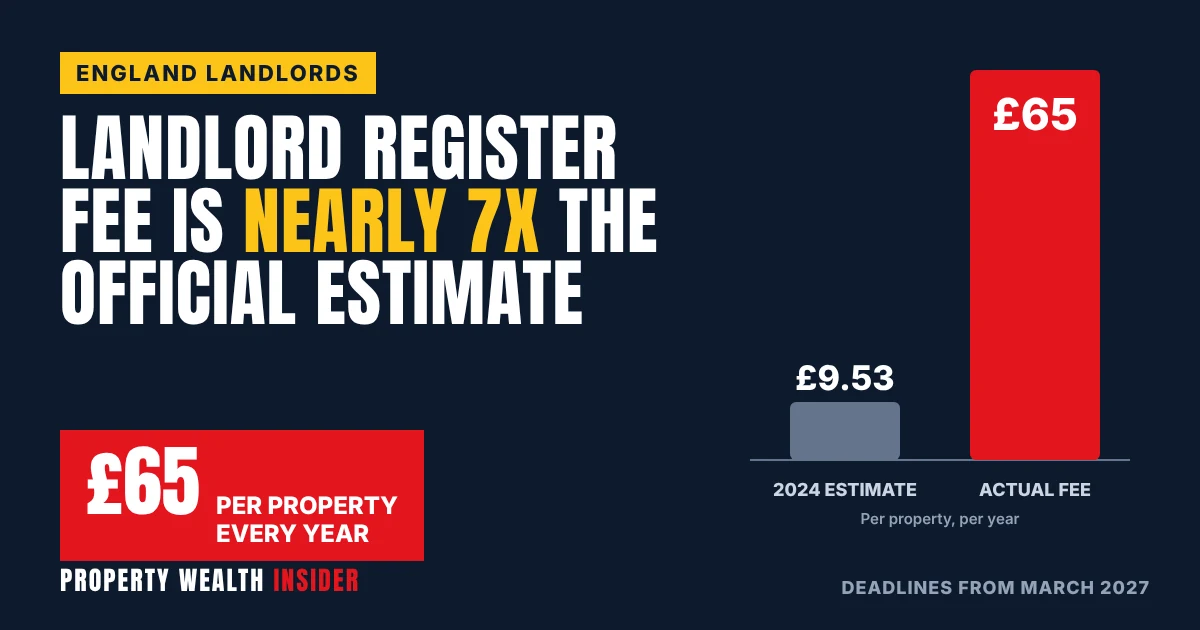
- The government’s 2024 impact assessment assumed a fee of £28.58 per property every three years, about £9.53 a year. £65 is roughly 6.8 times that.
- The NRLA estimates the sector-wide cost at £327m a year (£65 × just over 5 million PRS homes). Official figures show 5,030,000 private rented dwellings in England.
- Breaching the registration duties can bring a civil penalty of up to £7,000. False information or repeat breaches can bring up to £40,000.
- Unregistered landlords cannot get a possession order on most grounds, including rent arrears.
What the database is and who must register
Chapter 3 of Part 2 of the Renters’ Rights Act 2025 sets up the database. Section 82 makes it a duty for a residential landlord to hold an active “landlord entry” for themselves and an active “dwelling entry” for each property. The details sit in the draft Private Rented Sector Database Regulations 2026, which have been laid before Parliament.
According to the government’s landlord guidance, you must register if you let a property on an assured or regulated tenancy. For now that means properties currently let, or let during the rollout. Empty properties do not need registering yet. Future legislation will require them to be registered before they are marketed. Adverts will then also have to carry your landlord and property ID numbers.
Supported exempt accommodation is excluded. You need a GOV.UK One Login to use the service, and the government says offline routes will exist for landlords who need them. Wales, Scotland and Northern Ireland run their own landlord registration schemes and are not covered here.
Agents cannot do it all for you. The landlord must start the registration. A letting agent or property manager can then upload certain information, such as tenancy details and safety certificates, on your behalf. You remain legally responsible for all of it.
Regional deadlines: when you must register
The deadline depends on where the property is, not where you live. A London landlord with a flat in Birmingham works to the West Midlands deadline. You can register any property early, from 15 December 2026. Once a region’s deadline passes, councils there can start enforcement.
| Region (property location) | Duty starts | Deadline to register |
|---|---|---|
| West Midlands | 15 December 2026 | 14 March 2027 |
| East of England | 15 January 2027 | 14 April 2027 |
| East Midlands | 15 February 2027 | 14 May 2027 |
| South East | 15 March 2027 | 14 June 2027 |
| Yorkshire and Humber | 15 April 2027 | 14 July 2027 |
| North West | 15 May 2027 | 14 August 2027 |
| North East | 15 June 2027 | 14 September 2027 |
| London | 15 July 2027 | 14 October 2027 |
| South West | 15 August 2027 | 14 November 2027 |
Source: MHCLG Housing Hub; start dates match regulation 1 of the draft regulations.
What £65 a property really costs you
The fee is charged per property, not per landlord. You pay it to make each dwelling entry and again at each annual renewal. If you hold several properties, the draft regulations line up their renewal dates with your first property, so the whole portfolio renews on one day.
Note that £65 is not written into the regulations. The explanatory memorandum says the database operator sets the fee by reference to its costs, “which will allow it to be changed to account for changes such as inflation”. Those costs include council enforcement under the Act (section 81). Plan on £65 as a floor, not a fixed price.
| Portfolio | Per year | Over 5 years (at £65) | Per property per month |
|---|---|---|---|
| 1 property | £65 | £325 | £5.42 |
| 3 properties | £195 | £975 | £5.42 |
| 5 properties | £325 | £1,625 | £5.42 |
| 10 properties | £650 | £3,250 | £5.42 |
| 20 properties | £1,300 | £6,500 | £5.42 |
| 50 properties | £3,250 | £16,250 | £5.42 |
Worked example: a landlord with five houses let at £1,200 a month takes £72,000 a year in rent. The £325 fee is 0.45% of that. Under the impact assessment’s assumption (£28.58 per property every three years), five properties would have cost about £143 over three years. At £65 a year the same three years costs £975.
The fee is only part of the cost. You also need time to scan and upload certificates. Licensing fees still apply on top in areas with selective or additional licensing.
Calculator: your fee bill and fine exposure
PRS Database cost & risk calculator
Guide only, not legal or financial advice. Fees are per property per year and shown at a flat rate; the government says they are pro-rated during rollout and may change. Penalty figures are statutory maximums under section 91 of the Renters’ Rights Act 2025. Councils decide the actual amount.
The £327m row: NRLA vs the impact assessment
The NRLA’s sector-wide figure is a simple multiplication: £65 × “just over five million” PRS homes = a minimum of £327 million a year. The government’s dwelling stock estimates put the private rented sector at 5,030,000 dwellings at 31 March 2025, so the multiplication checks out. It is still the NRLA’s estimate and should be read as an upper bound. Empty homes are not yet required to register, and supported exempt accommodation is excluded.
The “almost seven times” claim also checks out against the Renters’ Rights Bill impact assessment (November 2024). It assumed registration would last three years at £28.58 per property, within a range of £12.23 to £45.31. That works out at about £9.53 a year. £65 is 6.8 times that central figure and more than four times the top of the range.
The impact assessment also put the fee’s cost to landlords at £36.0 million a year (present value, 2019 prices, over a ten-year appraisal). That is not directly comparable with the NRLA’s cash figure of £327 million, but the gap is clearly large. The explanatory memorandum for the new regulations says no fresh impact assessment was done, because the regulations do “not materially alter the impacts” already assessed.
The government says the fee balances fairness with the cost of running the service and tackling non-compliance. Part of the money will fund councils’ enforcement staff, and “taxpayers are not subsidising the service”. The NRLA’s chief executive, Ben Beadle, called it “a costly mess”. He noted that the fee is more than the £54.85 maximum MOT fee for a car, and that gas and electrical certificates must be uploaded by hand.
Fines, evictions and rent repayment orders
Civil penalties. Under section 91, a council can fine you up to £7,000 for breaching section 82. That covers letting without active entries, marketing without them, leaving the IDs off adverts once that rule applies, and failing to keep entries up to date. If the breach carries on more than 28 days after a penalty, another penalty can be imposed. The draft regulations give you 28 days to update an entry after something changes, such as a new rent or a renewed certificate.
£40,000 offences. Section 92 creates offences for three things, which a council can punish with a penalty of up to £40,000 or prosecute: knowingly or recklessly giving false or misleading information, continuing a breach after a penalty, and committing another breach within five years. legislation.gov.uk currently lists section 92 as not yet in force.
No registration, no possession. Section 90 stops the court making a possession order while you are in breach of the duty to hold active entries. The only exceptions are the anti-social behaviour grounds, Ground 7A and Ground 14. Rent arrears (Ground 8), selling up, moving in and every other ground are blocked until you register.
Worked example: your tenant is three months behind on £1,200 rent, which is £3,600 owed, and you never registered the property. The court cannot make the order. Registering costs £65 and could take minutes. Not registering could add months of lost rent on top of the £3,600.
Rent repayment orders. Section 98 adds two database offences to the rent repayment order regime: giving false or misleading information, and continuing breaches after a penalty. Those parts follow section 92’s commencement.
How to register: step by step and checklist
- Find your deadline. Use the table above for each property’s location. If you have properties in several regions, you can register them all at once from 15 December 2026.
- Set up a GOV.UK One Login now so you are not stuck on launch day.
- Digitise your certificates. Scan the current gas safety record, EICR (or EIC) and EPC for every property. Note the issue and expiry dates.
- Create your landlord entry. Under the draft regulations it goes inactive if no property is added within 3 months.
- Add each property and pay £65 per property (pro-rated during rollout). A let property’s safety documents can follow, but must be uploaded within 28 days or the entry goes inactive.
- Tell your agent. Agree in writing what they will upload and who will update the entry when rents, tenants or certificates change.
- Diary your renewal date. All your properties renew on the first one’s anniversary, and an unrenewed entry becomes inactive the next day.
- Your name, date of birth, home address, phone and email (companies: Companies House or charity number and a nominated contact)
- Any authority documents if acting as attorney, executor, deputy, receiver or mortgagee
- Property address, ownership type, dwelling type and number of bedrooms
- Freeholder, superior landlord and property manager names and emails
- Number of occupants and households
- HMO, additional or selective licence numbers (if applicable)
- Furnished, part-furnished or unfurnished
- Rent charged, payment frequency and any utilities included
- Gas safety record copy and issue date (if there is a gas supply)
- EICR or EIC copy and expiry date
- Most recent EPC, plus MEES exemption details if rated below the minimum
- Payment card for £65 per property
FAQs
How much is the landlord database fee?
£65 per property per year, paid when you register and at each annual renewal. It is pro-rated during the rollout. The operator sets the fee by reference to costs, so it can change.
When do I have to register my rental property?
It depends on the property’s region. The first deadline is 14 March 2027 for the West Midlands and the last is 14 November 2027 for the South West. You can register early from 15 December 2026.
Do I need to register an empty property?
Not yet. Only properties that are let, or let during the rollout, must be registered now. The government says future legislation will require empty properties to be registered before they are marketed.
Can my letting agent register for me?
Not fully. You must start the process yourself, then your agent or property manager can upload some information. You stay responsible for everything on the record.
What happens if I don’t register?
The council can fine you up to £7,000 per breach, and repeat or continuing breaches can lead to penalties of up to £40,000. The court also cannot grant you possession on most grounds, including rent arrears, until you are registered.
Does the database apply in Wales or Scotland?
No. The “Register your rental property” service covers properties in England. Wales, Scotland and Northern Ireland have their own landlord registration systems.
Sources
- MHCLG Housing Hub: Get ready for the ‘Register your rental property’ service
- GOV.UK press release, 9 September 2026: Stronger protections and greater confidence for renters
- Renters’ Rights Act 2025 (sections 81, 82, 90, 91, 92, 98)
- Draft Private Rented Sector Database Regulations 2026 and explanatory memorandum
- Renters’ Rights Bill impact assessment (MHCLG, November 2024)
- Dwelling stock estimates, England: 31 March 2025
- NRLA statement, 1 October 2026
- GOV.UK: MOT test fees
This article is news and general guidance only, not financial, legal or tax advice.