£10m holiday let refund row: council tax vs business rates
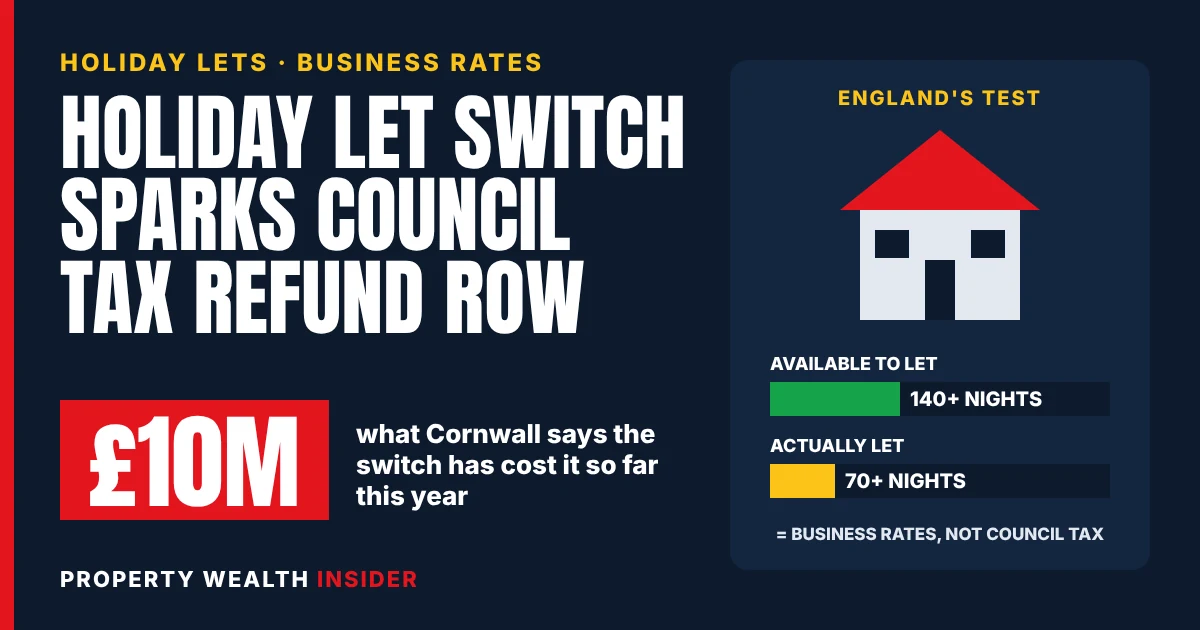
Cornwall Council says second home owners who switch their properties to holiday lets, then claim back years of council tax, have cost it about £10m so far this financial year. It wants the law changed. For anyone running a holiday let in England or Wales, the row is a reminder that the switch from council tax to business rates is worth thousands a year if you qualify, and a costly mess if you claim it without the booking records to back it up.
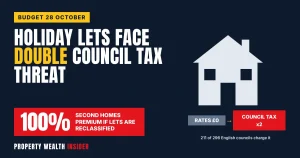
The council’s warning, reported by the BBC on 19 October 2026, comes as stricter council tax premiums on second homes push more owners to look at business rates. A small holiday cottage with a rateable value of £12,000 or less can pay nothing at all under small business rate relief, while the same property taxed as a second home could pay double council tax.
Here are the tests, the 2026/27 numbers, how backdating works and how to apply. All rules are as they stand before today’s Autumn Budget (28 October 2026).
Key facts
- Cornwall Council says backdated council tax refunds linked to holiday let switches have cost it about £10m so far in 2026/27.
- In England a holiday let goes on business rates if it was available for at least 140 nights and actually let for at least 70 nights in the last 12 months, and will be available for 140 nights in the next 12.
- Wales is much tougher: 252 nights available and 182 nights actually let.
- Small business rate relief in England is 100% for a rateable value of £12,000 or less, tapering to nothing at £15,000.
- Since 24 July 2026, English sites with 5 or more holiday lets, and lets sharing land with another business you run, no longer need to pass the 140/70-night history test.
- English councils can charge second homes up to a 100% council tax premium from April 2025.
Cornwall’s £10m refund bill explained
According to the BBC, Cornwall Council has seen more owners switch second homes into holiday lets since it brought in a second homes council tax premium last year. Once a property is accepted for business rates, the owner can ask for council tax paid over the period it qualified to be refunded.
Councillor Adam Paynter, the council’s portfolio holder for resources, called it “a huge loophole” that has cost over £10m this financial year. He told the BBC the council is only compensated for three years of retrospective business rates. The council says it may now have to review the council tax support it gives to up to 19,000 low-income households.
The Ministry of Housing, Communities and Local Government told the BBC that properties must meet “strict criteria” for business rates, and that councils get full pound-for-pound compensation for small business rate relief. The Cornwall Self-Catering Collective said owners must go through a genuine qualifying process. The rules have not changed as a result of the row, though North Cornwall MP Ben Maguire says he will push ministers for a change.
The traffic used to run the other way. When England’s 70-night test arrived on 1 April 2023, 10,710 English holiday lets were removed from the rating list in a year, more than double the year before. Across England and Wales, 95.6% of those deleted had a rateable value under £6,000.
The tests: England vs Wales
Whether you pay council tax or business rates is not your choice, or the council’s. It depends on what the property is used for, under section 66 of the Local Government Finance Act 1988, and the Valuation Office (VO, now part of HMRC) decides. Scotland and Northern Ireland have separate systems that this article does not cover.
| Test | England | Wales |
|---|---|---|
| Available to let commercially, last 12 months | 140 nights | 252 nights |
| Actually let, last 12 months | 70 nights | 182 nights |
| Intend to make available, next 12 months | 140 nights | 252 nights |
| Lets that count | Short lets of 28 nights or less, at a commercial rate | Short lets of 28 nights or less, at a commercial rate |
| Changes in 2026 | From 24 July 2026, sites of 5+ units and lets sharing land with your other business only need the next-12-months test | From 1 April 2026, nights let can be averaged over 24 or 36 months, and up to 14 nights donated to a registered charity count |
| Small business rate relief | 100% up to £12,000 rateable value, tapering to 0% at £15,000 | Separate Welsh scheme: check with your council |
The VO’s England guidance is strict about what counts. You cannot include nights the property was shut for repairs, nights the site was closed, nights you or friends and family used it at a discount, or future bookings that have not happened yet. A stay of more than 28 nights does not count towards the 70 let nights.
The July 2026 change comes from the Non-Domestic Rating (Definition of Domestic Property) (England) Order 2026. It helps holiday parks, cottage complexes, and farms or pubs with a cottage on the same land. Those units still must not be anyone’s main home, and must be intended for at least 140 nights of letting in the next 12 months.
Business rates vs council tax in 2026/27
Business rates are your rateable value multiplied by a multiplier. Government guidance names self-catering accommodation and holiday homes as qualifying hospitality, so a holiday let with a rateable value under £51,000 normally uses the small business retail, hospitality and leisure multiplier of 38.2p for 2026/27. Your council confirms which multiplier applies. Then small business rate relief comes off.
| Rateable value | Rates before relief (38.2p) | Small business rate relief | Bill 2026/27 |
|---|---|---|---|
| £6,000 | £2,292 | 100% | £0 |
| £12,000 | £4,584 | 100% | £0 |
| £13,500 | £5,157 | 50% | £2,579 |
| £14,000 | £5,348 | 33% | £3,565 |
| £15,000 | £5,730 | 0% | £5,730 |
Full relief needs this to be the only business property you use. You can keep it if your other properties each have a rateable value of £2,899 or less and the total is under £20,000 (£28,000 in London). Two qualifying cottages each rated above £2,899 means relief on neither of them.
On the council tax side, the average Band D bill in England for 2026/27 is £2,392. By law Band B is seven-ninths of Band D, so about £1,860. A council charging the full 100% second homes premium doubles that.
Worked examples (England, 2026/27)
- Small cottage that qualifies: available 210 nights, let 98, rateable value £5,500, the owner’s only business property. Rates before relief are £2,101, less 100% relief, so £0. As a Band B second home at the England average with a 100% premium it would pay about £3,720. That is about £3,720 a year better off on rates.
- Bigger let, part relief: rateable value £13,500, so 50% relief. Rates are £5,157 less half, so about £2,579. As a Band D second home with a 100% premium it would pay £4,784. The difference is about £2,200 a year.
- Misses the 70-night test: available 150 nights but let only 55. It stays on council tax: £4,784 a year at Band D with the premium. But if it is one of five or more units on the same site, the 2026 change means it could now qualify.
Checker: council tax or business rates?
Put in your own numbers. The checker uses England’s tests and 2026/27 rates. Your rateable value comes from the VO once it has assessed the property. Before then, try a range.
Council tax vs business rates checker (England)
Guide only, not tax advice. It assumes England, 2026/27 rates, the 38.2p small business hospitality multiplier (43p at £51,000 and above) and small business rate relief. It ignores transitional and other reliefs and your council’s local decisions. The VO, not you, decides if a property is rated.
How backdating and refunds work
When the VO accepts that a property became business property, it deletes it from the council tax list. Under regulation 11 of the Council Tax (Alteration of Lists and Appeals) (England) Regulations 2009, that deletion takes effect from the day the circumstances arose. In other words, the day it first met the business rates test, not the day you applied.
The council then rebills you: council tax since that date is refunded and business rates charged instead. With 100% small business rate relief the rates bill can be nil. The BBC reported that refunds can reach back more than 30 years.
For an older claim, the property has to have met the test that applied at the time. In England, before 1 April 2023 the main test was an intention to make the property available for 140 days of commercial short letting. The 2022 Order added the previous-year availability and 70-night letting conditions. Your evidence has to cover every year you claim for.
Example: say you paid £2,000 a year in council tax on a cottage that has met the 140/70-night tests since 1 April 2024, and the VO accepts that date. You could get back about £4,000 for 2024/25 and 2025/26, plus what you have paid so far this year. That is offset by any business rates due for the same period, which is £0 if the rateable value is £12,000 or less and you get full small business rate relief.
It works both ways. The VO sends a form each year asking you to confirm the property still qualifies. If it does not, it moves back to council tax, where the second homes premium may apply.
How to apply to the Valuation Office
- Count your nights honestly. Go through 12 consecutive months of calendars. Take out owner use, discounted stays for friends and family, closures and stays longer than 28 nights.
- Pin down your start date. The form asks when the property first became commercially available, and the date it reached 140 available and 70 let nights. Answers before 1 April 2022 may prompt questions from the VO.
- Download the England form from the VO’s application page. Use one form per property. Owners of sites with 5 or more lets, or lets sharing land with another business, should say so under “Further information or remarks”.
- Fill in the nights for each tax year from 2023/24 to 2025/26. Add your listing links, highest and lowest weekly prices, and number of bed spaces. The VO uses these to set your rateable value.
- Send it to selfcatering@hmrc.gov.uk with the subject “Self-catering application — England”, or post it to Valuation Officer, Wycliffe House, Green Lane, Durham DH1 3UW. Welsh properties have a separate form.
- Claim relief from your council. Once you have a rateable value, ask the council for small business rate relief and a recalculated council tax account covering the backdated period.
- Diary the annual check. Keep logging nights so you can answer the VO’s yearly confirmation form.
- Booking platform reports (Airbnb, Vrbo, agency statements) showing dates and nights for each stay
- Your own availability calendar for each month, including blocked dates and why they were blocked
- Invoices or payment records showing a commercial rate was charged
- A note of owner, family and friends’ stays, which you must exclude
- Dates of any closures for repairs or refurbishment
- Live listing URLs plus screenshots of past listings and prices
- Bed space count (doubles count as 2, sofa beds do not count)
- Council tax bills for the years you want refunded
- Details of any other business properties you use, for the relief check
FAQs
Can I choose to pay business rates instead of council tax on my holiday let?
No. The Valuation Office decides based on use: in England 140 nights available and 70 let in the last 12 months, plus 140 planned for the next 12. In Wales it is 252 and 182.
Do holiday lets pay the second homes council tax premium?
Only if they are on council tax. A let that has moved to business rates does not pay council tax at all. A furnished property that is nobody’s main home and stays on council tax can be charged the premium. There is an exception (Class L) for homes where planning rules ban year-round living or limit use to holiday accommodation.
How far back can I claim a council tax refund for my holiday let?
The council tax deletion runs from the day the property first met the business rates test, so it can be years. You must prove it met the rules in force each year, and business rates are charged for the same period. With 100% small business rate relief that charge can be nil.
Can I get small business rate relief on two holiday lets?
Usually only if each of the other properties has a rateable value of £2,899 or less and the total is under £20,000 (£28,000 in London). If you take on a second property on or after 27 November 2025, you keep relief on the first for 36 months.
Is the law changing because of Cornwall?
Not yet. Cornwall Council and local MPs want the rules changed, but the government has not announced any change. The Leader of the Commons told MPs that a call for evidence on the tax treatment of holiday lets will publish its findings in due course. The only recent change in England, from 24 July 2026, made it easier for sites with 5 or more lets and lets sharing land with another business to qualify.
- BBC News: Calls to change holiday lets council tax rules (19 October 2026)
- GOV.UK: Business rates for self-catering and holiday let accommodation
- GOV.UK: Apply for business rates for a self-catering property in England
- Local Government Finance Act 1988, section 66
- Non-Domestic Rating (Definition of Domestic Property) (England) Order 2026
- Non-Domestic Rating (Definition of Domestic Property) (England) Order 2022
- Council Tax (Alteration of Lists and Appeals) (England) Regulations 2009, regulation 11
- GOV.UK: Small business rate relief
- GOV.UK: Estimate your business rates (2026/27 multipliers)
- GOV.UK: Business rates multipliers, qualifying retail, hospitality or leisure
- MHCLG: Guidance on council tax premiums on long-term empty homes and second homes
- MHCLG: Council Tax levels set by local authorities in England 2026 to 2027
- Local Government Finance Act 1992, section 5 (band ratios)
- VOA: Self-catering holiday homes, movement between rating and Council Tax lists
- GOV.UK: How self-catering holiday lets are valued for business rates
This article is news and general guidance only, not financial, legal or tax advice. Rules are as they stood before the Autumn Budget on 28 October 2026.