Brighton licensing U-turn: 7,300 homes spared, £40k fines remain
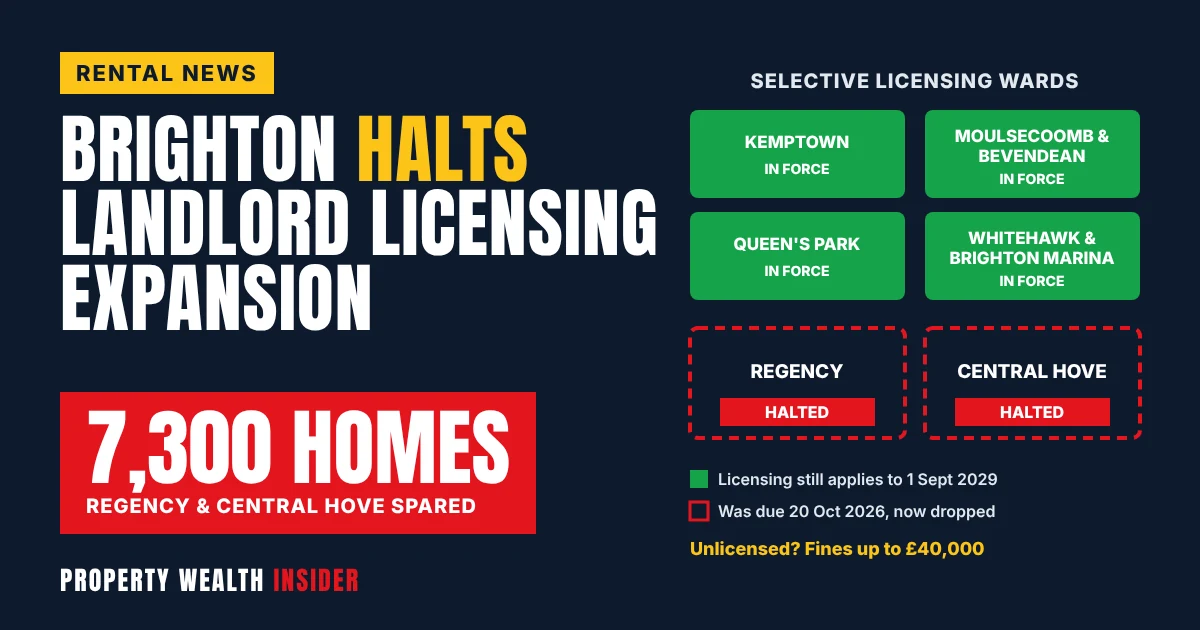
Brighton & Hove City Council has scrapped, for now, its plan to bring selective licensing to Regency and Central Hove. The move would have pulled an estimated 7,300 more privately rented homes into the scheme, and it was due to switch on from 20 October 2026.
The council confirmed on 25 November 2026 that the expansion is off while it “revisits the process”, after a legal challenge over how it was rolling licensing out ward by ward. It had already paused the start date in October while it weighed up the challenge.
Landlords in those two wards can stand down, for now. But do not confuse the halt with the end of licensing in the city. The existing four-ward scheme and HMO licensing are still fully in force, and since 1 May 2026 the penalties for getting it wrong are bigger than ever.
Key facts
- Selective licensing for Regency and Central Hove (about 7,300 homes) has been halted. It was due to start on 20 October 2026.
- The existing scheme in 4 wards (Kemptown, Moulsecoomb & Bevendean, Queen’s Park, Whitehawk & Brighton Marina) runs until 1 September 2029 and is unaffected.
- Mandatory and Additional HMO licensing across the city also remain in place.
- The fee agreed for the four-ward scheme was £670 per property for a licence of up to 5 years (£595 with a discount, £760 if you have to be prompted to apply).
- Letting an unlicensed property in England can now cost a civil penalty of up to £40,000, plus a rent repayment order of up to 2 years’ rent, for offending from 1 May 2026.
What has been halted, and why
The council made the designation for Central Hove and Regency on 6 July 2026, with a start date of 20 October 2026. It estimated that up to 7,274 properties would need a licence. It has now dropped the plan, describing the number as “around 7,300”.
The background matters. In March 2024 the council’s Housing & New Homes Committee agreed two things. One was a five-year scheme in four wards from 2 September 2024. The other was a plan to apply to the Secretary of State to bring in 13 further wards together, including Regency and Central Hove.
The council says national rules have changed since then and a 13-ward launch is now impractical because of the resources it would need. Instead it tried to phase the wards in, starting with two. The legal challenge went at that process of introducing the scheme in stages, and the council has decided not to fight on with this designation.
It is not giving up. The council says any future expansion will go through “evidence, consultation and formal decision-making”, which in practice means a fresh case and a fresh consultation before any new ward can be licensed.
What still applies in Brighton right now
This is where landlords could get caught out. Only the two-ward expansion has been halted. Everything else carries on.
| Scheme | Where | Status at 27 November 2026 |
|---|---|---|
| Selective licensing (phase 1) | Kemptown, Moulsecoomb & Bevendean, Queen’s Park, Whitehawk & Brighton Marina | In force, 2 September 2024 to 1 September 2029 |
| Selective licensing expansion | Regency, Central Hove | Halted. Was due 20 October 2026, never started |
| Other 11 wards in the 2024 plan | Brunswick & Adelaide, Goldsmid, Hanover & Elm Grove, Hollingdean & Fiveways, Preston Park, Rottingdean & West Saltdean, Round Hill, South Portslade, West Hill & North Laine, Westbourne & Poets Corner, Wish | Not designated. The council says it wants to expand again |
| Mandatory HMO licensing | Citywide | In force |
| Additional HMO licensing | As designated by the council | In force |
In the four live wards, you need a selective licence if you let to one or two people or to a family. The council also counts single-storey flats or bungalows let to three or four unrelated people if they are not already caught by HMO licensing.
The council is chasing landlords who have not applied. It reports 388 reports of possible unlicensed homes, 2 civil penalty notices served, 1 notice of intent and around 70 cases still under investigation. Its interim review found at least one in four inspected properties needed action on hazards.
The legal tests councils must pass
Selective licensing lives in Part 3 of the Housing Act 2004. The penalty and rent repayment rules below apply to England. A council can only designate an area if it can show at least one set of conditions is met under section 80:
- Low housing demand, or a real risk of it.
- Significant and persistent anti-social behaviour that landlords are failing to tackle.
- Or, under a 2015 order, a high proportion of private rented homes plus poor housing conditions, high migration, high deprivation or high crime.
Under section 80(9), it must take reasonable steps to consult the people likely to be affected and consider what they say. Under section 81, the scheme must fit its housing strategy, and it must have looked at other options and concluded licensing will “significantly assist”. A designation can last no more than five years.
One big change helped councils. From 23 December 2024 a new General Approval means councils in England no longer need Secretary of State confirmation for a scheme of any size. They are expected to consult for at least 10 weeks and must still meet every requirement of Part 3.
Why it matters beyond Brighton: with Whitehall sign-off gone, the main check on a new scheme is whether the council followed the Act. Brighton shows that a challenge to the process, timed before go-live, can stop a scheme even when the council is confident of the case for it.
What a Brighton licence actually costs
These are the fees the council agreed in March 2024 for the four-ward scheme. The fee is split into Part A, paid on application, and Part B, paid when the licence is granted. Check the council’s current fee before you apply.
| Fee type | Part A | Part B | Total |
|---|---|---|---|
| Standard application | £447 | £223 | £670 |
| Accredited landlord, Propertymark agent, or qualifying EPC rating | £75 discount | £595 | |
| Multi-dwelling (same block): 2nd property onwards | £447 | £173 | £620 |
| Registered housing charity | £447 | £148 | £595 |
| “Prompted” fee (council had to chase you) | – | £760 | |
The catch on timing: a licence runs from your application date until the scheme ends on 1 September 2029, not for a full five years. The council quoted £670 as under £3 a week over five years, but anyone applying late pays the same fee for less cover.
Worked example: Sam lets a one-bed flat in Queen’s Park for £1,400 a month and applies in December 2026. The £670 fee covers roughly 33 months to September 2029, about £20 a month. That is about 1.5% of the rent. Had Sam applied at launch in September 2024, the same fee worked out at about £11 a month, or 0.8%.
Calculator: licence cost vs penalty risk
Put in your own numbers to see what licensing costs per property against what you could face if a property is let without one. Default figures use the Brighton standard fee.
Selective licensing cost & risk calculator
Guide only, not legal or financial advice. Maximum exposure is a civil penalty of up to £40,000 per property plus a rent repayment order capped at the rent for the months unlicensed (no more than 24). Actual penalties are set case by case, and councils can prosecute instead.
The penalties for letting without a licence
Letting a property that needs a selective licence without one is a criminal offence under section 95 of the Housing Act 2004. Since the Renters’ Rights Act 2025 changes, the offence can catch any landlord in the chain, including superior landlords, as well as the manager.
- Civil penalty up to £40,000. Councils in England can fine instead of prosecuting. The cap rose from £30,000 to £40,000 on 1 May 2026 (section 249A).
- £12,000 starting point. Government guidance sets £12,000 as the starting point for an unlicensed selectively licensed property, before the council adjusts for the facts of the case.
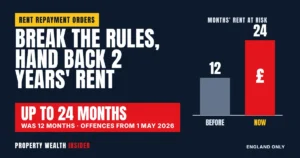
- Rent repayment orders up to 2 years. A tribunal can order you to repay rent for the period you were offending, up to 2 years (it was 12 months). The longer cap applies only to offending from 1 May 2026.
- Licence condition breaches are a separate offence, with penalty levels set locally by each council.
Worked example: a landlord in Moulsecoomb lets a house to a family at £1,600 a month and never applies. The council finds out after 12 months, all after 1 May 2026. The penalty could be up to £40,000, with £12,000 as the guidance starting point. A rent repayment order could add up to £19,200. That is a worst case of £59,200, against a £670 fee.
There is one important protection. Under section 95(3), it is a defence if a valid licence application had been made and was still in progress at the time. Getting the application in is what counts.
What landlords should do now
- Check the ward, not the postcode. Use the council’s address checker to confirm which ward each property is in. Ward boundaries do not follow postcode areas.
- Regency or Central Hove? No selective licence is needed for now. If you already applied for one, contact the council about the status of your application and any fee you paid.
- In one of the four live wards? Make sure every qualifying let has a licence or a valid application in. Apply before the council chases you so you avoid the £760 prompted fee.
- Check HMO status everywhere. Shared houses need an HMO licence wherever they are in the city. The halt changes nothing there.
- Read your licence conditions. Breaching them is a separate offence. Keep gas, electrical and fire-safety records ready to show.
- Watch for a new consultation. The council says it will try again. Any new scheme should face a consultation of at least 10 weeks, which is your chance to respond with evidence.
Do I need a selective licence in Brighton? Checklist
- The property is in Kemptown, Moulsecoomb & Bevendean, Queen’s Park or Whitehawk & Brighton Marina ward (confirmed with the council’s checker).
- It is let to one person, two people, or a family.
- Or it is a single-storey flat or bungalow let to three or four unrelated people that is not covered by Mandatory or Additional HMO licensing.
- It is not already licensed as an HMO.
- If all of the above apply, a licence or a live application must be in place now.
- If the property is in Regency or Central Hove, no selective licence is needed while the expansion is halted. HMO rules still apply.
- Diary note: the current scheme ends on 1 September 2029.
FAQ
Has Brighton scrapped selective licensing?
No. Only the expansion into Regency and Central Hove has been halted. The scheme in Kemptown, Moulsecoomb & Bevendean, Queen’s Park and Whitehawk & Brighton Marina runs until 1 September 2029.
Do I need a licence in Central Hove or Regency?
Not a selective licence, while the expansion is halted. If the property is an HMO, HMO licensing still applies.
How much is a selective licence in Brighton?
The fee agreed in 2024 is £670 (£447 on application plus £223 on grant). It is £595 for accredited landlords, Propertymark agents and qualifying EPC ratings, and £760 if the council has to prompt you. Check the council’s site for the current fee.
What is the fine for not having a selective licence?
In England, a civil penalty of up to £40,000 for offences from 1 May 2026, or prosecution. Government guidance gives a £12,000 starting point. Tenants or the council can also seek a rent repayment order of up to 2 years’ rent.
Can councils still bring in big licensing schemes without government approval?
Yes. Since 23 December 2024, councils in England do not need Secretary of State confirmation for a scheme of any size. They must still meet the Housing Act 2004 conditions and are expected to consult for at least 10 weeks.
Will Brighton try to expand licensing again?
The council says it will. Any new expansion must go through evidence-gathering, consultation and a formal decision, so landlords should get warning and a chance to respond.
Sources
- Brighton & Hove City Council: Plans to expand selective licensing in 2026 halted (25 November 2026)
- Brighton & Hove City Council: Selective licensing scheme expanded after positive impact in first 4 areas (July 2026)
- Brighton & Hove City Council: Selective licensing
- Brighton & Hove City Council: Decision, Discretionary Selective Licensing Scheme (March 2024)
- Brighton & Hove City Council: Committee report, fee structure (March 2024)
- Housing Act 2004, section 80, section 81, section 84, section 95, section 249A
- Selective Licensing of Houses (Additional Conditions) (England) Order 2015
- Housing and Planning Act 2016, section 44 (rent repayment orders) and S.I. 2026/421, regulation 11
- GOV.UK: Selective licensing in the private rented sector, a guide for local authorities (General Approval 2024)
- GOV.UK: Civil penalties under the Renters’ Rights Act 2025 and other housing legislation
This article is news and general guidance, not financial, legal or tax advice.