Rent Tribunals: Landlords Ask 10%, Get 6.2% – Evidence Wins
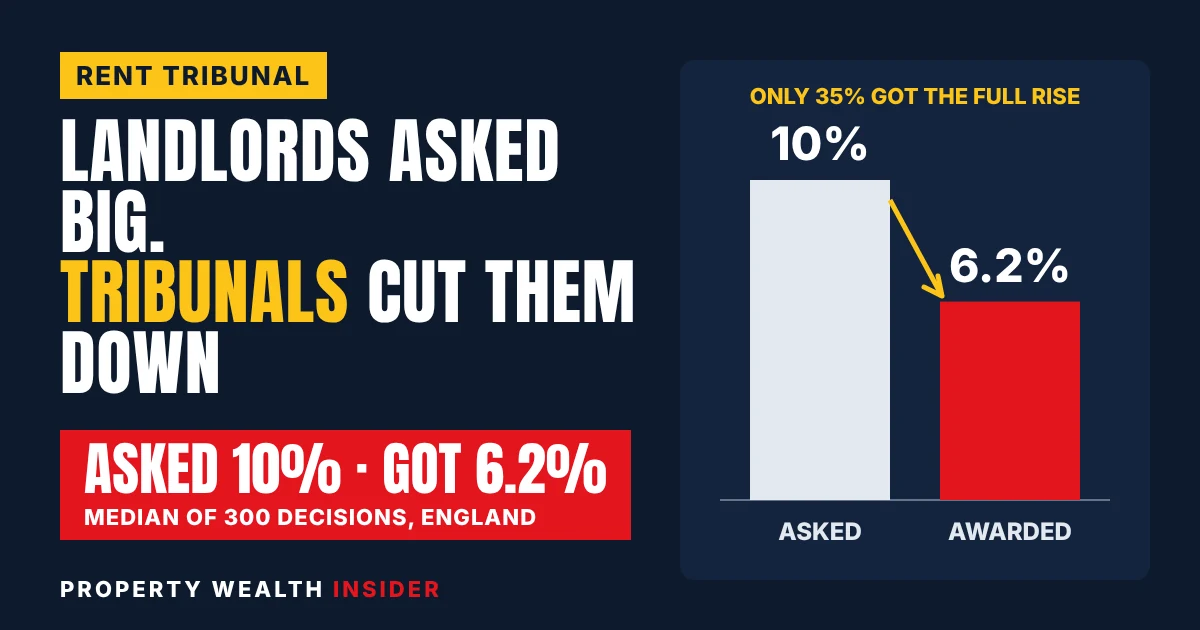
Landlords who take a rent increase to the First-tier Tribunal in England are typically asking for 10% and walking away with 6.2%. That is the headline from a count of all 336 published market rent decisions made under the new section 13 regime between 1 May and 11 November 2026, published on 17 November by online letting agent Hello Neighbour.
The bigger story is why. Most decisions were made on paper, many rested on thin or unusable evidence, and 31 cases fell over on paperwork before the tribunal even looked at the rent. Only about a third of landlords got the full increase in their notice.
If you let in England on an assured periodic tenancy and plan a rent rise this winter, this is the evidence standard you will be judged against. Below: the numbers, the rules, what the tribunal throws out, and a free tool to test your own comparables before you serve Form 4A.
Key facts
- Of 300 decisions that set a rent, the median landlord proposed +10.0% and was awarded +6.2%.
- Only 105 of 300 (35%) landlords got the full rent in their notice; 20 rents were set below what the tenant was already paying.
- 31 cases failed on process before the rent was valued, 20 of them in London.
- Advertised rents were relied on in 247 decisions, achieved lettings in only 139; about 7 in 10 decisions had comparables with no floor areas.
- By law the tribunal cannot set a rent above the one in your notice, and the new rent is never backdated to before its decision.
What 336 tribunal decisions show
Since 1 May 2026, any assured tenant in England can challenge a rent increase served under section 13 of the Housing Act 1988 by applying to the First-tier Tribunal (Property Chamber) before the new rent starts. The tenant pays a £47 application fee. The tribunal then decides the open market rent.
Hello Neighbour read every decision published on the gov.uk tribunal decisions register under the market rent case code up to 11 November. Of 336 decisions, 300 set a rent. It says the figures are its own count.
- Rent went up in 237 of 300 (79%). So a challenge rarely freezes the rent completely.
- Full increase awarded in 105 (35%). Two in three landlords were trimmed back.
- 43 unchanged, 20 cut. In 20 cases the tribunal set a rent lower than the tenant was already paying.
- 270 decided on paper. No hearing, no inspection: your written evidence is your whole case.
- Median 109 days from notice to decision, with most between 85 and 135 days.
On the median figures, landlords kept about two-thirds of the increase they asked for. On a £1,000 a month rent, a 10% ask is £1,100; a 6.2% award is £1,062. That is £38 a month, or £456 a year, left on the table.
North, South, London: the regional gap
Northern landlords asked for the biggest rises and also got the biggest awards. Landlords in the South and South West (outside London) fared worst, keeping well under half of what they proposed.
| Region | Rents set | Median proposed | Median awarded | Full increase awarded | £1,000 rent: asked vs got |
|---|---|---|---|---|---|
| North | 81 | 15.4% | 9.4% | 40% | £1,154 vs £1,094 |
| Midlands | 28 | 10.9% | 5.3% | 29% | £1,109 vs £1,053 |
| East | 33 | 10.0% | 7.0% | 27% | £1,100 vs £1,070 |
| London | 109 | 8.1% | 5.6% | 39% | £1,081 vs £1,056 |
| South and South West | 49 | 8.0% | 3.0% | 29% | £1,080 vs £1,030 |
Take a £1,200 two-bed in the South West. Ask for 8% (£1,296) and get the regional median award of 3% (£1,236), and you have lost £60 a month, or £720 a year, against your plan. The tribunal fee was the tenant’s £47. The paperwork cost was yours.
Fail the paperwork, lose before you start
31 cases failed on process before any valuation, 20 of them in London. An invalid notice means no increase at all, and you start the clock again. These are the rules for assured periodic tenancies in England from 1 May 2026, per gov.uk and section 13 of the Housing Act 1988:
- Use the right form. Form 4A, every time, even if the tenant has already agreed the rise. The old Form 4 is for notices given before 1 May 2026.
- Once a year only. The new rent cannot start until 52 weeks after the tenancy began or the last increase took effect (53 weeks in some cases). No increase in the first year.
- At least two months’ notice. And the new rent must start at the beginning of a period of the tenancy, i.e. on a rent day.
- Serve it properly. In person, by post, or by email only if the tenancy agreement allows it. Name and serve every joint tenant, and keep proof.
- Rent review clauses are dead. A clause agreed before 1 May 2026 that would take effect after it does not apply.
What evidence the tribunal actually believes
The tribunal sets the rent the home “might reasonably be expected to be let in the open market by a willing landlord”, under section 14. It ignores improvements the tenant paid for and any damage the tenant caused. Everything else comes down to comparables.
The official guidance is blunt: actual agreed lettings carry more weight than agent or website listings, and market lettings carry more weight than housing association rents, old fair rent decisions or Local Housing Allowance rates. Yet in the decisions counted, advertised or portal rents appeared in 247 of 300, achieved lettings in just 139.
Only 73 rents were built directly from named comparables. In 173, the panel set its own figure after weighing the comparables, and 53 had no usable evidence at all. Same-building evidence featured in 62.
| Why the tribunal discounted evidence | Decisions | Fix |
|---|---|---|
| No address, date or detail | 131 | Give full address, let date, beds, size, condition |
| Different size, type or specification | 117 | Match property type; quote floor area in sq m |
| Asking rent, not achieved | 64 | Lead with agreed lettings; label listings as such |
| Undated or out of date | 37 | Use lettings from the last few months |
| Too far away or different market | 29 | Same street, block or immediate area |
Condition matters too: deductions for condition or shortfalls were made in 134 of 300 decisions. A dated kitchen or missing white goods will pull the figure down against glossy portal listings.
About seven in ten decisions involved comparables with no floor areas. That is the easiest win available. Rent per square metre lets you compare a 58 sq m flat with a 72 sq m one fairly. Use the tool below to build your case the way a panel would read it.
Rent increase evidence builder
Comparable lettings (leave rent at 0 to skip a row; floor area 0 if unknown)
Guide only, not legal or valuation advice. The tribunal weighs condition, location, terms and its own knowledge; it cannot award more than your notice proposes.
The cap and the clock: why asking high costs you
Two rules in the Renters’ Rights Act 2025, inserted as new section 14ZB of the 1988 Act, change the maths of asking high.
The cap. The new rent is the open market rent if that is lower than your proposal, otherwise your proposal. The tribunal cannot award more than you asked. In 43 of the 300 decisions the market rent was found to be above the landlord’s figure, and those landlords were held to their own number. Under-ask and you lose; over-ask and you get trimmed.
The clock. If the tribunal decides after your proposed start date, the new rent runs from the first rent day on or after its decision. It is not backdated. The tribunal can also defer it on undue hardship grounds by up to two months from the decision. Hardship deferral was requested in 168 of 300 decisions and granted in 10.
Worked example: you serve Form 4A on 1 June for a rise from £1,000 to £1,100 starting 1 August, the earliest a two-month notice allows. The tenant applies in July. If the decision lands at the 109-day median, around 18 September, the new rent starts from the next rent day, 1 October. Even if you win in full, August and September are paid at the old rent: £200 you never recover. Get trimmed to £1,062 and you collect £62 extra a month from October.
What to do now: 7 steps
- Check the date. Find when the tenancy began or the last increase took effect. Your new rent cannot start until 52 weeks later, on a rent day.
- Measure the property. Get the floor area in sq m (your EPC usually shows it) and photograph every room.
- Collect 3-5 achieved lettings. Ask your agent for recently agreed rents nearby on similar homes, with addresses, dates, sizes and condition.
- Price from the evidence. Work out £ per sq m, apply it to your floor area, and adjust honestly for condition. Do not round up hoping to be trimmed down.
- Serve Form 4A correctly. All tenants named, at least two months’ notice, a permitted service method, and proof kept.
- Talk to the tenant. Share your comparables. A tenant who sees the evidence is less likely to pay £47 to challenge it.
- If challenged, reply on MR2. You have 28 days. Send your evidence pack, copied to the tenant and the tribunal.
- Tenancy start date / last increase date confirmed (52-week rule)
- Proposed start date falls on a rent day, at least two months after service
- Current Form 4A used, every tenant named
- Service method allowed by the tenancy agreement; proof of service kept
- Floor area of your property in sq m
- 3-5 comparables with address, date let, size, beds and condition
- Achieved lettings first; advertised rents clearly labelled
- Photos showing condition, plus a list of recent improvements you paid for
- MR2 response diarised for 28 days after any tenant application
FAQ
Can a rent tribunal increase the rent more than the landlord asked?
No. Under section 14ZB of the Housing Act 1988, the new rent is the open market rent only if it is lower than the rent in the notice. Otherwise it is the proposed rent.
Can the tribunal lower my rent below what my tenant pays now?
It happened in 20 of the 300 decisions counted. If the panel finds the open market rent is below the current rent, that lower figure can be set.
How long does a rent tribunal challenge take?
In the decisions analysed, the median was 109 days from notice to decision, with most between 85 and 135 days. Gov.uk gives no official timescale.
Is the new rent backdated after a tribunal decision?
No. If the decision comes after your proposed start date, the rent applies from the first rent day on or after the decision, and can be deferred up to two months for undue hardship.
What evidence is best for a section 13 rent increase?
Recently agreed rents on similar nearby homes, with full addresses, dates and floor areas. Gov.uk says these outweigh advertised rents, housing association rents and LHA rates.
Do these rules apply in Wales or Scotland?
No. The Form 4A section 13 process and these tribunal rules apply to assured periodic tenancies in England. Wales, Scotland and Northern Ireland have separate rent increase regimes.
Sources
- Hello Neighbour: Rent tribunals: what matters (17 November 2026)
- GOV.UK: Rent increases (guidance for landlords)
- GOV.UK: Apply for an open market rent determination
- GOV.UK: Assured tenancy forms from 1 May 2026 (Form 4A)
- GOV.UK: Residential property tribunal decisions
- Housing Act 1988, section 13
- Housing Act 1988, section 14
- Renters’ Rights Act 2025, section 7 (new sections 14ZA and 14ZB)
This article is news and general guidance only. It is not financial, legal or tax advice.