Damp league table: up to 27.8% of rentals hit in worst areas
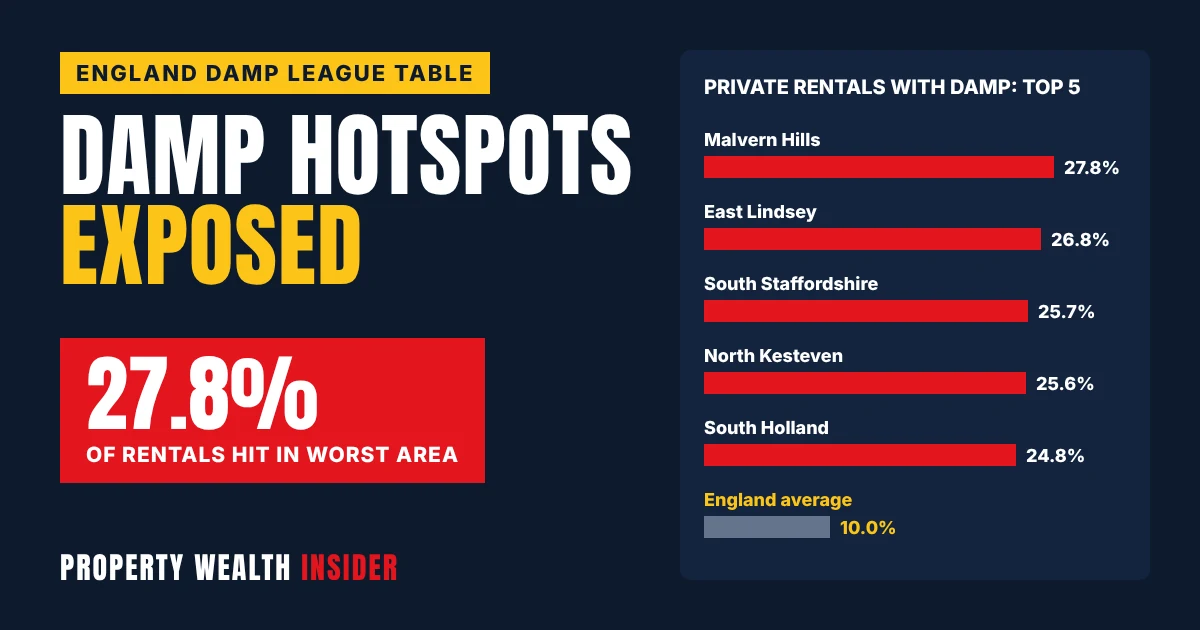
More than one in four privately rented homes in some parts of England has a damp problem, according to official government estimates. The worst council area overall is East Lindsey on the Lincolnshire coast, where 13.4% of all occupied homes are estimated to have damp, and 26.8% of private rentals.
The figures come from the English Housing Survey’s local authority stock condition modelling for 2024, published by the Ministry of Housing, Communities and Local Government (MHCLG) on 25 June 2026. They give the first council-by-council estimate of damp, split by tenure, and they do not flatter landlords: private rented homes have the highest damp rate of any tenure.
This matters now because councils in England have had new £7,000 fines for serious hazards such as severe damp and mould since 22 June 2026. On top of that, the government is consulting until 18 December 2026 on bringing Awaab’s Law deadlines into private renting. Below is the full league table, what is in force today, worked examples of what it could cost you, and a free checker that rates your property’s damp risk and tracks how long you have had to respond.
Key facts
- East Lindsey has the highest damp rate of any mainland council in England: 13.4% of homes, against an England average of 5.5%.
- Leaving out the tiny Isles of Scilly, 5 of the 7 worst council areas are in Lincolnshire.
- In Malvern Hills (27.8%) and East Lindsey (26.8%), more than one in four private rented homes is estimated to have damp.
- Nationally, 10% of private rented homes had a damp problem in 2024, against 7% of social homes and 4% of owner-occupied homes. That is about 486,000 private rentals.
- Since 22 June 2026, councils can fine landlords who fail to fix a serious (Category 1) hazard such as severe damp and mould up to £7,000. Ignoring an improvement notice can cost up to £40,000.
The damp league table: worst areas in England
We ranked all 296 local authorities in MHCLG’s Annex Table 1.7 by the share of occupied homes with “a problem with damp”. In the English Housing Survey that means penetrating damp, rising damp or serious condensation that a surveyor judges significant enough to count in a hazard assessment. Minor damp is not recorded.
| Rank | Council | Region | All homes with damp | Private rented | Owner occupied |
|---|---|---|---|---|---|
| – | Isles of Scilly* | South West | 17.0% | 16.6% | 13.3% |
| 1 | East Lindsey | East Midlands | 13.4% | 26.8% | 9.7% |
| 2 | City of London | London | 11.9% | 12.9% | 7.0% |
| 3 | South Holland | East Midlands | 11.5% | 24.8% | 8.5% |
| 4 | Boston | East Midlands | 11.1% | 18.4% | 9.2% |
| 5 | North Kesteven | East Midlands | 10.2% | 25.6% | 6.6% |
| 6 | Hillingdon | London | 10.2% | 20.8% | 3.6% |
| 7 | West Lindsey | East Midlands | 10.0% | 23.2% | 6.9% |
| 8 | Malvern Hills | West Midlands | 9.5% | 27.8% | 5.8% |
| 9 | Bassetlaw | East Midlands | 9.5% | 22.6% | 6.7% |
| 10 | North Yorkshire | Yorkshire and The Humber | 9.5% | 22.6% | 6.0% |
| England | 5.5% | 10.0% | 3.7% |
*The Isles of Scilly technically top the table, but the estimate covers only about 1,000 homes, so we have left it out of the ranking. North Kesteven and Hillingdon both round to 10.2%; North Kesteven is fractionally higher in the unrounded data.
At the other end, the lowest rates are in the East of England. Norwich (1.5%), Ipswich (1.6%) and Southend-on-Sea (1.6%) are all below a third of the national average.
Private rentals worst hit: up to 27.8%
Split by tenure, the picture is starker for landlords. In 16 council areas, at least one in five private rented homes is estimated to have damp. In 55 areas the private rented rate is 15% or more, at least one and a half times the national private rented average.
| Council | Private rented homes with damp | Estimated number |
|---|---|---|
| Malvern Hills | 27.8% | 1,370 |
| East Lindsey | 26.8% | 3,919 |
| South Staffordshire | 25.7% | 1,311 |
| North Kesteven | 25.6% | 2,231 |
| South Holland | 24.8% | 1,857 |
| Derbyshire Dales | 24.4% | 1,165 |
| Shropshire | 24.1% | 6,157 |
| Herefordshire | 24.0% | 3,974 |
| Stratford-on-Avon | 24.0% | 2,086 |
| West Lindsey | 23.2% | 1,880 |
Nationally, the English Housing Survey’s 2024 headline report puts damp at 10% of private rented homes, 7% of social homes and 4% of owner-occupied homes. That is about 486,000 private rented dwellings. The rise from 9% in 2022 was not statistically significant, but damp across all homes has increased since 2019.
Private rentals also have more of the structural types of damp. In 2024, 4% had penetrating damp and 3% rising damp, against 2% and 1% for owner-occupied homes. Serious condensation affected 6% of private rentals. Almost 3% of private rented homes had more than one type of damp at once.
Tenants notice it too. In the same survey, 46% of private renting households said their home had problems with condensation, damp or mould. Surveyors only confirmed a significant damp problem in about 18% of those homes, which shows how much of what tenants report is lower-level or seasonal. Low-level does not mean safe to ignore, though: it is often where serious damp starts.
How to read the figures (and their limits)
These are modelled estimates, not a survey of every home. MHCLG built them from the combined 2023 and 2024 English Housing Survey inspections using a machine-learning model. Its inputs include dwelling age, EPC ratings, cavity wall insulation, disrepair, excess cold, tenure and deprivation, drawn from EPC records, the 2021 Census and commercial data.
- Not a verdict on any one street. MHCLG says the estimates “should not be treated as surveyed totals”, and small pockets of very good or very poor housing may not show up.
- Small areas swing more. The report notes that damp rates above 10% tended to come up in councils with few homes. The City of London has about 5,300 occupied homes.
- No year-on-year comparisons. MHCLG advises against comparing a council’s figure with earlier editions.
- Weather plays a part. In the regional analysis, 6.7% of homes in the wettest quarter of England had damp, against 4.5% in the driest quarter. Penetrating and rising damp showed the clearest link with rainfall.
Dwelling type matters too. Across England, the modelled damp rate is 7.1% for terraced houses, 6.4% for flats, 5.6% for semis, 3.2% for bungalows and 2.2% for detached houses. The survey also found that 60% of the small number of homes with inadequate ventilation had a damp problem. All of these figures are for England only.
Damp rules for private landlords: in force vs proposed
Awaab’s Law is the rule that gets the headlines, but it does not yet apply to private landlords. Plenty of other rules already do. Everything in this table applies in England only.
| Rule | Status for private landlords | What it means for damp |
|---|---|---|
| Homes (Fitness for Human Habitation) Act 2018 | In force: tenancies of under 7 years, fully in force since 20 March 2020 | A “serious problem with damp” can make a home unfit. Tenants can sue for an order to fix it and damages, with no set cap. You must act within a reasonable time once told. |
| HHSRS (Housing Act 2004), updated 23 June 2026 | In force | Damp and mould is one of 21 hazards. Councils can serve improvement notices, do emergency work and recover costs. |
| £7,000 fine for serious hazards | In force since 22 June 2026 | Councils can fine up to £7,000 where a landlord fails to fix a Category 1 hazard such as severe damp and mould. |
| Civil penalty for breaching an improvement notice | In force: maximum raised to £40,000 from 1 May 2026 | An alternative to prosecution. A rent repayment order of up to two years’ rent can also follow. |
| Awaab’s Law | Social housing only (since 27 October 2025). Private rented: proposed, consultation closes 18 December 2026 | Proposed: investigate significant hazards in 10 working days and emergencies within 24 hours. The government says 2027 is the earliest feasible start. |
| Decent Homes Standard | Proposed for private renting; all rented homes to comply by 2035 at the latest | New criterion: “A home should be free of damp and mould.” |
For the full Awaab’s Law timetable and the options in the consultation, see our guide to Awaab’s Law phase 2 and what private landlords face. For the new hazard scoring councils now use, read our HHSRS shake-up explainer.
One point in the consultation matters for damp in particular. It proposes excluding hazards caused by a tenant breaching their tenancy, but warns that this must not become a way to dismiss damp and mould with assumptions about tenant lifestyle. Write “condensation, tenant should open windows” on a job sheet without investigating, and you are likely to be on the wrong side of the new rules.
What ignoring damp could cost: worked examples
Example 1: the worst case today. A landlord lets a terraced house in East Lindsey for a hypothetical £800 a month. A council officer finds severe black mould in two bedrooms and rates it a Category 1 hazard. The council issues a £7,000 penalty and serves an improvement notice, which the landlord then ignores.
| Possible consequence | Maximum |
|---|---|
| Fine for the Category 1 hazard | £7,000 |
| Civil penalty for breaching the improvement notice | £40,000 |
| Rent repayment order (24 months × £800) | £19,200 |
| Worst-case exposure, before the cost of the actual repair | £66,200 |
These are maximums. Councils set penalties according to their own policies, and a tribunal decides any rent repayment order. The repair bill still has to be paid on top.
Example 2: the cost of delay. A tenant on £1,000 a month reports mould and the landlord takes 10 weeks to send anyone round. No council gets involved, but the tenant brings a claim under the Fitness for Human Habitation Act. The court can order the work and award damages, with no fixed limit, and the landlord may have to pay the tenant’s legal costs as well. The repair costs the same either way. The delay is what adds the extra bills.
Damp risk and response checker
Pick your council and property details for an indicative damp risk rating, based on the official local private rented damp rate. Add the date your tenant reported a problem to see how many working days have gone and where you stand against the proposed Awaab’s Law benchmark. The tool skips weekends and England and Wales bank holidays.
Damp risk and response checker
Guide only, not legal advice. Local rates are MHCLG modelled estimates for 2024. The risk rating is PWI’s rough indicator, built from official averages for council area, dwelling type, ventilation and tenant reports. It is not a survey and not a probability for your home. Awaab’s Law timings are proposals for private landlords and not yet law.
How the rating works: it starts with your council’s modelled private rented damp rate. It scales that up or down by how damp-prone your property type is nationally, raises it if the tenant has reported a problem, and sets a high floor if ventilation is inadequate, because 60% of inadequately ventilated homes had damp. Treat it as a prompt to prioritise, not a diagnosis.
What to do now: step by step
- Look up your council. If your private rented rate is above the 10% national figure, move damp checks to the top of your pre-winter list.
- Treat every report as live from day one. Acknowledge in writing, ask for dated photos and log the date. Under the Fitness Act your clock starts when the tenant tells you.
- Inspect within 10 working days, or within 24 hours if someone’s health is at immediate risk. That matches the proposed private rented benchmark, so you will be ready if it becomes law.
- Find the cause, not just the mould. Penetrating and rising damp are more than twice as common in private rentals as in owner-occupied homes. Check gutters, downpipes, pointing, roofs, damp-proof courses and plumbing leaks, as well as ventilation.
- Fix ventilation and heating. Make sure extractor fans in kitchens and bathrooms work and are not switched off at an isolator, that trickle vents are open and that the heating can keep the home warm.
- Tell the tenant in writing what you found, what you will do and by when. Social landlords must do this within 3 working days of an investigation, and the same is proposed for private landlords.
- Respond to the consultation by 11.59pm on 18 December 2026 if you want a say on the private rented timescales.
- Every extractor fan tested and working (kitchen and bathroom)
- Trickle vents open; no blocked air bricks
- Gutters and downpipes cleared; no overflowing joints
- External pointing, render and window seals checked
- Damp-proof course not bridged by raised soil or paving
- No leaks under sinks, baths or from the roof
- Heating serviced and able to heat every room
- Mould treated and its cause fixed, not just painted over
- Written damp log: report date, inspection date, findings, work done, letters to tenant
- Tenant given simple written guidance on ventilation and drying clothes
FAQ
Which area of England has the most damp homes?
Leaving out the Isles of Scilly, which has only about 1,000 homes, East Lindsey in Lincolnshire has the highest modelled rate at 13.4% of homes. For private rented homes alone, Malvern Hills is highest at 27.8%.
Does Awaab’s Law apply to private landlords?
Not yet. It has applied to social landlords in England since 27 October 2025. The Renters’ Rights Act 2025 gives ministers the power to extend it to private tenancies, and the consultation runs until 18 December 2026. The government says 2027 is the earliest feasible start.
Can a council fine a landlord for damp and mould?
Yes. Since 22 June 2026, councils in England can fine landlords up to £7,000 for failing to fix a serious (Category 1) hazard such as severe damp and mould. Failing to comply with an improvement notice can lead to a civil penalty of up to £40,000.
How long does a landlord have to fix damp and mould?
For private landlords there is no fixed number of days yet. The Fitness for Human Habitation Act requires action within a reasonable time once you know about the problem, and a court decides what is reasonable. The proposed Awaab’s Law benchmark is 10 working days to investigate and 24 hours for emergencies.
Is condensation mould the tenant’s fault?
Not automatically. Landlords are not liable under the Fitness Act for problems caused by tenant behaviour. But poor ventilation, broken fans, cold walls and inadequate heating are the landlord’s responsibility. The Awaab’s Law consultation warns against dismissing damp because of assumptions about lifestyle. Investigate before you decide.
Do these damp rules apply in Wales or Scotland?
No. The figures and every rule in this article cover England only. Wales, Scotland and Northern Ireland have their own housing standards and enforcement regimes.
- MHCLG: English Housing Survey local authority housing stock condition modelling 2024 (Annex Tables 1 and 2)
- MHCLG: Local authority housing stock condition modelling 2024, main report
- MHCLG: English Housing Survey 2024 to 2025, Chapter 1: housing quality
- MHCLG: English Housing Survey 2024 to 2025 annex tables
- MHCLG: Extending Awaab’s Law to private rented tenancies and to licences (consultation)
- The Hazards in Social Housing (Prescribed Requirements) (England) Regulations 2025
- MHCLG: Crackdown on dangerous rented homes as new £7k fines kick in (21 June 2026)
- Housing Act 2004, section 249A (civil penalties)
- Housing and Planning Act 2016, section 44 (rent repayment orders)
- MHCLG: Guide for landlords, Homes (Fitness for Human Habitation) Act 2018
- MHCLG: Reformed Decent Homes Standard, government response (28 January 2026)
- MHCLG: Renters’ Rights Act 2025 implementation roadmap
- GOV.UK: UK bank holidays
This article is news and general guidance only. It is not financial, legal or tax advice.