HHSRS shake-up: 29 hazards cut to 21 and a £40k fine risk
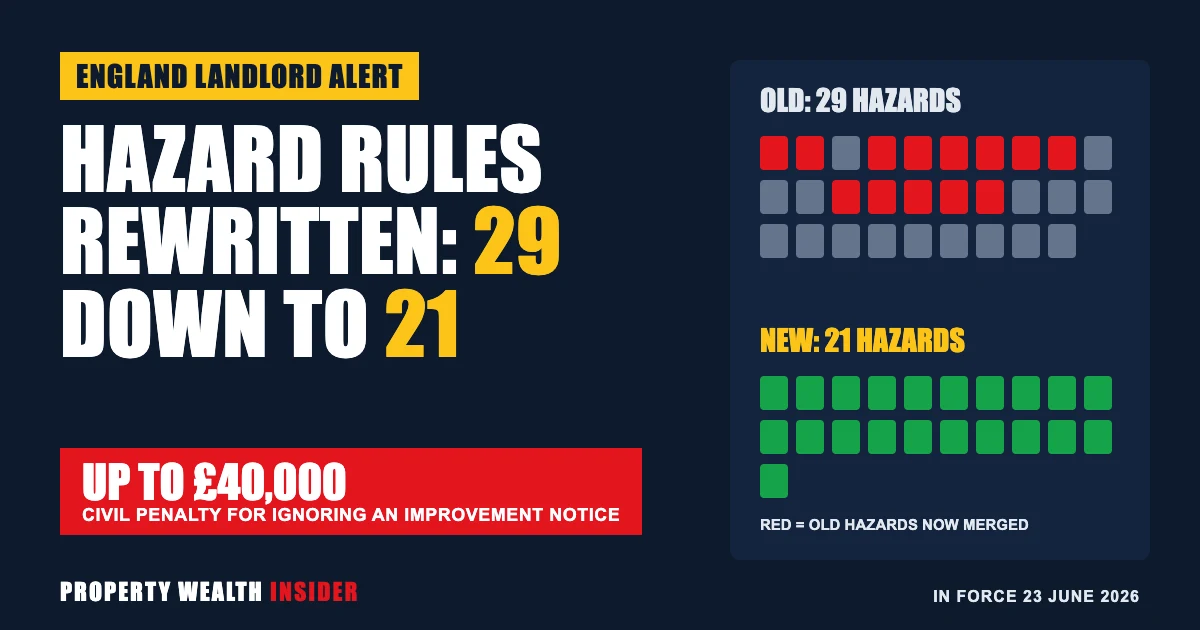
The rulebook councils use to judge whether a rented home is dangerous has been rewritten. Since 23 June 2026, every new council inspection in England has used a slimmed-down Housing Health and Safety Rating System (HHSRS) with 21 hazards instead of 29, three risk bands instead of ten, and a fresh set of “baseline indicators” that spell out what a safe home looks like.
It matters because the HHSRS is the yardstick behind improvement notices, prohibition orders and civil penalties. If an environmental health officer finds a Category 1 hazard, the council must act, and the fines for getting it wrong have just gone up.
Here is the full new hazard list, how the scoring now works, what it could cost you, and a free checker to run over your own property before the council does. These changes apply in England only.
Key facts
- The Housing Health and Safety Rating System (England) (Amendment) Regulations 2026 (SI 2026/571) came into force on 23 June 2026.
- Hazard categories cut from 29 to 21 by merging related hazards. None has been dropped entirely.
- Ten bands (A to J) replaced by three: High (1,000+) = Category 1, Medium (100 to 999) and Low (under 100) = Category 2.
- Ignoring an improvement notice can now cost a civil penalty of up to £40,000 (offences from 1 May 2026), plus a rent repayment order of up to two years’ rent.
- Councils can also fine up to £7,000 when they first take action on a Category 1 hazard you could reasonably have fixed (from 22 June 2026).
- 10.3% of private rented homes in England, about 505,000, had a Category 1 hazard in 2024, per the English Housing Survey.
What changed on 23 June 2026
The HHSRS has existed since the Housing Act 2004, with the hazards and scoring method set out in the Housing Health and Safety Rating System (England) Regulations 2005. The operating guidance councils followed dated from 2006.
That has now been overhauled in one go. SI 2026/571 was made on 1 June 2026 and came into force on 23 June 2026. The Ministry of Housing, Communities and Local Government (MHCLG) published a new three-part operating guidance the same day, replacing the 2006 version, together with a landlord and agent guide and new case studies.
The main changes are:
- Fewer hazards: 29 merged down to 21.
- Simpler bands: High, Medium and Low replace bands A to J. The Category 1 threshold stays at a score of 1,000.
- Baseline indicators: a checklist of reasonable standards, from handrails to heating, against which deficiencies are spotted.
- Wider fire hazard: now covers smoke and fumes, explosions, and collapse caused by fire or explosion.
What has not changed: councils still have a duty to act on Category 1 hazards and a discretion to act on Category 2. A correcting instrument, SI 2026/629, confirms the new rules apply to council inspections that began on or after 23 June 2026.
The full 21-hazard list: old vs new
This is the new list, in the order MHCLG gives it in Part 1 of the operating guidance, with the 2005 hazards each one replaces. Five hazards absorbed old ones; the other 16 carry over.
| # | New hazard (2026) | Replaces (2005 list) | Status |
|---|---|---|---|
| Protection against accidents | |||
| 1 | Falls on the level | Falls associated with baths etc; Falling on level surfaces etc | Merged |
| 2 | Falling on stairs etc | Falling on stairs etc | Unchanged |
| 3 | Falling between levels | Falling between levels | Unchanged |
| 4 | Fire and explosions | Fire; Explosions | Merged |
| 5 | Flames, hot surfaces etc | Flames, hot surfaces etc | Unchanged |
| 6 | Collisions, entrapment and ergonomics | Collision and entrapment; Position and operability of amenities etc | Merged |
| 7 | Structural collapse and falling elements | Structural collapse and falling elements | Wording widened |
| 8 | Electrical hazards | Electrical hazards | Unchanged |
| Physiological requirements | |||
| 9 | Excess cold | Excess cold | Unchanged |
| 10 | Radiation | Radiation | Unchanged |
| 11 | Damp and mould growth | Damp and mould growth | Unchanged |
| 12 | Lead | Lead | Unchanged |
| 13 | Indoor air pollutants | Biocides; Carbon monoxide and fuel combustion products; Uncombusted fuel gas; Volatile organic compounds | Merged (4 into 1) |
| 14 | Excess heat | Excess heat | Unchanged |
| 15 | Asbestos and MMF | Asbestos and MMF | Unchanged |
| Protection against infection | |||
| 16 | Domestic hygiene | Domestic hygiene, pests and refuse; Food safety; Personal hygiene, sanitation and drainage | Merged (3 into 1) |
| 17 | Water supply | Water supply | Unchanged |
| Psychological requirements | |||
| 18 | Crowding and space | Crowding and space | Unchanged |
| 19 | Entry by intruders | Entry by intruders | Unchanged |
| 20 | Noise | Noise | Unchanged |
| 21 | Lighting and obstructed views | Lighting | Renamed in guidance |
Sources: SI 2026/571 Schedule 1 amendments; HHSRS operating guidance Part 1 (2026). “Lighting and obstructed views” is the name used in the operating guidance; the regulations’ schedule heading remains “Lighting”.
The practical point: merging hazards does not lower the bar. The new “Indoor air pollutants” hazard still covers carbon monoxide, nitrogen dioxide, sulphur dioxide and smoke, unburnt gas, timber and mould treatments, and volatile organic compounds. “Domestic hygiene” now takes in kitchens, cleanability, pests, bins, washing facilities, toilets and drainage, all in one place.
How the new scoring and bands work
An assessor scores each hazard on two things: how likely it is to cause harm needing medical attention in the next 12 months, and how bad that harm could be (extreme, severe, serious or moderate). They assess against the most vulnerable age group for that hazard, not your actual tenant. Over-65s for stairs, for example. The one exception is crowding and space, which is judged on the household living there.
| Band | Score | Category | Council’s position |
|---|---|---|---|
| High | 1,000 or more | Category 1 | Must take enforcement action |
| Medium | 100 to under 1,000 | Category 2 | May take action |
| Low | Under 100 | Category 2 | May take action |
Band thresholds as set in Table 3 of the amended 2005 Regulations.
How quickly a score gets into Category 1: the government’s own worked example is a 1920 to 1945 house with no proper heating system. The national average likelihood of harm from excess cold for that age of home is 1 in 500. With no fixed heating, the assessor puts it at 1 in 10, and the formula produces a score of 31,145. That is 31 times the Category 1 threshold, from one missing boiler.
Why your routine inspection may be missing hazards
A quarterly walk-round to check the tenant is looking after the place is not an HHSRS assessment. The government guide says landlords don’t need to train as assessors, but they do need to keep homes free of Category 1 hazards. That takes enough familiarity with the system to know what one looks like.
Routine visits tend to focus on tenant damage, cleanliness and obvious leaks. An HHSRS inspection looks at the whole dwelling, including the garden, yard, outbuildings, shared stairs and the building envelope, and asks which of the 21 hazards each defect feeds into. One defect can feed several. Poor heating, for instance, counts towards both excess cold and damp and mould.
The private rented sector has improved a lot, but it still has more serious hazards than social housing. In 2024, 10.3% of private rented homes had a Category 1 hazard, against 4.8% of social homes. The most common in private rented homes were falls on stairs (5.0%, about 244,000 homes), excess cold (2.7%), damp (1.3%), falls on the level (1.0%) and falls between levels (0.7%). Around 125,000 private rented homes had more than one.
The new baseline indicators are the best tool you have for closing that gap. MHCLG’s landlord guide includes an abbreviated self-assessment checklist (Appendix A), and the full list is in Appendix 1 of operating guidance Part 2. Using it is optional, but anything below the baseline is treated as a deficiency for the assessor to score.
HHSRS self-inspection checker
Go round the property and set the condition for each hazard group. The checker flags likely Category 1 issues, gives you an overall risk rating and puts your fixes in priority order. It covers all 21 hazards, with the rarer ones grouped together. The defaults show a typical older terrace.
HHSRS self-inspection checker
Guide only. This is not an HHSRS assessment and does not produce an official hazard score. Only a trained assessor can do that. Exposure figure = £40,000 civil penalty + £7,000 Category 1 penalty + up to 24 months’ rent under a rent repayment order, the statutory maximums. Real penalties are set case by case. Not legal advice.
What it costs if the council finds a Category 1 hazard
Councils can inspect any home used as a dwelling, often after a tenant complaint or a referral from a GP, social services or the police. They can also demand documents such as gas and electrical certificates under section 235 of the Housing Act 2004. Failing to produce them without a reasonable excuse is a criminal offence.
| Action | What it means | Financial risk |
|---|---|---|
| Hazard awareness notice | Advisory only, for Category 1 or 2 hazards | None directly |
| Improvement notice | Legally requires works; must allow at least 28 days before works start | Not complying is an offence: civil penalty up to £40,000 (offences from 1 May 2026; £30,000 before) or an unlimited fine in court |
| Category 1 penalty (s.6A) | Can be imposed when the council first takes action, if you could reasonably have removed the hazard | Up to £7,000 (from 22 June 2026) |
| Rent repayment order | For failing to comply with an improvement or prohibition order | Up to 2 years’ rent for offences from 1 May 2026 (12 months before) |
| Prohibition / emergency orders | Ban use of all or part of the home; emergency versions for imminent risk | Lost rent, rehousing, enforcement charges |
Worked example 1. A landlord lets a two-bed terrace for £1,200 a month. The council finds steep, loose stairs with no handrail, scores it as a Category 1 falls hazard and serves an improvement notice. It also imposes a £7,000 penalty because the fix was reasonably practicable.
If the landlord ignores the notice, the statutory maximums stack up: £40,000 civil penalty plus up to 24 months’ rent (24 x £1,200 = £28,800) under a rent repayment order. Add the £7,000 and the worst case is £75,800, before the cost of the works and any council enforcement charges. A rent repayment order is limited to the period the landlord was in breach, so the real figure depends on how long it went on.
Worked example 2. The same landlord spots the stairs on a self-inspection and pays a joiner, say £400 for illustration, to fix the treads and fit a handrail. No hazard, no notice, no penalty. Prevention costs a tiny fraction of the worst case.
Bigger picture: the HHSRS also feeds into the new Decent Homes Standard, whose first test is being free of Category 1 hazards. The government’s January 2026 policy statement says the new standard will apply to private rented homes from 2035. Private landlords are already bound by the Category 1 duty under the Housing Act 2004. Awaab’s Law has applied to social landlords since 27 October 2025; MHCLG says it will consult on applying it to private renting, and recommends landlords learn the revised hazard list as preparation.
What to do now: step by step
- Download the landlord guide’s Appendix A checklist and use it as your inspection form for every property.
- Inspect the whole dwelling, not just the rooms: garden, paths, outbuildings, loft, shared stairs and the outside of the building.
- Think vulnerable occupant. Ask whether a toddler or an over-65 would be safe, even if your tenant is a fit 30-year-old.
- Run the checker above and fix anything flagged as likely Category 1 first.
- Get your certificates in order: gas safety record within 12 months, EICR within five years, smoke alarm on every storey, CO alarms where needed.
- Keep a dated file of photos, invoices and tenant correspondence so you can answer a section 235 document request quickly.
- Never ignore a council notice. If you disagree, appeal to the First-tier Tribunal (Property Chamber). An appeal suspends an improvement notice.
- Stairs: sound treads, secure coverings, handrails 900 to 1,000 mm high on flights of four or more risers
- Upper-floor windows: restrictors limiting opening to under 100 mm (easily overridden on escape windows)
- Guarding of 900 to 1,100 mm on landings, balconies and drops over 600 mm
- Heating able to reach 21°C in the living room and 18°C in other habitable rooms when it is minus 1°C outside
- At least 250 mm of loft insulation; cavity walls filled unless technically unfeasible
- Hot water no hotter than 45°C at the tap
- Extractor fans in kitchen and bathroom venting outside; no persistent damp
- Gas safety record (12 months), EICR (5 years), smoke alarm per storey, CO alarms by combustion appliances
- Escape routes that need no key or code; landlord-supplied furniture fire-labelled
- External doors with adequate locks, accessible windows lockable, good external lighting
- Working toilet, basin, bath or shower, kitchen sink and cooker; no pests; drains clear
- Asbestos register kept; radon below 200 Bq/m³ in affected areas
Checklist items are suggested baseline indicators from MHCLG’s 2026 guidance, plus the separate legal safety checks. Missing a baseline indicator is not automatically an offence, but it is what an assessor will score.
FAQs
How many hazards are in the HHSRS now?
Twenty-one, down from 29. The change took effect in England on 23 June 2026 under SI 2026/571. Related hazards were merged, such as four air-quality hazards becoming “Indoor air pollutants”. Nothing has been removed from scope.
Do landlords have to carry out an HHSRS assessment?
No. Formal assessments are done by council officers. But you must keep the property free of Category 1 hazards, so it pays to inspect against the baseline indicators yourself.
What score is a Category 1 hazard?
1,000 or more, which is now called the High band. Medium (100 to under 1,000) and Low (under 100) are Category 2.
What is the fine for not complying with an improvement notice?
A civil penalty of up to £40,000 for offences committed on or after 1 May 2026 (£30,000 before), or prosecution with an unlimited fine. A rent repayment order of up to two years’ rent can also follow.
Do the HHSRS changes apply in Wales?
No. MHCLG says the updates apply only to England. Wales has its own HHSRS regulations and guidance. Scotland and Northern Ireland are not covered.
Does an old inspection still count under the old rules?
The new method applies to council inspections that began on or after 23 June 2026. Inspections that started earlier continue under the previous rules.
Sources
- The Housing Health and Safety Rating System (England) (Amendment) Regulations 2026 (SI 2026/571)
- The Housing Health and Safety Rating System (England) (Amendment) (No. 2) Regulations 2026 (SI 2026/629)
- The Housing Health and Safety Rating System (England) Regulations 2005, Schedule 1
- MHCLG: HHSRS operating guidance (2026)
- HHSRS operating guidance Part 1: An introductory guide (PDF)
- MHCLG: Landlord and agent guide to the HHSRS
- Housing Act 2004, section 249A (financial penalties)
- Housing Act 2004, section 6A (Category 1 hazard penalty)
- The Renters’ Rights Act 2025 (Commencement No. 3) Regulations 2026
- English Housing Survey 2024 to 2025: housing quality and energy efficiency
- English Housing Survey 2024 to 2025: annex tables
- MHCLG: The new Decent Homes Standard policy statement
This article is news and general guidance only, not financial, legal or tax advice.