Awaab’s Law phase 2 lands 30 Nov: what private landlords face
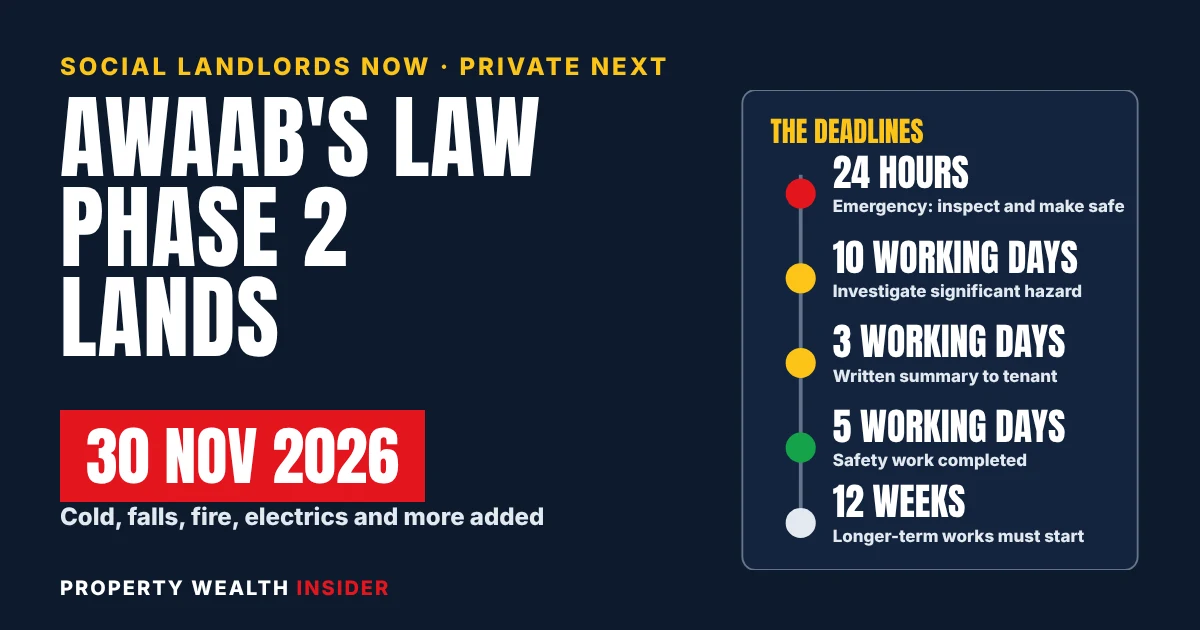
Awaab’s Law gets much bigger on 30 November 2026. From that date, social landlords in England must investigate and fix a far wider range of serious hazards to strict legal deadlines. The list now goes beyond damp and mould to include excess cold, excess heat, falls, electrical hazards, fire and explosions, structural collapse and domestic hygiene.
Private landlords are not covered yet. But the government is consulting right now on applying the same rules to private rented homes in England. The consultation closes on 18 December 2026 and says the earliest realistic start date would be 2027. The benchmark on the table is the social housing model: 24 hours for emergencies, 10 working days to investigate.
Here is what changes, what already applies to private landlords (including the new £7,000 fines), and how to get ready, plus a calculator for the exact deadlines.
Key facts
- Awaab’s Law phase 2 starts for social landlords in England on 30 November 2026. Phase 1 (damp, mould and emergency hazards) began on 27 October 2025.
- Emergency hazards: investigate and make safe within 24 hours. Significant hazards: investigate within 10 working days, give the tenant a written summary within 3 working days and finish safety work within 5 working days of the investigation.
- Private landlords are not covered yet. A consultation on extending Awaab’s Law to private tenancies runs until 18 December 2026, and the government says 2027 is the earliest feasible start.
- Already in force for private landlords: council fines of up to £7,000 for category 1 hazards (since June 2026) and civil penalties of up to £40,000 for ignoring an improvement notice.
- 10% of privately rented homes had a damp problem in 2024, the highest of any tenure (English Housing Survey).
What changes on 30 November 2026
Awaab’s Law is named after Awaab Ishak, the two-year-old who died in December 2020 after prolonged exposure to damp and mould at his family’s home in Rochdale. The rules are set out in the Hazards in Social Housing (Prescribed Requirements) (England) Regulations 2025. They apply to social homes in England only.
Phase 1 began on 27 October 2025. It covered all emergency hazards, plus damp and mould where they pose a significant risk of harm. The 2026 amendment regulations passed their final vote in Parliament on 20 October 2026 and come into force on 30 November 2026. They add seven more types of significant hazard, all taken from the Housing Health and Safety Rating System (HHSRS).
| Phase | Start date | Hazards covered (social homes, England) |
|---|---|---|
| Phase 1 | 27 October 2025 | All emergency hazards; damp and mould significant hazards |
| Phase 2 | 30 November 2026 | Adds significant hazards from excess cold, excess heat, falls (on the level, on stairs, between levels), electrical hazards, fire and explosions, structural collapse, domestic hygiene |
| Phase 3 | 2027 (no date set) | All remaining HHSRS hazards except overcrowding |
| Private rented sector | Not decided: consultation closes 18 December 2026 | Proposed starting point: all HHSRS hazards except crowding and space |
Some things are left out. According to the government’s phase 2 guidance, Awaab’s Law does not cover overcrowding or cladding work. It also excludes communal fire safety issues already covered by the Regulatory Reform (Fire Safety) Order 2005.
The Awaab’s Law deadlines explained
A hazard is an emergency hazard if a reasonable landlord would make it safe within 24 hours. It is a significant hazard if a reasonable landlord would make it safe within 15 working days. Working-day clocks start the day after the landlord becomes aware of the problem. The 24-hour clock starts straight away.
| Step | Emergency hazard | Significant hazard |
|---|---|---|
| Investigate | Within 24 hours of becoming aware | Within 10 working days of becoming aware |
| Make safe (relevant safety work) | Completed within 24 hours | Completed within 5 working days of the investigation |
| Written summary to tenant | Within 3 working days of the investigation (unless all work is already done) | Within 3 working days of the investigation (unless all work is already done) |
| Longer-term (supplementary preventative) work | Begin within 5 working days, or as soon as reasonably practicable and within 12 weeks | Begin within 5 working days, or as soon as reasonably practicable and within 12 weeks |
| If work cannot be done in time | Offer suitable alternative accommodation at the landlord’s expense | |
Note the wording: safety work must be completed within 5 working days, not just started. Working days exclude weekends, Christmas Day, Good Friday and England and Wales bank holidays, which matters around Christmas.
Awaab’s Law deadline calculator
Enter the date you became aware of a hazard and choose its type. The tool counts working days, skipping weekends and England and Wales bank holidays (2026 to 2028, from gov.uk). If the investigation has already finished, add that date to recalculate the later deadlines.
Awaab’s Law deadline calculator
Guide only, not legal advice. Based on the Hazards in Social Housing (Prescribed Requirements) (England) Regulations 2025 as amended from 30 November 2026. Private landlords are not yet legally bound by these deadlines; use them as a benchmark for the proposed rules.
Worked example: a tenant reports mould spreading across a bedroom wall on Monday 14 December 2026. Because of Christmas Day and the Boxing Day bank holiday on Monday 28 December, the 10-working-day investigation deadline is Wednesday 30 December, not Monday 28 December. If the investigation finishes that day, the written summary is due by Tuesday 5 January 2027 and safety work must be finished by Thursday 7 January 2027.
Private landlords: what is coming and when
The Renters’ Rights Act 2025 gives ministers the power, in sections 60 and 61, to apply Awaab’s Law to private tenancies and some licences in England. The government’s consultation on extending Awaab’s Law opened on 9 October 2026 and closes at 11.59pm on 18 December 2026. Nothing is final yet. These are proposals with options:
- Hazards: starting point is all HHSRS hazards except crowding and space, where significant or emergency.
- Investigation: 10 working days proposed, in line with social housing. Options are 5, 10 or 15.
- Written summary: options of 1, 3 or 5 working days, with 3 being the social housing standard.
- Making safe: options of 3, 5 or 10 working days, with 5 being the social housing standard.
- Emergencies: options of 12, 24 or 48 hours, with 24 hours matching social housing.
- Possible exclusions: hazards caused by the tenant breaching the tenancy, and how to handle hazards that are the freeholder’s responsibility in leasehold flats.
On timing, the consultation says the earliest feasible implementation date would be 2027. The Renters’ Rights Act implementation roadmap still lists the private rented start date as “TBC – subject to consultation”.
Enforcement would work differently from the social sector. The Act inserts an implied term into tenancies, so tenants could sue for breach of contract and ask for repairs, compensation and some costs. Councils would not enforce Awaab’s Law directly but keep their HHSRS powers. Tenants could also complain to the new private rented sector Landlord Ombudsman, which landlords are expected to join in 2028.
A separate reform is on a longer timetable. The government response on the new Decent Homes Standard (28 January 2026) says all rented homes must meet it by 2035 at the latest. It includes a new rule that homes should be free of damp and mould.
What already applies to private landlords now
No Awaab’s Law does not mean no deadline pressure. Three sets of rules already bite on private landlords in England:
| Rule | What it means | Maximum exposure |
|---|---|---|
| HHSRS (Housing Act 2004), updated 23 June 2026 | Councils assess 21 hazard types. A category 1 hazard lets them serve improvement notices, act directly or fine. | Up to £7,000 fine for a category 1 hazard (from June 2026) |
| Failing to comply with an improvement notice | A criminal offence. Councils can prosecute or issue a civil penalty instead. | Civil penalty up to £40,000 (since 1 May 2026) |
| Rent repayment order | Tenant or council can apply to a tribunal after an improvement notice breach. | Up to 2 years’ rent (since 1 May 2026) |
| Homes (Fitness for Human Habitation) Act 2018 | Home must be fit at the start and throughout the tenancy, including free of serious damp. Tenants can sue directly. | Court-ordered repairs plus compensation (no set limit) |
Worked example: what ignoring a hazard can cost. Say a flat lets for £1,200 a month and has a broken heating system rated a category 1 excess cold hazard. The council can fine you up to £7,000. If it serves an improvement notice and you ignore it, add a civil penalty of up to £40,000. The tenant could then seek a rent repayment order of up to 24 months’ rent, which is £28,800. That is a worst case of £75,800 before repair costs, legal fees or any compensation claim.
Worked example: fixing it fast. Compare that with an illustrative £3,000 boiler replacement: under 4% of that worst case. Acting within days is far cheaper than fighting enforcement.
Damp is worst in private rented homes
The latest English Housing Survey found 10% of privately rented homes had a damp problem in 2024. That compares with 7% of social homes and 4% of owner-occupied homes. Across England, 1.4 million homes (5%) had damp.
The same survey found 10% of privately rented homes had a category 1 hazard and 22% failed the Decent Homes Standard, again the worst of any tenure.
What to do now: a step-by-step plan
Step 1: Log every report with a date and time. Under Awaab’s Law the clock starts when you become aware, not when you get round to it. Use one inbox or app, and make sure your letting agent passes reports on the same day.
Step 2: Triage within hours. Ask: would a reasonable landlord make this safe within 24 hours (gas smell, live wiring, no heating for a vulnerable tenant in winter)? Or within 15 working days? Note who lives there. Children, older people and people with health conditions raise the risk.
Step 3: Line up trades now. Agree emergency call-out terms with an electrician, a Gas Safe engineer, a roofer and a damp specialist before you need them.
Step 4: Put findings in writing. Get into the habit of sending tenants a short summary within 3 working days: what you found, what you will do and by when. It is good evidence now and likely to become a legal duty.
Step 5: Tackle winter risks first. Excess cold and damp peak from November. Check heating, insulation, extractor fans and window seals before tenants report problems.
Step 6: Respond to the consultation. If 10 working days or 24 hours is unrealistic for your portfolio, say so before 18 December 2026.
- One log for all repair reports, with the date and time received
- Agent agreement updated: hazards passed to you the same day
- Emergency contacts for gas, electrics, roofing and damp
- Written summary template ready to send tenants
- Heating, ventilation and extractor fans checked before winter
- Photos and records kept of every visit, including refused access
- Gas safety record, EICR and smoke/CO alarms all in date
- Consultation response sent by 18 December 2026
FAQ
Does Awaab’s Law apply to private landlords?
Not yet. It applies only to social landlords in England. The government is consulting until 18 December 2026 on extending it to private tenancies, and says 2027 is the earliest feasible start.
What hazards are covered by Awaab’s Law from 30 November 2026?
All emergency hazards except overcrowding, plus significant hazards from damp and mould, excess cold, excess heat, falls, electrical hazards, fire and explosions, structural collapse and domestic hygiene.
How long does a landlord have to fix damp and mould under Awaab’s Law?
For a significant hazard, a social landlord must investigate within 10 working days and complete safety work within 5 working days of the investigation. Emergencies must be investigated and made safe within 24 hours.
Do bank holidays count as working days under Awaab’s Law?
No. Working days exclude Saturdays, Sundays, Christmas Day, Good Friday and bank holidays in England and Wales.
Can a council fine a private landlord for damp and mould now?
Yes. If damp and mould is rated a category 1 hazard under the HHSRS, councils in England can fine up to £7,000. Ignoring an improvement notice can mean a civil penalty of up to £40,000.
Does Awaab’s Law apply in Wales or Scotland?
No. The regulations and the private rented proposals cover England only.
Sources
- MHCLG: Awaab’s Law Phase 2 guidance for social landlords
- The Hazards in Social Housing (Prescribed Requirements) (England) Regulations 2025
- The Hazards in Social Housing (Prescribed Requirements) (England) (Amendment) Regulations 2026
- UK Parliament: approval stages for the 2026 amendment regulations
- MHCLG consultation: Extending Awaab’s Law to private rented tenancies and to licences
- MHCLG: Renters’ Rights Act 2025 implementation roadmap
- MHCLG: Decent Homes Standard government response
- English Housing Survey 2024 to 2025: Chapter 1, housing quality
- MHCLG: new £7,000 fines for dangerous rented homes
- The Housing Health and Safety Rating System (England) (Amendment) Regulations 2026
- Housing Act 2004, section 249A
- Housing and Planning Act 2016, section 44
- MHCLG: Guide for landlords, Homes (Fitness for Human Habitation) Act 2018
- GOV.UK: UK bank holidays
This article is news and general guidance only. It is not financial, legal or tax advice.