Rents tipped to rise as RICS gauge hits +41% and prices slip
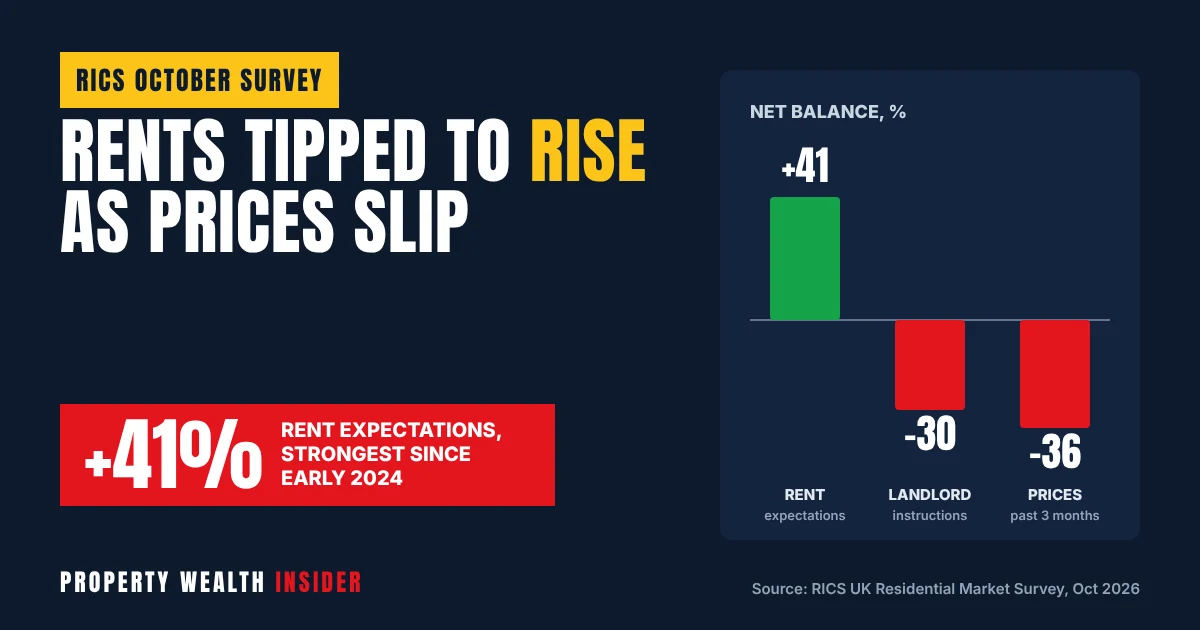
Rents look set to keep climbing while house prices drift lower. That is the clear message from the Royal Institution of Chartered Surveyors’ October 2026 UK Residential Market Survey, published this week, in which the gauge of expected rent rises over the next three months jumped to a net balance of +41%, its strongest reading since early 2024.
The engine behind it is simple supply and demand. Surveyors say new landlord instructions are still falling, while tenant demand has edged back into growth. On the sales side, the house price balance slipped to -36% and buyer enquiries remain weak, with the renewed rise in mortgage rates blamed for keeping buyers away.
For landlords and investors that combination matters: rising rents on a falling purchase price push yields up. Here is what the survey actually says, what it means for your numbers, where the picture differs by region, and how to use it.
Key facts
- RICS rent expectations (next three months) hit a net balance of +41%, up from +29%, the strongest since early 2024.
- New landlord instructions: net balance of -30%. Tenant demand: +7%, up from -1%.
- House price balance: -36% (from -34%). Twelve-month price expectations: -17%, which RICS says equates to a decline of around 1%.
- Official ONS data: UK private rents averaged £1,406 a month in September 2026, up 3.8% on a year earlier.
- The Bank of England raised Bank Rate to 4% on 5 November 2026 (from 3.75%). The next decision is due 17 December 2026.
What the RICS October survey found
The RICS survey is a monthly poll of chartered surveyors working in residential sales and lettings. This month’s sample covered 443 branches from 235 responses. The headline national readings cover England and Wales; Scotland and Northern Ireland are reported separately.
Every figure is a “net balance”: the share of surveyors reporting a rise minus the share reporting a fall. It measures how widespread a trend is, not how big it is. A rent balance of +41% does not mean rents will rise 41%. It means far more agents expect rents to rise than fall.
| Indicator (net balance) | Previous | October 2026 | Direction |
|---|---|---|---|
| Rent expectations, next 3 months | +29% | +41% | Stronger |
| Tenant demand | -1% | +7% | Back to growth |
| New landlord instructions | n/a | -30% | Still falling |
| New buyer enquiries | -24% | -24% | Unchanged, weak |
| Agreed sales | -18% | -24% | Weaker |
| New sales instructions | +6% | -8% | Weaker |
| Market appraisals | n/a | -34% | Firmly negative |
| House prices, past 3 months | -34% | -36% | Weaker |
| Price expectations, next 12 months | 0% | -17% | Turned negative |
The landlord supply squeeze behind rising rents
The lettings figures tell a story every landlord will recognise. Fewer landlords are bringing properties to agents (a net balance of -30% on new landlord instructions), while tenant demand has turned modestly positive at +7%, up from -1%.
RICS links the two directly: against “constrained supply and modestly rising tenant demand”, rental growth expectations strengthened. When the pool of available homes shrinks faster than demand, rents get bid up.
Official data backs up the direction. The ONS Price Index of Private Rents shows the average UK rent at £1,406 a month in September 2026, up 3.8% in a year, an annual rate unchanged from August. In England rents averaged £1,466, up 4.0%. That is £52 a month more than a year earlier on the UK average.
Worked example: a tenancy at £1,150 a month that rises 4% at renewal goes to £1,196, an extra £46 a month or £552 a year. Before you assume a rise, check the market rent for your area and follow the correct notice process for your nation and tenancy type.
Why prices are slipping: rates, buyers and sentiment
RICS puts the softness down to “the renewed rise in mortgage interest rates over recent months” weighing on buyer demand. The Bank of England then raised Bank Rate by 0.25 percentage points to 4% on 5 November 2026, by an 8-1 vote, with one member backing a bigger rise to 4.25%.
Buyer enquiries held at -24% and agreed sales fell to -24% from -18%. The twelve-month sales expectations balance dropped to -17%, which RICS says is the most pessimistic since July 2023.
Prices are edging down rather than crashing. The three-month price balance fell to -36%, and the year-ahead price expectations balance slid to -17% from zero. Crucially, RICS says that equates to “a relatively modest decline of around 1%” over twelve months.
The supply side is thinning too. New sales instructions slipped to -8% from +6%, and market appraisals (a lead indicator of future listings) sit at -34%. RICS suggests the pipeline of new listings may slow further in coming months, which could limit how far prices fall.
For context, the official ONS figure has UK house prices at an average of £273,000 in August 2026, still up 0.9% on a year earlier. The RICS survey is a forward-looking signal; official price indices lag.
What falling prices and rising rents do to yields
Gross yield is annual rent divided by purchase price. When rents rise and prices fall at the same time, both halves of that sum work in a buyer’s favour.
Take a £220,000 house letting at £1,150 a month (£13,800 a year). The gross yield today is 6.27%. If rents rise 4% and the price falls 1% over twelve months, the same house costs £217,800 and lets for £1,196 a month. Bought then, the gross yield is 6.59%.
Now compare negotiating. Knock 5% off today and pay £209,000: the gross yield on today’s rent is 6.60%. In other words, a 5% discount secured now delivers roughly what a year of waiting might, without betting on the forecast.
Don’t forget finance. With Bank Rate now at 4%, every 0.25 percentage point added to an interest-only loan of £156,750 (75% of £209,000) costs about £392 a year. Rising borrowing costs can wipe out the yield gain, so run the numbers on the rate you can actually get.
Yield shift calculator
Guide only, not financial advice. Gross yield ignores mortgage costs, stamp duty and fees. Rent and price changes are your own assumptions; RICS figures are sentiment balances, not forecasts of exact percentages.
Regional picture: where rents and prices diverge
RICS says London, East Anglia, the West Midlands and the South East all show weaker house price momentum than the national average, and those same areas are expected to see further softening through 2027. Prices continue to rise firmly in Northern Ireland, with modest growth in Scotland and the North West of England.
The latest ONS figures add the actual rent and price trends. Note the different dates: rents are to September 2026, prices to August 2026 (Northern Ireland lags further).
| Area | RICS price momentum (Oct 2026) | ONS rent, annual change | ONS average rent |
|---|---|---|---|
| London | Weaker than UK average | +3.5% (Sep) | £2,338 |
| South East | Weaker than UK average | +3.5% (Sep) | – |
| East Anglia / West Midlands | Weaker than UK average | – | – |
| North West | Modest growth | +5.7% (Sep), highest English region | – |
| Scotland | Modest growth | +0.7% (Sep) | £1,011 |
| Wales | Not singled out | +4.1% (Sep) | £848 |
| Northern Ireland | Rising firmly | +1.7% (Jul) | £879 |
Three takeaways. First, the North West combines the fastest rent growth in England with prices still rising modestly, so yield gains there come from rents rather than discounts. Second, London and the South East are where buyers have most negotiating power on price, while rents there are still rising 3.5% a year. Third, Scotland’s rent growth of 0.7% is the lowest annual change ONS has recorded for Scotland in this series, so don’t apply UK-wide rent assumptions north of the border.
On ONS averages, London house prices were down 2.2% in the year to August 2026, the weakest English region. Northern Ireland’s average price was £202,000 in the second quarter of 2026, up 9.2% on a year earlier, which is squeezing yields there rather than boosting them.
What to do now: a step-by-step guide
- Benchmark your rents. Compare each tenancy with current local asking rents and the ONS figure for your area. If you are well below market, plan a reviewed rent at the next lawful opportunity, using the correct notice for your nation.
- Protect your best tenants. With new landlord supply falling, good tenants have fewer alternatives, but a void still costs more than a modest below-market rent. Price rises sensibly.
- Re-run your finance numbers at today’s rates. Bank Rate is now 4%. Check fixed-rate expiry dates across your portfolio and get product quotes early.
- If buying, negotiate on yield, not asking price. Use the calculator above to set the price that hits your target yield and offer from there. With buyer enquiries and agreed sales weak, sellers in London, the South East, East Anglia and the West Midlands may be more flexible.
- Don’t wait for a crash. RICS expects only around a 1% price decline over twelve months. A negotiated discount now can beat waiting.
- Watch the next data points. The next ONS rents release is due 18 November 2026, the next Bank of England decision on 17 December 2026, and the November RICS survey on 10 December 2026.
- List every tenancy with current rent, renewal date and local market rent
- Note any fixed-rate mortgage ending in the next 12 months
- Stress-test each property at your lender’s quoted rate
- Calculate gross and net yield on any deal before viewing
- Set a maximum offer based on your target yield
- Diary 18 November, 10 December and 17 December data releases
FAQs
Are rents going up in 2027?
Surveyors think so in the near term: the RICS three-month rent expectations balance is +41%, the strongest since early 2024. Official ONS data shows UK rents up 3.8% in the year to September 2026. Neither is a guarantee, and growth varies widely by region.
Are house prices falling in the UK?
Surveyors report modest downward pressure, with a price balance of -36% in October 2026. RICS says twelve-month expectations equate to a fall of around 1%. Official ONS data still showed prices up 0.9% in the year to August 2026.
What does a RICS net balance of +41% mean?
It means the share of surveyors expecting rents to rise was 41 percentage points higher than the share expecting a fall. It measures how widespread the expectation is, not the size of any rent rise.
Is now a good time to buy a buy-to-let?
Weaker buyer demand gives investors more negotiating power, and rising rents help yields. Against that, Bank Rate rose to 4% on 5 November 2026, raising finance costs. Whether a deal works depends on the price you secure and the mortgage rate you can get.
Why are landlords leaving the rental market?
The RICS survey does not break down reasons, but it shows new landlord instructions running at a net balance of -30%, meaning fewer homes coming to the lettings market. Higher borrowing costs are one pressure on landlord finances.
Sources
- RICS UK Residential Market Survey, October 2026 (PDF)
- RICS UK Residential Market Survey hub
- ONS: Private rent and house prices, UK: October 2026
- Bank of England: Monetary Policy Summary, November 2026
- Bank of England: Bank Rate
This is news and general guidance, not financial, legal or tax advice.