+37% Rent Rise Signal: How to Lift Your Rent Legally This Winter
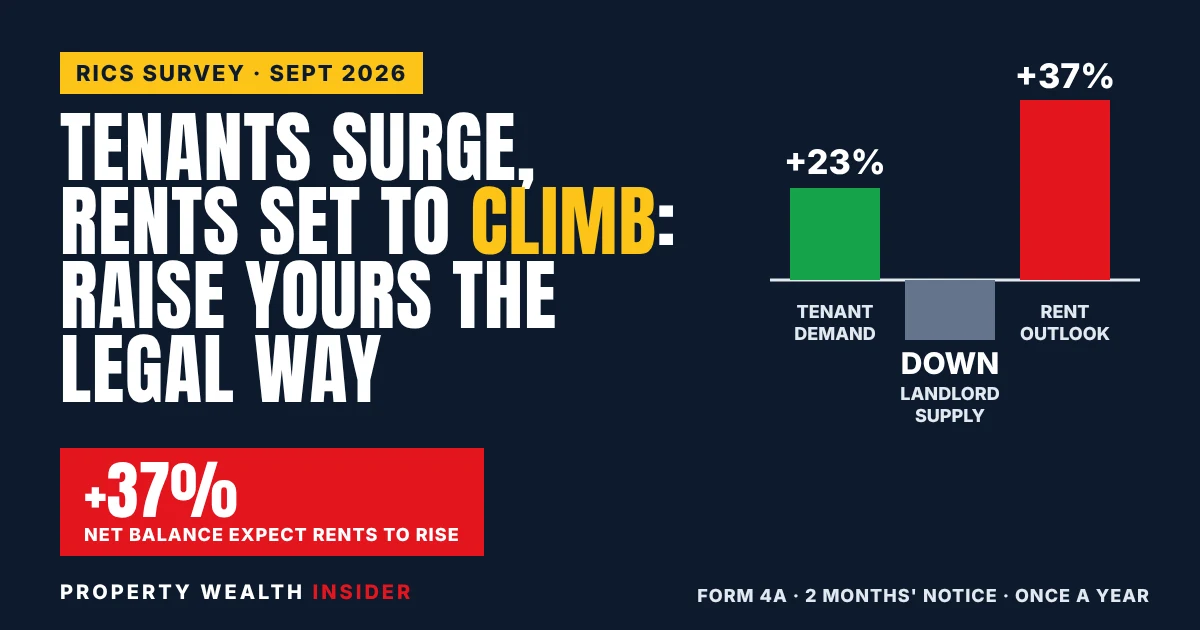
Tenants are queuing up again while landlords keep heading for the exit. The RICS UK Residential Market Survey for September 2026, published today (8 October 2026), shows tenant demand rising for a third month running, landlord instructions still firmly negative and a net balance of +37% of surveyors expecting rents to rise over the next three months.
That is a clear signal for any landlord sitting on a below-market rent. But the rules on how you raise it have changed. Since 1 May 2026, every rent increase on a private assured tenancy in England has to go through the section 13 process, with no exceptions and no shortcuts.
This guide covers what the survey actually says, the exact rules for raising rent in England this winter, the dates that matter, and a planner that works out your earliest legal start date and your tribunal risk.
Key facts
- A net balance of +23% of RICS surveyors reported rising tenant demand in September, up from +18% in August.
- Rent expectations for the next three months stand at +37%, down from +44% in August but well above the +27% first-half 2026 average.
- Landlord instructions remained firmly negative (they were -14% in August).
- In England you can raise rent only once a year, using Form 4A, with at least 2 months’ notice.
- Rent review clauses have had no effect since 1 May 2026, and tenants can challenge any proposed rise at the First-tier Tribunal.
What the RICS September survey shows
The RICS survey is a monthly sentiment poll of chartered surveyors. Its figures are net balances: the share reporting a rise minus the share reporting a fall. So +23% for tenant demand does not mean demand rose 23%; it means far more surveyors saw demand increase than decrease.
The headline story for September is a split market. Sales cooled as RICS blamed higher interest rate expectations for knocking buyer confidence. Lettings went the other way.
| RICS indicator (net balance) | August 2026 | September 2026 | Direction |
|---|---|---|---|
| Tenant demand | +18% | +23% | Stronger (3rd month in a row) |
| Landlord instructions | -14% | Firmly negative | Supply still shrinking |
| Rent expectations, next 3 months | +44% | +37% | Still high |
| New buyer enquiries | -18% | -22% | Weaker |
| Agreed sales | -16% | -18% | Weaker |
| New sales instructions | n/a | +6% | First positive since mid-2025 |
| House prices | -28% | -32% | Weaker |
| Price expectations, next 3 months | n/a | -24% | Further pressure |
| Price expectations, next 12 months | n/a | 0% | Broadly flat |
Two details matter for landlords. First, RICS notes this is the third consecutive month in which tenant demand growth has accelerated. Second, the +37% rent expectations reading remains comfortably above the +27% average for the first half of 2026, even after easing from August.
What it means for your rent
More tenants chasing fewer homes is the textbook recipe for rising rents. If your tenant is paying well below what a new tenant would pay, you are leaving money on the table every month.
Worked example: a two-bed let at £1,200 a month where comparable homes now advertise at £1,300. A 5% rise takes it to £1,260, worth £60 a month or £720 a year, and still sits £40 below market. That is a rise most tenants are unlikely to challenge.
Push to £1,400 instead and you are £100 above the market. The tenant can refer it to the tribunal, which cannot set a rent above the open-market level. You could end up with less than you would have got by pitching sensibly in the first place, and later.
Remember too that a sentiment survey is not a rent index. Surveyors expect rents to rise, but your increase must be justified by evidence for your own property: local listings, recent lets and condition.
The rent increase rules in England now
These rules apply to private assured periodic tenancies in England and have been in force since 1 May 2026 under the Renters’ Rights Act changes to section 13 of the Housing Act 1988. They are not proposals. Here is what gov.uk and the legislation require:
- Once a year only. You cannot increase rent in the first year of the tenancy, and the next increase cannot take effect until at least a year after the last one (the Act uses 52 weeks).
- Form 4A, every time. You must serve Form 4A: Landlord’s notice proposing a new rent. This applies even if your tenant has already agreed the increase.
- At least two months’ notice. The new rent must start at the beginning of a rental period, no earlier than two months after the notice is served.
- Serve it properly. In person, by post, or by email if your tenancy agreement allows email.
- Rent review clauses are dead. Any term saying rent will or may go up other than via section 13 has no effect. An increase agreed under a review clause before 1 May 2026 but due to take effect after that date does not apply.
- Tenants can challenge. If the tenant thinks the new rent is above open-market rent, they can apply to the First-tier Tribunal before the new rent starts.
Old notices still count. If you served the old Form 4 before 1 May 2026, the notice period and rent in it still apply. And the once-a-year clock runs from your last increase even if that was before 1 May 2026. Gov.uk’s example: an increase from 1 February 2026 means the next one cannot take effect until 1 February 2027.
Here is how the two-month rule works for a tenant whose rent is due on the 1st of each month, assuming no increase in the last year.
| Form 4A served on | Two months later | Earliest new rent date (rent due on the 1st) |
|---|---|---|
| 8 October 2026 | 8 December 2026 | 1 January 2027 |
| 1 November 2026 | 1 January 2027 | 1 January 2027 (no margin: serve earlier) |
| 15 November 2026 | 15 January 2027 | 1 February 2027 |
| 1 December 2026 | 1 February 2027 | 1 February 2027 (no margin: serve earlier) |
Cutting it to the exact day is risky, especially by post. Build in a few days’ margin so there is no argument about when the notice was served.
Rent increase planner
Enter your figures to see the new rent, extra income, the earliest date the increase can legally start in England and whether you are pitching above the local market.
Rent increase planner (England)
Guide only, not legal advice. Assumes a monthly private assured periodic tenancy in England, a correctly served Form 4A and the 52-week rule (the Act allows 53 weeks in some cases). Add margin for postal service.
Tribunal risk: what overpitching costs you
Under section 14ZB of the Housing Act 1988, if a tenant challenges your Form 4A, the tribunal sets the rent at the lower of the open-market rent and the rent you proposed. It cannot award you more than you asked for.
Timing is the bigger sting. If the tribunal decides after your proposed start date, the new rent runs only from the first rental period beginning on or after the decision. If paying from that date would cause the tenant undue hardship, the tribunal can push it back by up to two months from the decision.
Worked example: you propose £1,400 from 1 January 2027 on a £1,200 rent, but the market is £1,300. The tenant applies in December and the tribunal decides on 15 March 2027. The rent becomes £1,300 from 1 April 2027. You have collected £1,200 for January to March, losing £300 compared with a £1,300 increase that went unchallenged from 1 January.
Had you asked for £1,300 from the start, the tenant would have had little reason to apply. Accurate pricing is now worth real money.
What to do now: step by step
- Check the date of your last increase. Find when the current rent took effect, or the tenancy start date. Add 52 weeks: that is the earliest a new rent can start.
- Gather market evidence. Save three to five comparable listings and recent lets nearby: same size, type and condition. Keep screenshots with dates.
- Set a defensible figure. Pitch at or slightly below the market evidence. Take condition and any outstanding repairs into account.
- Talk to your tenant first. Gov.uk advises discussing the increase before serving notice. A good tenant staying put beats a void.
- Complete Form 4A. Download the current version from gov.uk. Do not use the old Form 4 or rely on a clause in the tenancy agreement.
- Serve with margin. Choose a start date at the beginning of a rental period, at least two months after service, plus a few days’ buffer. Keep proof of service.
- Update your records. Diary the new rent date, update the standing order request and set a reminder for 52 weeks later.
- Date of last rent increase (or tenancy start) confirmed
- 52-week date calculated
- 3-5 dated comparable lets saved
- Proposed rent at or below market evidence
- Conversation with tenant held and noted
- Current Form 4A completed (not old Form 4)
- Start date is a rent day, at least 2 months after service
- Email service permitted in tenancy agreement (if emailing)
- Proof of service kept
- Reminder set for next review
Wales, Scotland and Northern Ireland
Everything above is England-only. Gov.uk confirms there are different rules elsewhere. In Wales, landlords use the RHW12 notice of variation of rent under the Renting Homes regime. In Scotland, see mygov.scot’s rent increase guidance, and in Northern Ireland, nidirect. Check the official guidance for your nation before serving anything.
FAQ
How much notice do I need to give to increase rent in England?
At least two months, using Form 4A. The new rent must start at the beginning of a rental period, and no earlier than 52 weeks after the last increase or the start of the tenancy.
Can I still use a rent review clause in my tenancy agreement?
No. Since 1 May 2026, any clause providing for rent to go up other than through section 13 has no effect for private assured tenancies in England. You must serve Form 4A.
If my tenant agrees to a rent increase, do I still need a section 13 notice?
Yes. Gov.uk says you need to follow the section 13 process every time you increase the rent, even if the tenant has already agreed.
Can the tribunal increase the rent more than I asked for?
No. The tribunal sets the lower of the open-market rent and your proposed rent. It can also delay the start date if the decision comes after your proposed date, or by up to two months for tenant hardship.
Are rents going up in 2026?
RICS surveyors expect so in the short term: a net balance of +37% expect rents to rise over the next three months, with tenant demand up and landlord supply falling. That is a sentiment measure, not a guarantee for any individual property.
- RICS: UK Residential Survey September 2026 (press release, 8 October 2026)
- RICS UK Residential Market Survey September 2026 (PDF)
- RICS UK Residential Market Survey August 2026 (PDF)
- GOV.UK: Assured periodic tenancies, rent increases
- GOV.UK: Assured tenancy forms from 1 May 2026 (Form 4A)
- Housing Act 1988, section 13
- Housing Act 1988, section 14ZB
- GOV.UK: Apply to the housing tribunal
This article is news and general guidance only, not financial, legal or tax advice.