£4.2bn Rental Land Grab: Big Money Takes On Small Landlords
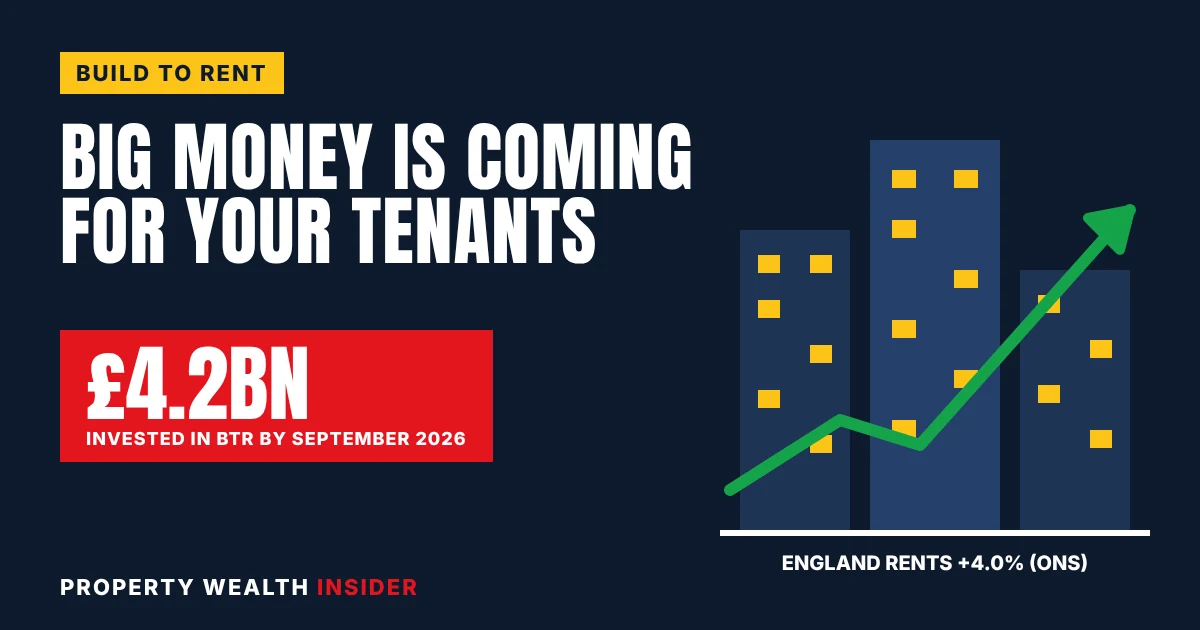
More than £900 million of institutional money went into UK Build to Rent in the third quarter of 2026, taking the year-to-date total to around £4.2 billion. According to Savills, that is more than any previous year had managed by the end of September.
The same research found that 72% of local authorities in England saw stronger-than-average rental growth over the summer. Savills puts much of that down to landlords rebasing rents after the Renters’ Rights Act came into force on 1 May 2026.
If you are a private landlord, the people buying up rental homes by the hundred are now competing with you for tenants. This guide covers where the money is going, what has happened to rents, and how to work out whether your own rent has fallen behind the market, using the section 13 process the new rules require.
Key facts
- More than £900m was invested in UK Build to Rent in Q3 2026, with year-to-date volumes at around £4.2bn (Savills).
- Q2 2026 brought £2.2bn, the strongest second quarter on record, and North American capital funded 60% of investment in the first half.
- 72% of English local authorities recorded stronger-than-average rental growth in the three months to August 2026.
- ONS figures show average private rents in England up 4.0% to £1,459 a month in the year to August 2026, with the UK rate rising to 3.8% from 3.7% in July.
- Since 1 May 2026 in England, rent can rise only once a year through the section 13 process (Form 4A, at least 2 months’ notice), and landlords cannot accept offers above the advertised rent.
Where the £4.2bn is going
Build to Rent (BTR) means homes designed, built and kept by one owner, usually a fund or pension scheme, purely to let. They tend to come with professional management, longer tenancies and on-site extras such as gyms, co-working space and concierge.
Savills’ Q3 2026 market update shows the money is spreading well beyond city-centre tower blocks. The biggest deal of the quarter was Border to Coast buying a portfolio of 866 stabilised single-family homes across the South East for around £400 million. That was the largest single-family housing deal of 2026.
Another £300 million or so of development funding was committed across five English regions during the quarter. Royal London also agreed to forward-fund 173 apartments in Newton Heath, Manchester. Savills says city-centre development funding still faces challenges.
| Savills BTR figure | Value | Period |
|---|---|---|
| Investment in the quarter | More than £900m | Q3 2026 |
| Year-to-date investment | c.£4.2bn (highest ever at this stage) | Jan–Sep 2026 |
| Investment in the quarter | £2.2bn (strongest Q2 on record) | Q2 2026 |
| Share funded by North American capital | 60% (UK investors 35%) | H1 2026 |
| Largest single-family deal of the year | c.£400m, 866 homes, South East | Q3 2026 |
| Development funding committed | c.£300m across five English regions | Q3 2026 |
Savills also points out that Q4 has been the biggest quarter for investment in each of the past three years, so 2026 could end as a record year. Its Q2 briefing recorded two landmark London deals: Morgan Stanley and Ridgeback buying L&Q’s Metra Living platform of nearly 3,200 homes for £1.045 billion, and Greystar’s £500 million purchase of 904 homes at Elephant Park.
Rents jumped over the summer, and why
According to Savills, England’s largest cities saw stronger rental growth in the three months to August 2026 than their historical averages. Birmingham was the exception, because high levels of rental supply there held rents back.
Savills links this to the Renters’ Rights Act. Landlords can no longer accept offers above the asking rent, so some have set a higher asking rent from the start to make sure they get full market value. Savills thinks the acceleration is “likely to reflect a one-off adjustment in rents” rather than a lasting shift in supply and demand.
The official figures point the same way. The ONS’s Price Index of Private Rents shows UK annual rent inflation had been slowing for more than a year, down to 3.3% in May and June 2026. It then rose again to 3.7% in July and 3.8% in August.
One thing to bear in mind is that the ONS index tracks all private rents, including sitting tenants who have not had an increase, not just new lets. That makes it a steady guide to the market as a whole. Rents on new lets in hot spots can move a lot faster.
Rent growth region by region
In the year to August 2026, the North East and North West had the fastest rent inflation of any English region, both at 5.8%. The South East was the slowest at 3.0%, and London was at 3.5%, with an average rent of £2,332 a month.
The table below shows what a £1,000 rent would become if it kept pace with each region’s current annual rate. If your rent hasn’t moved in two years, the right-hand column gives a rough idea of how far behind you could be.
| Region | Annual rent inflation (Aug 2026) | £1,000 after 12 months | £1,000 after 24 months |
|---|---|---|---|
| North East | 5.8% | £1,058 | £1,119 |
| North West | 5.8% | £1,058 | £1,119 |
| West Midlands | 4.9% | £1,049 | £1,100 |
| Yorkshire and The Humber | 4.9% | £1,049 | £1,100 |
| South West | 4.4% | £1,044 | £1,090 |
| England | 4.0% | £1,040 | £1,082 |
| East Midlands | 3.7% | £1,037 | £1,075 |
| London | 3.5% | £1,035 | £1,071 |
| East of England | 3.5% | £1,035 | £1,071 |
| South East | 3.0% | £1,030 | £1,061 |
The 24-month column assumes the current rate holds for two years, which it may not. Treat it as a guide only and check your actual local comparables.
Calculator: is your rent behind the market?
Enter your figures to estimate a market-rebased rent and see what it would do to your yield. The growth rate defaults to the ONS England figure of 4.0%. Swap in your region’s rate from the table above, or your own local evidence.
Rent rebase & yield calculator
This is a guide, not advice. It projects your rent forward at an average growth rate, so it is not a valuation. Check real comparable listings nearby, because under the section 13 process a tenant can challenge any increase above open market rent at the First-tier Tribunal. Net yield here is before mortgage interest and tax.
Worked example 1: England average
Take a £250,000 house let at £1,100 a month, with no increase for 18 months and £3,000 a year in running costs. At England’s 4.0% rate, the market rent is now about £1,167, which is £67 a month or roughly £800 a year more.
Gross yield rises from 5.28% to 5.60%, and net yield before finance goes from 4.08% to 4.40%.
Worked example 2: North West
Now take a £180,000 terrace in the North West at £850 a month, with no increase for 24 months and £2,500 of annual costs. At 5.8% a year, the market rent is about £951, so the gap is around £101 a month, or £1,218 a year.
Gross yield moves from 5.67% to 6.34%, and net from 4.28% to 4.95%. Leaving rents untouched for long periods costs real money in fast-moving regions.
How to raise the rent legally under the new rules
These rules apply to private tenancies in England. Wales, Scotland and Northern Ireland have their own separate regimes. Since 1 May 2026, gov.uk guidance says landlords cannot increase rent more than once a year.
To raise the rent, you complete Form 4A and give it to your tenant with at least 2 months’ notice. This is called the section 13 process.
Tenants can challenge a proposed increase they think is above open market rent. According to the government’s guide to the Act, a tenant who goes to the First-tier Tribunal will never pay more than the landlord asked for. The new rent then applies from the date of the tribunal’s decision, so it cannot be backdated.
At the start of a tenancy, you have to publish an asking rent and cannot accept offers above it. That is why setting the right asking rent at the outset matters so much now, and it is the rebasing behaviour Savills describes.
The new-let squeeze: You can no longer let tenants bid up the rent, and you can only change it once a year. If you set the asking rent too low, you are stuck with it for at least 12 months.
How small landlords can compete with Build to Rent
Big money isn’t only buying city flats any more. A £400 million block of family houses in the South East shows funds are moving into the suburban homes that have always been the core of small-landlord portfolios. Where they land, tenants get slick apps, quick repairs and on-site amenities.
Private landlords still have real advantages: lower overheads, flexibility on pets and furnishing, a personal relationship with tenants and stock in streets that BTR does not reach. Here is how to use them.
- Know if BTR is on your doorstep. Check planning portals and letting sites for large new rental schemes nearby. Birmingham shows how a lot of new supply can hold rents back.
- Price to the market, not to habit. You only get one increase a year, so review rent every year against real comparables rather than leaving it for several years.
- Compete on service. Fast repairs, clear communication and a well-presented home are what BTR sells. You can match most of that for far less money.
- Keep good tenants. With periodic tenancies, tenants can leave on two months’ notice. A void month on a £1,100 rent costs more than a year of under-pricing by £80 a month.
What to do now
- Note the date each property’s rent was last set or increased.
- Run each one through the calculator above using your region’s ONS rate.
- Check the result against at least three comparable listings within a mile of the property.
- Decide on a figure no higher than open market rent, and weigh it against the cost of a void.
- Serve Form 4A with at least 2 months’ notice, keep proof of service, and record the date so you don’t try a second increase within a year.
- For new lets, research the asking rent carefully before advertising, because you cannot accept higher offers.
- Date of last rent increase recorded for each tenancy
- Local annual rent growth figure checked (ONS region or local data)
- Three or more comparable listings saved as evidence
- Proposed rent is at or below open market rent
- Form 4A completed and served with at least 2 months’ notice
- Proof of service kept on file
- Asking rent for any new let researched before advertising
- Large BTR schemes near your properties identified
FAQ
How much was invested in Build to Rent in 2026?
Savills puts year-to-date investment at around £4.2 billion by the end of Q3 2026, including more than £900 million in Q3. That is more than in any previous year at the same stage.
How often can I put the rent up in England?
Since 1 May 2026, no more than once a year. You use the section 13 process with Form 4A and give at least 2 months’ notice.
Can a tenant challenge my rent increase?
Yes. If they think it is above open market rent, they can apply to the First-tier Tribunal. Under the government’s guidance, they will never pay more than you proposed, and the new rent applies from the date of the decision.
Can I accept a higher offer than the advertised rent?
No. In England it is now illegal to encourage bidding or to accept offers above the advertised rent.
How fast are rents rising in England?
The ONS says average private rents in England rose 4.0% to £1,459 a month in the 12 months to August 2026. Across English regions, rates ranged from 3.0% in the South East to 5.8% in the North East and North West.
- Savills: UK Build to Rent Market Update – Q3 2026
- Savills: UK Build to Rent Market Update – Q2 2026 (PDF)
- ONS: Private rent and house prices, UK: September 2026
- GOV.UK: Renters’ Rights Act – an overview for landlords
- GOV.UK: Guide to the Renters’ Rights Act
This article is news and general guidance only, not financial, legal or tax advice.