Landlord hit with £12,500 fine over electrical safety checks
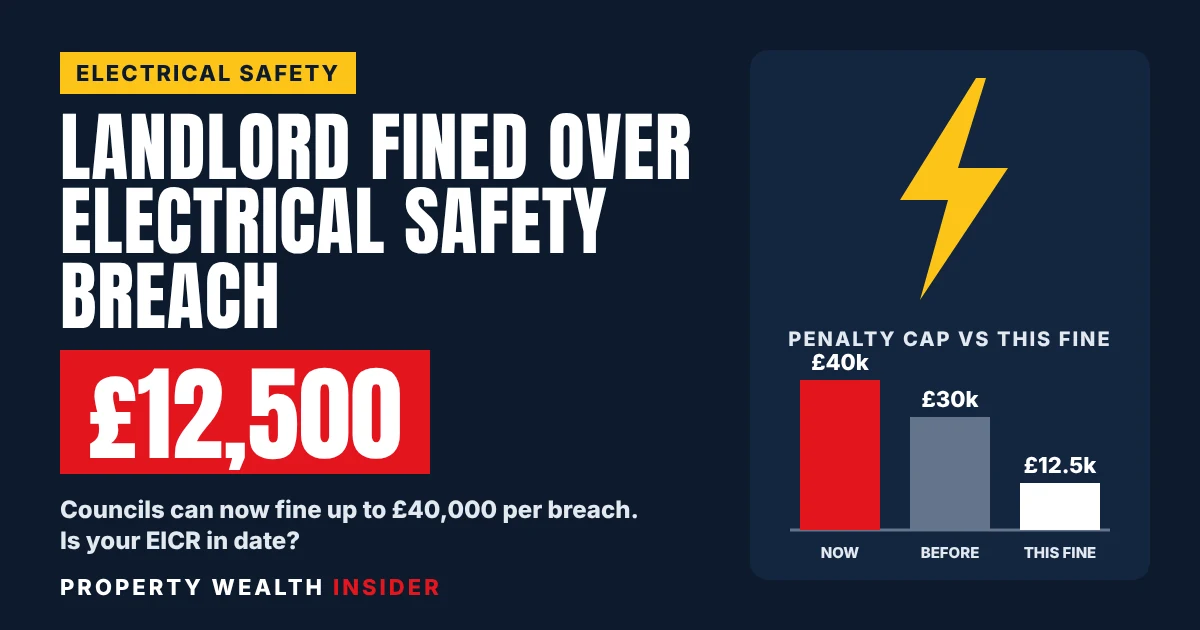
A private landlord in Darlington has been hit with a £12,500 financial penalty after the council found they had broken the electrical safety rules that apply to every privately rented home in England.
Darlington Borough Council announced the penalty on 6 November 2026. It did not name the landlord or the property, but the message is clear: missing or overdue electrical checks are now an easy target for councils, and the fine does not need a court case.
Much bigger fines are now possible. The maximum penalty under these regulations went up from £30,000 to £40,000 from 1 November 2025. Below we explain what the rules require, every deadline you must meet, and how to check your own position in two minutes with our EICR compliance checker.
Key facts
- Darlington Borough Council imposed a £12,500 civil penalty on a private landlord, announced on 6 November 2026.
- Landlords in England must have the fixed wiring inspected and tested by a qualified person at least every 5 years, and before a new tenancy starts.
- Remedial or further investigation work flagged in the report must be done within 28 days of the inspection, or sooner if the report says so.
- Tenants must get a copy of the report within 28 days of the inspection; the council can demand one within 7 days of a written request.
- The maximum penalty per breach rose from £30,000 to £40,000 from 1 November 2025, and councils can issue more than one penalty for a continuing failure.
What happened in Darlington
According to the council’s own announcement, its private sector housing team investigated a privately rented property in the borough and concluded the landlord had breached the Electrical Safety Standards regulations.
The council set the penalty at £12,500 under its enforcement policy. It has not published which specific duty was breached, the address, or whether the landlord made representations or appealed.
Councillor Jim Garner, the council’s cabinet member for stronger communities, said most landlords meet their legal responsibilities but the council will act against those who do not, describing the penalty as a clear message that non-compliance will not be tolerated.
What the electrical safety rules require
The rules are in the Electrical Safety Standards in the Private Rented Sector (England) Regulations 2020. They applied to new tenancies from 1 July 2020 and to all existing tenancies from 1 April 2021. Since 1 November 2025 they have been retitled to cover the social rented sector too, but the core duties for private landlords are unchanged.
They cover tenancies in England where the tenant lives in the property as their only or main home and pays rent. Lodgers sharing a kitchen, bathroom or living room with the landlord or the landlord’s family, long leases and tenancies of 7 years or more, and student halls are among the exclusions.
| Duty | Deadline | Regulation |
|---|---|---|
| Meet the national wiring standards (BS 7671:2018) while the property is let | At all times when occupied | 3(1)(a) |
| Inspect and test every electrical installation by a qualified person | Before a new tenancy starts, then at least every 5 years (or sooner if the report says so) | 3(1)(b)-(c), 3(2) |
| Obtain a report showing results and the date of the next test | After each inspection | 3(3)(a) |
| Give a copy to each existing tenant | Within 28 days of the inspection | 3(3)(b) |
| Give a copy to the council on written request | Within 7 days of the request | 3(3)(c) |
| Give a copy to a new tenant | Before they move in | 3(3)(e)(i) |
| Give a copy to a prospective tenant on written request | Within 28 days of the request | 3(3)(e)(ii) |
| Complete remedial or further investigative work | Within 28 days starting with the inspection date, or shorter period in the report | 3(4) |
| Send written confirmation of the work, with the report, to tenants and the council | Within 28 days of completing the work | 3(5) |
That last row catches people out. Once remedial work is done, you must send written confirmation and the original report to the council within 28 days without being asked, as well as to your tenants.
These rules apply in England only. Wales requires a valid electrical condition report at least every 5 years under its fitness for human habitation regulations, and Scotland requires a 5-yearly electrical safety inspection under the Repairing Standard. The detail, deadlines and penalties differ.
C1, C2, C3 and FI: what your EICR codes mean
The report is usually an Electrical Installation Condition Report (EICR). Any C1, C2 or FI code means the installation is unsatisfactory and your 28-day clock is already running.
| Code | Meaning | Must you act? |
|---|---|---|
| C1 | Danger present. Risk of injury. | Yes. Remedial work required, and the electrician will usually make it safe immediately |
| C2 | Potentially dangerous | Yes. Remedial work within 28 days or less |
| FI | Further investigation required without delay | Yes. Investigation within 28 days or less, then any work it reveals |
| C3 | Improvement recommended | No legal duty, but worth doing |
If further investigation turns up more problems, the 28-day work and confirmation steps start again for that new work (regulation 3(6)).
How the £40,000 penalty regime works
A council can impose a civil penalty if it is satisfied, beyond reasonable doubt, that a landlord has breached a duty under regulation 3. There is no court hearing unless the landlord appeals.
- Cap: £40,000 per penalty for breaches from 1 November 2025, up from £30,000 (SI 2025/1043, regulation 10).
- Continuing failure: the council can issue more than one penalty if the breach carries on (regulation 11(1)).
- Notice of intent: the council must first serve a notice of intent, normally within 6 months of being satisfied there is a breach. You then have 28 days to make written representations.
- Appeal: after a final notice, you have 28 days to appeal to the First-tier Tribunal (Property Chamber), which can confirm, cancel or vary the penalty.
- Council does the work: separately, a council can serve a remedial notice, arrange the work itself with the tenant’s consent, and recover its costs from you.
Since 1 November 2025 there is also a written defence: you are not in breach if you can show you took all reasonable steps to comply. If a tenant refuses access, you are not treated as failing just because you did not go to court to get in. Keep a dated record of every access request.
What about the Renters’ Rights Act 2025? The government’s statutory guidance on civil penalties under the Act, which applies from 1 May 2026, does not list electrical safety breaches among the offences it covers. Electrical safety penalties are set by the electrical safety regulations themselves, and it is those regulations that now carry the £40,000 cap.
EICR compliance checker
Enter the dates from your latest report. The checker works out your next test date, your remedial deadline, whether the tenant copy went out in time and how many potential breaches you have.
EICR compliance checker
Guide only, based on the Electrical Safety Standards Regulations 2020 as amended (England). It assumes the £40,000 cap per breach and cannot see your paperwork. It is not legal advice; check your report and get advice for your situation.
Worked examples in pounds and dates
Example 1: the C2 timeline. An electrician tests a flat on 3 March 2026 and records a C2. The 28-day period starts with the inspection date, so the work must be finished by 30 March 2026. The tenant must have a copy of the report by 31 March 2026.
The work is completed on 25 March 2026. Written confirmation plus the report must reach the tenant and the council by 22 April 2026. The next full test is due no later than 3 March 2031, unless the report sets an earlier date.
Example 2: the fine in rent terms. Take a hypothetical single let at £850 a month. A £12,500 penalty like Darlington’s wipes out almost 15 months of gross rent. A penalty at the £40,000 cap would equal more than 47 months, close to four years.
Example 3: a small portfolio. A landlord with three houses lets all three EICRs lapse. Each property is a separate breach, so the theoretical maximum is 3 x £40,000 = £120,000, before any extra penalties for a continuing failure. Actual penalties are set by each council’s policy and will usually be lower, but the exposure is real.
Example 4: the lost days. Your electrician tests on 10 January but emails the report on 24 January. You have already used 14 of your 28 days. Ask for the report on the day, and book remedial work at the same time.
What to do now: step by step
- Pull every EICR. For each property, note the inspection date and the next test date written on the report. Some reports set an interval shorter than 5 years.
- Run each one through the checker above. Anything overdue or due within 90 days goes to the top of the list.
- Book a qualified person. The government guidance points landlords to competent person scheme registers to find one.
- Clear every C1, C2 and FI within 28 days. Get written confirmation from the electrician that the work is done and the installation meets the standards.
- Send the paperwork. Report to tenants within 28 days of the inspection; confirmation plus report to tenants and the council within 28 days of completing works.
- Keep proof. Keep dated emails or signed receipts showing when tenants got documents, plus a log of any access requests refused.
- Diary the next test. Set a reminder at least 3 months before the due date so you are never chasing an electrician at the last minute.
- Current EICR on file for every let property in England
- Next test date logged in a diary or spreadsheet
- No outstanding C1, C2 or FI codes
- Written completion confirmation from the electrician for all remedial work
- Tenant copy sent within 28 days, with proof of delivery
- Completion confirmation and report sent to the council within 28 days of works
- Copy given to new tenants before they move in
- Access requests and refusals logged with dates
- Report ready to send to the council within 7 days if asked
FAQ
How often does a landlord need an EICR in England?
At least every 5 years, and before a new tenancy starts. If the report says the next test is due sooner, you must follow the earlier date.
What is the fine for not having an EICR?
Councils can impose a civil penalty of up to £40,000 per breach for breaches from 1 November 2025 (previously £30,000). They can issue more than one penalty for a continuing failure. Darlington’s recent penalty was £12,500.
How long do I have to fix C1 and C2 faults?
28 days starting with the date of the inspection, or a shorter period if the report specifies one. The clock does not wait for you to receive the report.
Do I have to send my EICR to the council?
You must provide it within 7 days if the council asks in writing. If remedial work was needed, you must also send the report and the electrician’s written confirmation to the council within 28 days of the work being finished.
What if my tenant will not let the electrician in?
You are not in breach if you can show you took all reasonable steps, and you are not expected to go to court just to get access. Keep a written record of every request and refusal.
Do the same rules apply in Wales and Scotland?
No. These regulations cover England only. Wales and Scotland also require 5-yearly electrical checks, but under their own laws with different deadlines and enforcement.
Sources
- Darlington Borough Council: Landlord fined for breaching electrical safety requirements (6 November 2026)
- The Electrical Safety Standards in the Private Rented Sector (England) Regulations 2020 (SI 2020/312)
- The Electrical Safety Standards in the Private Rented Sector (England) (Amendment) (Extension to the Social Rented Sector) Regulations 2025 (SI 2025/1043)
- GOV.UK: Electrical safety standards in the private and social rented sectors: guidance
- GOV.UK: Civil penalties under the Renters’ Rights Act 2025 and other housing legislation
- The Renting Homes (Fitness for Human Habitation) (Wales) Regulations 2022, regulation 6
- mygov.scot: Repairing Standard
This article is news and general guidance only. It is not financial, legal or tax advice.