No Official Tenancy Template: Miss One Item, Risk a £7,000 Fine
There will be no official, government-approved tenancy agreement for private landlords in England. Housing minister Matthew Pennycook has confirmed in a written parliamentary answer that ministers will not force landlords to use a single template or set wording, even though the law now dictates exactly what information every new tenant must receive in writing.
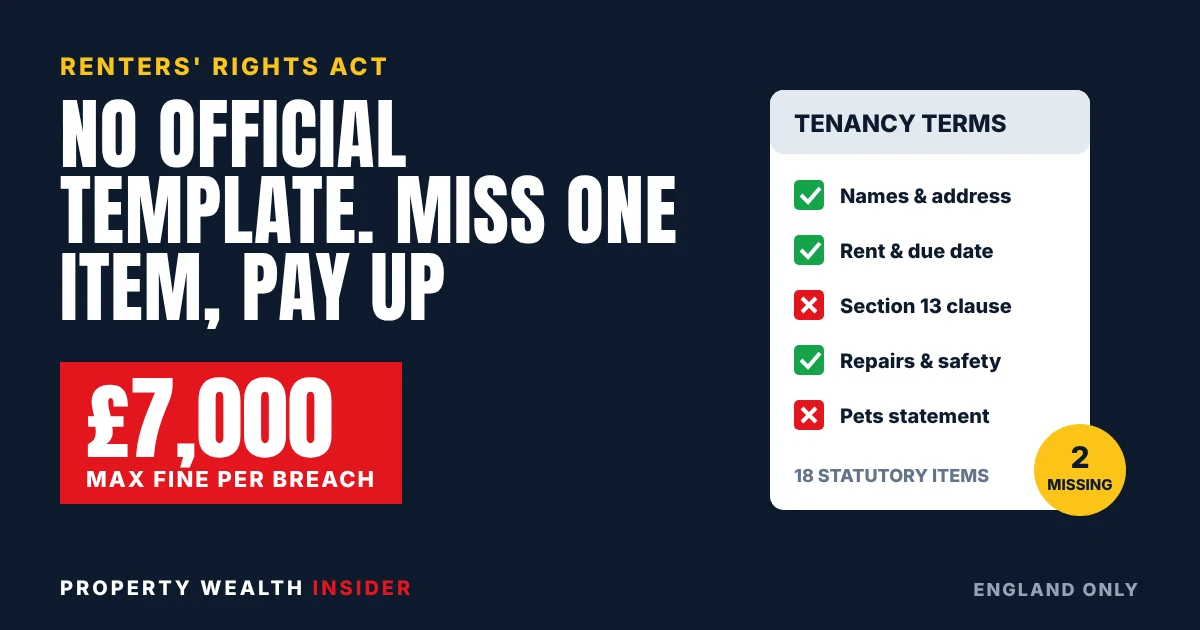
That sounds like freedom, but it shifts the risk squarely onto you. Since 1 May 2026, a landlord who fails to hand over the required “written statement of terms” can be fined up to £7,000 by the council, and there is no official form to hide behind if your paperwork misses an item.
This affects every private landlord and letting agent granting assured tenancies in England, the rolling tenancies that replaced fixed-term ASTs when section 21 was abolished. Below we list all 18 statutory items, explain which ones apply to you, and give you a free checker to audit your own tenancy pack.
Key facts
- Government will not mandate a tenancy agreement template or wording (written answer, 5 November 2026).
- Rules in force since 1 May 2026 under SI 2026/324, for private assured tenancies in England only.
- The Schedule lists 18 items: 8 apply to every tenancy, the rest depend on bills, deposit, gas and the type of let.
- Must be given before the tenancy is agreed. It can be in the tenancy agreement or a separate document.
- Failure: civil penalty of up to £7,000; continuing for 28 days after a penalty is an offence, with a penalty of up to £40,000 as an alternative to prosecution.
- Pre-1 May written tenancies needed the government Information Sheet by 31 May 2026 instead.
What the minister actually said
Liberal Democrat MP Lee Dillon asked whether tenancy agreements should be required to carry a plain-English summary section. The question was tabled on 3 September 2026 and answered on 5 November 2026.
Mr Pennycook’s answer made four points. Regulations in force since 1 May 2026 require landlords to give specified information in writing at the start of new assured periodic tenancies. The government expects most landlords to put it in the tenancy agreement. It does not consider it appropriate to mandate a template or wording, because one approach will not suit every tenancy. And landlords should give tenants enough opportunity to understand, or take advice on, the terms before signing.
So the plain-English summary idea is off the table, and so is any “official” agreement. What stays is the legal minimum content, set out in The Assured Tenancies (Private Rented Sector) (Written Statement of Terms etc and Information Sheet) (England) Regulations 2026 (SI 2026/324), made under section 16D of the Housing Act 1988 as inserted by the Renters’ Rights Act 2025.
Who must comply, and when
The duty applies to private landlords of assured tenancies in England, which since 1 May 2026 means almost every private let. Social housing assured tenancies are excluded from these regulations. If a letting agent has contracted to handle compliance, the duty applies to the agent too, although the council cannot fine the agent if the landlord has already complied.
Timing depends on when and how the tenancy started:
| Your situation | What you must give | Deadline |
|---|---|---|
| New tenancy agreed on or after 1 May 2026 | Written statement of terms (all applicable items) | Before the tenancy is agreed or signed |
| Tenancy before 1 May 2026 with a written agreement or written record of terms | The Renters’ Rights Act Information Sheet 2026 | 31 May 2026 (now passed) |
| Tenancy before 1 May 2026 agreed wholly verbally | Written statement of terms | 31 May 2026 (now passed) |
| Valid section 21 or section 8 notice served before 1 May 2026 that has lapsed, or court case ended without possession | The Information Sheet | Within one month of the notice lapsing or the case ending |
The key point from the minister’s answer: you do not have to re-issue a full statement to tenants whose written agreements pre-date 1 May 2026. But that is only because they were meant to receive the Information Sheet instead. If you missed the 31 May deadline, fix it today.
The 18 required items, with wording notes
The Schedule to SI 2026/324 lists 18 items. You do not need to copy the legal wording, but the substance of each applicable item must be covered. The wording notes below are our illustrative suggestions, not official text.
| # | Required item | When it applies | Example wording note |
|---|---|---|---|
| 1 | Name of every landlord | Always | “The Landlord is Jane Smith and John Smith (joint landlords).” |
| 2 | Name of every tenant | Always | List every joint tenant in full. |
| 3 | Address in England or Wales for serving notices on the landlord | Always | Can be a business or agent address where post is received. Email and phone are optional. |
| 4 | Property address | Always | Include flat number and postcode. |
| 5 | Date tenant is first entitled to possession | Always | “The tenancy starts on 15 November 2026.” Use the move-in date, not the signing date. |
| 6 | Rent and when it is due | Always | “Rent is £1,200 per month, payable in advance on the 15th of each month.” |
| 7 | Rent increase statement | Always | “If the Landlord proposes a new rent increase, the Landlord will serve notice in accordance with section 13 of the Housing Act 1988.” |
| 8 | Bills paid to the landlord | If council tax, utilities, TV licence, communications or green deal payments go to you | Say which bills, whether inside or on top of rent and, if on top, the amount and due date (or how you will notify them). |
| 9 | Deposit amount | If a tenancy deposit is taken | “Deposit: £1,150.” Prescribed information still due within 30 days. |
| 10 | Tenant’s minimum notice to quit | Where s5(1) Protection from Eviction Act 1977 applies (most lets) | Any period up to two months. If omitted it defaults to two months. |
| 11 | How the landlord can end the tenancy | Where s5 Housing Act 1988 applies | Court order usually needed; possession notice in the prescribed form naming the ground(s); notice period depends on the ground. |
| 12 | Fitness for human habitation | Where s9A Landlord and Tenant Act 1985 applies (most lets) | One sentence citing section 9A is enough. |
| 13 | Repairing obligations | Where s11 LTA 1985 applies, unless a court order or RTM exception applies | Structure and exterior; water, gas, electricity and sanitation installations; space and water heating. |
| 14 | Electrical safety duties | Where reg 3 of the 2020 Electrical Safety Regulations applies | Standards met; inspection by a qualified person at least every five years (or sooner if the report says); copy of report to tenant. |
| 15 | Gas safety duties | If a relevant gas fitting is installed in or serves the property | Fittings and flues kept safe; checks by an HSE-approved (Gas Safe) engineer at intervals set by the 1998 Regulations; copy record to tenant. |
| 16 | Disability improvements (s190 Equality Act 2010) | If the tenant may make improvements with your consent | Consent not to be unreasonably withheld for a disabled occupier; point to definitions in s6 and s190(9). |
| 17 | Pets statement | Always | Tenant may keep a pet if they ask under s16A Housing Act 1988 and you consent; consent not to be unreasonably refused. |
| 18 | Supported accommodation | Only if let as supported accommodation | State that it is, and why. |
Separately from the Schedule, if you might later rely on certain special possession grounds, such as Ground 4A for student lets or Grounds 2ZA to 2ZD where there is a superior lease, you must tell the tenant in writing at the start. Government guidance says that without this “prior notice” you cannot use Ground 4A at all, and using the other grounds risks a fine of up to £7,000.
Watch out: old AST templates usually miss items 7 (section 13 rent statement), 11 (court order wording) and 17 (pets). They are also likely to contain a fixed end date, and claiming to let on a fixed term is itself a separate breach carrying a penalty of up to £7,000.
Written terms compliance checker
Tell the tool about the tenancy, then tick each item your paperwork already covers. It works out which items apply, scores your pack and shows your penalty exposure.
Written terms compliance checker
Tick what your tenancy paperwork already contains:
Guide only, based on SI 2026/324 and GOV.UK guidance as at 10 November 2026. England only. Not legal advice: have your tenancy pack checked by a qualified adviser.
With the default settings (new tenancy from 15 November 2026, deposit and gas, no bills) 15 items apply. A typical pre-reform AST template covering 13 of them still leaves two gaps, the section 13 rent statement and the pets statement, and that is enough to expose you to a fine.
Penalties: what a missing clause could cost
Under section 16I of the Housing Act 1988, the local housing authority may impose a financial penalty of up to £7,000 if satisfied beyond reasonable doubt that you breached the written statement duty. The council sets the amount.
It escalates. A further penalty can be imposed if the breach continues for more than 28 days after the first one (or after any appeal ends). Under section 16J, continuing after that 28-day window, or a new breach within five years of a previous penalty, is a criminal offence. Councils can then fine up to £40,000 under section 16K instead of prosecuting.
Worked example: a three-property portfolio
Sam lets three flats in Leeds at £1,100 a month each and re-let all three since May using an old AST template with no section 13 or pets wording. Each tenancy carries its own written statement duty, so in principle each could attract a separate penalty of up to £7,000: a worst case of £21,000.
That is almost 6.4 months of the combined £3,300 monthly rent. If Sam is fined and does not fix the paperwork within 28 days, the exposure moves to up to £40,000 per offence. Adding two paragraphs to the template costs nothing.
Worked example: the bills trap
Priya lets an HMO room for £750 a month “all bills included”, plus a separate £40 a month broadband charge. She must state which bills the £750 covers, that broadband is payable on top, its £40 amount and when it is due. Leaving out the broadband details means item 8 is incomplete, even though the rent itself is correctly stated.
What to do now: step by step
- Sort every tenancy into one of three buckets: new since 1 May 2026, pre-May written, or pre-May verbal.
- Pre-May written lets: check you can prove each named tenant received the Information Sheet. If not, send it now by email attachment or post and keep evidence.
- Pre-May verbal lets: give a full written statement immediately. The 31 May 2026 deadline has passed.
- Audit your template against the 18-item table above, or run each tenancy through our checker.
- Strip out fixed terms and any wording that requires the tenant to give more than two months’ notice.
- Add prior-notice wording if you might ever use a special ground such as 4A or 2ZA to 2ZD.
- Brief your agent in writing on who is responsible for giving the statement, and ask for a copy each time.
- Give it before signing, leave time for questions, and keep a dated record of delivery.
Print this checklist and keep it with your tenancy pack:
- All landlord and tenant names listed
- Postal address in England or Wales for notices
- Property address and start date (move-in date)
- Rent amount and due date
- Section 13 rent increase statement
- Bills paid to you: which, inside or on top of rent, amounts and due dates
- Deposit amount (and prescribed information within 30 days)
- Tenant notice period, no more than two months
- Landlord ending the tenancy: court order, prescribed notice, grounds
- Fitness (s9A) and repairs (s11) statements
- Electrical safety and, if gas, gas safety statements
- Section 190 Equality Act wording if improvements allowed
- Pets statement
- Prior notice of any special grounds
- No fixed end date anywhere in the paperwork
- Given before signing, with a dated record kept
FAQs
Is there an official government tenancy agreement template for 2026?
No. The minister confirmed on 5 November 2026 that government will not mandate a template or wording. GOV.UK publishes a guidance list of the required information, and you can use any agreement that covers every applicable item.
Does the written information have to be in the tenancy agreement?
No. Government guidance says you may include it in the tenancy agreement or give it separately. Either way, it must reach the tenant before the tenancy is agreed.
Do I need to give existing tenants a new written statement?
Not if the tenancy started before 1 May 2026 and there is a written agreement or record. Those tenants should instead have received The Renters’ Rights Act Information Sheet 2026 by 31 May 2026. Wholly verbal pre-May tenancies needed a full written statement by the same date.
Do I have to give tenants my phone number or email?
No. You must give a postal address in England or Wales where notices can be served, which can be a business address. Phone and email are optional, as are your agent’s details.
What is the fine for not giving written terms to a tenant?
Up to £7,000 per breach, imposed by the local council. Continuing the breach more than 28 days after a penalty, or repeating it within five years, is an offence that can lead to a penalty of up to £40,000 or prosecution.
Do these rules apply in Wales or Scotland?
No. SI 2026/324 applies to private assured tenancies in England. Wales and Scotland have their own separate tenancy regimes.
- UK Parliament: written question 27157, Tenancy Agreements (answered 5 November 2026)
- legislation.gov.uk: SI 2026/324, Written Statement of Terms etc and Information Sheet (England) Regulations 2026
- GOV.UK: Tenancy agreements: written information for your tenant
- GOV.UK: Written information that must be given to tenants, guidance for landlords and agents (PDF)
- GOV.UK: The Renters’ Rights Act Information Sheet 2026
- legislation.gov.uk: Housing Act 1988, section 16D
- legislation.gov.uk: Housing Act 1988, section 16I (penalty up to £7,000)
- legislation.gov.uk: Housing Act 1988, section 16K (penalty up to £40,000)
- GOV.UK: Enforcement measures for landlords: Renters’ Rights Act 2025
- GOV.UK: Repossessing your privately rented property after 1 May 2026
This article is news and general guidance only, not financial, legal or tax advice.