Room rents hit record £769: when does an HMO beat a single let?
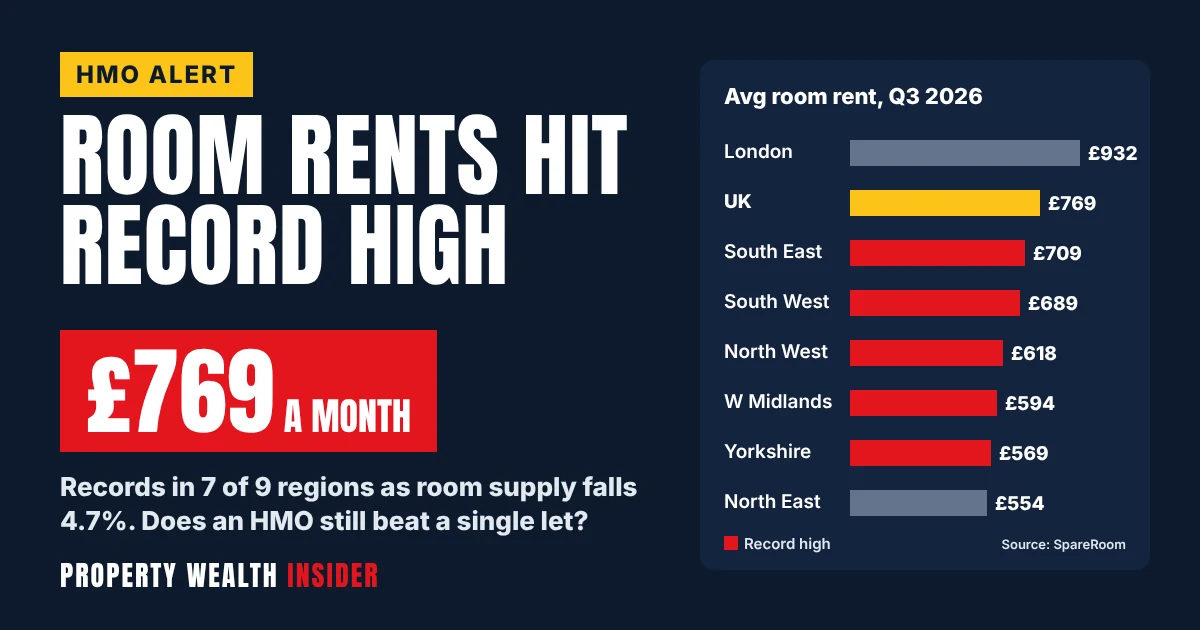
The average room in a UK flatshare now costs £769 a month, the highest SpareRoom has ever recorded. Its Q3 2026 rental index, covering July to September, shows record room rents in seven of the UK’s nine regions while the number of rooms advertised fell 4.7% year on year.
For HMO landlords and rent-to-rent operators that sounds like good news. But a record headline rent is not the same as a record profit. Room rents in this index include bills, and HMOs carry licensing, furnishing, management and void costs that a single let does not.
So the real question is simple: at today’s rents, when does letting by the room actually beat letting the whole house to one household? Our calculator below lets you test your own property. The licensing and tenancy rules below apply in England.
Key facts
- UK average room rent hit a record £769 a month in Q3 2026, up from £762 a year earlier (SpareRoom, rents include bills).
- Room rents hit records in 7 of 9 regions; only Greater London (£932) and North East England (£554) did not.
- UK room supply fell 4.7% year on year, after growth of 8.2% in Q3 2025 and 20.1% in Q3 2024.
- Inner London averaged £1,002, just short of its £1,003 record from Q4 2023, with supply down 7.3%.
- A licence is mandatory in England for an HMO with 5 or more people in 2 or more households; bedrooms for one adult must be at least 6.51 sq m.
- ONS puts the average UK private rent for a whole home at £1,400 a month, up 3.8% in the year to August 2026.
Where room rents hit records
South West England posted the biggest annual rise, up 2.3% to a record £689. The East Midlands (£576, +1.8%), East Anglia (£687, +1.2%) and South East England (£709, +1.2%) also set new highs.
Greater London is still the most expensive region at £932, but that is not a record. North East England was flat at £554, down 0.1%.
| Region | Q3 2026 | Q3 2025 | Change | Record? |
|---|---|---|---|---|
| Greater London | £932 | £926 | +0.6% | No |
| South East England | £709 | £701 | +1.2% | Yes |
| South West England | £689 | £673 | +2.3% | Yes |
| East Anglia | £687 | £679 | +1.2% | Yes |
| North West England | £618 | £614 | +0.6% | Yes |
| West Midlands | £594 | £590 | +0.6% | Yes |
| East Midlands | £576 | £566 | +1.8% | Yes |
| Yorkshire & the Humber | £569 | £564 | +1.0% | Yes |
| North East England | £554 | £554 | -0.1% | No |
| Whole of UK | £769 | £762 | +1.0% | Yes |
By nation, England averaged a record £775 a room. Scotland hit £726 and Northern Ireland £600, both records, with Northern Ireland up 7%. Wales was £593.
Among the big flatshare cities, Belfast (+6.8%) and Exeter (+4.5%) saw the sharpest rises. SpareRoom says demand for rooms in Exeter jumped 79% year on year because of a shortage of on-campus student accommodation. Manchester (-2.1%) and Swansea (-3.6%) went the other way.
The supply squeeze behind the rise
The number of room ads fell 4.7% in the year to Q3 2026, ending a three-year run of growth. A year earlier supply was up 8.2%, and in Q3 2024 it was up 20.1%.
London is tighter still. Inner London supply fell 7.3% and outer London 1.7%. In the WC postcode area, room supply dropped 30.1% while average rent jumped 7.3% to a record £1,464.
SpareRoom director Matt Hutchinson links the fall to the Renters’ Rights Act, which took effect in England on 1 May 2026, and to councils “cracking down on HMOs”. He also argues the ban on rental bidding means asking rents are being set higher from the start. That is SpareRoom’s view, not an official finding.
Read the index correctly: SpareRoom’s figures are mean asking rents, inclusive of bills, from more than 241,000 UK room ads. Rooms under £150 a month are excluded. The index methodology was updated in Q2 2026 and past data recalculated, so compare like with like.
For official context, the ONS Price Index of Private Rents shows whole-home rents rising faster than SpareRoom’s room rents, though the two measure different things. The average UK private rent was £1,400 a month in August 2026, up 3.8% in a year. In England it was £1,459, up 4.0%. The next ONS release is due on 21 October 2026.
Room-by-room vs single let: the maths
ONS puts the average UK rent for a home with four or more bedrooms at £2,080 a month. Five rooms at SpareRoom’s £769 average would bring in £3,845 a month in gross rent. That gap looks huge. It shrinks fast once you pay the bills and the extra costs.
Worked example 1: an average five-bed. Five rooms at £769 give £46,140 a year gross. Take off 5% voids (£2,307), 12% management on what you collect (£5,260), bills of £600 a month (£7,200), a £1,250 five-year licence (£250 a year), £1,000 furnishing and £1,000 other running costs. That leaves about £29,123.
The same house let whole at £2,080, with 3% voids and 10% management, nets about £21,790. Room-by-room wins by roughly £7,333 a year. Your break-even room rent is about £623. Below that, the single let pays more for less work.
Worked example 2: a cheaper region. At North East England’s £554 average, five rooms net about £18,339 on the same costs. If a whole-house let in that area fetched £1,500, it would net about £15,714. The HMO still wins, but only by around £2,625 a year, before you count the extra hours, licensing risk and higher tenant turnover.
The costs in both examples are illustrative assumptions, not market data. Plug your own numbers into the calculator below.
Room-by-room vs single let calculator
Guide only, not financial advice. Net income here is before mortgage costs, insurance, safety certificates and tax, which apply to both options. Check your council’s actual licence fee and any planning (Article 4) restrictions before converting.
Rent-to-rent operators can use it too. Put the guaranteed rent you pay the owner in the single-let box and set single-let voids and management to 0%. The difference is your margin before your own time and overheads.
HMO licensing and room size rules in England
Gov.uk defines an HMO as a property rented out by at least 3 people who are not from one household but share facilities such as a kitchen or bathroom. Licensing is where the extra costs start.
| Rule (England) | What it says |
|---|---|
| Mandatory licence | Needed if 5 or more people from 2 or more households live there, share a toilet, bathroom or kitchen, and at least one pays rent. |
| Smaller HMOs | Your council may still require a licence under a local scheme. Check before you let. |
| Licence length | Maximum 5 years. You need a separate licence for each HMO. |
| Licence fee | Set by your council. |
| Bedroom, 1 person over 10 | At least 6.51 sq m. |
| Bedroom, 2 people over 10 | At least 10.22 sq m. |
| Bedroom, 1 child under 10 | At least 4.64 sq m. |
| Any room under 4.64 sq m | Cannot be used as sleeping accommodation. |
| Running an unlicensed HMO | Unlimited fine. |
The room sizes are mandatory licence conditions under the Licensing of Houses in Multiple Occupation (Mandatory Conditions of Licences) (England) Regulations 2018. They are a legal floor, and many councils set higher local standards.
Gov.uk also says licence holders must send the council an updated gas safety certificate every year, install and maintain smoke alarms, and show the manager is “fit and proper”. If a box room falls short of 6.51 sq m, take it out of your room count.
What the Renters’ Rights Act changed for room lets
Phase 1 of the Renters’ Rights Act 2025 took effect in England on 1 May 2026. The government’s implementation roadmap says these changes apply to the private rented sector, so they cover room lets as well as whole-house lets:
- Periodic tenancies. Most new and existing private tenancies became assured periodic tenancies. Section 21 no-fault evictions were abolished.
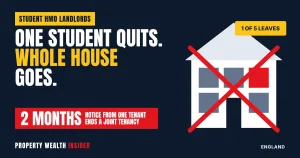
- Two months’ notice. Tenants can end a tenancy by giving two months’ notice. For a room let, that means each tenant can leave on their own timetable, so build realistic voids into your figures.
- Rent rises once a year. Increases must use the revised section 13 procedure with at least two months’ notice.
- No bidding, limited rent in advance. You cannot ask for or accept offers above the advertised rent, or ask for more than one month’s rent in advance.
- No blanket bans. It is illegal to discriminate against renters with children or on benefits. You must also consider pet requests within 28 days.
Still to come: the roadmap says a mandatory private rented sector database, with an annual landlord fee, will start rolling out from late 2026. It expects membership of a new landlord ombudsman to become mandatory in 2028. Both are extra costs that haven’t been priced yet, and an HMO landlord’s room-let margin will need to absorb them.
What to do now: step by step
- Price against your own street, not the national average. Check live room ads within a mile and compare them with your region’s figure in the table above.
- Measure every bedroom. Anything under 6.51 sq m cannot be let to one adult in a licensed HMO. Rooms for couples need 10.22 sq m.
- Call your council’s licensing team. Ask if mandatory, additional or selective licensing applies, what the fee is, and whether planning rules restrict HMOs on your street.
- Cost bills honestly. Get real energy, water and broadband quotes for full occupancy. Because room rents include bills, bills are the biggest swing factor in the sums.
- Run the calculator twice. First use today’s rents, then cut room rent by 10% and add 5 points to voids. If the HMO still wins, the case is robust.
- Set rents right first time. With bidding banned and rises limited to once a year, your advertised rent is the rent you’ll get for at least 12 months.
- Every bedroom measured against 6.51 sq m (single) and 10.22 sq m (double)
- Council confirmed which licence applies and the fee
- Planning position checked before converting a family home
- Annual gas safety certificate ready to send to the council
- Smoke alarms installed and tested
- Bills quoted for full occupancy, not current use
- Room rents benchmarked against local live ads
- Tenancy paperwork updated for assured periodic tenancies
- Rent review process set up for once-a-year section 13 notices
FAQ
What is the average room rent in the UK?
According to SpareRoom’s Q3 2026 index, the UK average was £769 a month, including bills. That is a record, up 1.0% on Q3 2025. In England it was £775.
Is an HMO more profitable than a single let?
Often, but not always. On our five-bed example at the UK average room rent, letting by the room netted about £7,300 a year more. In cheaper areas, or with high bills and licence fees, the gap can shrink to almost nothing.
Do I need an HMO licence for 4 tenants?
Mandatory licensing in England starts at 5 or more people in 2 or more households. However, your council may run an additional licensing scheme that covers smaller HMOs, so check locally.
What is the minimum bedroom size in an HMO?
In a licensed HMO in England, a room for one person over 10 must be at least 6.51 sq m, and for two people over 10 at least 10.22 sq m. No room under 4.64 sq m can be used for sleeping.
Can HMO tenants still sign fixed-term tenancies in England?
Not for most private lets. Since 1 May 2026, most private tenancies in England have been assured periodic tenancies, and tenants can leave with two months’ notice.
- SpareRoom: UK quarterly rental index Q3 2026
- SpareRoom: London room rent surpasses £1K (Q3 2026)
- ONS: Private rent and house prices, UK: September 2026
- GOV.UK: House in multiple occupation licence
- legislation.gov.uk: Licensing of HMOs (Prescribed Description) (England) Order 2018, article 4
- legislation.gov.uk: Licensing of HMOs (Mandatory Conditions of Licences) (England) Regulations 2018
- GOV.UK: Implementing the Renters’ Rights Act 2025 roadmap
This article is news and general guidance only, not financial, legal or tax advice.