Welsh Flats Safety Shake-Up: Is Your Block on the New Register?
Welsh landlords and agents who manage flats now know which councils are likely to police the new building safety regime. The Welsh Government wants Flintshire County Council to be the building safety authority for North Wales and Vale of Glamorgan Council to take the role for South Wales. Its consultation on the plan closes on Friday 16 October 2026.
Mid and West Wales has no proposed council yet. Propertymark, the agents’ professional body, has named Carmarthenshire as its pick. It has also told ministers that managing and letting agents need a recognised role and clear guidance under the new rules.
This matters because the Building Safety (Wales) Act 2026 covers much more than tower blocks. It applies to almost any building in Wales with two or more homes in it, including small converted blocks over shops. It also covers certain HMOs. Most duties are not in force yet, so now is the time to get ready.
Key facts
- The Act covers buildings in Wales with at least 2 residential units, which it splits into 3 categories. Certain HMOs are covered for fire safety.
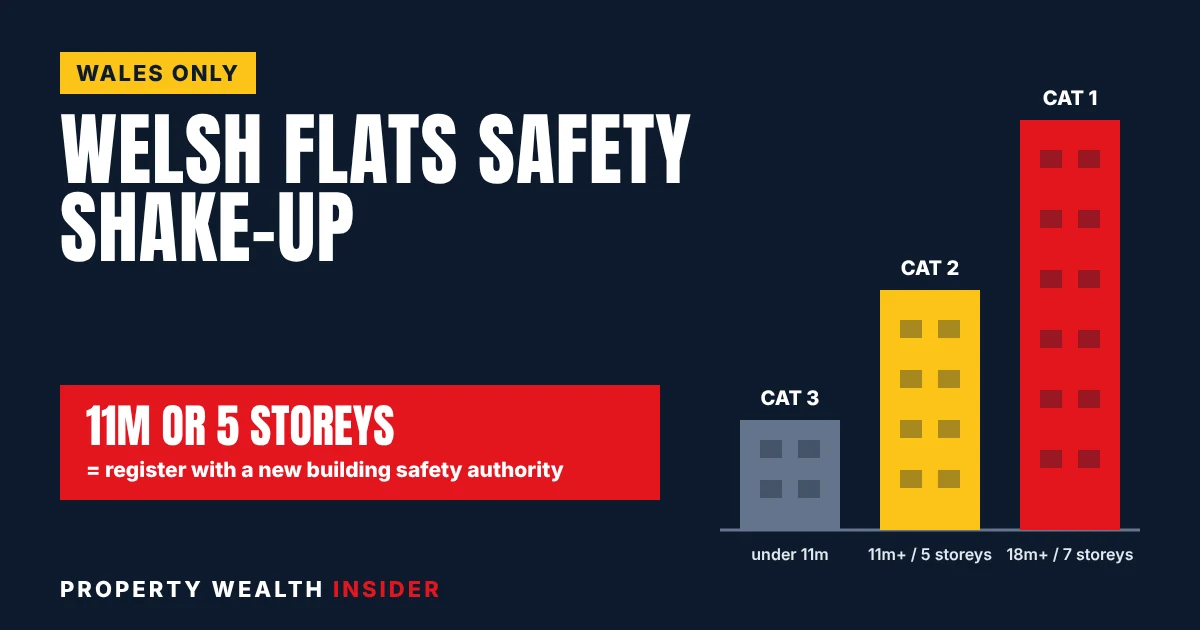
- Category 1 and category 2 buildings, meaning those at least 11 metres tall or with at least 5 storeys, will have to be registered with a building safety authority.
- The proposed building safety authorities are Flintshire (North Wales) and Vale of Glamorgan (South Wales). Mid and West Wales is still open.
- The designation consultation runs from 10 August to 16 October 2026.
- The Act received Royal Assent on 27 April 2026. Only definitions and general sections are in force. Landlords’ duties start on dates not yet set.
- Fixed penalties for failing to register will be capped at £10,000. Running an unregistered building can also lead to up to 2 years in prison.
The three regions and the proposed councils
Section 122 of the Act says the Welsh Ministers must name one council in each fire and rescue authority area as its “building safety authority” (BSA). Wales has three of these areas, so there will be three BSAs. Each will cover every council area inside its fire region.
The consultation document says the councils were chosen for their building safety expertise, their capacity and how ready they said they were to take on the role. For Mid and West Wales, ministers are asking consultees which council should do the job.
Propertymark backs both named councils. For Mid and West Wales it suggests Carmarthenshire, pointing to its central location and the fact that the region’s fire and rescue service has its headquarters in Carmarthen. It also supports other councils paying towards the cost when one council does the work for a whole region. The Act allows the regulations to require this.
Which buildings are caught
Under section 2, a “regulated building” is one that is wholly or mainly in Wales and contains at least two residential units. A residential unit can be a flat or house, an HMO, or another unit of living accommodation. Section 6 then sorts each building into one of three categories by height and number of storeys.
| Category | Test (section 6) | Register with BSA? | Typical example |
|---|---|---|---|
| Category 1 | At least 18m tall or at least 7 storeys | Yes | High-rise block of flats |
| Category 2 | Under 18m and under 7 storeys, but at least 11m or at least 5 storeys | Yes | Five or six-storey block |
| Category 3 | Under 11m and under 5 storeys | No | Converted house split into flats, or flats above a shop |
Some buildings are excluded by Schedule 1. They include buildings used solely as care homes, hospitals, schools, prisons or other secure accommodation, or by the armed forces. A mixed-use block with shops below is not excluded. If it has two or more homes, it is in scope.
Rules on measuring height are still being drafted. In a consultation that closed on 7 September 2026, ministers proposed measuring from ground level on the lowest side up to the floor of the top storey. Rooftop plant rooms would be ignored. Commercial floors would not change how height is measured.
Part 2 of the Act brings in separate fire safety duties for “relevant HMOs”, meaning HMOs that do not themselves contain two or more residential units. Section 78 excludes an HMO where the owner or head tenant lives there with their household and no more than two other people.
Checker: is my Welsh building in scope?
Is my Welsh building in scope?
This is a guide only, not legal advice. It is based on sections 2, 6 and 78 and Schedule 1 of the Building Safety (Wales) Act 2026 and the August 2026 consultation. Building safety authority designations are proposals until regulations are made, and the rules on measuring height are still being consulted on. Most duties are not yet in force.
What duties apply, and when
The duties fall on each “accountable person” (section 8). That is usually whoever owns the common parts or is legally responsible for repairing them, such as a freeholder or a right to manage company. Where a building has more than one accountable person, the one responsible for the external structure is the “principal accountable person” (section 9). A landlord who owns one flat on a long lease is not normally an accountable person.
| Duty (when commenced) | Cat 1 | Cat 2 | Cat 3 |
|---|---|---|---|
| Fire risk assessment by a competent person, reviewed at least every 12 months (ss.29-32) | Yes | Yes | Yes |
| Take all reasonable steps to manage fire risks, with written records (s.33) | Yes | Yes | Yes |
| Structural risk assessment and management (ss.34-35) | Yes | Yes | No |
| Register with the building safety authority and report changes within 14 days (ss.19-21) | Yes | Yes | No |
| Safety case report, occurrence recording, residents’ engagement strategy, building certificate | Yes | No | No |
| Keep and share building information; handle complaints (details partly left to regulations) | Yes | Yes | Yes |
| Resident and flat owner duties not to create fire risks, and to repair fire-resistance damage (ss.54-56) | Yes | Yes | Yes |
Timing: under section 138, only the overview and definitions (sections 1 to 9 and 13 to 17) and some general sections came into force on 28 April 2026. The duties, registration and penalties all start on dates the Welsh Ministers will set by order. Until then, the Regulatory Reform (Fire Safety) Order 2005 still applies to the common parts of blocks.
Plan your fire risk assessment around the start date. Under Schedule 4, an existing Fire Safety Order assessment made or reviewed in the six months before section 29 starts will count under the new Act. A new assessment is then due within 12 months of that earlier one. Without one, the first assessment is due within six months.
What it means for letting and managing agents
The Act puts its legal duties on accountable persons, not agents. In practice, though, agents will do much of the work: booking assessments, keeping records, dealing with residents and handling access. Propertymark is asking the regulations and the new authorities to:
- recognise agents as a key link between building owners, accountable persons, leaseholders and residents
- involve agents when drawing up guidance, processes and communications
- set out agents’ responsibilities, reporting requirements and how building safety information should be shared
- give agents easy ways to ask for advice and send information to each authority
For HMOs, agents are directly in the frame. Section 79 makes any “person managing” a relevant HMO a duty holder, and that includes an owner’s or lessee’s agent. Anyone with a contract covering repair, maintenance or safety is a duty holder for matters within that contract.
Section 74 will also change paperwork for leasehold flats. Written demands to tenants must include building safety information. That means the names and contact details of the principal accountable person and the BSA, plus a UK address for serving notices. If a demand leaves this out, the service and administration charges in it are not due until the information is given.
Worked example: a managing agent sends a Swansea leaseholder a £1,400 half-yearly service charge demand once section 74 is in force, but leaves out the building safety details. The £1,400 is treated as not due until the information is supplied. That delays cash flow for the whole block budget.
Penalties, with £ examples
Once section 19 is in force, the principal accountable person for an occupied category 1 or 2 building commits an offence if the building is not registered. On indictment the maximum is a fine, up to two years in prison, or both. Section 110 lets the BSA issue a fixed penalty instead. The amount will be set in regulations, but it cannot be more than four times level 4 on the standard scale.
| Scenario | Rule | Maximum exposure |
|---|---|---|
| Fixed penalty for an unregistered 6-storey Cardiff block | Cap of 4 x level 4 (£2,500) | £10,000 |
| Still unregistered 30 days after conviction | Level 1 (£200) per day | £6,000 on top of the original penalty |
| Same block, 90 days after conviction | £200 x 90 | £18,000 in daily fines |
Section 107 creates a broader offence for any accountable person or HMO duty holder whose breach puts people at significant risk of death or serious injury. The maximum is two years in prison. There is a defence for anyone who took all reasonable steps. Paying a competent fire risk assessor is cheap protection by comparison.
Wales vs England
Landlords with flats on both sides of the border face two different systems. The Welsh net catches far more buildings.
| Wales: Building Safety (Wales) Act 2026 | England: Building Safety Act 2022 (Part 4) | |
|---|---|---|
| Buildings that must register | Category 1 and 2: at least 11m or 5 storeys, with 2 or more residential units | Higher-risk buildings: at least 18m or 7 storeys, with 2 or more residential units |
| Low-rise blocks | Category 3, with fire safety duties under the Act | Not higher-risk buildings under Part 4 |
| Regulator for registration | One designated council per fire and rescue area | The Building Safety Regulator |
| Registration offence in force? | Not yet. The date will be set by order | Yes, since 1 October 2023 |
| Max sentence for an occupied but unregistered building | 2 years on indictment | 2 years on indictment |
What to do now
- Respond by 16 October 2026 if you have a view on the councils. You can reply online or email buildingsafety@gov.wales, quoting WG54868.
- Categorise every building you own or manage using the checker above. Measure height and count storeys properly.
- Identify the accountable persons. Check who owns or must repair the common parts and the external structure under each lease.
- Review your fire risk assessment and check your assessor is competent. Aim to have a current assessment ready for when section 29 starts.
- Gather the registration data now for category 1 and 2 blocks: address, height, storeys, principal accountable person and a UK service address.
- Update management agreements so it is clear who does what, who keeps records and who talks to the BSA.
- Building category confirmed (1, 2 or 3), with height and storey evidence on file
- Accountable person and principal accountable person named for each block
- Current fire risk assessment by a competent person, with its date logged
- Written record of fire safety measures and the steps taken
- Contact details ready for building safety information on demands
- HMOs checked against the “relevant HMO” test
- Agency terms updated to cover building safety tasks
- Diary note to watch for commencement orders and the final BSA regulations
FAQs
Does the Building Safety (Wales) Act apply to my converted flats?
Yes, if the building has at least two residential units. A house converted into two or more flats, under 11m and under five storeys, is a category 3 building. It will have fire safety duties but no registration.
When do I need to register my building in Wales?
Not yet. Registration of category 1 and 2 buildings starts on a date the Welsh Ministers will set by order. The registration process and any fee will also be set out in regulations.
Who is the building safety authority for Cardiff?
Cardiff is in the South Wales fire and rescue area, where Vale of Glamorgan Council is the proposed authority. This is not final until regulations are made after the consultation.
Am I an accountable person if I own a buy-to-let flat?
Usually not if you hold a long lease of one flat. Accountable persons are normally those who own the common parts or are legally obliged to repair them. You will, however, have duties as a flat owner, such as not creating fire spread risks and repairing fire-resistance damage.
Does the Welsh Act cover HMOs?
Yes. Part 2 creates fire safety duties for “relevant HMOs”, including a fire risk assessment by a competent person. Duty holders can include managing agents. Small owner-occupied HMOs with no more than two other occupiers are excluded.
- Building Safety (Wales) Act 2026 – legislation.gov.uk
- Building Safety (Wales) Act 2026 – law.gov.wales
- Regulations for designating Building Safety Authorities – Welsh Government consultation
- Consultation document (HTML) – Welsh Government
- Implementing the Building Safety (Wales) Act 2026 – Welsh Government consultation
- Building safety programme – GOV.WALES
- Find your local fire and rescue service – GOV.WALES
- Agent voice is vital for new regional building safety regime – Propertymark
- Building Safety Act 2022, section 65 – legislation.gov.uk
- Building Safety Act 2022, section 77 – legislation.gov.uk
- Sentencing Act 2020, section 122 (standard scale of fines) – legislation.gov.uk
This article is news and general guidance only. It is not financial, legal or tax advice.