3x deposit penalty: why your PI may not be as faulty as you fear
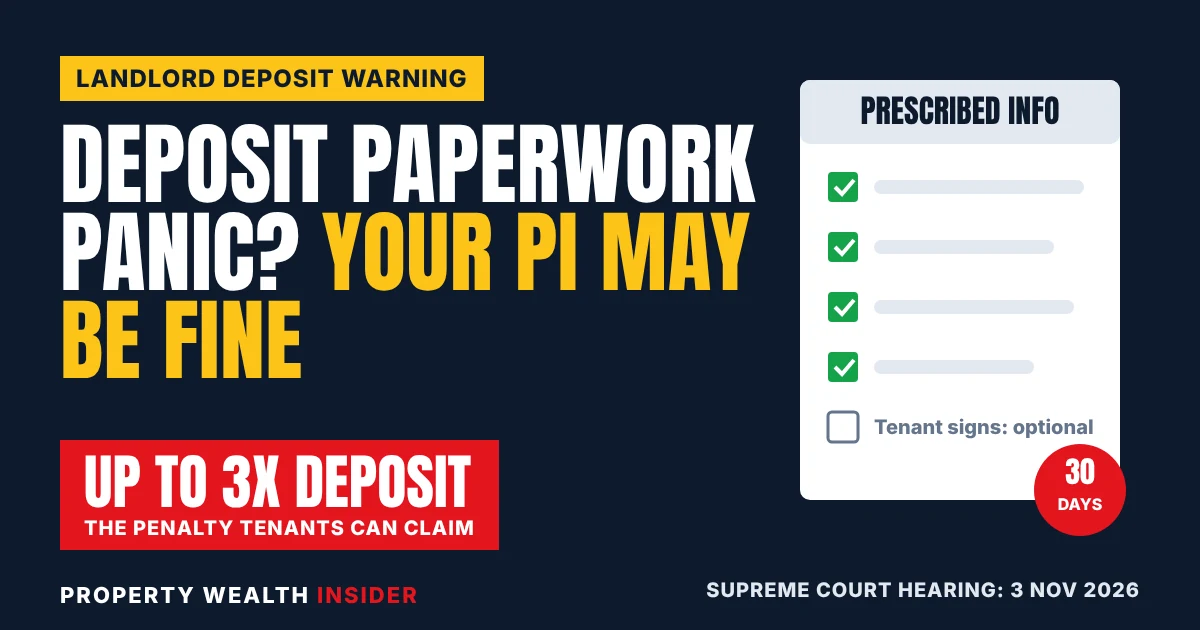
Landlords and letting agents are being told their deposit paperwork is fatally flawed far more often than the law supports. A leading housing solicitor has warned that claims of “defective” prescribed information, invalid notices and doomed possession cases are frequently overstated, and the Court of Appeal’s recent rulings back that up.
It matters because the stakes are real. A tenant who proves the deposit rules were broken can win between 1x and 3x the deposit, and since 1 May 2026 a deposit failure in England can stop a court making a possession order on most grounds.
The next big moment is 3 November 2026, when the Supreme Court hears Lowe v Charterhouse, a case about how strictly the paperwork must be followed. This guide covers what the law in England actually requires, what the courts have said, and how to work out your own exposure.
Key facts
- Deposits must be protected, and prescribed information (PI) given, within 30 days of receiving the money (Housing Act 2004, s.213).
- If a court finds a breach it must award the tenant not less than 1x and not more than 3x the deposit (s.214(4)).
- From 1 May 2026 in England, a court can only make a possession order if the deposit is protected and PI has been given, except on Grounds 7A and 14 (new s.215).
- The tenant must be given the opportunity to sign the PI; whether they actually sign does not matter (2007 Order, art. 2(1)(g)(vii)).
- Deposit cap in England: 5 weeks’ rent, or 6 weeks’ where annual rent is £50,000 or more (Tenant Fees Act 2019).
- The Supreme Court hears Lowe v Charterhouse (UKSC/2025/0143) on 3 November 2026.
What the law actually requires
Under section 213 of the Housing Act 2004, a landlord who takes a money deposit for an assured tenancy has two duties. First, meet the “initial requirements” of an authorised scheme within 30 days, starting with the day the deposit is received. Second, within the same 30 days, give the tenant (and anyone who paid the deposit on their behalf) the prescribed information.
The PI must be given “in the prescribed form or in a form substantially to the same effect”. The content is set by article 2 of the Housing (Tenancy Deposits) (Prescribed Information) Order 2007. No single official template has to be used.
| Article 2 ref | What the tenant must be told |
|---|---|
| (1)(a) | Scheme administrator’s name, address, phone, email and any fax number |
| (1)(b) | The information in the scheme’s leaflet explaining ss.212-215 and Schedule 10 |
| (1)(c)-(e) | Scheme procedures for repaying the deposit, for when either party cannot be contacted, and for disputes |
| (1)(f) | The scheme’s dispute resolution facilities (no need to go to court) |
| (1)(g)(i)-(ii) | Deposit amount and the property address |
| (1)(g)(iii)-(v) | Contact details for the landlord, the tenant (including end-of-tenancy contact details) and any relevant person |
| (1)(g)(vi) | When all or part of the deposit can be kept, by reference to the tenancy terms |
| (1)(g)(vii) | A landlord-signed certificate that the (g) details are accurate to the best of their knowledge and belief, and that the tenant has had the opportunity to sign to confirm them |
Where an agent protected the deposit, references to “the landlord” in the certificate can be read as the agent (article 2(3)). The certification wording is the bit most often attacked, so it is worth reading the exact text above carefully.
Five deposit myths that cost landlords money
These are the claims landlords most often hear, checked against the legislation and the case law.
- “The tenant never signed the PI, so it is invalid.” Wrong. Article 2(1)(g)(vii)(bb) only requires that the landlord gave the tenant the opportunity to sign. A tenant who ignores the form does not make it defective.
- “You did not use the scheme’s template.” The statute accepts any form “substantially to the same effect”. What matters is that every required item is there.
- “It has to be one document.” The Court of Appeal in Lowe confirmed that a certificate can be read together with its covering letter, and the scheme leaflet itself forms part of the information.
- “A company director signed, not the company, so it is void.” Rejected in Northwood (Solihull) Ltd v Fearn: a certificate signed by an authorised person on the company’s behalf was valid.
- “Every renewal needs fresh PI.” Not if the original was done properly. Under section 215B, where PI was given for the original tenancy and the deposit stays in the same scheme, a replacement tenancy between the same landlord and tenant for the same property is treated as compliant.
The real danger zones are not cosmetic errors. They are deposits never protected, PI never given at all, required items missing entirely, and a certificate that nobody signed for the landlord. Those are the gaps worth fixing today.
What the Court of Appeal has decided
Northwood (Solihull) Ltd v Fearn & Ors [2022] EWCA Civ 40. The tenants argued the PI certificate was invalid because the company landlord had not executed it under section 44 of the Companies Act 2006. The court disagreed. Section 212(9) of the 2004 Act treats people acting on the landlord’s behalf as the landlord, and the certificate, signed by an authorised director, gave the tenants all the information required.
Lowe v Governors of Sutton’s Hospital in Charterhouse [2025] EWCA Civ 857, handed down on 10 July 2025. The PI said deductions were governed by “Clause 6” of an “attached” tenancy agreement. Nothing was attached, and the tenant’s agreement had no clause 6; the deposit terms were at clause 5.3. The certificate itself was unsigned, but the covering letter was signed.
Lady Justice Asplin dismissed the tenant’s appeal. A reasonable reader would see the clause number was a mistake and know where to look. The certificate could be read with its signed covering letter. And it was enough that the tenant had the opportunity to check and sign the information; that opportunity did not have to come before the landlord’s own confirmation.
Lowe v Charterhouse: the Supreme Court hearing
The tenant was given permission to appeal on 17 December 2025. According to the Supreme Court case page, the hearing is listed for 3 November 2026 before Lord Reed, Lord Hamblen, Lord Leggatt, Lady Simler and Lord Doherty. Hearing dates can change.
The court will decide two questions: whether the “circumstances for retaining the deposit” item is satisfied by a reference to a clause that is not attached and is wrongly numbered, and whether a signed covering letter satisfies the certificate requirement when the certificate itself is unsigned.
The money involved shows why this matters. The case page records a £3,300 deposit, about 12 years of occupation across 10 successive tenancies, and a claimed penalty of £120,888. Until judgment, the Court of Appeal’s purposive approach is the law. A reversal would make the exact wording of PI far more important, so tidy documents now.
Deposits and possession since 1 May 2026
The Renters’ Rights Act 2025 tenancy reforms took effect in England on 1 May 2026. The government’s roadmap confirms that section 21 “no fault” evictions were abolished and assured periodic tenancies introduced for private renting from that date.
That changed how deposit failures bite. The old rule barred section 21 notices. The new section 215 instead says a court may make a possession order on an assured tenancy only if:
- the deposit is held in an authorised scheme;
- the scheme’s initial requirements have been met, whether or not within the 30 days; and
- the PI has been given in the prescribed form or substantially to the same effect.
Two points stand out. The bar now applies to section 8 grounds such as rent arrears, not just no-fault cases. But late compliance cures the possession problem, though not the penalty. The bar does not apply to Grounds 7A and 14 (the serious offence and anti-social behaviour grounds), or where the deposit has been returned in full (or with agreed deductions), or where a section 214 claim has been decided, withdrawn or settled.
Calculator: penalty exposure, deposit cap and PI checklist
Enter your rent and deposit to check the lawful cap, see the 1x to 3x penalty range, and tick off the PI items you can evidence. It is preloaded with a £1,300 a month example.
Deposit penalty exposure and PI checker
Guide only, for England. The penalty range is set by Housing Act 2004 s.214(4); the actual award within it is for the court. Whether a separate penalty is due for each renewal is disputed and not settled by statute. This is not legal advice.
What to do now: step by step
Worked example. Rent is £1,300 a month, so annual rent is £15,600 and one week’s rent is £300. The maximum deposit is 5 x £300 = £1,500. If that deposit was protected on day 45, the tenant can claim £1,500 to £4,500. If the landlord now needs possession for rent arrears, late protection no longer blocks the order, provided PI has also been given.
Second example. Rent is £4,200 a month (£50,400 a year), so the six-week cap applies: £50,400 / 52 x 6 = £5,815. A breach on that deposit carries a range of £5,815 to £17,446.
- Pull the scheme certificate for every tenancy and confirm the protection date is within 30 days of receipt.
- Find the PI you sent, with proof of delivery (email, portal log or signed receipt).
- Check it against all 14 items in the calculator checklist above.
- Confirm the certificate is signed by the landlord or the agent who protected the deposit.
- Check the “when the deposit can be kept” wording points to the right clause of the current agreement.
- Confirm the PI went to anyone who paid the deposit on the tenant’s behalf.
- If anything is missing, protect the deposit and serve complete PI now, before any possession claim.
- Check the deposit does not exceed 5 weeks’ rent (6 weeks at £50,000+ a year); refund any excess.
- If a tenant threatens a s.214 claim, get advice before conceding. Many “defects” do not survive the case law.
- Diary the Supreme Court hearing on 3 November 2026 and review your templates once judgment is out.
Wales and Scotland: this guide covers England. Wales runs its own deposit rules for occupation contracts under the Renting Homes (Wales) Act 2016, and Scotland has separate schemes and legislation.
FAQ
Does the tenant have to sign the prescribed information?
No. The landlord must give the tenant the opportunity to sign to confirm the details. If the tenant chooses not to sign, the PI is not invalid for that reason.
How much can a tenant claim if the deposit was not protected?
The court must order at least the amount of the deposit and no more than three times it, payable within 14 days. It can also order the deposit to be repaid or paid into a custodial scheme. Claims can be made after the tenancy has ended.
Can I evict a tenant if I protected the deposit late?
In England since 1 May 2026, yes, as long as the deposit is now protected and full PI has been given. The new section 215 accepts the scheme requirements being met outside the 30 days. Late protection still exposes you to the 1x to 3x penalty.
Do I need to re-serve prescribed information when a tenancy is renewed?
Not if PI was properly given for the original tenancy, the deposit stays in the same scheme, and the landlord, tenant and property are the same. Section 215B treats the replacement tenancy as compliant. Many landlords re-serve anyway as a belt-and-braces step.
What is the maximum deposit a landlord can take in England?
Five weeks’ rent where annual rent is under £50,000, and six weeks’ rent where it is £50,000 or more. One week’s rent is the annual rent divided by 52.
When will the Supreme Court decide Lowe v Charterhouse?
The hearing is listed for 3 November 2026. Judgment usually follows some weeks or months later; there is no published date yet.
Sources
- Housing Act 2004, s.213 (legislation.gov.uk)
- Housing Act 2004, s.214 (legislation.gov.uk)
- Housing Act 2004, s.215 as substituted by the Renters’ Rights Act 2025 (legislation.gov.uk)
- Housing Act 2004, s.215B (legislation.gov.uk)
- Housing (Tenancy Deposits) (Prescribed Information) Order 2007, art. 2 (legislation.gov.uk)
- Tenant Fees Act 2019, Schedule 1 (legislation.gov.uk)
- Tenancy deposit protection (GOV.UK)
- Renters’ Rights Act 2025 implementation roadmap (GOV.UK)
- Lowe v Governors of Sutton’s Hospital in Charterhouse, UKSC/2025/0143 (Supreme Court)
- Lowe v Charterhouse [2025] EWCA Civ 857 (National Archives)
- Northwood (Solihull) Ltd v Fearn & Ors [2022] EWCA Civ 40 (National Archives)
This article is news and general guidance only. It is not financial, legal or tax advice.