Warm Homes Grant: One Rental Free, Then Landlords Pay 50%
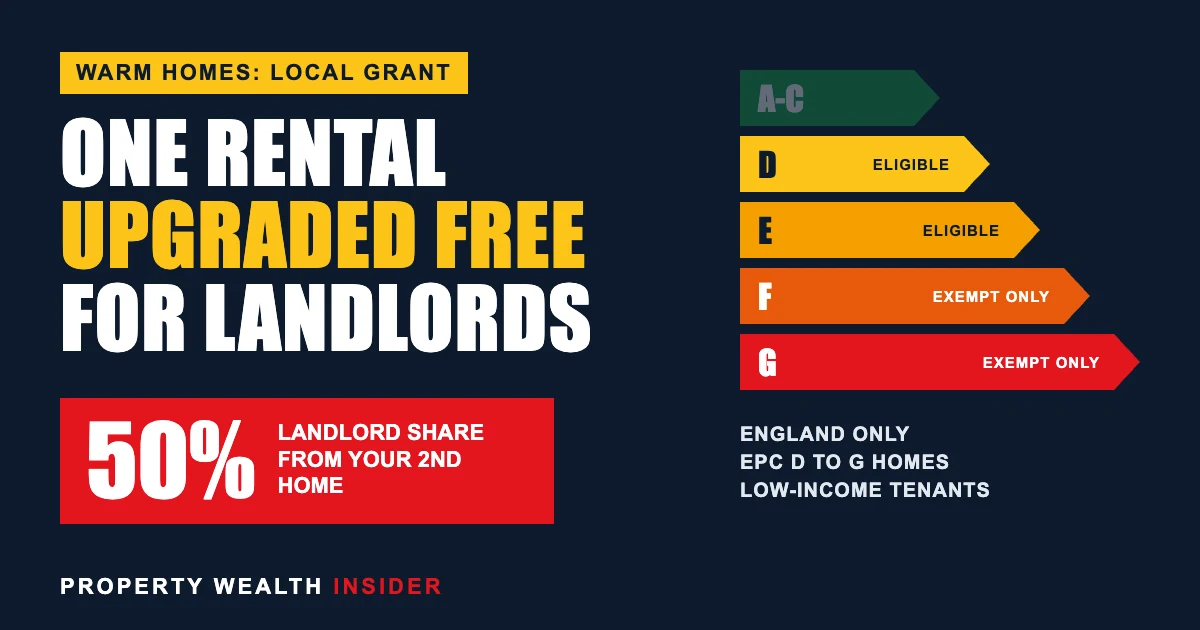
Landlords in England can get one rental home upgraded with insulation, solar panels or a heat pump at no cost through the Warm Homes: Local Grant, as long as the tenant household is on a low income. From the second property onwards, the landlord pays half.
With winter approaching, more owners and landlords are looking at the scheme. The rules for landlords are stricter than most guides suggest, though, and they connect directly to the government’s proposed EPC C target for 2030.
We checked the scheme against the government’s own policy guidance for councils. Below you’ll find who qualifies, what you’ll pay and how the grant counts towards the proposed £10,000 EPC spending cap. There’s also a checker to run your own numbers.
Key facts
- England only, for privately owned homes (owner-occupied or privately rented) rated EPC D to G. Homes rated A to C are excluded.
- The household qualifies with a gross income of £36,000 or less, a listed means-tested benefit, or a home in one of the most income-deprived postcodes. In a rental, the tenant’s household is the one that must qualify.
- Each landlord gets one rental fully funded. Every property after that needs a 50% landlord contribution.
- Cost caps are £16,600 for energy performance upgrades plus £16,600 for low-carbon heating per home, averaged across each council project.
- Rentals rated F or G only qualify if they already have a registered MEES exemption. The grant can’t be used to bring a home up to the legal minimum of E.
- £500m has been allocated, with delivery running until 31 March 2028.
What the grant pays for
The Warm Homes: Local Grant is funded by the Department for Energy Security and Net Zero (DESNZ) and run by local councils. It replaced earlier council schemes such as the Home Upgrade Grant. Funding went to 74 projects covering 271 councils, which is over 97% of eligible councils in England.
It pays for upgrades from two separate pots. The first covers energy performance measures: loft, cavity, solid wall and underfloor insulation, draught-proofing, double or triple glazing, energy-efficient doors, heating controls, solar PV, solar thermal and domestic batteries. The second covers low-carbon heating such as air source heat pumps.
You don’t pick the work. A retrofit assessor surveys the home and the council decides which measures to fund. Solar PV has been the most common so far, making up 38% of measures reported to the end of July 2026. Insulation made up around 24% and batteries 18%.
Who qualifies in a rental: the tenant’s household
The landlord’s own income doesn’t affect eligibility. The DESNZ guidance says funding is for “landlords who have low-income tenants that meet the household eligibility criteria”. The household only needs to meet one of three routes:
- Postcode route: the home is in an income decile 1 or 2 area of the Indices of Multiple Deprivation. No income check is needed. From the second year of delivery, new applications must use the postcode list based on the 2025 index.
- Benefits route: someone in the household gets Housing Benefit, income-based JSA, income-related ESA, Income Support, Pension Credit or Universal Credit. A household can also qualify through Route 2 of ECO Flex.
- Income route: gross annual household income of £36,000 or less, or below an “after housing costs” threshold that depends on who lives in the home. The income of every adult counts, except anyone in full-time education.
On top of this, the home itself must be in England, already built and occupied (not a new build), and rated EPC D, E, F or G. That means an Energy Efficiency Rating SAP score of 68 or below. Social housing is mostly excluded.
HMO landlords: a shared house with a shared kitchen is usually treated as one home. In bedsit-style HMOs where each room has its own cooking facilities, each tenant only qualifies for their own room. The whole building qualifies only if every room has an eligible resident or the average income across all the households meets the criteria.
Plenty of rentals could meet the property test. The English Housing Survey estimates that 2.41 million privately rented homes in England were rated D to G in 2024, which is 49% of the sector.
What landlords pay: one free, then 50%
The GOV.UK application page only says that a landlord “may need to pay for some of the improvements”. The detail is in the policy guidance DESNZ issues to councils. The scheme fully funds one property per landlord. For the second property and every one after, the landlord must pay 50% of the total cost of works. Tenants never pay anything.
| Per home | First rental: max grant | First rental: you pay | 2nd+ rental: max grant | 2nd+ rental: you pay (at cap) |
|---|---|---|---|---|
| Energy performance (insulation, glazing, solar, batteries) | £16,600 | £0 | £8,300 | £8,300 |
| Low-carbon heating (e.g. heat pump) | £16,600 | £0 | £8,300 | £8,300 |
| Total | £33,200 | £0 | £16,600 | £16,600 |
Some practical points:
- The one free home applies across the whole scheme, not per council. DESNZ keeps a central database of landlords and checks ownership against the title deeds. Councils can’t confirm a fully funded offer until that check is done.
- You can upgrade as many homes as you like. Unlike the old Home Upgrade Grant, there’s no limit based on portfolio size. You do pay 50% from the second home onwards and must stay under the £315,000 subsidy limit over three years.
- You must sign a landlord declaration saying you don’t intend to raise the rent as a direct result of the funded upgrades, and agree to take part in DESNZ surveys.
- The caps are averages, not fixed limits. Councils must meet them on average across a project, so a costly job may still go ahead while another may be cut back. DESNZ also says it may change the private rented rules, or remove rentals from the scheme, at any time.
Worked examples in £
Example 1: your first rental. A terrace rated EPC E, with a tenant on Universal Credit. The survey recommends loft and cavity insulation plus solar PV, costing £9,000. This is your first property under the scheme, so the grant covers all £9,000 and you pay £0.
Example 2: your second rental, fabric work plus a heat pump. A semi rated EPC D, where the tenant household earns £28,000 a year. The works are £12,000 of insulation and solar plus a £14,000 heat pump, £26,000 in total. You pay 50% of each pot: £6,000 plus £7,000, so £13,000. The grant pays the other £13,000. Both halves are under the £8,300 limit per pot.
Example 3: your second rental, with a bigger fabric job. Solid wall insulation and glazing cost £20,000. Half of that is £10,000, but the grant for the energy performance pot stops at £8,300. If the council works to that limit, you pay £11,700. Get the figures in writing before you sign.
Example 4: an F-rated flat with no exemption. This home doesn’t qualify. Bringing it up to E is already a legal requirement, and the grant can’t be used for that. You need to reach E yourself (spending up to the £3,500 cap) or register a valid exemption first.
Eligibility and landlord cost checker
Enter the details for the home and the estimated cost of works. The checker uses the published DESNZ rules to show whether the home is likely to qualify, how much grant to expect and what you’d pay.
Warm Homes Grant eligibility and landlord cost checker
This is a guide only, not advice. It uses the Warm Homes: Local Grant policy guidance for councils (updated June 2026). Your council decides which measures to fund and how much, and caps are applied as averages, so actual offers can differ. The £10,000 EPC C cap is a proposal, not yet law.
How it fits with EPC E now and EPC C in 2030
The current law. Under the Energy Efficiency (Private Rented Property) (England and Wales) Regulations 2015, a privately rented home in England or Wales must be rated at least EPC E, unless a valid exemption is registered. You don’t have to spend more than £3,500 including VAT to get there. Penalties can reach £5,000 per property.
What’s confirmed but not yet law. In January 2026 the government said all private tenancies in England and Wales must meet a new standard equivalent to EPC C by 1 October 2030. Landlords would have to spend up to £10,000 per property. Spending on qualifying measures installed since 1 October 2025 would count towards that cap.
The government response says these changes are “subject to Parliamentary approval”. Regulations are planned to take effect in 2027, after new primary legislation.
The link to the grant matters. According to that response, third-party funding a landlord receives, including from government schemes such as the Warm Homes: Local Grant, can count towards the £10,000 cap. Boiler Upgrade Scheme money is the exception.
In Example 1, that means £9,000 of grant-funded work could cover 90% of your expected 2030 obligation at no cost to you, if it goes through as planned. Grant funding runs out on 31 March 2028, and councils have fixed budgets.
What to do now: step by step
- List your D to G homes. Check each property on the official EPC register. Ignore anything rated A to C.
- Choose your free property. You only get one fully funded rental, so use it where the works would cost the most and the tenant clearly qualifies.
- Talk to your tenants. Their household income, benefits or postcode decide eligibility, and they’ll need to provide evidence. Explain that the works cost them nothing.
- Apply through GOV.UK. Use the Warm Homes: Local Grant application, or call the helpline on 0800 098 7950. The council usually gets in touch within 10 working days.
- Return the landlord declaration form and have proof of ownership ready. It must match the title deeds.
- Get the offer in writing before work starts, including the grant amount and your contribution. Keep the invoices and the new EPC as evidence for the proposed 2030 cost cap.
- Current EPC for each rental checked (band D to G)
- F/G rentals: exemption registered on the PRS Exemptions Register, or works planned to reach E
- Tenant eligibility route confirmed (income, benefits or postcode)
- Tenant’s consent and evidence gathered
- Title deeds / proof of ownership ready
- Landlord declaration (no rent rise because of the upgrades) signed
- Written offer showing grant and landlord contribution
- Invoices and post-works EPC filed for the proposed £10,000 cap
FAQ
Can landlords get the Warm Homes: Local Grant?
Yes, if the property is in England, rated EPC D to G, and the tenant household meets the income, benefits or postcode test. The first property is fully funded. From the second onwards, you pay 50% of the cost.
Whose income counts for a rented home?
The tenant household’s. The landlord’s income doesn’t matter. All adults in the household count, apart from those in full-time education. Disability benefits such as PIP and Attendance Allowance are left out.
Can I use the grant to get an F-rated rental up to E?
No. F and G rentals only qualify if they already have a registered exemption. The grant can pay for improvements beyond the legal minimum, but not for meeting it.
Can I put the rent up after the upgrades?
Landlords must sign a declaration saying they don’t intend to raise the rent as a direct result of grant-funded upgrades.
Is there a deadline to apply?
The delivery window closes on 31 March 2028. Each council has a fixed budget and can use first come, first served when demand is high, so funding may run out locally sooner.
Does it apply in Wales or Scotland?
No. The Warm Homes: Local Grant is for England only. Wales, Scotland and Northern Ireland run their own schemes.
- GOV.UK: Apply for the Warm Homes: Local Grant to improve a home
- DESNZ: Warm Homes: Local Grant policy guidance for local authorities (updated June 2026)
- DESNZ: Warm Homes: Local Grant statistics, August 2026
- DESNZ: Improving the energy performance of privately rented homes, government response (January 2026)
- GOV.UK: Domestic private rented property minimum energy efficiency standard, landlord guidance
- Energy Efficiency (Private Rented Property) (England and Wales) Regulations 2015
- MHCLG: English Housing Survey 2024 to 2025, energy efficiency annex tables
- Federation of Master Builders: Warm Homes: Local Grant scheme
This article is news and general guidance only. It is not financial, legal or tax advice.