Leaseholders’ defect bills unknown as 86% see charges rise
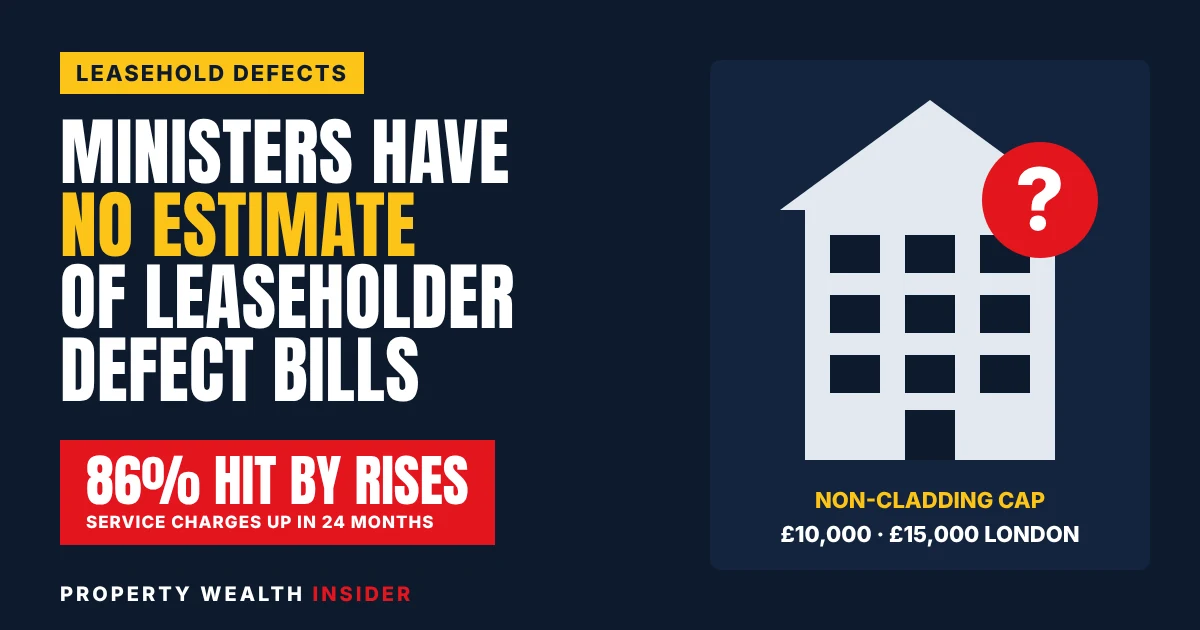
The government has confirmed it has no idea what leaseholders are paying to fix building defects that developers have not signed up to cover. Asked in Parliament how much those bills add up to, ministers said they have made no estimate at all.
The admission lands as new research from Propertymark shows 86% of leaseholders paying a service charge have seen it rise in the past two years, with more than one in four of them hit by increases of over 60%. Agents say leasehold flats are getting harder to sell.
For buy-to-let investors who own flats in taller blocks, this matters twice over. The legal shield against these bills depends on how many properties you owned on 14 February 2022, and many portfolio landlords fall outside it. Here is how the rules work in England, what you could be charged, and what to do now.
Key facts
- The government has made no estimate of the costs leaseholders face for defects outside the Developer Remediation Contract.
- 86% of leaseholders who pay a service charge saw it rise in the past 24 months. Of those, 62% saw rises of more than 21% (Propertymark).
- Cladding costs for qualifying leaseholders are £0. Other defect costs are capped at £10,000 (£15,000 in London) for most flats, payable at no more than one tenth a year.
- Your lease qualifies only if the flat was your main home on 14 February 2022, or you owned no more than 3 UK dwellings in total that day.
- The government plans to raise that limit to 6 properties. This is a proposal, not law.
- These protections apply in England only.
What the minister said
Liberal Democrat MP Gideon Amos asked the Ministry of Housing, Communities and Local Government (MHCLG) what estimate it had made of the costs leaseholders face for defects outside the scope of the Developer Remediation Contract. The written answer came from Florence Eshalomi, Minister of State at MHCLG, whose brief covers homelessness, democracy, communities and faith.
Her answer was that no estimate has been made. She pointed instead to the leaseholder protections in the Building Safety Act 2022, and to Remediation Contribution Orders and other redress routes for pursuing developers, landlords and associated companies.
The gap is real. The Developer Remediation Contract makes signed-up developers fix life-critical fire-safety defects in buildings of 11 metres and over that they built or refurbished in England in the 30 years before 5 April 2022. It does not cover buildings under 11 metres. It does not repay past interim safety costs, rises in insurance premiums or compensation to leaseholders. And it does not help where the developer never signed or no longer exists.
Anything outside the contract falls back on the building owner. The owner can then try to pass costs to leaseholders through the service charge, within the limits of the Act.
Service charges: what Propertymark found
Propertymark’s report, Leasehold: still a life sentence?, surveyed more than 1,200 leaseholders and over 200 Propertymark member agents between February and November 2025. It was run with the National Leasehold Campaign and the Leasehold Knowledge Partnership.
Rising bills are also hitting resale. 58% of leaseholders said service charges had a large impact on their ability to sell, and 53% said the same of ground rent. Over 78% of agents had at least one leasehold property become unsellable or come off the market in the past 24 months.
For landlords this is an exit problem as much as a cash-flow one. A flat with an open remediation bill, or a lease that has lost its protections, can be very hard to sell or mortgage.
Who qualifies for protection, and why many landlords don’t
The protections in Schedule 8 of the Building Safety Act 2022 apply only to a “relevant building”. Under section 117, that is a self-contained building in England with at least two dwellings that is at least 11 metres high or has at least 5 storeys. Blocks that leaseholders have bought through collective enfranchisement or a right of first refusal, leaseholder-owned freeholds and commonhold are excluded.
Within such a building, the strongest protection goes to a “qualifying lease”. Under section 119, the lease must:
- be a long lease (over 21 years) of a single dwelling, with a service charge payable;
- have been granted before 14 February 2022; and
- at the start of 14 February 2022, meet one test: the flat was the tenant’s only or principal home, or the tenant owned no other UK dwelling, or the tenant owned no more than two UK dwellings apart from this one.
In plain terms, a landlord who owned this flat plus up to two other UK homes on 14 February 2022 (three in total) qualifies. Someone with a fourth property that day does not, unless the flat was their main home. “Own” here means a freehold or a long lease of more than 21 years.
Portfolio landlords: if you owned four or more UK dwellings on 14 February 2022, your buy-to-let flats in affected blocks are likely to be non-qualifying. You then lose the £0 cladding protection and the caps, unless the building owner was the developer or linked to it. On 27 October 2026 the government said it plans to raise the threshold to six properties, mainly for non-cladding costs. That is not law yet: no commencement date has been set and the details are still to come.
Status attaches to the lease, not the person. According to government guidance, a qualifying lease keeps its protection when it is sold. The reverse also holds: a buyer since 2022 can inherit a non-qualifying lease from a portfolio landlord. The government says it is “exploring” a fix for main-home buyers in that position.
The caps and worked examples
Qualifying leaseholders pay nothing towards unsafe cladding. Nor do they pay for non-cladding defects if the building owner was the developer or linked to it on 14 February 2022, or if the landlord group passes the net-worth test (worth more than £2 million for each relevant building it holds). In every other case, non-cladding costs are capped based on the lease’s value on 14 February 2022.
| Lease value on 14 Feb 2022 | Greater London: total cap | Rest of England: total cap | Most you can be charged in any 12 months |
|---|---|---|---|
| Under £175,000 | £0 | £0 | £0 |
| £175,000 to £324,999 | £0 | £10,000 | £0 / £1,000 |
| £325,000 to £1m | £15,000 | £10,000 | £1,500 / £1,000 |
| Over £1m up to £2m | £50,000 | £50,000 | £5,000 |
| Over £2m | £100,000 | £100,000 | £10,000 |
Under paragraph 7 of Schedule 8, you can be charged at most one tenth of the cap in any 12-month period, which spreads a full cap over at least 10 years. What you have already paid towards remediation or interim measures, such as a waking watch, since 28 June 2017 counts towards the cap. For shared owners, the cap is scaled to their equity share. The table follows the government’s contribution caps guidance.
Example 1: qualifying landlord in Manchester
Sam owned three UK properties on 14 February 2022, including a Manchester flat worth £240,000 in a 6-storey block. The freeholder now wants £18,000 from each flat for fire-stopping defects. Sam paid £2,500 for a waking watch in 2021. The cap is £10,000, so Sam can be asked for no more than £7,500 more, at no more than £1,000 a year. The other £10,500 is the building owner’s problem.
Example 2: portfolio landlord in London
Priya owned five UK properties on 14 February 2022. One is a £450,000 London flat she lets out. The lease is non-qualifying, so the £15,000 cap does not apply. Unless the building owner was the developer or linked to it, the lease decides what she can be charged, subject to the usual reasonableness rules on service charges. A £22,000 share of non-cladding works could fall on her in full. If the six-property proposal becomes law, she may come within the protections, but only on the terms finally set out.
Example 3: low-value flat
A qualifying flat in Leeds worth £160,000 in February 2022 is below the £175,000 threshold. The leaseholder’s cap is £0, whatever the defect.
Leaseholder protection checker
Enter the facts as they stood on 14 February 2022 to see roughly whether the lease qualifies and the most you could be asked to pay for one building.
Leaseholder protection checker (England)
Guide only, not legal advice. It simplifies Schedule 8 of the Building Safety Act 2022 (England only). It ignores lease-extension rules, superior leases, how jointly or company-owned property is counted, and the proposed six-property change, which is not yet law. Ask your building owner for the landlord’s certificate, and take advice before you pay or refuse a bill.
Making someone else pay: tribunal orders
The minister pointed to the Act’s enforcement tools. Both are decided by the First-tier Tribunal (Property Chamber).
- Remediation Order (section 123): makes the landlord responsible for repairs fix specified relevant defects by a set date. Any “interested person” can apply, including a leaseholder, the council, the fire and rescue authority or the Building Safety Regulator.
- Remediation Contribution Order (section 124): makes a company or partnership pay towards the costs where the tribunal thinks it “just and equitable”. The target can be the landlord, the landlord at 14 February 2022, the developer or an associated company. Covered costs include works, expert reports and decant accommodation.
An RCO is the main route when a non-qualifying landlord is facing a bill. It lets you reach a developer’s group company, or the freeholder’s parent company, even where the developer has not signed the government contract. These cases cost money and take time, so leaseholders in the same block often apply together.
What to do now
- Step 1: Work out your position on 14 February 2022. List every UK dwelling you owned that day (freehold or a lease of over 21 years) and note whether each flat was your main home.
- Step 2: Complete the leaseholder deed of certificate for each flat in an 11m+ or 5+ storey block and send it to the building owner. It records whether the lease qualifies and its value, and lenders use it too.
- Step 3: Ask for the landlord’s certificate. Government guidance advises against paying historical remediation costs until the owner has met its transparency duties or supplied this certificate.
- Step 4: Split each demand into cladding and non-cladding items, then check it against your cap and the one-tenth annual limit. Include past waking watch and interim costs.
- Step 5: Find out whether the developer has signed the Developer Remediation Contract and whether your building is on its list. If not, ask the managing agent whether an RCO is being considered.
- Step 6: Portfolio landlords should track the Remediation of Unsafe Cladding Bill. If you owned four to six properties, the planned extension could change your position. Think twice before selling at a heavy discount while the details are unclear.
- List of UK dwellings owned on 14 February 2022
- Main-home status of each flat on that date
- Leaseholder deed of certificate sent for each affected flat
- Landlord’s certificate received from the building owner
- Receipts for remediation and waking watch payments since 28 June 2017
- Demand split into cladding and non-cladding costs
- Developer contract status checked
- RCO or Remediation Order option discussed with other leaseholders
FAQ
Do buy-to-let landlords get leaseholder protection for cladding costs?
Yes, if the lease is qualifying: the flat was your main home on 14 February 2022, or you owned no more than three UK dwellings in total that day. Landlords with four or more properties at that date are generally non-qualifying unless the building owner was the developer or linked to it.
What is the maximum a leaseholder pays for non-cladding defects?
For a qualifying lease the cap is £10,000 outside London and £15,000 in Greater London. It rises to £50,000 for leases worth over £1 million and £100,000 over £2 million. Below £175,000 (£325,000 in London) the cap is £0. You can be charged at most a tenth of the cap in any 12 months.
Does the protection pass to a buyer if I sell my flat?
Yes. Qualifying status belongs to the lease and passes to later buyers. A non-qualifying lease also stays non-qualifying when it is sold, though the government says it is looking at this for main-home buyers.
Has the property limit been raised to six?
Not yet. On 27 October 2026 the government announced plans to raise it from three to six alongside the Remediation of Unsafe Cladding Bill. Details and a start date have not been published.
Do these rules apply in Scotland or Wales?
No. The Schedule 8 leaseholder protections and caps cover relevant buildings in England. Scotland, Wales and Northern Ireland have separate arrangements.
- Building Safety Act 2022, Schedule 8 (legislation.gov.uk)
- Building Safety Act 2022, section 119: qualifying leases
- Building Safety Act 2022, section 117: relevant buildings
- Building Safety Act 2022, section 123: remediation orders
- Building Safety Act 2022, section 124: remediation contribution orders
- GOV.UK: Leaseholder contribution caps
- GOV.UK: Remediation costs, what leaseholders do and do not have to pay
- GOV.UK: Leaseholder protections FAQs
- GOV.UK: Developer remediation contract resident factsheet
- GOV.UK: More people protected as government acts to make more homes safe (27 October 2026)
- Propertymark: Leasehold, still a life sentence?
- GOV.UK: Florence Eshalomi MP
This article is news and general guidance only, not financial, legal or tax advice.