36% of Landlords Hike Rents: How to Raise Yours Lawfully
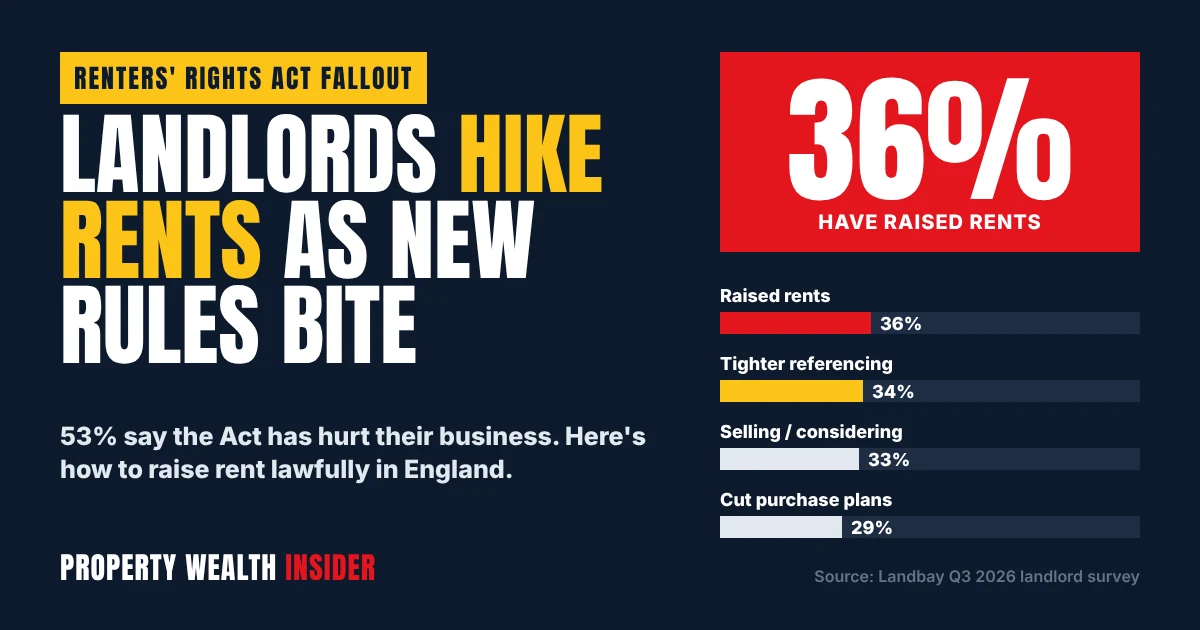
More than a third of landlords say they have already put rents up because of the Renters’ Rights Act, according to buy-to-let lender Landbay’s latest quarterly landlord survey. The poll, sent to more than 2,000 landlords, also found 53% believe the Act has damaged their business since its main tenancy reforms landed in England on 1 May 2026.
The headline number is 36% raising rents. The bigger story for anyone planning to join them is how. Since May, every rent rise on an assured periodic tenancy in England must go through the Section 13 notice process, no more than once a year, and the tenant can ask a tribunal to rule on it if they think you have gone above market rent.
Get the paperwork or the timing wrong and the increase simply does not bite. Push it too far and you risk a tribunal hearing or an empty property. Here is what the survey shows, the rules that now apply, and a planner to work out what your increase is really worth.
Key facts
- 36% of landlords in Landbay’s Q3 survey have raised rents in response to the Renters’ Rights Act; 34% have tightened referencing or affordability checks.
- 53% say the Act has hurt their business (31% somewhat, 22% very negatively); 33% have sold or are considering selling.
- In England, rent can now only rise once a year, using Form 4A, with at least 2 months’ notice, and not in the tenancy’s first 52 weeks.
- Tenants can challenge an above-market rise at the First-tier Tribunal and will never pay more than you proposed.
- The landlord register opens 15 December 2026 (West Midlands first) at £65 per property per year; all regions must be registered by 14 November 2027.
What Landbay’s landlords told it
Landbay asked landlords what they had actually changed because of the Act, not what they feared might happen. Rent rises topped the list, closely followed by stricter tenant checks and decisions to sell up or stop buying.
Asked which single part of the Act had hit, or would hit, them hardest, 32% named the abolition of Section 21 “no fault” evictions. A further 15% pointed to the switch to periodic tenancies and the end of fixed terms, and 14% to the changed possession grounds.
Landbay’s sales and distribution director Rob Stanton said the striking point was that landlords were already acting, by raising rents, changing who they let to and rethinking buying and selling, rather than just voicing worries about the future. He added that the impact would vary with each landlord’s circumstances and portfolio.
The survey also asked about the coming landlord register. Over 90% knew it was on the way, but 17% said they did not fully understand what was required and another 17% did not know the details. Some 65% expect it to push up their costs, 44% expect to spend more time on admin, and 38% said it could lead them to raise rents where they can. Only 12% expect little or no impact.
The rent increase rules since 1 May
The Renters’ Rights Act’s tenancy reforms took effect in England on 1 May 2026, and the rent rules changed with them. These apply to assured periodic tenancies in England only. Wales, Scotland and Northern Ireland have their own systems.
| Rule | What it means in practice |
|---|---|
| How to raise rent | Serve Form 4A (the Section 13 notice). You must use it every time, even if the tenant has already agreed. |
| Minimum notice | At least 2 months before the new rent starts. |
| How often | Once a year. A further rise generally cannot start until 52 weeks after the last one took effect. |
| First year | No increase can start until 52 weeks after the tenancy began. |
| Start date | The new rent must start at the beginning of a rent period (for monthly tenancies, your rent day). |
| Rent review clauses | An increase agreed under a review clause before 1 May 2026 but due after that date does not apply. |
| Tenant challenge | The tenant can apply to the First-tier Tribunal before the new rent starts if they think it is above market rent. |
| Tribunal outcome | The tenant never pays more than you proposed, and does not pay the new rent until the tribunal decides. |
“Market rent” has a plain meaning in the government guidance: the rent you would expect if you relet the property on the open market today. Your current tenant’s rent, the rent on your other properties and your mortgage costs are not the test.
The government has also announced that HMRC’s Valuation Office Agency will eventually take over decisions on rent increase challenges in England. No start date has been set, so for now challenges still go to the First-tier Tribunal.
When can your increase actually start?
Three dates matter: two months after you serve the notice, 52 weeks after the tenancy began (or after the last increase took effect), and your next rent day. The new rent starts on the first rent day that clears both of the first two hurdles.
Example 1: the straightforward case. Your tenant has been in since November 2025 and pays on the 15th of each month. You serve Form 4A today, Monday 2 November 2026. Two months takes you to 2 January 2027, and the 52-week mark passed in mid-November 2026. The first rent day after both is 15 January 2027.
Example 2: too early in the tenancy. The tenancy began on 1 June 2026 and rent is due on the 1st. Serve notice today and two months gets you to 2 January 2027, but the 52-week point is not until 31 May 2027. The earliest start is 1 June 2027. Serving notice now gains you nothing, and you risk the tenant feeling squeezed for seven months.
Watch the post. If you serve by post, leave a few days’ margin so the full two months runs from when the tenant actually receives the notice. Email service is only valid if your tenancy agreement allows it.
Market rent and the tribunal risk
The tribunal decides what it thinks the open market rent is. You can only lose if you ask for more than that: the tenant will not pay above your proposal, and the tribunal’s figure may come in below it.
Example 3: overreaching. You let a two-bed for £1,200 a month and comparable flats nearby are advertised at around £1,275. You serve notice for £1,350. The tenant applies to the tribunal before the start date. They keep paying £1,200 until it decides, and if it agrees market rent is £1,275, that is the most you get. You have lost months of any uplift while waiting, and the relationship with your tenant.
Example 4: the cost of a void. A rise from £1,200 to £1,260 (5%) earns an extra £60 a month, or £720 a year. If it prompts the tenant to leave and the property sits empty for one month, you lose £1,260, which is 21 months of the increase. Add re-letting and referencing costs and the sums get worse.
That is why the best-run rent reviews are built on evidence: three or four comparable listings or recent lets, dated and saved, before you serve anything.
Rent increase planner
Enter your figures to see the uplift, the earliest lawful start date under the two-month and 52-week rules, and whether you are straying above your own market estimate.
Rent increase planner (England)
Guide only, not legal advice. Assumes a monthly assured periodic tenancy in England. Dates assume Form 4A is validly served and received on the date entered; allow extra days for postal service. Check the Form 4A notes before serving.
Rent in advance, bidding and the landlord register
Raising rent is not the only money rule that changed on 1 May. Two others catch landlords out when they re-let, and a third is about to arrive. All three apply in England only.
- Rent in advance: you cannot ask for or accept rent before the tenancy agreement is signed, and after signing you can take no more than one month’s rent up front. Councils can fine up to £5,000 for breaches.
- Rental bidding: adverts must show an asking rent, and you cannot invite or accept offers above it. The penalty is up to £7,000.
- Landlord register: the government’s “Register your rental property” service opens region by region from 15 December 2026. The fee is £65 per property per year, and failing to register can bring a penalty of up to £7,000.
The bidding ban matters for rent setting. When you re-let, your advertised price becomes the ceiling, so set it from proper market evidence rather than hoping applicants will bid it up.
| Region | Registration opens | Deadline |
|---|---|---|
| West Midlands | 15 December 2026 | 14 March 2027 |
| East of England | 15 January 2027 | 14 April 2027 |
| East Midlands | 15 February 2027 | 14 May 2027 |
| South East | 15 March 2027 | 14 June 2027 |
| Yorkshire and Humber | 15 April 2027 | 14 July 2027 |
| North West | 15 May 2027 | 14 August 2027 |
| North East | 15 June 2027 | 14 September 2027 |
| London | 15 July 2027 | 14 October 2027 |
| South West | 15 August 2027 | 14 November 2027 |
At £65 per property, a five-property landlord pays £325 a year. Spread across a £1,200-a-month let, the fee is about £5.42 a month, which is far below the rent rises many landlords are considering. If you plan to pass the cost on, you can only do it through the same once-a-year Section 13 process.
What to do now
- Find your anchor date. Note when each tenancy began and when rent last went up. No new rent can start within 52 weeks of either.
- Gather market evidence. Save three or four comparable listings or recent lets, with dates, addresses and sizes.
- Talk to the tenant first. The government guidance advises discussing a rise before serving notice. It also tells you whether you are about to trigger a move.
- Run the numbers. Use the planner above to compare the extra rent against the cost of a void.
- Serve the current Form 4A from GOV.UK, with a start date on a rent day at least two months away. Keep proof of service.
- Diary your register window. Check your region in the table and budget £65 per property.
- Tenancy start date and last increase date recorded
- Comparable rents saved, dated and sourced
- Latest Form 4A downloaded from GOV.UK
- Start date is on a rent day, at least 2 months after service
- Start date is at least 52 weeks after tenancy start or last increase
- Proof of service kept (and email service allowed by the tenancy, if used)
- No review clause relied on for the increase
- Adverts for new lets show an asking rent, with no offers above it accepted
- No more than one month’s rent taken in advance
- Register window and £65 per property fee in the diary
FAQ
How often can a landlord increase rent under the Renters’ Rights Act?
Once a year in England. The first increase cannot start until 52 weeks after the tenancy began, and later increases generally need 52 weeks after the last one took effect.
How much notice do I need to give for a rent increase?
At least two months, using Form 4A. The new rent must also start at the beginning of a rent period.
Can I still use a rent review clause in my tenancy agreement?
Government guidance says you must follow the Section 13 process every time, even if the tenant agrees. An increase agreed under a review clause before 1 May 2026 that was due to start after that date does not apply.
Can a tribunal set a higher rent than I asked for?
No. The tenant will not pay more than you proposed. The tribunal decides the open market rent, which may be lower than your figure, and the tenant keeps paying the old rent until it decides.
How much is the landlord register fee and when do I register?
£65 per property per year. Registration opens by region from 15 December 2026, starting in the West Midlands, and every region’s deadline falls by 14 November 2027.
Do these rules apply in Wales or Scotland?
No. The rent increase rules, rent in advance and bidding bans and the register described here apply to England. Wales, Scotland and Northern Ireland have separate rules.
- Landbay Q3 2026 landlord survey, as published by The Intermediary (30 October 2026)
- GOV.UK: Renting out your property, rent increases
- GOV.UK: Form 4A, landlord’s notice proposing a new rent
- legislation.gov.uk: Housing Act 1988, section 13
- GOV.UK: Guide to the Renters’ Rights Act
- GOV.UK: Renters’ Rights Act, an overview for landlords
- GOV.UK: Renters’ Rights Act implementation roadmap
- GOV.UK: Register your rental property service, guidance for landlords
- GOV.UK: Stronger protections and greater confidence for renters
This article is news and general guidance only, not financial, legal or tax advice.