38% of Mortgaged Landlords to Refinance: Check Your Rate Shock
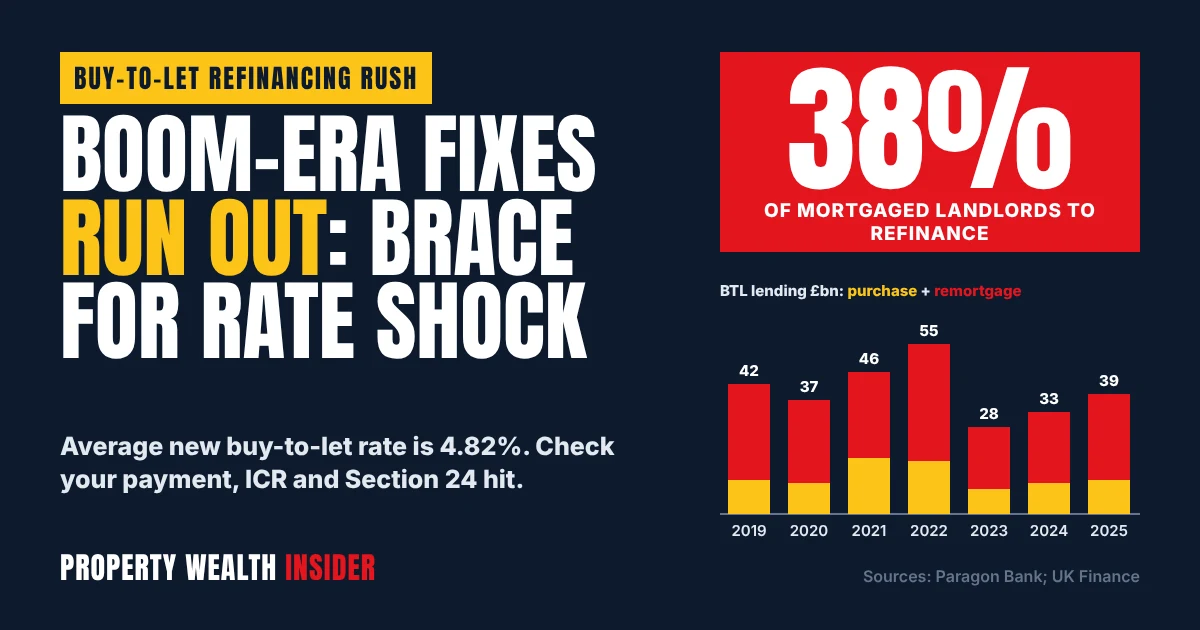
Almost four in ten landlords with buy-to-let mortgages expect to refinance at least one loan in the next 12 months, according to new research from Paragon Bank. Those planning to move are juggling an average of 2.9 loans each, so the decisions involved are portfolio-sized.
The timing isn’t a coincidence. Landlords bought in record numbers in 2021 and 2022, many on five-year fixes. Those deals are now running out, and the rate waiting for them is usually much higher than the one they’re leaving.
If you have a fix ending before the end of 2027, this guide shows what the jump could cost you each month, whether your lender’s stress test will still pass, and why Section 24 makes the hit to your cash flow worse than the headline payment rise suggests.
Key facts
- Paragon Bank surveyed nearly 600 landlords. 38% of those with mortgages plan to remortgage or take a product transfer in the next 12 months, covering an average of 2.9 loans each.
- Remortgages made up £7.5bn of the £10.7bn in new buy-to-let lending in Q2 2026 (UK Finance).
- The average rate on new buy-to-let loans was 4.82% in Q2 2026, and the average interest cover ratio was 217% (UK Finance).
- Bank Rate is 3.75%. At the last vote in September, three of the nine committee members wanted a rise. The next decision is due on 5 November 2026.
- Regulator guidance sets a 5.5% minimum stress rate and an industry-standard 125% rent-to-interest cover for new borrowing. Five-year fixes and like-for-like remortgages are treated differently.
What the Paragon research found
Pegasus Insight carried out the survey for Paragon. It found that most landlords aren’t fully geared. Just over a quarter (26%) have a mortgage on every rental property, 43% own their whole portfolio outright, and 31% have a mix of mortgaged and unmortgaged homes.
Among landlords who do have mortgages, 38% expect to remortgage or switch product in the coming year. They expect to refinance 2.9 loans each on average. Paragon’s managing director of mortgages, Louisa Sedgwick, says remortgaging made up around three quarters of buy-to-let business in the first half of 2026. She also says reviewing several loans together can benefit portfolio landlords.
Official figures back up the scale. UK Finance’s Q2 2026 buy-to-let update counted 39,631 buy-to-let remortgages in the quarter, worth £7.5bn. That compares with 16,026 purchase loans worth £2.7bn. By value, remortgaging was about 70% of all new buy-to-let lending.
The 74% of landlords with at least some unmortgaged property also have an option. They could raise finance against those homes to pay for upgrades or further purchases, subject to the lender’s criteria.
Why so many fixes are ending now
UK Finance’s lending tables show how unusual 2021 and 2022 were. Buy-to-let purchase lending reached about £18bn in 2021 and £17bn in 2022, against £10bn to £11bn in a normal year. Remortgaging peaked at £38bn in 2022. A five-year fix taken in 2021 ends in 2026, and one taken in 2022 ends in 2027.
Lender data points the same way. The Mortgage Works, analysing CACI’s Mortgage Market Database at the end of May 2026, forecasts that 35% of buy-to-let balances will reach the end of a fixed rate in 2027. It expects remortgage and product transfer activity to be 45% higher than in 2026.
Rates are higher now than when those deals were taken out. The Bank of England has held Bank Rate at 3.75% since December 2025. At the September 2026 meeting the vote was 6–3, with the three dissenters wanting a rise. The next announcement is on Thursday 5 November 2026, so don’t assume rates will fall before your fix ends.
What the jump costs: remortgage shock calculator
Interest-only payments rise in direct proportion to the rate. The table shows the monthly interest on every £100,000 you borrow. The 4.82% row is the UK Finance average for new buy-to-let loans in Q2 2026. Your own rate will depend on your loan-to-value, product type and fees.
| Interest rate | Monthly interest per £100,000 | Annual interest per £100,000 |
|---|---|---|
| 2.00% | £167 | £2,000 |
| 2.50% | £208 | £2,500 |
| 3.00% | £250 | £3,000 |
| 4.00% | £333 | £4,000 |
| 4.82% (Q2 2026 average new BTL rate) | £402 | £4,820 |
| 5.50% (PRA minimum stress rate) | £458 | £5,500 |
Worked example. A landlord has a £200,000 interest-only loan at 2.5% and moves to 4.82%. The monthly payment rises from £417 to £803. That is £387 more a month, or £4,640 more a year. The same loan on capital repayment with 20 years left goes from about £1,060 to £1,300 a month.
Enter your own numbers below. The default figures are examples only. The new rate is set to the UK Finance Q2 2026 average, so replace it with the rate you have actually been offered.
Remortgage shock calculator
This is a guide, not financial or tax advice. ICR is shown as the lender sees it: annual rent divided by annual interest at the stress rate. Lenders apply their own criteria. The tax estimate is for an individual landlord. It assumes the rental profit is all taxed in your chosen band and the full finance cost credit can be used. It ignores capital repaid and fees. It does not apply to limited companies or to Scottish income tax rates.
The ICR stress test: will your lender say yes?
Buy-to-let lenders mainly assess affordability with the interest cover ratio (ICR). This is annual rent divided by annual mortgage interest at a stressed rate. The Prudential Regulation Authority’s supervisory statement SS13/16 sets out how lenders should do this. It applies across the UK.
- Stress rate: lenders should allow for buy-to-let rates rising by at least 2 percentage points and should assume a rate of at least 5.5% over the first five years.
- Five-year fixes: the stress does not have to apply if the rate is fixed for five years or more. Many lenders therefore test longer fixes at or near the actual pay rate.
- 125%: SS13/16 describes a minimum ICR of 125% as the current industry standard.
- 145%: under Section 24, higher-rate taxpayers keep less of their rent. The Bank of England notes that most lenders test them at a stressed ICR of around 145%. Lenders may also simply assume every borrower pays higher-rate tax.
- Portfolio landlords: borrowers with four or more mortgaged buy-to-let properties get a fuller, portfolio-wide assessment.
- Like-for-like remortgages: the SS13/16 expectations do not apply to buy-to-let remortgages with no additional borrowing. Individual lenders still set their own criteria.
Here is what that means in rent. On each £100,000 borrowed and stressed at 5.5%, you need about £573 a month in rent to reach 125% and £665 a month to reach 145%. If the loan is assessed at a 4.82% five-year fixed pay rate instead, the figures fall to about £502 and £582.
| Assessment rate | Rent needed per £100,000 at 125% ICR | Rent needed per £100,000 at 145% ICR |
|---|---|---|
| 5.50% stress rate | £573 a month | £665 a month |
| 4.82% pay rate (five-year fix) | £502 a month | £582 a month |
Under the calculator’s defaults, a higher-rate landlord with a £200,000 loan and £1,300 a month rent has an ICR of 142% at 5.5%. That is above 125% but just below 145%. This landlord would probably pass with a five-year fix tested at the pay rate (162%) or with a product transfer, but could fail a full remortgage with extra borrowing at a lender that stresses at 5.5%.
For context, UK Finance reports that the average ICR on new buy-to-let loans was 217% in Q2 2026. Most landlords who are refinancing successfully have plenty of headroom.
Section 24: why your tax bill falls when your interest rises
Individual landlords, including partners in partnerships, cannot deduct mortgage interest from rental income. Instead, HMRC gives a tax reduction at the basic rate, currently 20%. It is based on the lowest of three figures: finance costs, property profits, or income above the personal allowance. Any unused amount is carried forward. Limited companies are not affected by this restriction.
In practice, every extra £1 of interest costs an individual landlord roughly 80p after tax, whatever their tax band. A higher-rate landlord still pays 40% tax on rent before interest, so a rate rise does not reduce their tax by much.
Worked example (2026-27, higher-rate). Take £15,600 a year in rent, £2,400 of other costs and the £200,000 interest-only loan. Tax is 40% of £13,200, which is £5,280, minus 20% of the interest.
- At 2.5%, interest is £5,000 and tax is £4,280. Cash left is £3,920 a year.
- At 4.82%, interest is £9,640 and tax is £3,352. Cash left is £208 a year.
Interest rises by £4,640, but tax falls by only £928, so the net loss is £3,712 a year.
Tax changes from April 2027. Finance Act 2026 creates separate property income tax rates from 6 April 2027 of 22%, 42% and 47% for England, Wales and Northern Ireland. Finance cost relief moves to the property basic rate of 22%. On 29 October 2026, HMRC published Budget 2026 proposals to raise these rates to 24%, 44% and 49% from April 2027. That increase is proposed, not yet law, and the documents we checked do not confirm the finance cost credit rate under it. Scotland sets its own rates.
Product transfer or full remortgage?
A product transfer moves you to a new deal with the same lender. It is usually quick and needs no legal work, and if you aren’t borrowing more there is often little or no new affordability test. A full remortgage moves the loan to another lender. That can get you a lower rate or let you release equity, but it means a new valuation, legal work, a fresh ICR test and the risk of delays.
The right choice depends on the total cost over the fixed period, not just the headline rate. The tool below compares the two. Its defaults are made-up examples, not market rates.
Product transfer vs remortgage: fee break-even
This is a guide, not financial advice. It compares interest on an interest-only basis plus upfront fees, and ignores fees added to the loan, early repayment charges and tax. Use the actual rates and fees you have been quoted.
On those example numbers, the remortgage saves £3,250 over five years. The extra £750 in upfront costs is recovered in about 11 months. With a smaller loan or a two-year fix, fees take up a bigger share of the cost, and the product transfer often comes out ahead.
What to do now: step by step
- List every fix end date. Collect them across the whole portfolio, along with balances, current rates and any early repayment charges. If you have 2.9 loans to sort out, a spreadsheet helps.
- Start four to six months early. Many lenders let you lock in a product transfer months before your fix ends, so ask yours what its window is. A remortgage needs time for valuation and legal work.
- Run each property through the calculator at the rate you have actually been offered. Mark any property whose ICR at 5.5% is below 125%, or below 145% if you are a higher-rate taxpayer.
- Get your rent evidence ready. Have current tenancy agreements and up-to-date rent figures to hand. A justified rent review can make the difference on a borderline ICR.
- Compare a product transfer with the whole market. Use a broker for the comparison, and look at both five-year and shorter fixes, since five-year fixes may be tested at the pay rate.
- Decide on equity release carefully. Extra borrowing brings back the full stress test and adds Section 24 drag. Only borrow more if the project pays for itself.
- Re-run your tax. Use the 2027-28 property income rates and talk to an accountant before April 2027, especially if you are a higher-rate landlord whose cash flow is already thin.
- Fix end dates and early repayment charges for every loan
- Current balance and remaining term per property
- Current rent, tenancy agreements and rent payment history
- ICR at 5.5% and at the offered pay rate for each property
- Product transfer offer from your current lender (in writing)
- At least one whole-of-market comparison via a broker
- Total cost comparison including all fees over the fixed period
- Updated Section 24 cash-flow estimate for 2026-27 and 2027-28
- Diary reminder six months before each fix ends
FAQ
How much will my buy-to-let mortgage go up when my fix ends?
On an interest-only loan, the monthly payment changes in direct proportion to the rate. Moving £200,000 from 2.5% to 4.82%, the Q2 2026 average for new buy-to-let loans, adds about £387 a month. Use the calculator above with your own figures.
What ICR do buy-to-let lenders require?
The PRA describes 125% as the industry-standard minimum, usually tested at a stressed rate of at least 5.5%. According to the Bank of England, most lenders apply around 145% to higher-rate taxpayers. Five-year fixes can be assessed at or near the pay rate.
Do I have to pass a stress test for a product transfer?
Usually not a full one if you aren’t borrowing more. The PRA’s buy-to-let underwriting expectations do not apply to remortgages with no additional borrowing. Each lender still sets its own rules, so check with yours.
Does Section 24 apply to limited company landlords?
No. The finance cost restriction applies to individual landlords, including partners in partnerships. Companies deduct interest as a business cost under corporation tax rules.
Will interest rates fall before my fix ends?
Nobody knows. Bank Rate has been 3.75% since December 2025, and three of the nine committee members voted for a rise in September 2026. The next decision is on 5 November 2026. Plan for today’s rates, not hoped-for cuts.
- Paragon Bank landlord research, as reported by The Intermediary (30 October 2026)
- UK Finance: Buy-to-Let Update Q2 2026
- UK Finance: Buy-to-let Mortgage Market Update Q2 2026 (PDF)
- UK Finance: Mortgage Market Forecasts 2026–2027 (PDF)
- The Mortgage Works: Buy to let maturities
- Bank of England: Bank Rate
- Bank of England: September 2026 Monetary Policy Summary
- Bank of England: December 2025 Monetary Policy Summary
- PRA SS13/16: Underwriting standards for buy-to-let mortgage contracts
- Bank of England: How do lenders account for tax when assessing affordability?
- GOV.UK: Tax relief for residential landlords, how it’s worked out
- GOV.UK: Restricting finance cost relief for individual landlords
- GOV.UK: Change to tax rates for property, savings and dividend income, technical note
- Finance Act 2026, section 7
- GOV.UK: Income Tax, changes to tax rates for property and savings income (Budget 2026)
This article is news and general guidance only. It is not financial, legal or tax advice.