Awaab’s Law for private landlords: 24-hour repair deadline plan
Private landlords in England are next in line for Awaab’s Law. On 9 October 2026 the government opened a consultation on forcing private landlords to investigate and fix serious hazards such as damp and mould within strict legal deadlines, the same regime that has applied to social landlords since 27 October 2025.
Nothing changes for private landlords today. But the government’s starting point is to copy the social housing rules: a 24-hour deadline for emergency hazards and 10 working days to investigate everything else. If that sticks, “within a reasonable time” will no longer be a defence on its own.
The proposals cover England only. They would affect the 2.3 million-plus private landlords, their letting agents, and the roughly 11 million people renting privately. You have until 11.59pm on 18 December 2026 to respond.
Key facts
- Consultation open from 9 October to 18 December 2026. It applies to England only.
- Starting point is the social housing rules: investigate within 10 working days and make safe within 5 working days of that. Emergencies must be dealt with within 24 hours.
- The earliest feasible start for private rentals is 2027. The government’s impact assessment models a phased start in 2028 to 2030.
- Already in force: councils can fine landlords up to £7,000 over Category 1 hazards (since 22 June 2026).
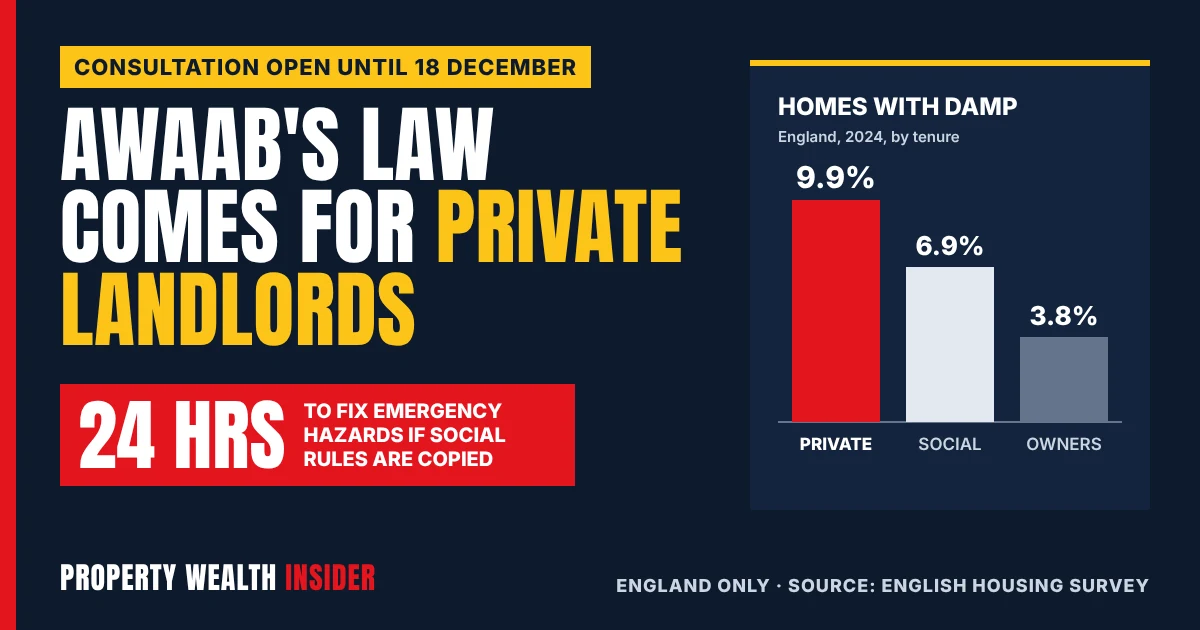
- 9.9% of privately rented homes had a damp problem in 2024. The rate was 6.9% for social homes and 3.8% for owner-occupied homes.
What the government has announced
The Ministry of Housing, Communities and Local Government (MHCLG) has published Extending Awaab’s Law to private rented tenancies and to licences. Housing Minister Matthew Pennycook says the aim is for private renters to “enjoy the same protections” as social tenants.
The legal power already exists. Section 60 of the Renters’ Rights Act 2025 rewrites section 10A of the Landlord and Tenant Act 1985. The new version covers any lease of a dwelling-house in England for a term of under seven years, not just social housing. That section has not been switched on yet. Regulations setting the actual deadlines are still needed, and this consultation is about what goes into them.
The consultation also asks whether to extend Awaab’s Law to three kinds of accommodation occupied under licence rather than a tenancy: supported housing, temporary accommodation for homeless households and care leaver accommodation.
It does not create new repair duties. Private landlords already have to repair the structure and installations under section 11 of the 1985 Act and keep homes fit for human habitation under section 9A. What Awaab’s Law adds is a clock: fixed timescales and a set process for dealing with serious hazards.
What is law now and what is only proposed
| Rule | Who it applies to | Status |
|---|---|---|
| Awaab’s Law, phase 1 (damp and mould, plus all emergency hazards) | Social landlords, England | In force since 27 October 2025 |
| Awaab’s Law, phase 2 (excess cold and heat, falls, electrical, fire, hygiene, structural collapse) | Social landlords, England | Due 30 November 2026, subject to Parliament |
| Updated HHSRS (29 hazards cut to 21) | All housing, England | In force since 23 June 2026 |
| Council fines of up to £7,000 for Category 1 hazards | Private landlords, England | In force since 22 June 2026 |
| Section 21 “no fault” evictions abolished | Private landlords, England | In force since 1 May 2026 |
| Awaab’s Law deadlines for private tenancies | Private landlords, England | Proposed. Consultation closes 18 December 2026 |
| Private Rented Sector Landlord Ombudsman membership | Private landlords, England | Expected 2028 |
| Decent Homes Standard for private rentals | Private landlords, England | Planned from 2035 |
Councils will not enforce the Awaab’s Law deadlines themselves. The Act writes them into every tenancy as an implied term. A tenant whose landlord misses a deadline can sue for breach of contract, and the court can order repairs, compensation and legal costs. Once the Ombudsman is running, tenants will be able to complain there too. Council enforcement under the HHSRS, including the £7,000 penalty, carries on alongside all of this.
The deadlines private landlords could face
The consultation takes the Hazards in Social Housing (Prescribed Requirements) (England) Regulations 2025 as its template. For each deadline it asks whether private landlords should get the same, less or more time. The options below are taken from the consultation questions.
| Step | Social housing rule today | Options in the consultation |
|---|---|---|
| Investigate a potential significant hazard | 10 working days, starting the day after you become aware | 5, 10 or 15 working days |
| Written summary of findings to the tenant | 3 working days after the investigation ends | 1, 3 or 5 working days, or no summary at all |
| Make a significant hazard safe | 5 working days after the investigation ends | 3, 5 or 10 working days |
| Start further preventative works | Start, or take steps to start, within 5 working days. Physically start within 12 weeks | 3, 5 or 10 working days, with or without the 12-week backstop |
| Emergency hazard: investigate and make safe | As soon as practicable and within 24 hours | 12, 24 or 48 hours |
| Can’t make safe in time | Landlord must arrange suitable alternative accommodation | Government “concerned” this may not be feasible for private landlords |
In the social housing rules, a “working day” excludes weekends, Christmas Day, Good Friday and bank holidays in England and Wales. A significant hazard is one that a reasonable landlord would fix urgently but not within 24 hours. An emergency hazard is one that would need fixing within 24 hours.
Social landlords have a defence if they took all reasonable steps but failed for reasons genuinely beyond their control. Hazards caused by the tenant’s own breach of the tenancy are excluded. The consultation sees “a good case” for keeping that exclusion for private rentals, and points to the defence as built-in flexibility.
Awaab’s Law deadline calculator
Enter the date and time you first heard about a problem. The calculator works out each deadline using the current social housing rules, or one of the faster or slower options in the consultation. These are not yet legal deadlines for private landlords. They show what you could face if the social rules are copied across.
Awaab’s Law deadline calculator
This is a guide only, not legal advice. The deadlines are not yet law for private landlords. The final rules may differ once regulations are made. Bank holidays for England and Wales are built in for 2026 and 2027 only. Deadlines are end of day unless a time is shown.
Why private rentals are in the firing line
The government’s latest English Housing Survey figures for 2024 show the private rented sector had the worst conditions of any tenure:
- Damp: 9.9% of private rented homes, about 486,000, had a damp problem. That compares with 6.9% of social homes and 3.8% of owner-occupied homes.
- Category 1 hazards: 10% of private rented homes had at least one, compared with 5% of social homes.
- Decent Homes Standard: 22% of private rented homes failed it, compared with 10% of social homes.
Under the social rules, hazards caused wholly or mainly by the tenant breaching the tenancy are excluded. But the social housing guidance warns landlords not to blame damp and mould on tenant “lifestyle” as a way to avoid acting. Expect the same message for private landlords.
What it could cost you: worked examples
The government’s impact assessment puts the paperwork cost at £8.17 per property per year in its central case. It also estimates £37.54 per landlord to learn the new rules. It assumes 15 minutes per letter or email to a tenant, at about £4.69 each. The extra cost of getting trades out faster is not counted.
Example 1: a five-property landlord. 5 x £8.17 = £40.85 a year in admin, plus about £37.54 to get up to speed. That is small money. The real risk is missing a deadline.
Example 2: ignoring a serious damp hazard. Suppose a council rates a damp problem as a Category 1 hazard and finds you took no reasonably practicable steps. It can fine you up to £7,000 today, before Awaab’s Law even arrives. Say the repair would have cost £1,800. Ignoring it could cost £8,800 or more, plus an improvement notice. Once Awaab’s Law applies, the tenant could also claim compensation and costs in court.
Example 3: the tenant who leaves. The impact assessment assumes a 21-day void, worth £638 at the median English rent of £208 a week. For a home let at £1,100 a month, 21 days empty costs £1,100 x 12 / 365 x 21 = £759 in lost rent, before re-letting fees.
Example 4: alternative accommodation. If the social rule on alternative accommodation were copied across, a landlord who could not make a home safe in five working days would have to pay for somewhere else. At, say, £95 a night, a family hotel room for seven nights is £665. The government admits this would be “highly challenging” for the 45% of landlords who own a single property.
What to do now
- Respond to the consultation by 18 December 2026. Questions 11 to 29 cover the deadlines, alternative accommodation and timing. Evidence from landlords on costs and trade availability is specifically requested.
- Log every report with a date and time. Every deadline runs from when you “become aware”, whether from the tenant, your agent, a contractor or a third party such as a GP.
- Line up trades now. Find a damp specialist, an electrician and a plumber who can attend within days. The consultation flags trade availability as a key challenge for private landlords.
- Review your agent’s contract. The duty is an implied term of the tenancy, so you stay liable even if your agent manages repairs. Write response times into the agreement.
- Write a template written summary. Under the social rules it must say whether a hazard was found, what will be done and by when, and how the tenant can contact you.
- Tackle damp before winter. Check ventilation, extractor fans, gutters, pointing and heating. The £7,000 fine regime already applies.
- Single log for repair reports, with the date and time received
- Contact list of trades who can attend within 24 hours and within 5 working days
- Agent agreement updated with hazard response times
- Template written summary for tenants
- Photos, video and invoices kept for every damp job
- Pre-winter checks done on fans, trickle vents, gutters, roof and heating
- Consultation response submitted by 18 December 2026
Awaab’s Law FAQs
Does Awaab’s Law apply to private landlords yet?
No. It currently applies only to social landlords in England. For private tenancies it is at consultation stage until 18 December 2026, and regulations will set the start date. The government says 2027 is the earliest feasible date.
When will Awaab’s Law start for private rentals?
That has not been decided. The consultation asks whether to bring it in all at once or in phases. The impact assessment assumes three phases in 2028, 2029 and 2030 for modelling purposes only.
How long does a landlord have to fix damp and mould under Awaab’s Law?
For social landlords, the rule is to investigate within 10 working days and make safe within 5 working days after that. A written summary goes to the tenant within 3 working days of the investigation. Emergencies must be dealt with within 24 hours. Private landlords may get the same or different timescales.
Does Awaab’s Law apply in Wales or Scotland?
No. These proposals apply to England only. Wales, Scotland and Northern Ireland set their own housing standards rules.
Can I be fined for damp and mould now?
Yes. Since 22 June 2026 councils in England can issue penalties of up to £7,000 where a private landlord has not taken reasonably practicable steps to deal with a Category 1 hazard. Damp and mould is one of the 21 HHSRS hazards.
Will I have to rehouse my tenant if I can’t fix a hazard in time?
Social landlords must. For private landlords this is still an open question. The government says it has concerns about whether it would work, and asks for views in question 25.
- MHCLG: Extending Awaab’s Law to private rented tenancies and to licences (consultation, 9 October 2026)
- MHCLG press release: Clampdown on dangerous homes to protect more tenants and families
- Extending Awaab’s Law: impact assessment (PDF)
- The Hazards in Social Housing (Prescribed Requirements) (England) Regulations 2025 (SI 2025/1042)
- Renters’ Rights Act 2025, section 60
- MHCLG: Crackdown on dangerous rented homes as new £7k fines kick in
- English Housing Survey 2024 to 2025: housing quality and energy efficiency
- HHSRS: landlord and agent guide
- UK bank holidays
This article is news and general guidance only, not financial, legal or tax advice.