£240,000 Fine After Tower Block Firm Ignores Fire Notice
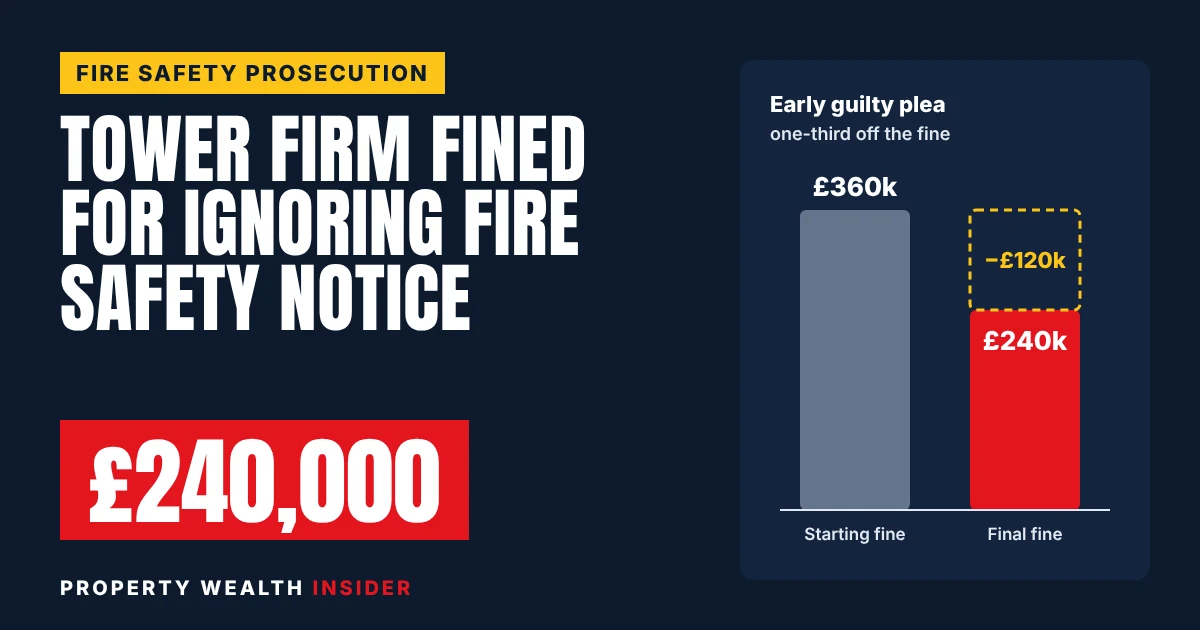
A company responsible for a three-tower residential development in Birmingham has been fined £240,000 for ignoring a council improvement notice that ordered it to fit a fire detection system. Avamore Limited, the company responsible for Solihull Heights, pleaded guilty at Birmingham Magistrates’ Court and was sentenced on 16 October 2026.
The court started at £360,000 and took a third off for the early guilty plea. Birmingham City Council says 26 more developments in the city are now subject to enforcement action, and its specialist officers are still investigating fire safety concerns.
This is not just a tower-block story. The same improvement notice powers apply to a two-bed flat or a small HMO. Since 1 May 2026, councils in England can also fine you up to £40,000 without going to court. Below we explain how the system works, what a fine could cost you, and the fire safety duties you need to have covered.
Key facts
- Avamore Limited was fined £240,000, down from £360,000, after an early guilty plea to failing to comply with an improvement notice at Solihull Heights.
- It must also pay prosecution costs and a £2,000 victim surcharge, which is the maximum surcharge on a fine.
- Birmingham City Council says 26 further developments are subject to enforcement action.
- Failing to comply with an improvement notice is an offence under section 30 of the Housing Act 2004. In the magistrates’ court the fine has no upper limit.
- The civil penalty alternative in England rose from £30,000 to £40,000 for offences committed on or after 1 May 2026. National guidance sets a £25,000 starting point for this offence.
What happened at Solihull Heights
According to Birmingham City Council’s announcement of 20 October 2026, the council had served an improvement notice on Avamore Limited. The notice required a fire detection system across all three tower blocks, to warn residents early if a fire broke out on the external walls.
The work was not done. The company pleaded guilty to failing to comply with the notice. On 16 October the court set the fine at £360,000, cut it to £240,000 for the early plea, and added prosecution costs and a £2,000 victim surcharge.
The council said the case “sends a clear message” to landlords, developers and building owners who ignore legal notices. With 26 more developments under enforcement, more cases look likely.
How improvement notices work
Councils in England assess homes using the Housing Health and Safety Rating System (HHSRS). If an inspector finds a serious category 1 hazard, section 5 of the Housing Act 2004 means the council must take enforcement action. Serving an improvement notice under section 11 is one option. For less serious category 2 hazards, the council may serve one under section 12.
Fire is one of the listed hazards. The HHSRS was updated on 23 June 2026 by SI 2026/571, and the old “fire” hazard became “fire and explosions”: exposure to uncontrolled fire and associated smoke and fumes, or an explosion. The new rules apply to inspections that started on or after 22 June 2026.
For flats, the notice can cover the whole building and its common parts, not just the individual flat. That is how a single notice can require detection across three tower blocks.
| Stage | Rule | Law |
|---|---|---|
| Notice served | The notice sets out the work, when it must start and how long you have to finish it | Housing Act 2004 s11, s12, s13 |
| Appeal window | 21 days from service to appeal to the First-tier Tribunal (later only with good reason) | Sch 1 para 14 |
| Notice operative | Normally at the end of that 21-day period, unless you appeal or the notice is suspended | s15 |
| Failure to comply | An offence if the work is not started and finished on time. “Reasonable excuse” is a defence | s30 |
| Duty continues | You still have to do the work after the deadline passes, even once you have been fined | s30(5) |
Prosecution or civil penalty: what it can cost
A council has two routes. It can prosecute. Section 30(3) sets the penalty as a “level 5” fine, and section 85 of LASPO 2012 removed the cap on these fines for offences committed from 12 March 2015. That is why a magistrates’ court could start at £360,000.
It can also impose a civil penalty under section 249A. It must first be satisfied beyond reasonable doubt that you committed the offence. The maximum was £30,000. SI 2026/319 raised it to £40,000 from 1 May 2026, but only where the conduct happened on or after that date.
The government’s civil penalty guidance sets a £25,000 starting point for failing to comply with an improvement notice. Councils then adjust it up or down for aggravating and mitigating factors. Only one penalty can be imposed per notice, however many hazards it covers. If the work still is not done, the council can serve a fresh notice.
Worked example: A landlord ignores a notice to fit a mains-wired, interlinked fire alarm in a converted house. The council chooses a civil penalty. From the £25,000 starting point, aggravating factors (a previous warning, vulnerable tenants) could push it towards the £40,000 cap. If the council prosecutes instead, there is no cap at all. The alarm system still has to be installed either way.
How the guilty plea discount works
Under the Sentencing Council’s guilty plea guideline, which applies to organisations as well as individuals, the maximum reduction is one-third. You get it for a plea indicated at the first stage of proceedings, normally the first hearing where a plea is asked for.
After that, the maximum drops to one-quarter, and it slides down to one-tenth on the first day of trial. A plea entered during the trial can earn even less, possibly nothing.
Solihull Heights shows the maths: £360,000 less one-third (£120,000) is £240,000. Had the company held out until the trial date, the same starting fine would have become £324,000, which is £84,000 more.
Then comes the victim surcharge. For offences committed on or after 16 June 2022, it is 40% of the fine, capped at £2,000 (SI 2022/584). Any fine above £5,000 therefore hits the £2,000 cap, which is exactly what Avamore paid. Prosecution costs come on top.
Calculator: your fine exposure
Enter the fine a court might start at, choose the plea stage and add an estimate of the council’s costs. The calculator shows the reduced fine, the surcharge and your total bill, compared with the civil penalty route.
Improvement notice fine exposure estimator
Guide only, not legal advice. Courts set the starting fine on the facts and your means, and the reduction after the first stage is a sliding scale with one-quarter as the maximum. Costs vary by case. You still have to do the work in the notice whatever you pay.
Fire safety duties every landlord must meet
Improvement notices are the backstop. The quickest way to avoid one is to meet the fixed legal duties that apply in England.
Smoke and carbon monoxide alarms (all private lets). Under the Smoke and Carbon Monoxide Alarm (England) Regulations 2015, as amended in 2022, you must have:
- a smoke alarm on every storey with a room used as living accommodation (bathrooms and toilets count)
- a carbon monoxide alarm in any such room with a fixed combustion appliance, other than a gas cooker
- every alarm checked on the day a new tenancy begins
- any faulty alarm the tenant reports repaired or replaced as soon as reasonably practicable
If you ignore a remedial notice under these rules, the council can charge a penalty of up to £5,000.
Blocks of flats. The Fire Safety (England) Regulations 2022 have applied since 23 January 2023. They place duties on the “responsible person”, who is often the freeholder or managing agent, and sometimes the landlord of a converted building.
| Building | Duty |
|---|---|
| 2+ flats with common parts used for escape | Display fire safety instructions and give them to new residents and to all residents every 12 months. Give residents information about fire doors on the same schedule |
| Above 11 metres | Check communal fire doors at least every 3 months. Use best endeavours to check flat entrance doors every 12 months, and keep records |
| High-rise (18m+ or 7+ storeys) | Install a secure information box, keep floor plans and an external wall record and send them to the fire service, check firefighting lifts and equipment monthly, and put up wayfinding signs |
What to do if you get an improvement notice
- Diary the dates the same day. Note the date of service, the 21-day appeal deadline, the date the work must start and the date it must be finished.
- Read the schedule of works line by line. If anything is unclear, ask the officer in writing.
- Decide quickly whether to appeal. If you think the notice is wrong, appeal to the First-tier Tribunal within 21 days. While an appeal is pending, the notice is not operative.
- Get quotes and book contractors at once. For alarm and detection work, use a competent installer and keep certificates.
- If you hit a delay, tell the council in writing before the deadline. Explain why and give a revised date. Keep evidence, because “reasonable excuse” is the only defence.
- Send proof when the work is finished. Include photos, invoices and certificates, and ask the council to confirm compliance.
- If you are charged, take advice early. A first-stage guilty plea is worth up to a third off the fine.
- Smoke alarm on every storey with living accommodation, tested on move-in day
- CO alarm in every room with a fixed combustion appliance (not gas cookers)
- Written log of alarm checks and repairs made after tenant reports
- Fire risk assessment for common parts, if you are the responsible person
- Fire safety instructions and fire door information given to residents within the last 12 months (blocks of 2+ flats)
- Communal fire doors checked every 3 months (buildings above 11m)
- Any council letter or notice diarised, with appeal and completion dates
- Contractor invoices and certificates filed for all fire safety work
FAQ
What happens if a landlord ignores an improvement notice?
It is a criminal offence under section 30 of the Housing Act 2004. The council can prosecute, and the fine is unlimited. In England it can instead impose a civil penalty of up to £40,000 for failures from 1 May 2026. You still have to do the work afterwards.
How much is the civil penalty for not complying with an improvement notice?
The maximum is £40,000 where the failure happened on or after 1 May 2026, and £30,000 before that. Government guidance sets a £25,000 starting point, which the council adjusts for culpability, harm and other factors.
Can I be fined and prosecuted for the same failure?
No. Section 249A bars a civil penalty if you have already been convicted or proceedings are under way. Section 30(8) bars a conviction once a civil penalty has been imposed for the same conduct.
How long do I have to appeal an improvement notice?
21 days from the day it was served, to the First-tier Tribunal (Property Chamber). The tribunal can allow a late appeal only if there is a good reason.
How much does an early guilty plea reduce a fine?
Up to one-third if you indicate the plea at the first stage of proceedings. After that the maximum is one-quarter, falling to one-tenth on the first day of trial. That is how £360,000 became £240,000 in the Solihull Heights case.
Does this apply in Wales or Scotland?
The £40,000 civil penalty, the smoke and CO alarm rules and the Fire Safety (England) Regulations covered here apply in England. Wales and Scotland have their own regimes, so check the local rules if you let property there.
Sources
- Birmingham City Council: Company fined £240,000 after failing to improve fire safety for residents (20 October 2026)
- Housing Act 2004, section 30
- Housing Act 2004, section 11 and section 12
- Housing Act 2004, section 249A
- The Financial Penalties (Housing Offences and Breach of Banning Orders) Regulations 2026 (SI 2026/319)
- GOV.UK: Civil penalties under the Renters’ Rights Act 2025 and other housing legislation
- Legal Aid, Sentencing and Punishment of Offenders Act 2012, section 85
- Sentencing Council: Reduction in sentence for a guilty plea
- Sentencing Council: What is the surcharge?
- Sentencing Act 2020 (Surcharge) (Amendment) Regulations 2022 (SI 2022/584)
- Housing Health and Safety Rating System (England) (Amendment) Regulations 2026
- Smoke and Carbon Monoxide Alarm (England) Regulations 2015, as amended
- Fire Safety (England) Regulations 2022
This article is news and general guidance only. It is not financial, legal or tax advice.