5-Week Deposit Cap: Is £1,442 Really Enough to Cover You?
Is five weeks’ rent enough? Seven years after the tenancy deposit cap was introduced, landlords keep asking the same question: will it cover a bad tenancy, especially one with a pet?
The law hasn’t changed. In England, a landlord or agent can take no more than five weeks’ rent as a deposit where the annual rent is under £50,000, and six weeks’ rent at £50,000 or more. Anything above that is a prohibited payment.
What has changed is the risk around it. The Renters’ Rights Act 2025 is now in force, tenants have stronger rights to ask for a pet, and you can no longer ask for rent in advance before the tenancy is signed. Below you’ll find what the cap allows at each rent level, where it runs out, and how to work out your own gap.
Key facts
- Deposit cap in England: 5 weeks’ rent if annual rent is under £50,000, 6 weeks’ if it is £50,000 or more (Tenant Fees Act 2019, Schedule 1).
- Holding deposits are capped at 1 week’s rent. One week’s rent is the annual rent divided by 52.
- You must protect the deposit in an approved scheme and give the prescribed information within 30 days of receiving it.
- Fail to protect it and a court must order you to pay 1 to 3 times the deposit, on top of repaying it.
- Taking a prohibited payment can lead to a civil penalty of up to £5,000, or up to £30,000 for a repeat breach within five years.
- At £1,250 a month the most you can take is £1,442.
What the deposit cap allows at each rent level
The cap comes from Schedule 1, paragraph 2 of the Tenant Fees Act 2019, in force since 1 June 2019. The Act applies to England. Wales has its own law, covered in the FAQ.
The maths catches people out. The Act defines a week’s rent as the annual rent divided by 52, so you multiply the monthly rent by 12 and divide by 52. Five weeks is therefore about 1.15 months’ rent. It isn’t “a month plus a bit”.
| Monthly rent | Weekly rent (×12÷52) | Max holding deposit (1 week) | Cap weeks | Max tenancy deposit |
|---|---|---|---|---|
| £800 | £184.62 | £184 | 5 | £923 |
| £1,000 | £230.77 | £230 | 5 | £1,153 |
| £1,250 | £288.46 | £288 | 5 | £1,442 |
| £1,500 | £346.15 | £346 | 5 | £1,730 |
| £2,000 | £461.54 | £461 | 5 | £2,307 |
| £3,000 | £692.31 | £692 | 5 | £3,461 |
| £4,150 | £957.69 | £957 | 5 | £4,788 |
| £4,200 | £969.23 | £969 | 6 | £5,815 |
Figures in the last two money columns are rounded down to the pound, so you stay safely under the cap. Even £1 over is a prohibited payment.
The £50,000 cliff edge
The six-week limit starts when the annual rent “immediately after its grant, renewal or continuance” is £50,000 or more. That works out at £4,166.67 a month.
There’s a sharp jump at that line. At £4,150 a month (£49,800 a year) the cap is £4,788. At £4,200 a month (£50,400 a year) it is £5,815. A £50 difference in monthly rent means a deposit that can be £1,027 higher.
Very top-end lets drop out of the Act altogether. The government’s enforcement guidance says tenancies with an annual rent above £100,000 are not covered.
Where five weeks runs out: worked examples
A deposit has to cover everything a tenant might owe when they leave: unpaid rent, cleaning, damage beyond fair wear and tear, and missing items. Here are three illustrative end-of-tenancy bills on a £1,250-a-month flat, where the cap is £1,442. The costs are examples, not industry averages.
| Scenario (rent £1,250 pcm) | Arrears | Cleaning | Damage | Total claim | vs £1,442 cap |
|---|---|---|---|---|---|
| A. Tidy exit, small repairs | £0 | £250 | £300 | £550 | £892 to spare |
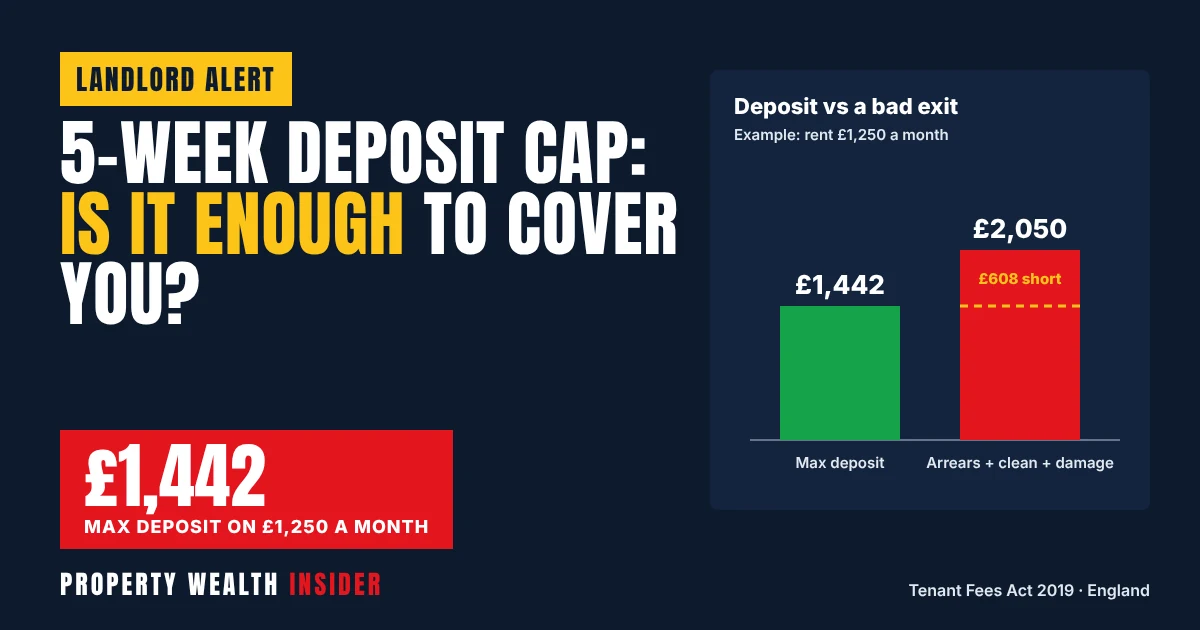
| B. One month’s arrears plus cleaning and damage | £1,250 | £300 | £500 | £2,050 | £608 short |
| C. As B, plus pet damage to carpets and doors | £1,250 | £300 | £900 | £2,450 | £1,008 short |
The lesson: five weeks covers routine wear, cleaning and minor damage. It does not cover a month of arrears plus anything else. If arrears are your main worry, the deposit isn’t really your safety net. Referencing, affordability checks and your own rent guarantee cover do that job.
If you claim more than the deposit holds, you can still pursue the tenant for the balance. Government guidance on pets says landlords can go to court for costs beyond the deposit, though it expects this to be needed only rarely.
Pets, insurance and the Renters’ Rights Act
Pets are the pressure point. Under the Renters’ Rights Act 2025, landlords in England must consider a tenant’s request for a pet and cannot unreasonably refuse it. Government guidance says you have 28 days to respond in writing.
The guidance gives examples of reasonable refusals: another tenant’s allergy, a home too small for the animal, a pet that is illegal to own, or a head lease that bans pets. It says refusing because you dislike pets, had a bad experience before, or worry generally about damage would usually be unreasonable.
The early version of the Bill would have let landlords make pet damage insurance a condition of consent. That provision was withdrawn, and the final Act contains no specific pet-risk mechanism. Propertymark backed a Lords amendment for a separate pet deposit of up to three weeks’ rent. It did not become law.
Watch out: the Tenant Fees Act still stops you requiring a tenant to pay for insurance unless a Schedule 1 exception applies. A “pet deposit” on top of the five weeks is also illegal, because any amount over the cap is a prohibited payment. Your options are to price the risk into the rent you set before the tenancy, buy landlord cover yourself, and document the property’s condition carefully.
Deposit cap calculator
Enter your rent and a realistic worst-case exit. The calculator shows the legal maximum deposit and holding deposit, and how far a bad tenancy could outrun them.
Deposit cap and risk gap
Guide only, for tenancies in England under the Tenant Fees Act 2019. One week’s rent = annual rent ÷ 52, and figures are rounded down to the pound to stay under the cap. Not legal or financial advice.
Protection rules and penalties
Taking the right amount is only half the job. Under section 213 of the Housing Act 2004, which applies in England and Wales, you must protect the deposit and give the prescribed information within 30 days of receiving it.
The three government-approved schemes are the Deposit Protection Service, mydeposits and the Tenancy Deposit Scheme. Once you and the tenant agree the amount to return, it must be repaid within 10 days. Disputed money stays in the scheme until the dispute is settled.
| Breach | Consequence | Source |
|---|---|---|
| Deposit over 5 (or 6) weeks’ rent | Excess is a prohibited payment and must be repaid. Civil penalty up to £5,000, or up to £30,000 or prosecution for a repeat within five years | Tenant Fees Act 2019 / gov.uk guidance |
| Holding deposit over 1 week’s rent | Excess is a prohibited payment | TFA 2019 Sch 1 para 3 |
| Deposit not protected or prescribed info not given within 30 days | Court must order 1x to 3x the deposit, plus repayment or protection within 14 days | Housing Act 2004 s213-214 |
| Deposit not properly protected when seeking possession | Can’t gain possession (except on antisocial behaviour grounds) until it’s put right | gov.uk Guide to the Renters’ Rights Act |
Worked example: a £1,442 deposit left unprotected could cost between £1,442 and £4,326 in compensation alone, before you even get to the possession problems.
There’s one more upfront limit. Since the Renters’ Rights Act took effect on 1 May 2026, you can’t require or accept rent in advance before the tenancy is entered into. After signing, and before the tenancy starts, you can ask for no more than one month’s rent.
What to do now
- Recalculate every deposit properly. Use monthly rent × 12 ÷ 52 × 5 and round down. Check renewals and rent increases too, because the cap is tested against the rent immediately after grant, renewal or continuance.
- Check you aren’t over the cap on existing tenancies. If you took too much, repay the excess now rather than waiting for a council to find it.
- Audit your protection paperwork. Confirm each deposit is in a scheme and that the tenant got the prescribed information within 30 days.
- Run your own risk gap. Use the calculator with realistic numbers for your property. If arrears are what worries you, the answer lies in referencing and insurance, not the deposit.
- Prepare for pet requests. Write a short policy, reply within 28 days, and record your reasons if you refuse. Never add a pet top-up to the deposit.
- Win the evidence battle. A detailed, dated, photographed inventory at check-in and check-out is what decides how much of the deposit you can actually keep.
- Deposit at or below 5 weeks’ rent (6 weeks if rent is £50,000+ a year)
- Holding deposit at or below 1 week’s rent
- No rent in advance taken before signing; no more than one month after signing
- Deposit protected with DPS, mydeposits or TDS within 30 days
- Prescribed information served within 30 days, and proof kept
- Check-in inventory signed, dated and photographed
- Pet request process written down, with a 28-day response diary note
- No tenant-paid insurance demanded as a condition of the tenancy
FAQ
How do I calculate a five-week deposit?
Multiply the monthly rent by 12, divide by 52 to get the weekly rent, then multiply by 5. For £1,250 a month that is £288.46 × 5 = £1,442.30. Take £1,442 to stay under.
Can I charge a higher deposit if the tenant has a pet?
No. The cap is the same with or without a pet, and any amount above it is a prohibited payment. A proposal for a separate pet deposit was debated in the Lords but did not make it into law.
Can I make tenants take out pet insurance?
The pet damage insurance condition was removed from the Renters’ Rights Bill before it became law. The Tenant Fees Act also bars requiring tenants to pay for insurance unless a specific exception applies. You can insure the property yourself.
When does the six-week deposit cap apply?
When the annual rent is £50,000 or more, which is £4,166.67 a month or above. Below that the cap is five weeks.
Does the five-week cap apply in Wales?
The Tenant Fees Act cap is for England. Wales has the Renting Homes (Fees etc.) (Wales) Act 2019, which caps holding deposits at one week’s rent. The Welsh Government’s 2019 landlord guidance said no limit had yet been set on security deposits, so check its current guidance. Deposit protection under the Housing Act 2004 applies in both nations.
What happens if I don’t protect a deposit in time?
The tenant can apply to court, which must order you to pay between one and three times the deposit and to repay or protect it within 14 days. You also can’t gain possession (except on antisocial behaviour grounds) until it’s put right.
Sources
- Tenant Fees Act 2019, Schedule 1 (legislation.gov.uk)
- Tenant Fees Act 2019: statutory guidance for enforcement authorities (GOV.UK)
- Housing Act 2004, section 213 (legislation.gov.uk)
- Housing Act 2004, section 214 (legislation.gov.uk)
- Tenancy deposit protection (GOV.UK)
- If a tenant wants a pet to live with them (GOV.UK)
- Guide to the Renters’ Rights Act (GOV.UK)
- Pet insurance withdrawn from Renters’ Rights Bill (Propertymark)
- Renting Homes (Fees etc.) (Wales) Act 2019, Schedule 1 notes (legislation.gov.uk)
- Renting Homes (Fees etc.) (Wales) Act 2019: guidance for landlords and agents (Welsh Government)
This article is news and general guidance only, not financial, legal or tax advice.