Tenants Now Stay 4.7 Years – Why Keeping Them Pays Off
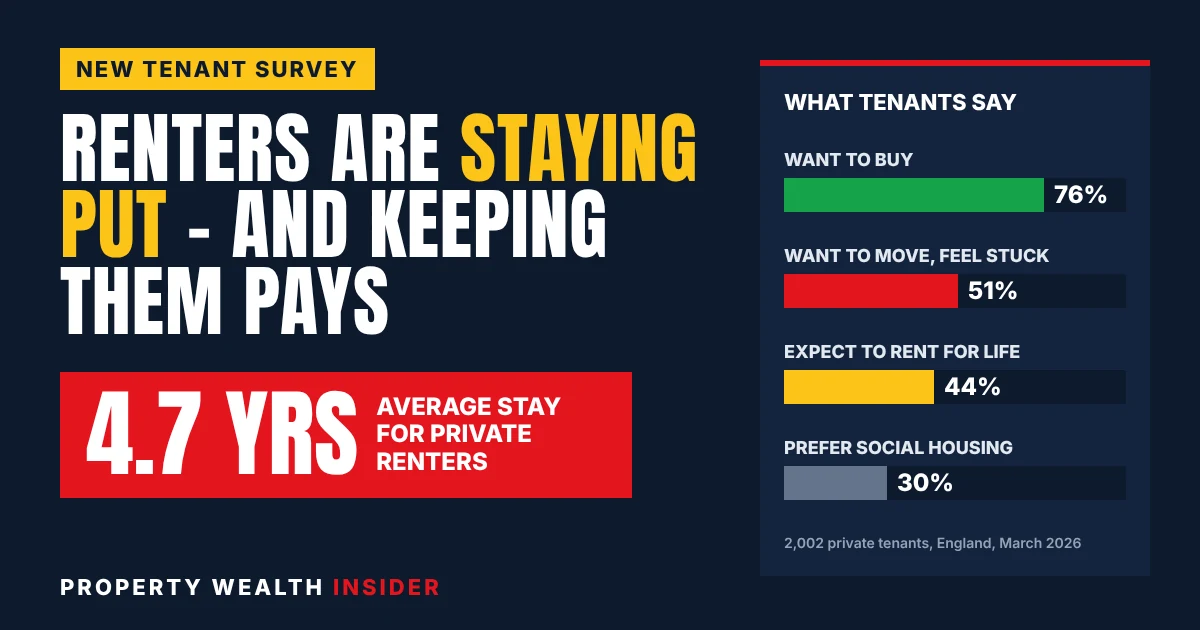
Private tenants in England are staying put for longer than ever, and a big new survey suggests many of them would rather be somewhere else. The Voice of the Tenant Survey, funded by the TDS Charitable Foundation, found that 51% of renters would like to move but feel unable to, while 44% expect to rent for the rest of their lives.
The official figure backs it up. The government’s English Housing Survey 2024-25 puts the average private renter’s time in their current home at 4.7 years. That is a long-stay customer, and since 1 May 2026 the Renters’ Rights Act has made every tenancy in England open-ended.
For landlords, the takeaway is simple: a good tenant who stays is now your most valuable asset. Here is what the research says about who rents today, what the new rules mean for long tenancies, and how to work out what keeping a tenant is worth to you in pounds.
Key facts
- Private renters in England have lived in their current home for an average of 4.7 years (English Housing Survey 2024-25).
- 51% of tenants would like to move but feel unable to; 44% expect to rent for life.
- 76% would like to buy their own home, up from 69% in March 2023.
- Average reported rent was £1,108 a month in March 2026, up £51 on a year earlier.
- 30% would now prefer social housing, up from 21% in 2025.
- In England, rent can now only be raised once a year using the section 13 process with at least 2 months’ notice.
What the tenant survey found
The report, Living in the Private Rented Sector in 2026, is the sixth wave of the survey. It questioned 2,002 private tenants across England between 4 and 13 March 2026, weighted to be representative by age, gender, region and rent band. So this is England-only data, gathered just before the Renters’ Rights Act changes began.
The headline tension is between ambition and reality. Three in four tenants want to buy, but only 33% disagree that they will rent for life. In other words, a large group want to own and do not believe they will.
Other findings landlords should note:
- Average rent reported was £1,108 a month, up 4.8% on March 2025. 46% of tenants had a rent increase in the past year.
- 19% of tenants are in rent arrears, the highest share recorded in the survey’s history.
- Just 24% plan to stay in their current home for three years or more, and 23% have no fixed plan. Yet the actual average stay is 4.7 years: plans and reality differ.
- 78% did not know they can challenge a rent increase at the First-tier Tribunal.
Who rents privately now
Forget the stereotype of the twenty-something sharer. In the TDS sample, 40% of tenants were aged under 35, 26% were 45 to 64, and 10% were 65 or over. 47% of households had at least one dependent child, and 49% reported household income of £40,000 or more.
The English Housing Survey shows the same shift. Households whose reference person is aged 45 to 54 made up 18% of private renters in 2024-25, up from 15% a year earlier and 14% a decade ago. The sector houses 4.7 million households, or 19% of all households in England.
Families, older tenants and higher earners tend to want stability: schools, commutes and fewer moves. They are exactly the tenants who will stay for years if the home and the relationship work.
| Tenure (England, 2024-25) | Average years in current home |
|---|---|
| Outright owners | 23.7 |
| All owner occupiers | 17.0 |
| Social renters | 12.2 |
| Buying with a mortgage | 8.9 |
| Private renters | 4.7 |
| All households | 13.9 |
Source: English Housing Survey 2024-25 Headline Report, Annex Table 3.6. Private renters still move most often, but 4.7 years means a typical tenant pays dozens of monthly rents before moving on.
The rules that now govern long tenancies
Since 1 May 2026, the Renters’ Rights Act has changed how tenancies work in England. It does not apply in Wales, Scotland or Northern Ireland, which have their own systems. The main points, from the government’s landlord guidance and tenant guidance:
| Rule (England, from 1 May 2026) | What it means for keeping tenants |
|---|---|
| Existing assured shorthold tenancies became assured periodic tenancies; new tenancies are periodic too. | No fixed end date. A tenancy runs until the tenant leaves or you have a legal ground to end it. |
| Tenants can end a periodic tenancy with 2 months’ notice. | A tenant can leave at any time, so retention depends on whether they want to stay. |
| Section 21 no-fault eviction has ended. You need a legal reason (ground) to evict. | Choose tenants carefully at the start; it is harder to change course later. |
| Rent can be increased only once a year, not in the first 12 months, using Form 4A with at least 2 months’ notice. | Plan one annual review. Tenants can challenge a rise above market rent at the First-tier Tribunal. |
| You cannot evict to sell or move in within the first 12 months of a tenancy. | Factor this into any plans to exit or refinance. |
| Tenants can ask to keep a pet; you can only refuse with a valid reason. | Pet-friendly lets widen your pool and remove one reason to move. |
| Rent bidding is banned, and after signing you can ask for at most 1 month’s rent in advance. | You cannot use bidding wars at re-let to recoup void losses. |
Put together, these rules shift the economics. You can still move rent towards market level once a year with a sitting tenant, so the main financial gain from a new tenancy, a fresh market rent, is now available without one. The costs of a changeover, though, have not gone away.
Calculator: what a long-stay tenant is worth
Enter your own numbers. The calculator compares a tenant who stays for the whole period with a property that turns over every few years. It assumes the same annual rent increase in both cases, because section 13 lets you review rent once a year either way. Re-letting cost covers agent fees, referencing, inventory, cleaning and any refresh between tenants. The defaults are illustrative, using the survey’s average rent of £1,108.
What a long-stay tenant is worth
Guide only, not financial advice. It ignores tax, mortgage costs, maintenance, arrears risk and any rent uplift you might achieve on a re-let. Rent lost to voids is based on the rent at the time of each changeover.
Worked example: six years, two ways
Take a £1,108-a-month let with 3% annual rent increases. Tenant A stays six years: you collect about £86,004. With turnover every two years instead, you face two changeovers, at years two and four.
Three empty weeks at the year-two rent of about £1,175 loses roughly £814; at the year-four rent of about £1,247 it is roughly £863. Add an assumed £900 re-letting cost each time and the churn scenario nets about £82,527. Keeping tenant A is worth about £3,477, or roughly £580 a year.
Worked example: the rent rise that costs you a tenant
Say the market supports a 3% rise on £1,108, which is £33 a month. Taking 1.5% instead gives up about £17 a month, or roughly £199 a year. One changeover with three void weeks (about £767) plus £900 of costs is around £1,667. You would need to forgo that half of the increase for about eight years before it cost as much as losing the tenant once.
A moderate, well-explained annual increase is usually cheaper than a vacancy. But do not go below what your costs need: the same survey found 19% of tenants in arrears, so affordability checks and early conversations about payment matter as much as the headline rent.
Why tenants leave, and what you can control
The survey asked tenants why they left their last rental. Most tenancies are ended by the tenant, not the landlord. The top reasons:
- 21% wanted a larger or smaller home.
- 19% wanted a better neighbourhood or more pleasant area.
- 16% said the landlord asked them to leave or was selling.
- 12% said the previous home was in poor condition or disrepair.
- 8% could not afford the rent, and 4% left because they wanted a pet.
Size and location are mostly outside your control. Condition, affordability, pets and your own plans are not. Those four account for a big share of moves you could have prevented.
Condition matters most for satisfaction. 65% of tenants reported at least one quality issue in the past six months. Nearly half thought their home’s energy efficiency could be improved, but only about half of those raised it, often because they feared a rent increase would follow. Tenants who stay quiet about problems are tenants quietly planning to leave.
What landlords should do now
- Price your vacancy. Run the calculator with your real re-letting costs and void history. That figure is your retention budget.
- Set one annual rent review date. Use Form 4A with at least two months’ notice, benchmark against local market evidence, and keep a note of the comparables. A rise above market can be challenged at the tribunal.
- Talk before you serve. Tell the tenant what is coming and why. Many tenants do not know their rights, but surprises push people to look elsewhere.
- Fix things fast and make reporting easy. Separate repair requests from rent reviews so tenants do not fear raising problems.
- Plan improvements around long stays. Energy upgrades and kitchen or bathroom refreshes pay back best when the same tenant enjoys them for years.
- Have a pet policy ready. Decide what you will accept and on what terms, so you can answer a request quickly and lawfully.
- Watch for arrears early. With one in five tenants in arrears, a quick call at the first missed payment beats a dispute later.
- Calculated my cost per changeover (fees, voids, cleaning, refresh)
- Diarised one annual rent review per property
- Gathered local rent comparables for each review
- Have Form 4A ready and know the two-month notice rule
- Repair reporting route shared with every tenant
- Written pet request policy in place
- Arrears contact process for the first missed payment
- Annual check-in with each tenant about their plans
FAQ
How long do private tenants stay in a property in England?
The English Housing Survey 2024-25 found private renters had lived in their current home for an average of 4.7 years, against 12.2 years for social renters and 17.0 years for owner occupiers.
How often can a landlord increase rent under the Renters’ Rights Act?
In England, once a year and not in the first 12 months of a tenancy. The landlord must use Form 4A and give at least two months’ notice, and the tenant can challenge a rise above market rent at the First-tier Tribunal.
How much notice does a tenant have to give to leave?
For an assured periodic tenancy in England after 1 May 2026, a tenant can end the tenancy with two months’ notice, according to government guidance.
Do fixed-term tenancies still exist in England?
Not for most private lets. Existing assured shorthold tenancies became assured periodic tenancies on 1 May 2026, and new tenancies are periodic. They run until the tenant gives notice or the landlord uses a legal ground for possession.
How many renters want to buy a home?
76% of tenants in the TDS-funded March 2026 survey said they would like to buy, but 44% expect to rent for life. The English Housing Survey 2024-25 found 58% of private renters expected to buy at some point.
- TDS Charitable Foundation: Living in the Private Rented Sector in 2026, Voice of the Tenant Survey Wave 6 (PDF)
- TDS Charitable Foundation: Housing research
- MHCLG: English Housing Survey Headline Report 2024-25 (PDF)
- GOV.UK: Renters’ Rights Act, an overview for landlords
- GOV.UK: Renters’ Rights Act overview for tenants
This article is news and general guidance only, not financial, legal or tax advice.